The Complete Digital Marketing Funnel Explained: From First Click to Loyal Customer

Imagine someone discovers your brand today.
They’ve never heard of you.
They don’t know what you sell.
They don’t trust you.
And they’re definitely not ready to give you money.
Now imagine that six months later, the same person:
- knows your brand
- follows you
- reads your content
- compares your offering
- buys from you
- comes back
- and recommends you to someone else
What happened in between?
That’s what a marketing funnel helps explain.
And here’s the mistake many businesses make:
They think marketing is about getting people to the final step.
“How do we get more sales?”
But people don’t usually go from:
Never heard of you → Take my money.
They move through a journey.
They notice.
They become curious.
They learn.
They compare.
They hesitate.
They decide.
They buy.
Then they decide whether you were worth trusting in the first place.
That’s the digital marketing funnel.
What Is a Digital Marketing Funnel?
A digital marketing funnel is a framework for understanding how people move from first discovering a brand to taking a desired action—and potentially becoming repeat customers or advocates.
The classic funnel is often represented as:
Awareness → Consideration → Conversion
But that’s incomplete.
For modern digital marketing, a more useful version is:
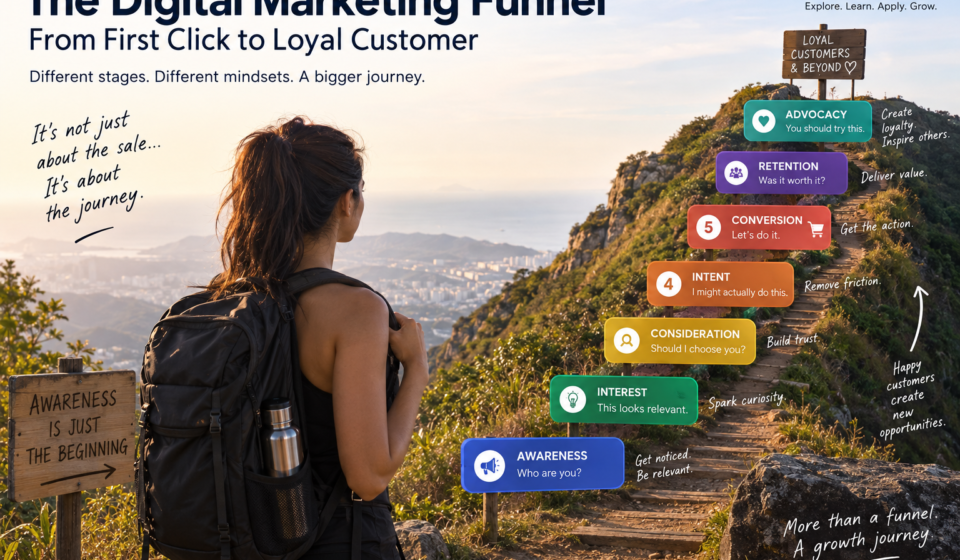
Awareness → Interest → Consideration → Intent → Conversion → Retention → Advocacy
Not every customer follows these stages in exactly this order.
Real customer journeys are messy.
People jump between Google, Instagram, YouTube, Reddit, reviews, websites, AI tools, marketplaces, friends and competitors.
But the funnel remains useful because it gives marketers a way to ask:
What does this person need from us at this particular stage?
Google itself now encourages advertisers to map the complete lead journey rather than optimizing only for shallow lead volume, including stages such as leads, qualified leads and converted leads. :contentReference[oaicite:0]{index=0}
That’s the important idea.
The funnel isn’t a literal tunnel.
It’s a model for understanding customer progression.
The Digital Marketing Funnel at a Glance
| Funnel Stage | Customer’s Mindset | Main Question | Typical Marketing Goal |
|---|---|---|---|
| Awareness | “Who are you?” | What exists? | Get attention |
| Interest | “This looks relevant.” | Could this help me? | Build curiosity |
| Consideration | “Which option is better?” | Should I choose you? | Build trust |
| Intent | “I might actually do this.” | Is this right for me? | Remove friction |
| Conversion | “Let’s do it.” | How do I buy/sign up? | Get the action |
| Retention | “Was it worth it?” | Should I stay? | Deliver value |
| Advocacy | “You should try this.” | Would I recommend it? | Generate loyalty/referrals |
Now let’s break down every stage.
Stage 1: Awareness
“Who are you?”
At the top of the funnel, the person may not even know your brand exists.
They might not know your product exists either.
They simply have a problem, interest or need.
For example:
Someone notices:
“My company’s Instagram isn’t generating leads.”
They don’t know your agency.
They don’t know your blog.
They don’t know your services.
They simply have a problem.
Your first job isn’t necessarily to sell.
It’s to become visible and relevant.
How brands create awareness
Common awareness channels include:
- SEO
- Social media
- YouTube
- Influencer marketing
- Paid advertising
- PR
- Podcasts
- Content marketing
- Communities
- Word of mouth
- AI/search discovery
- Events
- Partnerships
Imagine someone searches:
“Why is my Instagram engagement dropping?”
They discover your article.
They didn’t search for your company.
They searched for an answer.
That’s awareness.
The awareness mistake
A lot of businesses try to sell immediately.
Someone watches their first Instagram Reel and gets:
“BOOK A FREE CONSULTATION NOW.”
Someone searches for an informational article and gets:
“BUY OUR SERVICE.”
That’s often too much, too soon.
The person doesn’t know you yet.
They haven’t developed enough trust.
At the awareness stage, your job is often simpler:
Get noticed.
Get remembered.
Get associated with a problem or topic.
Stage 2: Interest
“This might be useful.”
Now something has changed.
The person isn’t completely unaware anymore.
They’ve encountered your brand or content.
Maybe they:
- read your article
- watched your video
- followed your Instagram account
- subscribed to your newsletter
- watched a product demo
- visited your website
- saved your post
- searched your brand name
They’ve moved from:
“Who are you?”
to:
“What do you know?”
This is where content becomes extremely powerful.
What Works at the Interest Stage?
Think:
Education + relevance + curiosity.
Examples:
Blog content
“How to Build a Digital Marketing Strategy”
YouTube
“5 Reasons Your Meta Ads Aren’t Converting”
Social content
“Why ₹999 feels cheaper than ₹1,000”
Newsletter
“3 marketing changes you should know this week”
Webinar
“How to Build Your First SEO Strategy”
The objective isn’t always to sell.
It’s to make the person think:
“These people understand my problem.”
Stage 3: Consideration
“Should I choose you?”
This is where the competition becomes more serious.
The customer now knows what they need.
They may also know several alternatives.
Suppose someone wants an SEO agency.
They may compare:
- Agency A
- Agency B
- Freelancer C
- In-house hire
- AI tools
- Doing it themselves
Now your brand has to answer:
“Why you?”
This is where trust becomes critical.
What Builds Trust During Consideration?
Customers may look for:
- Case studies
- Reviews
- Testimonials
- Pricing
- Comparisons
- Demonstrations
- Portfolio
- Expertise
- Credentials
- Results
- Customer stories
- Free resources
- Product information
- FAQs
They may search:
“Brand X reviews”
“Brand X vs Brand Y”
“Is Brand X worth it?”
“Brand X pricing”
“Brand X alternatives”
This is why your brand needs to exist beyond your own website.
People increasingly research brands across multiple channels before deciding.
Stage 4: Intent
“I’m seriously considering this.”
This stage is sometimes hidden inside the consideration stage, but separating it is useful.
Intent means the person is moving closer to action.
For example:
They:
- add a product to cart
- request a quote
- book a demo
- start a free trial
- visit your pricing page
- download a proposal
- contact sales
- search for your location
- compare specific plans
The question has changed again.
Earlier:
“Is this useful?”
Now:
“Should I actually do this?”
Intent Is Where Friction Becomes Expensive
Imagine a customer is ready to buy.
They click:
BUY NOW
And the website asks them to:
- create an account
- verify email
- enter 17 fields
- download an app
- enter payment details
- answer a survey
They leave.
The marketing did its job.
The funnel failed at the final moment.
This is why conversion rate optimization matters.
You don’t always need more traffic.
Sometimes you need to make the next step easier.
Stage 5: Conversion
“I’m doing it.”
Conversion is the action your business wants the person to take.
It could be:
- Purchase
- Lead form
- Booking
- App install
- Subscription
- Free trial
- Newsletter signup
- Demo request
- Phone call
- WhatsApp enquiry
- Download
- Account creation
And here’s something important:
A conversion isn’t always a sale.
For an e-commerce company:
Purchase = conversion.
For a B2B SaaS company:
Demo request = conversion.
For a publication:
Newsletter subscription = conversion.
For a service business:
Qualified enquiry = conversion.
The definition depends on the business model.
Don’t Confuse a Conversion With a Business Result
This is a major marketing mistake.
Suppose your campaign generated:
1,000 leads.
Sounds great.
But only:
20 were qualified.
And:
2 became customers.
Then “1,000 leads” is not necessarily a success.
Google’s current lead-generation guidance explicitly encourages advertisers to measure deeper stages such as qualified leads and converted leads rather than optimizing only around initial lead volume. :contentReference[oaicite:1]{index=1}
The real funnel might be:
10,000 visitors
↓
1,000 leads
↓
200 qualified leads
↓
40 sales conversations
↓
10 customers
Now you can see where the actual problem is.
That’s much more useful than celebrating the first number.
Stage 6: Retention
“Was this worth it?”
This is where many marketing funnels stop too early.
They think:
Customer bought → Done.
But the customer hasn’t finished evaluating you.
They’re now asking:
“Was this worth my money?”
If the answer is yes, something powerful happens.
They may:
- Buy again
- Renew
- Upgrade
- Subscribe
- Increase usage
- Stay longer
- Become less price-sensitive
- Recommend you
If the answer is no:
They leave.
That’s why retention is part of the funnel.
Google’s current advertising ecosystem also explicitly treats customer acquisition and retention as distinct lifecycle goals. :contentReference[oaicite:2]{index=2}
Retention Is Often Cheaper Than Starting From Zero
Imagine two situations.
Customer A
You spend money to find a new customer.
They buy once.
Then disappear.
Customer B
You acquire them once.
They buy again next month.
Then again.
Then upgrade.
Then refer someone.
The second customer becomes much more valuable over time.
That’s why marketers care about:
Customer Lifetime Value (CLV/LTV).
A business shouldn’t only ask:
“How much did it cost to acquire this customer?”
It should also ask:
“How much value can this customer generate over the relationship?”
Stage 7: Advocacy
“You should try this.”
This is the final stage—and one of the most powerful.
A happy customer becomes a marketing channel.
They might:
- Leave a review
- Refer a friend
- Post about you
- Tag your brand
- Recommend you in a community
- Create content
- Share your product
- Give a testimonial
- Buy again
- Defend your brand
This creates something every marketer wants:
Trust transferred from one person to another.
A recommendation from someone you trust can be much more persuasive than an advertisement.
The Funnel Is Actually a Flywheel
This is where the traditional funnel model becomes incomplete.
A traditional funnel ends here:
Customer
But a modern customer can restart the system.
They buy.
They love the product.
They recommend it.
Someone else discovers the recommendation.
That person enters the top of the funnel.
So we get:
Content → Discovery → Trust → Purchase → Experience → Advocacy → New Discovery
This is closer to a marketing flywheel than a one-way funnel.
The customer isn’t necessarily the end of marketing.
They can become part of marketing.
A Real Example: Imagine a ₹50,000 Marketing Service
Let’s make this practical.
Suppose you’re selling a ₹50,000/month digital marketing service.
A stranger sees your LinkedIn post:
“Why your company’s SEO traffic isn’t converting.”
That’s:
Awareness
They click your profile.
They read three posts.
They visit your website.
Interest
They download your SEO checklist.
They read a case study.
They subscribe to your newsletter.
Consideration
They compare you with two other agencies.
They look at your portfolio.
They read testimonials.
They study your methodology.
Intent
They visit your services page.
They request a consultation.
Conversion
You have a sales call.
They sign the contract.
Retention
You deliver results.
They renew for another six months.
Advocacy
They refer another company.
That referral becomes another customer.
Now the funnel starts again.
Which Digital Marketing Channel Works at Which Funnel Stage?
This is where things get practical.
| Channel | Awareness | Interest | Consideration | Conversion | Retention |
|---|---|---|---|---|---|
| SEO | ✓ | ✓ | ✓ | ✓ | |
| Blog content | ✓ | ✓ | ✓ | ✓ | |
| Social media | ✓ | ✓ | ✓ | ✓ | ✓ |
| Paid search | ✓ | ✓ | ✓ | ✓ | |
| Paid social | ✓ | ✓ | ✓ | ✓ | ✓ |
| ✓ | ✓ | ✓ | ✓ | ||
| Influencers | ✓ | ✓ | ✓ | ✓ | |
| Case studies | ✓ | ✓ | ✓ | ||
| Webinars | ✓ | ✓ | ✓ | ||
| Retargeting | ✓ | ✓ | ✓ | ||
| CRM | ✓ | ✓ | ✓ | ||
| Referral marketing | ✓ | ✓ | ✓ | ✓ |
But don’t treat this table as a rigid rule.
A single channel can influence multiple stages.
For example:
SEO can generate awareness through an informational article and conversion through a product page.
Email can educate a new subscriber and later bring back an existing customer.
Social media can create awareness, build community and generate direct sales.
The channel isn’t the funnel stage.
The user’s intent determines the stage.
The Same Channel Can Serve Different Funnel Stages
Consider Instagram.
A brand might publish:
Awareness content
“5 marketing mistakes killing your growth.”
The user doesn’t know the brand.
↓
Interest content
“How we increased organic leads by 73%.”
Now the user is learning about the brand.
↓
Consideration content
“Why our SEO process is different.”
Now they’re evaluating the company.
↓
Conversion content
“Book a strategy call.”
Now they’re being asked to act.
↓
Retention content
“Advanced SEO insights for our clients.”
Now the brand is helping existing customers.
Same platform.
Different job.
That’s why saying:
“Instagram is for awareness.”
is too simplistic.
Funnel Marketing Is About Matching the Message to the Mindset
This may be the most important lesson in the entire article.
Imagine you’re selling running shoes.
Someone searching:
“Why do my knees hurt when running?”
is in a different mental state from someone searching:
“Nike Pegasus 42 price India.”
The first person needs:
Education.
The second may need:
Product information and purchase options.
If you show the first person a hard-sell product page, you’re skipping a psychological step.
If you show the second person a 3,000-word article explaining running biomechanics, you’re creating unnecessary friction.
The funnel helps you match:
The right message → to the right person → at the right stage.
The Most Common Funnel Mistakes
1. Trying to sell to everyone immediately
Not everyone is ready to buy.
2. Measuring only traffic
10,000 visitors mean very little if nobody converts.
3. Measuring only conversions
A sudden drop in awareness can eventually create a conversion problem weeks later.
4. Ignoring retention
Acquiring customers while losing existing ones is an expensive treadmill.
5. Creating the same content for everyone
A first-time visitor and a loyal customer need different communication.
6. Sending every visitor to the homepage
Different users often need different landing pages.
7. Making the conversion process complicated
Every unnecessary step creates potential friction.
8. Optimizing for cheap leads instead of valuable customers
A low-cost lead isn’t necessarily a good lead.
9. Assuming the funnel is linear
Real people jump around.
They may see an ad, read a review, ask ChatGPT, visit Instagram, search Google, watch YouTube and then return three days later.
10. Forgetting the post-purchase experience
The customer’s evaluation doesn’t end at checkout.
The Funnel Is Not Always a Funnel
Here’s something marketers should stop pretending.
Real customer journeys rarely look like this:
Awareness → Interest → Consideration → Conversion → Retention
Instead, they can look like:
Google → Instagram → Website → Reddit → YouTube → AI search → Competitor → Google → Website → Purchase
Or:
Friend recommendation → Instagram → Product page → Leave → Retargeting ad → Review → Purchase
Or:
AI answer → Brand search → YouTube review → Website → Purchase
That’s why modern marketing is increasingly about customer journeys, not just funnel diagrams.
The funnel is a model.
The customer is real.
And real customers are messy.
How AI Is Changing the Marketing Funnel
AI search adds another discovery layer.
Someone might not search:
“Best digital marketing agency.”
They might ask:
“I’m a B2B SaaS company in India with a small marketing team. Which digital marketing agencies would be suitable for us, and what should we evaluate before hiring one?”
An AI system may provide:
- Categories
- Recommendations
- Comparisons
- Criteria
- Brand mentions
- Sources
That means a brand can enter the funnel before the person ever visits its website.
The journey could become:
Question → AI recommendation → Brand discovery → Google search → Website → Case study → Enquiry
This is one reason modern marketers need to think beyond traditional rankings and consider how their brand appears across the wider discovery ecosystem.
How to Measure Each Funnel Stage
You can’t optimize what you don’t measure.
But each stage needs different metrics.
Awareness Metrics
Look at:
- Impressions
- Reach
- Organic impressions
- Video views
- Brand searches
- Website new users
Interest Metrics
Look at:
- Engaged sessions
- Content engagement
- Pages viewed
- Newsletter signups
- Video completion
- Returning visitors
- Resource downloads
Consideration Metrics
Look at:
- Pricing page visits
- Product page views
- Case study views
- Demo requests
- Comparison-page engagement
- High-intent searches
Conversion Metrics
Look at:
- Purchases
- Qualified leads
- Conversion rate
- Revenue
- Cost per acquisition
- Customer acquisition cost
Retention Metrics
Look at:
- Repeat purchases
- Renewal rate
- Churn
- Customer lifetime value
- Product usage
- Subscription retention
Advocacy Metrics
Look at:
- Referrals
- Reviews
- Testimonials
- Referral revenue
- User-generated content
- Repeat purchases
Why GA4 Is Useful for Funnel Analysis
This is exactly where analytics becomes useful.
Google Analytics 4 includes Funnel Exploration, which lets marketers visualize steps users take toward a goal and identify where people drop out of the journey. :contentReference[oaicite:3]{index=3}
For example, imagine:
Landing page
↓
10,000 users
Pricing page
↓
2,000 users
Checkout
↓
500 users
Purchase
↓
150 users
Now you can ask:
Why did 8,000 people disappear before reaching pricing?
Or:
Why did 350 people reach checkout but not purchase?
That’s where marketing becomes less about guessing and more about diagnosis.
How to Build Your Own Digital Marketing Funnel
Here’s a simple process.
Step 1: Define the final business goal
What actually matters?
- Sale?
- Lead?
- Booking?
- Subscription?
- App install?
- Repeat purchase?
Step 2: Define your audience
Who are you trying to move through the funnel?
Step 3: Identify the problem
What makes them search for a solution?
Step 4: Map awareness channels
Where do they discover information?
Google?
Instagram?
YouTube?
AI?
Communities?
Events?
Step 5: Build consideration assets
What helps them trust you?
- Case studies
- Reviews
- Demonstrations
- Comparisons
- Expert content
- Testimonials
Step 6: Remove conversion friction
Make the desired action obvious and easy.
Step 7: Build retention
What happens after the sale?
Step 8: Create advocacy
Give satisfied customers a reason and easy mechanism to recommend you.
A Simple Funnel Template You Can Use
You can literally map a business like this:
AUDIENCE
Who are we trying to reach?
↓
PROBLEM
What problem are they experiencing?
↓
AWARENESS
Where will they discover us?
↓
INTEREST
What will make them want to learn more?
↓
CONSIDERATION
What proof will make them trust us?
↓
INTENT
What will convince them they’re ready?
↓
CONVERSION
What action do we want?
↓
RETENTION
Why should they stay?
↓
ADVOCACY
Why would they recommend us?
This is much more useful than simply drawing a triangle.
The Full Digital Marketing Funnel
Here’s the whole thing in one picture:
1. AWARENESS
“I’ve heard of you.”
↓
2. INTEREST
“This looks relevant.”
↓
3. CONSIDERATION
“Could you be the right choice?”
↓
4. INTENT
“I might actually buy.”
↓
5. CONVERSION
“I’m doing it.”
↓
6. RETENTION
“I’m glad I did.”
↓
7. ADVOCACY
“You should try this too.”
And then:
Advocacy creates new Awareness.
That’s the flywheel.
The Biggest Lesson About Funnels
A funnel isn’t really about pushing people toward a sale.
It’s about understanding what a person needs before they are ready for the sale.
Someone who has never heard of you needs something different from someone comparing your pricing.
Someone comparing pricing needs something different from someone who has already purchased.
And someone who already loves your brand can become something even more valuable:
A distribution channel.
That’s why great marketing doesn’t simply ask:
“How do we get more customers?”
It asks:
“What does the customer need at every stage of the relationship?”
Once you understand that, digital marketing becomes much easier to organize.
SEO has a role.
Content has a role.
Social media has a role.
Paid advertising has a role.
Email has a role.
Analytics has a role.
CRM has a role.
AI has a role.
But none of them is the funnel.
The customer journey is the funnel.
The channels are simply the tools you use to move people forward.
FAQs
What is a digital marketing funnel?
A digital marketing funnel is a framework that maps how people move from discovering a brand to becoming interested, considering an offer, converting and potentially becoming repeat customers and advocates.
What are the stages of a digital marketing funnel?
A practical modern funnel can be divided into seven stages: awareness, interest, consideration, intent, conversion, retention and advocacy. Some businesses combine or rename stages depending on their customer journey.
What is the difference between a marketing funnel and a sales funnel?
A sales funnel usually focuses more specifically on the progression toward a sale. A marketing funnel can cover a broader customer journey, including awareness, content, brand building, conversion, retention and advocacy.
Is the marketing funnel linear?
No. Real customer journeys are rarely linear. People can move backward, skip stages, revisit previous stages and interact with multiple channels before converting.
Which marketing channels work at the top of the funnel?
SEO, social media, video, paid advertising, PR, influencers, content marketing, communities, partnerships and other discovery channels can generate awareness. The best channel depends on where the target audience actually spends attention.
What is a conversion in digital marketing?
A conversion is a desired action taken by a user. Depending on the business, it could be a purchase, lead form, booking, subscription, demo request, app install or another measurable action.
Why is retention part of the marketing funnel?
Because the customer relationship doesn’t end when someone buys. Repeat purchases, renewals, upgrades and continued engagement can create significantly more value than a one-time transaction.
What is the difference between a funnel and a flywheel?
A funnel traditionally represents people progressing toward conversion. A flywheel emphasizes how customers can continue generating value through retention, referrals, reviews and advocacy, which can create new customer acquisition.
How does AI affect the marketing funnel?
AI search can introduce brands earlier in the customer journey by answering questions, comparing options and recommending products or companies. A person may discover a brand through an AI-generated answer before visiting its website.
How do I measure my marketing funnel?
Use metrics appropriate to each stage. Awareness can include impressions and reach; consideration can include engagement and high-intent visits; conversion can include sales and qualified leads; retention can include repeat purchases and churn; advocacy can include referrals and reviews.
Can a small business use a digital marketing funnel?
Absolutely. A small business doesn’t need a complicated marketing stack. It can start with a simple journey such as social/search discovery → useful content → enquiry → sale → follow-up → referral.
Final Takeaway
Digital marketing can look complicated because there are so many channels.
SEO.
Google Ads.
Instagram.
YouTube.
Email.
Influencers.
Content.
AI.
Analytics.
CRM.
But underneath all of them is one simple question:
Where is the customer right now—and what do they need next?
Someone discovering you needs a reason to pay attention.
Someone interested needs a reason to continue.
Someone comparing you needs proof.
Someone ready to buy needs less friction.
Someone who bought needs a reason to stay.
And someone who loves you needs a reason to tell others.
That’s the digital marketing funnel.
Don’t build marketing around channels.
Build it around the customer journey.
Because the best marketers aren’t simply good at getting attention.
They’re good at turning attention into trust, trust into action, and action into relationships.
And when those relationships create new customers, the funnel doesn’t end.
It starts again.
Sources & Further Reading
- Google Ads — Best practices for generating high-quality leads and mapping the lead journey. :contentReference[oaicite:4]{index=4}
- Google Analytics — Funnel Exploration and analyzing user journeys. :contentReference[oaicite:5]{index=5}
- Google Ads — Customer lifecycle goals and customer retention. :contentReference[oaicite:6]{index=6}
- Google Ads — Campaign objectives and matching marketing activity to business outcomes. :contentReference[oaicite:7]{index=7}
Brand Yaatra Takeaway:
Digital marketing isn’t a collection of channels. It’s the system that moves people from discovery to trust, action and eventually advocacy.