
For years, digital marketing had a simple equation:
You create a website.
You optimize it.
Google ranks it.
Someone searches.
They click.
You get the visitor.
That model built an entire industry around three letters:
SEO.
But now something strange is happening.
A person can ask:
“What’s the best CRM for a small business?”
…and instead of opening five Google results, comparing websites and making a decision, they can ask an AI tool and receive a synthesized answer in seconds.
The answer may mention several brands.
It may cite websites.
It may recommend a product.
It may explain the differences.
And the user may never visit most of the websites that helped create that answer.
That changes the game.
But it does NOT mean:
“SEO is dead.”
That is the lazy version of the story.
The more interesting reality is this:
Search isn’t disappearing. The interface is changing.
Google Search is becoming more conversational and AI-powered.
Google’s AI Overviews and AI Mode are now part of the core Search experience, while ChatGPT and other AI systems can search the web, synthesize information and provide sources.
Google said in 2026 that AI Overviews had reached more than 2.5 billion monthly active users and AI Mode had surpassed 1 billion monthly users. Google also says AI Mode queries have been more than doubling every quarter since launch.
Meanwhile, ChatGPT Search can search the web and provide links to relevant sources.
So marketers are entering a world where people can discover information through:
- Traditional search results
- AI-generated search summaries
- Conversational AI
- Social platforms
- Communities
- Video
- Recommendations
- Brand ecosystems
The question is no longer simply:
“Can I rank #1 on Google?”
The bigger question is:
“Can my brand be discovered, understood, trusted and recommended wherever people are looking for answers?”
That’s the real shift.
What Is Traditional Google Search?
Let’s start with the model most marketers already understand.
Someone searches:
“best running shoes for beginners”
Google traditionally responds with a list of results.
The user then:
- Reads the titles
- Scans descriptions
- Clicks websites
- Compares information
- Makes a decision
For publishers and businesses, the objective is straightforward:
Get visibility.
Get the click.
Get the visitor.
Then convert the visitor.
This created an enormous ecosystem around:
- Keywords
- Search intent
- Rankings
- Backlinks
- Technical SEO
- Content
- Internal linking
- Structured data
- Page experience
- E-E-A-T
- Organic traffic
- Conversion optimization
None of that has suddenly become irrelevant.
In fact, Google continues to tell website owners that its existing SEO fundamentals remain relevant for its generative AI search experiences.
The important change is what happens AFTER the user searches.
What Is AI Search?
AI search changes the interface.
Instead of simply giving you a list of links, an AI-powered search experience can attempt to understand the question, retrieve information and synthesize an answer.
For example:
Traditional search:
“best digital marketing agencies in Mumbai”
↓
10 blue links
AI search:
“I’m looking for a digital marketing agency in Mumbai for a B2B SaaS company with a budget of ₹2 lakh per month. What should I look for, and which agencies might fit?”
↓
A conversational answer
↓
Recommendations
↓
Explanations
↓
Sources
↓
Follow-up questions
The search experience becomes less like:
“Here are some pages.”
And more like:
“Let me help you solve the problem.”
That is a fundamental change in user behaviour.
Google Search Is Becoming AI Search Too
This is an important point.
The future isn’t necessarily:
Google vs AI.
Because Google itself is becoming an AI search platform.
Google’s AI Overviews provide AI-generated summaries within Search.
AI Mode goes further by allowing users to explore questions conversationally and continue with follow-up queries.
Google has also been adding more ways for users to discover original content, websites and firsthand perspectives inside AI-powered Search.
So saying:
“People will stop using Google and move to ChatGPT”
is too simplistic.
The more accurate statement is:
“Google itself is changing what search looks like.”
Traditional results and AI-generated experiences are increasingly becoming part of the same ecosystem.
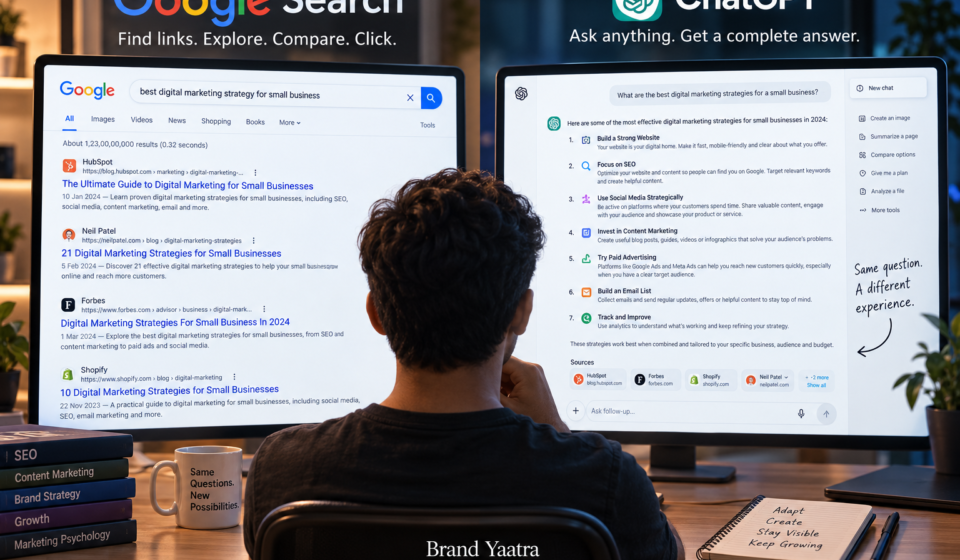
Google Search vs AI Search: What’s Actually Different?
Here’s the simplest way to understand it.
| Traditional Search | AI Search |
|---|---|
| User searches for pages | User asks for an answer |
| Results are primarily links | Results can be synthesized |
| User compares multiple pages | AI can summarize multiple sources |
| Click is often central | Answer may satisfy part of the intent before the click |
| Keywords are important | Meaning and context become increasingly important |
| Ranking is a major visibility metric | Mentions, citations and inclusion can also matter |
| Website is the destination | Website can become a source within an answer |
| Search journey is often fragmented | Search can become conversational |
But there is an important caveat:
AI search still depends heavily on the web.
AI systems need information.
They need sources.
They need current facts.
They need websites, databases, publications, documentation and other forms of knowledge.
So the web doesn’t suddenly become irrelevant.
Its role changes.
The Biggest Change: From Ranking to Being Referenced
This is probably the most important idea for marketers to understand.
In traditional SEO, you might think:
“I want my page to rank #1.”
In AI search, another possibility emerges:
“I want my information to be useful enough and trustworthy enough to be included in the answer.”
That can happen in different forms.
Your brand might be:
- Mentioned
- Cited
- Recommended
- Used as evidence
- Included in a comparison
- Used as a source
- Referenced for a statistic
- Mentioned as an example
This doesn’t make traditional rankings irrelevant.
It adds another layer.
Think of it like this:
SEO asks:
“Can people find my page?”
AI-era search asks:
“Can systems understand my information well enough to use it when answering someone?”
That is a much broader problem.
Does This Mean Clicks Don’t Matter Anymore?
No.
Clicks still matter enormously.
If someone sees your brand in an AI answer and then visits your website, that’s valuable.
If someone discovers your company through Google Search, that’s valuable.
If someone reads your original research and links to it, that’s valuable.
But marketers need to recognize something new:
Not every valuable interaction will necessarily begin with a click.
Imagine someone asks an AI:
“What are the best project management tools for a 20-person marketing team?”
The AI mentions:
- Notion
- Asana
- ClickUp
- Monday.com
The user may remember those four names.
They might then search one of them directly.
The original discovery happened inside the AI answer.
The eventual conversion might happen somewhere else.
This makes attribution harder.
But it also makes brand visibility more important.
Search Is Moving From Keywords Toward Questions
Traditional SEO taught marketers to think about keywords.
For example:
“best CRM”
“CRM software”
“CRM for startups”
But real users often think in complete problems.
For example:
“I run a five-person sales team. We need a CRM that doesn’t require a full-time administrator. What should we use?”
That’s not simply a keyword.
It’s a situation.
AI search is particularly well suited to these longer, contextual questions.
This means marketers need to understand:
- The problem
- The audience
- The context
- The intent
- The constraints
- The alternatives
- The follow-up questions
The future of search isn’t necessarily about abandoning keywords.
It’s about understanding the person behind the keyword.
Search Intent Is Becoming More Important
Consider this query:
“best running shoes”
Traditional SEO might classify it as commercial investigation.
But AI search can reveal much more context.
A user might actually mean:
“I have flat feet, run three times a week, mostly on roads, and want shoes under ₹10,000.”
Now the useful answer isn’t a generic article about running shoes.
It’s a recommendation based on constraints.
That means content needs to become more useful.
Not simply longer.
Not stuffed with keywords.
Useful.
This Is Where GEO Enters the Picture
We already explored GEO in our article:
“What Is GEO? The New SEO Every Marketer Needs to Understand.”
GEO, or Generative Engine Optimization, broadly refers to improving the likelihood that your information is understood, surfaced or referenced in AI-generated answers.
But there’s an important distinction.
GEO is NOT:
“Put the keyword 17 times and ChatGPT will cite you.”
There is no magic formula like that.
Modern AI search systems evaluate information using complex retrieval, ranking and generation systems.
So the practical strategy is much more fundamental:
Make your content:
- Clear
- Useful
- Well-structured
- Factual
- Specific
- Original
- Well-supported
- Easy to understand
- Relevant to real questions
And make your brand discoverable across the wider web.
SEO Isn’t Being Replaced by GEO
This is another misconception.
Think of SEO and GEO as overlapping disciplines.
SEO helps search engines discover, understand and rank your website.
GEO focuses more specifically on visibility within generative AI experiences.
But the foundations overlap heavily.
For example:
Good technical SEO helps AI systems access your content.
Clear headings help humans and machines understand it.
Strong internal linking helps connect related information.
Authoritative sources strengthen credibility.
Original research creates something worth referencing.
Structured information reduces ambiguity.
So instead of thinking:
SEO OR GEO
think:
SEO + GEO
What Google Says About AI Search
Google’s own documentation is particularly important here.
In 2026, Google published guidance for optimizing for generative AI features in Search.
One of its key messages is surprisingly familiar:
Existing SEO best practices continue to matter.
Google also emphasizes the importance of providing non-commodity content and useful local, shopping, image and video content.
In other words:
Google isn’t telling publishers to throw SEO away.
It’s telling them to create better information for a search environment that increasingly uses AI.
That’s a very different message from:
“SEO is dead.”
AI Search Creates a New Problem: Zero-Click Discovery
Here’s where publishers have legitimate reasons to worry.
Suppose you write an excellent article answering:
“What is a marketing funnel?”
For years, someone might search the term, see your result and click your article.
But imagine an AI system now provides a useful summary directly in the search interface.
The user may get enough information without clicking.
That’s sometimes called a zero-click experience.
And this creates a difficult question:
If your content helps produce the answer but the user never visits your website, how do you benefit?
There isn’t one universal answer yet.
But brands can benefit through:
- Brand awareness
- Direct searches
- Citations
- Reputation
- Product discovery
- Assisted conversions
- Future branded searches
- Returning visitors
- Links and mentions
This means marketers may need to think beyond:
“Organic sessions.”
The New Marketing Funnel May Look Different
The old model:
Search → Click → Website → Conversion
The emerging model can look like:
Question → AI/Search Discovery → Brand Mention → Research → Website → Trust → Conversion
Or:
AI Recommendation → Brand Search → Website → Purchase
Or:
Google Search → Article → AI Follow-up → Brand Discovery → Conversion
The journey is becoming less linear.
And that’s why attribution is becoming harder.
Brand Becomes More Important in AI Search
This may be one of the biggest long-term consequences.
Imagine two companies.
Company A
Has 500 articles.
Most are generic.
They rewrite information already available elsewhere.
They have little original research.
Their brand is barely mentioned outside their website.
Company B
Has 100 excellent articles.
They publish original studies.
Experts quote them.
Other websites reference them.
They have recognizable authors.
They publish proprietary data.
Their brand appears across industry conversations.
Which one is more likely to have information worth retrieving and referencing?
Probably Company B.
This is why brand authority and content authority increasingly reinforce each other.
Original Research Becomes More Valuable
This is a huge opportunity.
Imagine you publish:
“50 Digital Marketing Statistics.”
That’s useful.
But imagine you publish:
“We analyzed 10,000 Indian D2C ads and found that 63% used discount-led messaging.”
Now you’ve created something new.
Other websites might reference it.
Journalists might cite it.
Marketers might discuss it.
AI systems may encounter it across the web.
Your research becomes an information asset.
This is one reason Brand Yaatra should eventually invest heavily in:
- Original surveys
- Experiments
- Industry benchmarks
- Data analysis
- Marketing experiments
- Proprietary frameworks
- First-party case studies
Not because AI will magically reward you.
But because original information is more valuable than another rewritten version of information everyone already has.
AI Search Also Changes How Content Should Be Written
The old question was:
“How do I write a 2,500-word article that ranks?”
A better question is:
“How do I create the clearest and most useful answer to this problem?”
That changes the writing process.
Instead of:
- Find keyword
- Look at competitors
- Rewrite them
- Add more words
- Publish
Try:
- Understand the question
- Understand the audience
- Identify the real problem
- Research primary sources
- Add original insight
- Structure the answer clearly
- Include examples
- Address objections
- Cite evidence
- Make the article genuinely useful
That’s better SEO.
And it’s also better GEO.
Structure Matters More Than Ever
AI systems need to interpret information.
Clear structure helps.
Instead of writing a wall of text:
Use:
- Clear H2s
- Short paragraphs
- Definitions
- Tables
- Lists
- Examples
- Comparisons
- FAQs
- Explicit conclusions
- Sources
For example:
What Is GEO?
Definition.
How Is GEO Different From SEO?
Comparison table.
Why Does GEO Matter?
Explanation.
How Can a Brand Improve Its AI Visibility?
Practical framework.
This structure is useful to humans.
And it makes the information easier to parse.
But Don’t Start Writing for Robots
This is where marketers can overcorrect.
You might think:
“AI needs structured content, so I’ll make every article sound like a database.”
Don’t.
Humans are still the audience.
A great article should be:
Readable for people.
Structured for machines.
Not:
Written for machines.
That distinction matters.
AI Search Rewards Clarity, But It Doesn’t Mean Simplification
Being clear doesn’t mean making everything shallow.
You can write deeply while remaining understandable.
For example:
Bad:
“GEO leverages semantic retrieval optimization paradigms to enhance probabilistic answer inclusion.”
Better:
“GEO is about making your information easier for AI systems to understand, retrieve and potentially reference in their answers.”
Same idea.
One sounds like a conference paper.
The other sounds like someone actually wants to help you.
What Happens to Backlinks?
Backlinks aren’t suddenly irrelevant either.
Google continues to use links and other signals as part of Search.
And across AI systems, web sources still matter because AI search often retrieves information from external sources.
But the role of a backlink can become broader.
A link can provide:
- Referral traffic
- Authority
- Discovery
- Context
- Brand association
- Evidence of recognition
The goal shouldn’t be:
“Get 1,000 backlinks.”
It should be:
“Become the kind of source other people naturally want to reference.”
That’s a much healthier long-term strategy.
What Happens to Keywords?
Keywords aren’t dead.
Search engines still need to understand what a page is about.
People still search using words.
Keywords remain useful for:
- Topic research
- Search demand
- Content planning
- Page optimization
- Understanding language
- Identifying search intent
But keyword strategy is becoming less about exact-match repetition and more about:
Topics + entities + intent + context + questions.
If you’re writing about digital marketing, for example, you shouldn’t only repeat:
“digital marketing”
You should naturally cover relevant concepts such as:
- SEO
- Paid advertising
- Social media
- Content marketing
- Analytics
- CRM
- Conversion optimization
- AI marketing
- GEO
- Marketing strategy
That’s topical completeness.
Search Is Becoming More Multimodal
Another major change is that search is no longer purely text.
Modern search experiences increasingly work with:
- Images
- Video
- Voice
- Files
- Screenshots
- Products
- Maps
- Visual search
Google has explicitly been moving toward a more multimodal AI-powered Search experience.
This means a modern SEO strategy shouldn’t think only about blog articles.
It should consider:
Text + Images + Video + Data + Products + Local information + Structured information
depending on the business.
What This Means for E-Commerce
Imagine someone asks:
“I’m looking for running shoes under ₹8,000 for daily road running.”
Traditional e-commerce SEO wants your product category page to rank.
AI-powered shopping/search experiences can potentially help users compare:
- Price
- Features
- Reviews
- Brands
- Alternatives
- Availability
That means product information needs to be accurate and structured.
Your product pages aren’t just sales pages anymore.
They’re information sources.
What This Means for Local Businesses
Local search is changing too.
Someone might ask:
“What’s a good Italian restaurant near me for a quiet dinner?”
The system needs to understand:
- Location
- Restaurant category
- Reviews
- Opening hours
- Price
- Atmosphere
- Menu
- Availability
A local business therefore needs accurate information across the web.
Your website matters.
But so do your broader digital signals.
This is why local SEO is increasingly about maintaining a coherent digital presence rather than simply ranking for:
“best restaurant near me.”
What This Means for Publishers
Publishers may face one of the biggest changes.
The traditional model was:
Publish article → rank → receive traffic → monetize traffic
AI search introduces:
Publish information → become a source → receive some traffic and/or brand visibility
That second model is still evolving.
Some publishers may receive fewer clicks for certain informational queries.
Others may benefit from new discovery opportunities.
The outcome will vary by topic, query type, source quality and platform.
But one thing is clear:
Publishing generic information is becoming a weaker competitive advantage.
What This Means for Brand Yaatra
This is where the topic becomes particularly relevant to us.
Brand Yaatra shouldn’t try to become:
“Another digital marketing blog.”
That’s a crowded game.
The stronger opportunity is to become:
A recognizable digital marketing knowledge source.
That means we should build around:
1. Deep foundational guides
Explain the fundamentals properly.
2. Brand case studies
Don’t just summarize what happened.
Decode:
Origin → Problem → Insight → Positioning → Strategy → Execution → Growth → Turning Point → Mistakes → Lessons
3. Original research
Eventually:
- Surveys
- Experiments
- Data
- Benchmarks
- Marketing tests
4. Strong authorship
Make it clear who is behind the publication.
5. Primary sources
Whenever possible, go to:
- Company reports
- Official announcements
- Research papers
- Government data
- Original datasets
- First-party documentation
6. Distinctive frameworks
Create concepts people can remember and reference.
7. Real-world execution
Eventually show that Brand Yaatra isn’t only explaining marketing.
We actually practice it.
That creates something much more valuable than a large archive of generic articles.
The New SEO Strategy: Become Worth Finding
Here’s the mindset shift I’d make.
Old mindset:
“How do I get Google to rank this article?”
Better mindset:
“How do I create the best answer to this question?”
Even better:
“How do I create information that people, search engines, journalists, creators and AI systems have a reason to discover and reference?”
That changes everything.
You stop asking:
“How many keywords should I include?”
And start asking:
“What’s missing from the existing conversation?”
That’s where competitive advantage begins.
A Practical AI-Era SEO Framework
If you’re building a website today, use this framework.
Step 1: Understand the search intent
What is the person actually trying to accomplish?
Not just:
“What did they type?”
But:
“What problem are they trying to solve?”
Step 2: Build the best answer
Cover the topic comprehensively.
Don’t add unnecessary words just to hit a word count.
Step 3: Add original value
Ask:
“What can I provide that 20 other websites haven’t?”
It could be:
- Data
- Experience
- Examples
- Analysis
- Interviews
- Experiments
- Frameworks
- Visuals
- Case studies
Step 4: Make the information easy to understand
Use:
- Clear headings
- Tables
- Definitions
- Examples
- Short paragraphs
- FAQs
- Sources
Step 5: Strengthen your entity
Make it obvious:
Who are you?
What do you know?
What does your brand represent?
What topics are you associated with?
Step 6: Build the wider web presence
Don’t rely only on your own website.
Earn:
- Mentions
- Links
- Interviews
- Citations
- Collaborations
- Community recognition
- Social discussion
Step 7: Measure more than rankings
Track:
- Rankings
- Organic clicks
- Impressions
- Branded searches
- Referral traffic
- AI referrals where measurable
- Brand mentions
- Conversions
- Assisted conversions
- Leads
The dashboard is changing because the journey is changing.
10 Things Marketers Should Start Doing Now
1. Stop chasing only keywords
Understand topics and intent.
2. Start publishing original information
Don’t become another rewriting machine.
3. Strengthen authorship
Show who is creating the information and why they are qualified.
4. Use primary sources
Build content on evidence.
5. Create recognizable brand assets
Become easier to remember.
6. Build topic authority
Cover a subject deeply instead of publishing random articles.
7. Make content easy to extract
Definitions, facts, frameworks and explanations should be clear.
8. Think beyond Google
People discover information through many platforms.
9. Track brand demand
Branded searches can reveal whether awareness is growing.
10. Don’t panic about every AI announcement
The fundamentals still matter.
The interface is changing faster than the underlying need for useful information.
What NOT to Do for AI Search
The AI era is already creating a new wave of bad advice.
Avoid:
“Write 10,000 words because AI likes long content.”
There is no universal word-count rule.
“Repeat the same keyword 50 times.”
That’s not optimization.
That’s spam.
“Add an FAQ to every page so ChatGPT cites you.”
There is no guaranteed citation formula.
“Publish 100 AI-generated articles every month.”
Volume without value creates a larger archive of mediocrity.
“Mention ChatGPT everywhere.”
Talking about AI doesn’t make content authoritative.
“Get fake brand mentions.”
Manipulated visibility is not the same as genuine authority.
“SEO is dead.”
It’s one of the least useful conclusions you can draw.
So, Will SEO Still Exist in 2030?
Almost certainly.
But the job description may look different.
SEO used to be heavily focused on:
Search engines → rankings → clicks
The broader discipline is moving toward:
Discovery → understanding → visibility → authority → recommendation → conversion
SEO becomes part of a larger discipline of search and discovery optimization.
And that includes:
- Search engines
- AI systems
- Social platforms
- Communities
- Video platforms
- Marketplaces
- Recommendation systems
The question becomes:
Can your brand be found when someone has a problem you can solve?
That’s bigger than Google.
The Future Isn’t Google OR ChatGPT
This is probably the biggest misconception to avoid.
The future isn’t necessarily:
Google loses.
ChatGPT wins.
Everyone stops searching.
Websites disappear.
That’s too simplistic.
Instead, we’re likely moving toward a world where different search interfaces coexist.
Someone may:
Google for a quick fact.
Ask ChatGPT for an explanation.
Use YouTube to learn how to do something.
Ask Reddit what real users experienced.
Use Instagram or TikTok to discover a product.
Use Google Maps to find a local business.
Ask an AI assistant to compare options.
Visit the brand website before buying.
Search becomes fragmented.
Discovery becomes everywhere.
The New Competition Is for Attention Before the Click
This may be the biggest conceptual shift.
For years, marketers competed for:
Rank #1 → Get the click.
Now they increasingly have to compete for:
Be discovered → Be understood → Be trusted → Be remembered → Earn the click or conversion.
The click is still valuable.
But it may become only one part of the journey.
Google Search vs AI Search: The Bottom Line
Google Search isn’t disappearing.
SEO isn’t dead.
Websites aren’t dead.
Keywords aren’t dead.
Backlinks aren’t dead.
But the search experience is changing.
Google is adding AI directly into Search.
ChatGPT can search the web.
AI systems can synthesize information instead of simply presenting lists of pages.
Users can ask increasingly complex questions.
And brands can be discovered through answers, recommendations and citations before someone ever visits their website.
That means marketers need to evolve.
Don’t abandon SEO.
Expand your definition of SEO.
Build useful content.
Create original information.
Strengthen your brand.
Make your expertise visible.
Earn mentions.
Understand search intent.
Structure information clearly.
And think beyond the ten blue links.
Because the next generation of search isn’t simply asking:
“Which website should I show?”
Increasingly, it’s trying to answer:
“What is the best answer I can give this person?”
And if your brand becomes one of the sources that helps produce that answer, you’ve achieved something much bigger than a ranking.
You’ve become part of the answer.
FAQs
Is Google Search being replaced by AI search?
No. Google is integrating AI into Search rather than abandoning traditional search. AI Overviews and AI Mode are becoming part of Google’s broader Search experience, while traditional results and links continue to exist.
Is SEO dead because of ChatGPT?
No. SEO remains important because AI search still relies heavily on web information, discoverability and authoritative sources. What is changing is the number of ways people can discover information and brands.
What is the difference between SEO and GEO?
SEO focuses broadly on improving visibility in search engines. GEO, or Generative Engine Optimization, focuses on improving the likelihood that information is understood, surfaced or referenced within generative AI experiences. The two overlap significantly.
Will AI search reduce website traffic?
It can reduce clicks for some informational searches because users may receive enough information directly in an AI-generated answer. However, AI search can also create new discovery and referral opportunities. The impact varies by query, industry, platform and website.
Should I stop writing blog articles because of AI search?
No. But the standard for content should rise. Generic content that simply rewrites existing information has less differentiation. Original research, expert analysis, useful frameworks, firsthand experience and genuinely helpful explanations become more valuable.
How do I optimize my website for AI search?
Start with strong fundamentals: technically accessible pages, useful and original content, clear structure, accurate information, descriptive titles and headings, strong internal linking, authoritative sources and a recognizable brand. Don’t rely on gimmicks or guaranteed “AI citation” formulas.
Will keywords still matter in AI search?
Yes. Keywords remain useful for understanding search demand, language and intent. But marketers should also think about entities, topics, context, questions and the problems users are trying to solve.
What is zero-click search?
Zero-click search occurs when someone gets the information they need directly from a search interface without visiting a website. AI-generated answers can increase this behaviour for some types of queries.
How can a brand become more visible in AI search?
Create information worth using. Publish original research, provide accurate and clearly structured information, demonstrate expertise, build brand recognition and earn genuine mentions and references across the web. There is no guaranteed checklist that forces an AI system to cite a particular website.
What should marketers measure in the AI-search era?
Continue measuring rankings, impressions, clicks and conversions, but also pay attention to branded search demand, referral sources, brand mentions, citations where measurable and assisted conversions. The exact measurement model will continue to evolve as search interfaces change.
Brand Yaatra Takeaway
The future of SEO isn’t about optimizing only for where people click.
It’s about becoming visible wherever people go to find answers.
Google.
AI.
Social.
Communities.
Video.
Marketplaces.
Recommendations.
The brands that win won’t necessarily be the ones that publish the most.
They’ll be the ones that create information worth discovering, trusting and remembering.
**Search is changing.
The job of marketing is changing with it.**