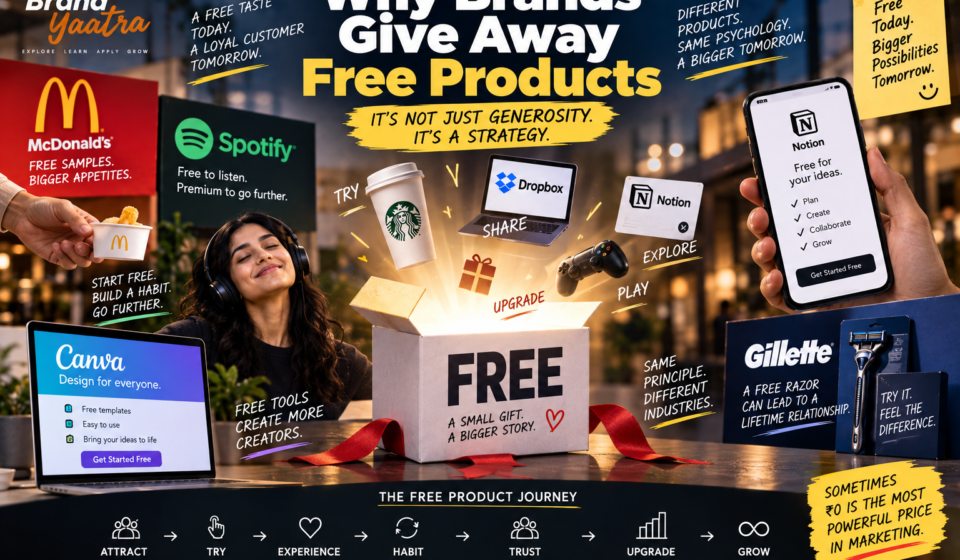

Why would a company spend ₹500 making something…
…and then give it away for ₹0?
At first, it sounds like terrible business.
Give away the product.
Pay for manufacturing.
Pay for packaging.
Pay for delivery.
And make…
nothing.
Yet some of the world’s biggest businesses have built enormous growth engines around exactly this idea.
Spotify lets people use its service without paying for a Premium subscription.
Dropbox offers free storage.
Google gives away products used by billions of people.
Brands hand out free samples.
SaaS companies offer free trials.
Restaurants give away tasting portions.
Gaming companies give away the game and monetize players later.
And sometimes, companies literally give away the thing they’re trying to sell.
So what’s going on?
The answer is surprisingly simple:
The smartest free product isn’t the one that costs a company the least. It’s the one that makes the next purchase more likely.
Because “free” isn’t always generosity.
Sometimes…
free is marketing.
Why Does “Free” Feel So Powerful?
Let’s start with something strange about human behaviour.
Suppose you’re choosing between:
- Chocolate A: ₹1
- Chocolate B: ₹2
You might reasonably think about quality, taste and value.
Now change the prices:
- Chocolate A: ₹0
- Chocolate B: ₹1
The difference between the products hasn’t changed.
Chocolate B is still ₹1 more expensive.
But people’s preferences can change dramatically when one option becomes free.
Research by Kristina Shampanier, Nina Mazar and Dan Ariely found that consumers respond disproportionately strongly to a zero price. Their experiments suggested that people don’t simply treat ₹0 as “₹1 cheaper”; the move to zero can change the perceived attractiveness of the option itself.
In other words:
₹0 isn’t psychologically just another number.
It can feel like a different category.
The Psychology of Zero
Think about these phrases:
₹10
₹1
FREE
The first two are numbers.
The third is almost an emotion.
“Free” removes one of the biggest barriers to action:
The fear of making a bad purchase.
If you spend ₹1,000 and hate something, you’ve lost ₹1,000.
If you try something for free and hate it…
you’ve lost very little financially.
That dramatically reduces perceived risk.
And that’s why free can be such a powerful acquisition tool.
Free Removes the “Should I?” Moment
Imagine you’ve never used a productivity app.
The company says:
“₹999 per year.”
You think:
Do I really need this?
Then imagine it says:
“Try it free for 14 days.”
Now the question changes.
It’s no longer:
“Should I spend ₹999?”
It’s:
“Why not try it?”
That’s a much easier decision.
And once you’ve tried the product, something important happens.
You have crossed the biggest psychological barrier:
You started.
Free Is Often About Getting the First Yes
Marketing has a lot of tiny decisions.
Click.
Sign up.
Download.
Try.
Visit.
Taste.
Install.
Book.
Subscribe.
Buy.
The hardest step is often the first meaningful commitment.
Free can make that first step dramatically easier.
And once someone has entered your ecosystem, you have something you didn’t have before:
a relationship.
That’s the real value of the free product.
The Free Product Is Often Not the Product
This is where the strategy gets interesting.
Imagine:
Free sample → full-size purchase
The sample isn’t the business.
The sample is the introduction.
Or:
Free software → paid subscription
The free plan isn’t necessarily the final destination.
It’s the entry point.
Or:
Free game → in-game purchases
The game isn’t necessarily monetized at download.
It’s monetized through what happens afterward.
So you can think of it as:
Free is the top of the funnel.
And the paid product sits further down.
The Free → Paid Funnel
A simple version looks like this:
FREE
↓
TRIAL
↓
EXPERIENCE
↓
VALUE
↓
HABIT
↓
TRUST
↓
UPGRADE
↓
REVENUE
This is why giving something away can make economic sense.
The company isn’t necessarily trying to make money from the free transaction.
It’s trying to increase the probability of a future transaction.
Spotify: Free as a Massive Funnel
Spotify is one of the clearest examples.
Its business combines an ad-supported Free tier with paid Premium subscriptions.
In 2026, Spotify described its scaled Free tier as a way to reach and monetize a very large audience through advertising, while Premium tiers monetize users willing to pay for additional value. As of March 31, 2026, Spotify reported 761 million monthly active users and 293 million Premium subscribers.
Think about the strategy.
A user can enter Spotify without immediately paying.
They listen.
They build playlists.
They discover artists.
They develop habits.
Spotify learns what they like.
Then eventually some users decide:
“I don’t want the limitations anymore.”
And Premium becomes much easier to sell.
The free experience effectively becomes a product demonstration at massive scale.
Dropbox: Give Storage Away to Acquire Customers
Dropbox used another version of the same idea.
Instead of asking everyone to pay immediately for cloud storage, it offered a free tier.
But there was an even more interesting growth mechanism:
Referrals.
Dropbox’s referral program rewarded users with additional storage for bringing friends onto the service.
That creates a beautiful loop:
User needs storage
↓
Uses Dropbox
↓
Needs more storage
↓
Invites friends
↓
Gets more free storage
↓
Friend becomes a user
↓
Dropbox gains another potential customer
The product itself becomes part of the acquisition mechanism.
Historical analyses of Dropbox’s referral strategy have documented a major lift in sign-ups from the double-sided free-storage incentive.
That’s much more powerful than simply saying:
“Refer a friend and get 10% off.”
The reward is directly connected to the product.
This Is the Difference Between a Giveaway and a Growth Engine
Anyone can give something away.
That’s not necessarily smart marketing.
The real question is:
What happens after I give it away?
A bad free offer looks like:
Free product → customer leaves
A better one looks like:
Free product → customer experiences value
An excellent one looks like:
Free product → customer experiences value → customer shares it → customer develops a habit → customer buys
That’s a growth engine.
The Five Big Reasons Brands Give Things Away
Let’s break down the strategy.
1. To Reduce Risk
The customer doesn’t have to gamble much.
Free samples, demos and trials can remove uncertainty.
Especially when the customer doesn’t yet know:
- whether the product works
- whether they’ll like it
- whether it’s worth the price
- whether it’s easy to use
- whether they can trust the company
Free lets the customer answer those questions firsthand.
2. To Create Habit
This is especially powerful for digital products.
Imagine someone uses your app once.
That’s interesting.
Imagine they use it every day for three months.
Now you’ve created a habit.
And habits are valuable.
The user isn’t evaluating the product from scratch every time.
It has become part of their routine.
That’s why free tiers can be particularly powerful for:
- productivity software
- music
- video
- cloud storage
- communication
- gaming
- education
- finance apps
The company is effectively trying to move the user from:
“What is this?”
to:
“I use this.”
3. To Demonstrate Value
Some products are difficult to explain.
You can spend 20 minutes telling someone how useful your software is.
Or…
you can let them use it.
This is especially powerful when:
the product sells itself once experienced.
For example:
A design tool can say:
“Our editor is incredibly easy to use.”
Or it can say:
“Try it.”
If the product is genuinely good, the second approach can be much stronger.
4. To Create Word of Mouth
Free can also make sharing easier.
Imagine someone pays ₹999 for a product.
They might recommend it.
But imagine they get something useful for free.
Now they may tell a friend:
“You have to try this.”
That’s especially powerful when the product itself becomes more useful with more users.
Examples include:
- communication tools
- collaboration software
- social platforms
- games
- marketplaces
- referral-driven products
The free user isn’t only a customer.
They can become distribution.
5. To Build a Customer Base Before Monetizing
This is one of the biggest reasons startups use free models.
A company may initially prioritize:
users
over
revenue.
Why?
Because a large active user base can create:
- network effects
- brand awareness
- data
- referrals
- social proof
- advertising inventory
- product feedback
- future conversion opportunities
Of course, this only works if the company eventually has a credible path to monetization.
Users are not automatically valuable.
Engaged users with sustainable economics are.
The Freemium Model
One of the most famous versions of “free” is:
Freemium
A combination of:
Free + Premium
The basic version is free.
Advanced functionality costs money.
For example:
Free
- basic features
- limited storage
- limited usage
- advertisements
- basic support
Premium
- more features
- more storage
- higher limits
- no ads
- advanced tools
- premium support
The trick is finding the right dividing line.
If the free version is too weak:
Nobody stays.
If the free version is too good:
Nobody upgrades.
The company needs a balance.
The Perfect Freemium Question
A useful question for marketers is:
What can we give away that demonstrates our value without giving away the entire business?
That’s the heart of freemium.
You want the free product to create:
desire for more.
Not frustration.
There’s a difference.
Free Trial vs Free Product
These are often confused.
They’re not identical.
Free trial
“Use the full product for 14 days.”
The goal is to let users experience the complete value before asking them to pay.
Freemium
“Use this version forever, but pay for advanced capabilities.”
The goal is to create a permanent acquisition layer.
Free sample
“Try a small amount of the physical product.”
The goal is usually to reduce uncertainty and encourage the full purchase.
Giveaway
“Win/get something without buying.”
The goal might be attention, engagement, lead generation or goodwill.
Loss leader
“We intentionally sell one product at a very low margin to attract customers.”
The company hopes the customer purchases other profitable products.
These are all different strategies.
The Supermarket Sample Effect
Walk through a large supermarket and you may encounter:
“Would you like to try this?”
A tiny piece of cheese.
A sip of juice.
A bite of a snack.
Why?
Because the company isn’t really trying to sell you that tiny sample.
It’s trying to move you from:
Unknown
to
Known
and then:
Known → Liked → Bought
Taste is evidence.
And evidence can be much more persuasive than advertising.
Free Can Create Reciprocity
There’s another psychological mechanism at work.
Someone gives you something.
You may feel a subtle desire to respond positively.
This is related to the principle of reciprocity in social psychology.
A free sample can create:
“They gave me something.”
Which can make:
“Maybe I’ll buy something.”
more psychologically comfortable.
But there’s an important caveat:
Reciprocity isn’t a magic button.
If the product is terrible, a free sample won’t save it.
Free can get you to the table.
It can’t guarantee the meal is good.
Free Can Also Create Commitment
Suppose you download a free fitness app.
You create an account.
You choose your goals.
You enter your information.
You complete your first workout.
You return the next day.
You’ve now invested:
time + effort + attention.
The financial price was zero.
But psychologically, you’ve invested something.
And that can make continuing more likely.
This is one reason product onboarding matters so much.
A free product with terrible onboarding can waste the very opportunity that free created.
The Hidden Cost of Free
Here’s where marketers sometimes get carried away.
They see:
FREE = MORE USERS
and celebrate.
But free users still cost money.
They can consume:
- server capacity
- customer support
- payment infrastructure
- delivery
- storage
- staff time
- inventory
- marketing resources
A free user isn’t free to the company.
That’s the uncomfortable truth.
“Free to the customer” ≠ “free to produce.”
That’s Why Unit Economics Matter
Suppose your product costs ₹100 to serve.
You offer it free.
You acquire 10,000 users.
That’s potentially ₹10 lakh of cost.
Now imagine only 1% eventually become paying customers.
That’s:
100 customers.
If each customer generates ₹500 of gross profit, you’ve generated:
₹50,000
against ₹10 lakh of service cost.
The “viral” campaign is actually a disaster.
This is why growth without economics can be dangerous.
Free Only Works If the Math Works
A simple framework:
Expected customer value
Conversion rate × customer lifetime value
must be meaningfully greater than:
Acquisition + servicing cost
In simplified terms:
Free strategy works when the future value created by free users exceeds the cost of serving and acquiring them.
The exact economics vary by business.
But the principle doesn’t.
Sometimes Free Is Actually More Expensive Than Advertising
Imagine a company can acquire a customer through ads for ₹300.
Or it can give away a ₹250 product to get the same customer.
Which is better?
You can’t answer from the word “free.”
You need to compare:
CAC + free-product cost + servicing cost
against:
customer lifetime value.
Free isn’t automatically cheaper.
It’s simply a different acquisition mechanism.
The Dark Side: Free Can Destroy Perceived Value
Here’s an interesting contradiction.
Free can increase demand.
But too much free can reduce perceived value.
Imagine two products.
Product A
Free forever.
Product B
₹999.
If both appear identical, some consumers may think:
“Why would I pay for this?”
That’s why premium products often avoid giving away too much.
Price itself can communicate something.
We saw the same principle in our Apple pricing article.
Price isn’t just a transaction. It’s a signal.
And “free” sends a very different signal from ₹999.
Free Can Attract the Wrong Customers
Another problem:
You may get lots of users who love free things…
but have zero intention of ever paying.
Imagine you build a premium B2B software company.
You launch a completely free version.
You get:
1 million users.
Sounds amazing.
But if 99.9% never have any reason to upgrade?
You’ve built an impressive vanity metric.
Not necessarily a business.
That’s why the quality of users matters.
The “Freebie Hunter” Problem
Every marketer eventually discovers this.
Some customers aren’t interested in your brand.
They’re interested in:
free stuff.
Give away a ₹100 coupon?
They disappear after using it.
Give away a free sample?
They never buy.
Offer a huge discount?
They wait for the next one.
These customers can inflate:
- signups
- downloads
- followers
- coupon redemptions
- traffic
without creating sustainable revenue.
So ask:
Are we attracting future customers or professional deal hunters?
Why Premium Brands Are Careful With Free
Luxury brands have an even more complicated relationship with free.
Their entire business can depend on:
scarcity + exclusivity + perceived value.
If you give away the product everywhere, you may weaken those signals.
That’s why premium brands may prefer giving away:
- experiences
- samples to carefully selected customers
- access
- consultations
- private events
- trials
- content
rather than indiscriminately giving away the core product.
The free experience becomes:
a preview of the premium world.
Not a substitute for it.
Free as a Sampling Strategy
For physical products, one of the strongest applications is sampling.
Suppose you’re launching a new:
- coffee
- snack
- skincare product
- perfume
- beverage
- food product
The customer has uncertainty.
They don’t know what it tastes or feels like.
A sample removes some of that uncertainty.
That’s why sampling can work particularly well when:
the product is experienced better than it can be explained.
If your product tastes incredible, don’t just tell people.
Let them taste it.
Free Can Also Create Data
Digital businesses have another advantage.
A free user can generate useful product signals.
What do they click?
What do they use?
Where do they stop?
Which features create retention?
Which features are ignored?
This can help improve the product and identify the features people might eventually pay for.
But this needs to be handled responsibly.
Data isn’t a free asset.
Privacy, consent, security and regulation matter.
The Best Free Products Have a “Natural Upgrade”
This is one of the most important concepts in freemium strategy.
Imagine the customer starts with:
Free storage: 5 GB
Eventually they reach:
4.9 GB.
Now they need more.
The upgrade isn’t random.
The product created the reason.
Or:
Free team: 2 users
The company grows.
Now they need 10 users.
Upgrade.
Or:
Free reports: 3/month
The business needs 20.
Upgrade.
That’s a natural monetization boundary.
The customer doesn’t feel:
“They’re forcing me to pay.”
They think:
“I need more.”
That’s much healthier.
The Best Paywall Is Created by Success
This sounds counterintuitive.
But think about it.
A bad paywall says:
“Pay before you get value.”
A better one says:
“You’ve experienced the value. Here’s what more looks like.”
And the best one can be:
“You’ve become successful enough that you now need the premium version.”
That’s beautiful product design.
The customer upgrades because their own success created the need.
Free Can Become Distribution
This is one of the most powerful ideas in modern marketing.
What if your free product doesn’t just attract customers?
What if customers spread it for you?
Dropbox did this through referrals.
Other products do it through:
- watermarks
- shared links
- invitations
- templates
- public profiles
- collaboration
- referrals
- branded outputs
For example:
You create something.
You share it.
Someone else sees it.
They discover the product.
They create something.
They share it.
And the cycle continues.
Now:
Product → Distribution
That’s incredibly powerful.
Free + Sharing = A Growth Loop
The model becomes:
Free product
↓
User creates something
↓
User shares it
↓
New person sees it
↓
New person tries product
↓
New user creates something
↓
Repeat
That’s no longer just a free product.
It’s a distribution engine.
And this connects directly to what we saw in our Notion case study.
The best products don’t just get used.
They produce things that spread.
“Free” Can Mean Many Different Things
Don’t reduce free strategy to:
“Give away your product.”
There are at least eight different things you can give away.
1. Free Product
Give away the actual product.
2. Free Sample
Give away a small amount.
3. Free Trial
Give temporary access.
4. Free Tier
Give permanent access with limitations.
5. Free Content
Give away knowledge to attract customers.
6. Free Tool
Create a useful tool that brings people into your ecosystem.
7. Free Experience
Give access to something memorable.
8. Free Access
Give people entry into a community, event or platform.
The strategy depends on what you’re trying to achieve.
The “Free Tool” Strategy Is Especially Powerful for Marketing
Imagine you’re an SEO company.
You could advertise:
“We provide SEO services.”
Or…
you could create:
a free website SEO checker.
People enter their website.
They receive a report.
Now you have:
attention + value + lead + problem awareness.
The free tool isn’t necessarily the business.
It’s the door into the business.
This is one of the smartest applications of free in digital marketing.
Free Content Works the Same Way
A marketing consultant might give away:
- guides
- templates
- calculators
- newsletters
- checklists
- frameworks
- research
- webinars
Why?
Because expertise can function as a sample.
You demonstrate competence before asking someone to buy.
The customer thinks:
“If this is what they give away for free, imagine what the paid product is like.”
That’s essentially sampling with knowledge.
And it’s one reason content marketing can work.
The Free Product Should Answer One Question
Before giving anything away, ask:
What behaviour do we want this free offer to create?
Not:
“What can we give away?”
But:
“What should happen next?”
For example:
Free sample
Goal → full purchase
Free calculator
Goal → lead
Free trial
Goal → subscription
Free tier
Goal → upgrade
Free content
Goal → trust
Free referral reward
Goal → acquisition
Free event
Goal → community / sale
This one question makes free strategy much more intentional.
A Simple Framework: FREE → NEXT
Here’s a framework Brand Yaatra can use.
F — Friction
What prevents someone from trying your product?
Risk?
Price?
Trust?
Complexity?
Uncertainty?
R — Reason
Why would they care about the free offer?
It must solve a real problem.
E — Experience
Can the customer actually experience the value?
Don’t just give away information.
Whenever possible, let them experience the product.
E — Expansion
What happens after they get value?
More usage?
More users?
More features?
More products?
A subscription?
N — Next Step
Make the next action obvious.
Try.
Share.
Upgrade.
Book.
Buy.
Invite.
E — Economics
Can the model actually make money?
Calculate:
CAC + free cost + servicing cost + conversion rate + LTV.
X — X-factor
Can the free product spread?
Can users share it?
Can it create word of mouth?
Can it become content?
Can it become distribution?
T — Trust
Does the free offer genuinely help?
Because if your “free” product is just bait for a terrible paid experience, customers will eventually notice.
How to Decide What You Should Give Away
Here’s a practical decision table.
| Business Type | Good Free Offer |
|---|---|
| SaaS | Free tier / trial |
| Consulting | Audit / checklist / report |
| E-commerce | Sample / trial size |
| Food | Tasting sample |
| Education | Mini-course / lesson |
| Fitness | Trial session / workout |
| Finance | Calculator / educational tool |
| SEO | Free audit / checker |
| Design | Templates |
| Creator | Free guide / newsletter |
| Marketplace | Free listing / onboarding |
| Gaming | Free-to-play |
| Consumer app | Free core experience |
The goal isn’t to copy another company.
It’s to identify the lowest-cost free experience that demonstrates your highest-value benefit.
When Should You NOT Give Something Away?
Sometimes the smartest marketing decision is:
Don’t.
Avoid free when:
1. The product is already highly desirable.
You don’t need to remove the price barrier.
2. Free attracts the wrong audience.
Lots of users, little revenue.
3. Your capacity is limited.
A free offer can overwhelm operations.
4. Free damages premium positioning.
Especially for luxury or highly curated brands.
5. The customer needs to pay to take the product seriously.
Sometimes a financial commitment increases engagement.
6. The economics don’t work.
This is the biggest one.
Never let “viral” make you forget arithmetic.
The Biggest Mistake: Confusing Free With Cheap
Free and cheap are not the same.
A ₹99 product communicates:
“This has a price, but it’s affordable.”
A free product communicates:
“There is no financial barrier.”
Those create different psychological reactions.
Research into zero-price effects suggests that the transition from a small positive price to zero can create a disproportionate change in consumer preference.
So if you’re choosing between:
₹1
and
FREE
don’t assume the difference is “only ₹1.”
Psychologically, it may be much bigger.
The Real Question Isn’t “Should We Give It Away?”
The real questions are:
What does free unlock?
What behaviour does it create?
Who does it attract?
What happens next?
Can those users become valuable customers?
Can the free experience spread?
Can the economics support it?
If you can’t answer those questions…
you don’t have a free-product strategy.
You have a giveaway.
The Brand Yaatra Takeaway
“Free” looks like generosity.
Sometimes it is.
But in marketing, free can be much more strategic.
It can:
reduce risk
→ start a relationship
→ create a habit
→ demonstrate value
→ build trust
→ generate referrals
→ create demand
→ drive upgrades
→ produce revenue
The smartest companies don’t ask:
“How much money will we lose by giving this away?”
They ask:
“What valuable behaviour will this free experience create?”
That’s the difference between a giveaway and a growth strategy.
Because ultimately…
the best free product isn’t the one that costs the customer nothing.
It’s the one that makes the customer think:
“Now that I’ve experienced this, I don’t want to go back.”
And that’s when ₹0 becomes one of the most powerful prices in marketing.
Frequently Asked Questions
Why do brands give away free products?
Brands give away products to reduce purchase risk, acquire customers, demonstrate product value, create habits, generate word of mouth, encourage referrals and eventually convert users into paying customers.
Why does “free” work so well in marketing?
Research suggests that zero pricing can create a disproportionate psychological response. Consumers may perceive a free option as more attractive than simply a low-priced option because the transition to zero changes how the choice is evaluated.
What is the free product marketing strategy?
A free product marketing strategy uses a no-cost product, sample, trial, tool, service or experience to attract potential customers and move them toward a valuable next action such as a purchase, subscription, referral or upgrade.
What is freemium?
Freemium combines a free version of a product with paid premium features or capabilities. The free version acts as an acquisition layer, while premium users generate revenue.
What is the difference between freemium and a free trial?
A free trial usually provides access for a limited period, after which the customer must pay or stop using the product. Freemium generally provides an ongoing free version while charging for advanced features, higher limits or premium functionality.
Can free products actually increase sales?
Yes. Free products can increase sales when they reduce uncertainty, allow customers to experience value and create a clear path toward a paid product. But free does not automatically increase sales; the economics and conversion path matter.
Is giving away products good for small businesses?
It can be, especially when the free offer is inexpensive to provide and directly demonstrates the value of the paid product. Small businesses should track conversion, acquisition cost, repeat purchase and lifetime value rather than focusing only on the number of people claiming the free offer.
Can free products hurt a brand?
Yes. Excessive free offers can attract customers who never intend to pay, reduce perceived value, train customers to wait for promotions or damage a premium positioning strategy.
What is a loss leader?
A loss leader is a product sold at a very low margin or sometimes below cost to attract customers, with the expectation that they will purchase other products or services that generate profit.
What is the biggest lesson from free-product marketing?
Don’t give something away simply because “free gets attention.” Give something away because it creates a valuable next behaviour.
Sources & Further Reading
- Shampanier, Mazar & Ariely, Zero as a Special Price: The True Value of Free Products, Marketing Science — foundational research on the zero-price effect.
- Federal Reserve Bank of Boston — How Small is Zero Price? The True Value of Free Products.
- Spotify 2026 Investor Day — current explanation of its Free and Premium model.
- Spotify SEC filing — March 2026 user and Premium subscriber figures.
- Dropbox growth case study — referral-driven free storage model.
Last updated: September 2026