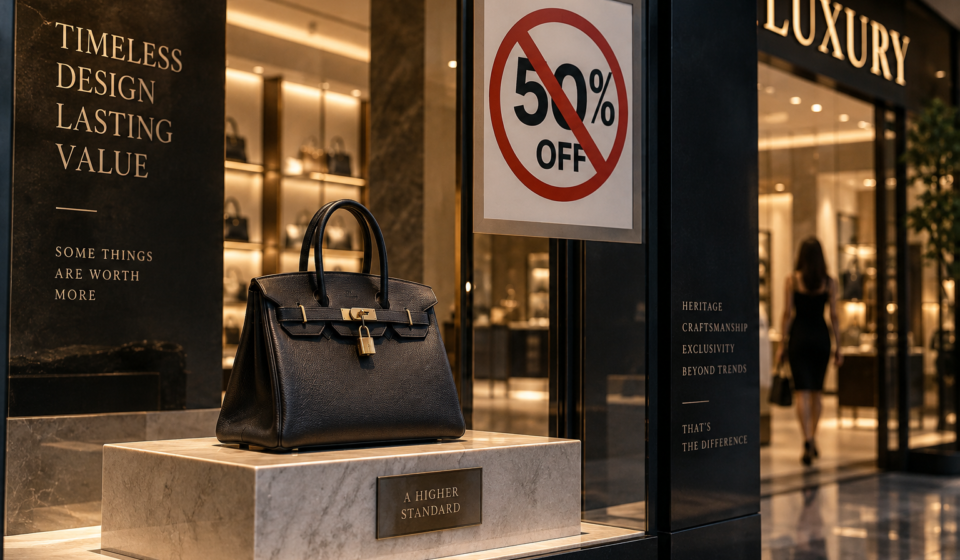

Imagine walking into a luxury boutique.
You pick up a handbag.
₹3,00,000.
You think about it.
Then the salesperson says:
“Actually, today it’s 40% off.”
Would you feel lucky?
Probably.
But something else might happen too.
You might start wondering:
“Why was it ₹3 lakh in the first place?”
And if the same brand ran a 40% discount every few months, another question would eventually appear:
“Why should I ever pay full price?”
This is the uncomfortable problem luxury brands face.
For a normal retailer, a discount can be a powerful sales weapon.
For a luxury brand, the discount itself can damage what the customer is paying for.
Luxury isn’t only selling a product.
It’s selling quality, rarity, identity, status, craftsmanship, experience and desire.
And that’s why many luxury brands are extremely careful about how, when and where they reduce prices.
The short answer: luxury brands aren’t only selling products
If you’re buying a pair of ordinary sneakers, your decision might look something like this:
Price → features → quality → convenience → purchase
But luxury purchases can work differently.
The decision may look more like:
Desire → identity → exclusivity → perceived quality → status → experience → purchase
The price isn’t merely an obstacle to overcome.
The price can become part of the product’s meaning.
Research on luxury consumption has repeatedly found that rarity and exclusivity can contribute to how consumers perceive luxury and its value.
That’s where things get interesting.
Because if you suddenly put a luxury product on a massive sale, you’re not merely changing the price.
You’re potentially changing the signal the price sends.
1. Price can become a signal of value
We normally think:
High price = expensive.
Luxury marketing often tries to create:
High price = desirable, exceptional and worth wanting.
This doesn’t mean expensive products are automatically better.
It means consumers sometimes use price as one of the signals through which they judge a product.
Research on luxury consumption has found that consumers can use price as a cue when making inferences about luxury and quality.
Think about two watches.
Watch A
₹5,000
50% OFF
Watch B
₹5,00,000
No discount.
You obviously cannot conclude that Watch B is objectively 100 times better.
But psychologically, the two products are communicating completely different things.
Watch A says:
“Here’s a deal.”
Watch B can say:
“This product exists at a different level of the market.”
That distinction matters enormously for luxury brands.
2. Luxury brands sell rarity, not just availability
Here’s one of the biggest differences between mass-market marketing and luxury marketing.
Mass-market businesses generally want:
More people → more distribution → more sales.
Luxury brands often have to balance:
More demand → without destroying exclusivity.
That’s a difficult equation.
Research examining luxury consumers found that perceived rarity and exclusivity can significantly influence perceptions of luxury.
And this creates a fascinating paradox:
Making something harder to obtain can sometimes make people want it more.
Imagine two restaurants.
Restaurant A:
“Walk in anytime. Always available.”
Restaurant B:
“Reservations open two weeks in advance and sell out quickly.”
Which one feels more desirable?
Not necessarily the second one.
But scarcity creates a signal:
Other people want this.
And therefore:
Maybe I should want it too.
Luxury brands spend enormous amounts of effort managing exactly this perception.
3. Discounting can destroy the feeling of exclusivity
Suppose a luxury handbag costs ₹4 lakh.
Only a limited number of people can comfortably afford it.
That price creates a natural barrier.
Now imagine the brand announces:
EVERYTHING 60% OFF
Suddenly, the product becomes accessible to a much larger audience.
That’s great if the objective is simply:
Move inventory.
But luxury has another objective:
Protect desirability.
A 2026 study examining promotions in luxury hotels found that discount strategies can affect luxury brand identification differently depending on how the promotion is structured. The research specifically highlights the importance of symbolic value and scarcity cues rather than treating all promotions as psychologically equivalent.
That’s an important distinction.
The question isn’t simply:
“Do discounts increase sales?”
Of course they often can.
The better question is:
“What happens to the meaning of the brand while we’re increasing sales?”
4. Luxury brands don’t want customers trained to wait for sales
This is one of the biggest problems with frequent discounting.
Imagine a normal fashion retailer.
January:
20% OFF
March:
25% OFF
May:
BUY 2 GET 1
August:
END OF SEASON SALE
November:
BLACK FRIDAY — 50% OFF
Eventually, customers learn something.
They stop asking:
“Should I buy this?”
They start asking:
“When will this be discounted?”
The brand has accidentally created a new customer habit.
And that’s dangerous.
Because the advertised price is no longer the customer’s real reference price.
The customer mentally creates a lower one.
5. Discounts can change the reference price
Suppose your product normally costs:
₹10,000
You repeatedly sell it for:
₹7,000
Eventually, ₹10,000 may stop feeling like the “normal” price.
₹7,000 becomes the customer’s mental benchmark.
Now imagine removing the discount.
Suddenly:
₹10,000 feels expensive.
Even though ₹10,000 was the original price.
This is one reason constant promotions can become a trap.
The brand doesn’t just sacrifice margin.
It can teach customers what they should consider a fair price.
Luxury brands have an even bigger reason to avoid this because their positioning depends heavily on maintaining perceived value and desirability.
6. Luxury brands are protecting more than profit margin
This is where people often misunderstand premium pricing.
They assume:
“Luxury brands don’t discount because they want higher margins.”
That’s only part of the story.
The bigger asset they’re protecting is:
Brand equity.
Brand equity is the additional value a brand creates beyond the basic functional product.
A plain leather handbag is a product.
A handbag associated with:
- heritage
- craftsmanship
- cultural relevance
- exclusivity
- celebrity visibility
- status
- distinctive design
- scarcity
- exceptional retail experience
becomes something much bigger.
You’re no longer simply comparing:
Leather + stitching + size + features.
You’re comparing:
What owning this brand says about me.
And that symbolic layer can be extremely valuable.
7. That’s why luxury brands obsess over desirability
Look at how major luxury groups talk about their businesses.
LVMH’s current strategy explicitly emphasizes desirability, quality, creativity and exceptional retail experiences as central to its luxury-brand strategy. Its 2025 results also describe continued investment in the desirability and distribution of its brands.
Notice what isn’t at the centre of that positioning.
You don’t see:
“Our mission is to offer the biggest discounts.”
Because the business isn’t fundamentally competing on price.
It’s competing on:
desire.
And that’s a very different game.
8. Look at Rolex
Consider Rolex.
The brand doesn’t position its watches like ordinary consumer electronics:
“Limited-time 30% OFF!”
Instead, Rolex emphasizes authorized retail, craftsmanship, quality standards and long-term ownership. Its official purchasing information directs customers to official Rolex retailers and highlights its quality standards and five-year international guarantee.
The interesting part isn’t simply that Rolex watches are expensive.
It’s that the buying experience itself reinforces the product’s perceived significance.
The product isn’t presented as:
“Here’s a watch. Want a deal?”
It’s closer to:
“You’re acquiring something with heritage, craftsmanship and enduring value.”
That’s a completely different psychological frame.
9. But here’s an important correction: luxury brands DO sometimes discount
This is where the headline “Luxury brands never discount” becomes misleading.
They can.
And some do.
Luxury businesses may use:
- private-client offers
- outlet channels
- selective markdowns
- end-of-season inventory management
- loyalty benefits
- limited promotions
- trade-in mechanisms
- special access
- gifts or experiences
- different pricing across markets or channels
The key is how visible, frequent and brand-wide the discount is.
A private invitation to a selected customer is psychologically very different from:
EVERYTHING 50% OFF — THIS WEEKEND ONLY
That’s the distinction marketers need to understand.
10. Not all promotions damage premium brands equally
This is one of the most useful insights for marketers.
A price reduction isn’t the only way to create value.
Imagine these two offers.
Offer A
20% OFF
Offer B
Free premium service for one year
Both have economic value.
But they communicate different things.
Offer A says:
“The product costs less.”
Offer B can say:
“You’re getting something extra.”
Research on premium products has found that different promotion structures can affect both sales and brand perceptions differently.
That’s why premium brands often have alternatives to blunt price cuts.
Instead of reducing the headline price, they can increase the value surrounding the purchase.
11. Scarcity can be more powerful than discounting
This is where luxury marketing gets particularly interesting.
Imagine:
Only 50 made.
versus:
50% OFF.
Both create urgency.
But they create completely different kinds of urgency.
Discount urgency
“Buy now before you lose the deal.”
Scarcity urgency
“Buy now before you lose the product.”
The first is based on saving money.
The second is based on losing access.
For a luxury brand, the second can be far more compatible with the positioning.
Research has found that rarity and exclusivity can influence different forms of perceived value in luxury, including social and emotional value.
12. This is why limited editions work so well
Luxury brands frequently use:
Limited editions.
Why?
Because a limited edition changes the psychological question.
Instead of:
“Is this worth ₹X?”
The consumer may begin thinking:
“Will I still be able to get this later?”
That’s a very different mental calculation.
Scarcity shifts attention from:
price
to:
availability.
And when consumers become worried about losing access, the product can become more desirable.
This is one reason limited releases, special collections and invitation-only experiences are so common in premium markets.
13. Exclusivity is not the same thing as being expensive
This is an important distinction.
You can make something expensive without making it exclusive.
For example:
A ₹2 lakh product available everywhere, all year, in unlimited quantities isn’t necessarily exclusive.
Meanwhile, a ₹50,000 product available only to a small group through a limited release can feel highly exclusive.
So luxury positioning isn’t simply:
High price.
It’s a combination of things such as:
Price + rarity + quality + symbolism + craftsmanship + experience + selective distribution + brand meaning.
That’s why simply raising your prices doesn’t magically turn your business into a luxury brand.
14. The store itself becomes part of the pricing strategy
Walk into a premium store and notice what’s missing.
You usually don’t see:
- giant red discount banners
- crowded racks
- “BUY 2 GET 3”
- aggressive countdown timers
- flashing sale graphics everywhere
Instead, you may see:
- space
- lighting
- storytelling
- carefully presented products
- trained staff
- architecture
- packaging
- personalized service
- controlled access
Why?
Because the environment helps justify the price.
LVMH, for example, has emphasized exceptional stores and cultural experiences alongside product quality and desirability in its recent reporting.
The store isn’t simply where the transaction happens.
The store helps create the meaning of the transaction.
15. Luxury pricing is partly about signalling
Humans don’t buy products purely for functional reasons.
We also use products to communicate things.
A luxury product can communicate:
“I can afford this.”
But it can also communicate:
“I appreciate craftsmanship.”
“I understand this category.”
“I belong to this community.”
“I have achieved something.”
“This represents who I am.”
That makes luxury consumption deeply connected to identity.
And when a product’s price contributes to that identity signal, dramatically reducing the price can weaken the signal.
This is one reason researchers distinguish functional, social and emotional forms of perceived value in luxury consumption.
16. But there’s a darker side to this strategy
Luxury pricing isn’t automatically brilliant marketing.
There are risks.
Risk #1: Becoming inaccessible
If prices rise too aggressively, even loyal customers can leave.
Risk #2: Losing younger consumers
New generations may want luxury experiences without accepting traditional luxury pricing structures.
Risk #3: Counterfeit markets
Extreme price gaps can create incentives for counterfeit products.
Risk #4: Economic downturns
When consumers become more cautious, aspirational luxury can face pressure.
Risk #5: Overusing scarcity
If everything is “limited edition,” consumers eventually stop believing the scarcity.
Risk #6: Brand dilution
If a luxury brand expands too aggressively into lower-priced categories, mass distribution or constant promotions, its original positioning can weaken.
So the lesson isn’t:
“Never discount.”
It’s:
“Understand what your price is communicating.”
17. When discounting actually makes sense
Here’s where the advice becomes practical.
If you’re running a normal business, don’t read this article and conclude that discounts are bad.
They’re not.
Discounts can be extremely useful when you need to:
- acquire new customers
- clear old inventory
- stimulate demand
- encourage trial
- compete in a crowded market
- respond to seasonal demand
- increase basket size
- launch a new product
- reactivate inactive customers
The mistake is using discounts without understanding their long-term psychological effect.
18. The real danger is becoming addicted to discounts
Imagine a company sees this:
10% discount → sales increase
So it tries:
20% discount → sales increase more
Then:
30% discount → huge spike
Management celebrates.
But six months later:
- customers wait for promotions
- full-price sales fall
- margins shrink
- acquisition becomes harder
- customers become more price-sensitive
- the brand loses differentiation
The company now has a problem.
It has trained customers to buy only when the price is reduced.
The promotion has become the product.
19. What ordinary brands can learn from luxury pricing
You don’t need to sell ₹5 lakh handbags to use luxury psychology.
A ₹999 skincare brand can use it.
A SaaS company can use it.
A restaurant can use it.
A consultant can use it.
A local clothing brand can use it.
The lesson is not:
“Charge more.”
The lesson is:
“Build enough perceived value that price isn’t the only reason people buy.”
Here are some ways.
1. Make your product distinctive
If customers can’t tell you apart from competitors, price becomes the easiest comparison.
2. Build recognizable brand assets
Colours, packaging, language, design, symbols and distinctive experiences can make your brand easier to recognize.
3. Create scarcity honestly
Limited production, limited access or genuinely limited editions can increase desirability.
Don’t fake scarcity.
4. Improve the buying experience
Sometimes the product isn’t the problem.
The experience is.
5. Give customers a reason to talk about you
A strong brand gives people something worth sharing.
6. Use discounts strategically
Don’t make “20% OFF” the only reason people remember your brand.
7. Protect your reference price
If you constantly reduce your price, customers eventually stop believing the original price.
20. The biggest lesson: don’t sell the discount, sell the reason
Here’s the difference.
A weak brand says:
“Buy because it’s cheaper.”
A stronger brand says:
“Buy because it’s worth it.”
And a luxury brand tries to reach:
“I want this because of what it represents.”
That’s the real game.
Luxury brands don’t necessarily win because consumers don’t care about money.
They win when they make the consumer care about something beyond the money.
A simple framework: The Premium Value Equation
You can think about premium positioning like this:
Perceived Value = Functional Value + Emotional Value + Social Value + Brand Meaning
Discounting attacks the equation from one direction:
Lower Price → Easier Purchase
Premium branding tries to strengthen the other side:
Better Product + Better Experience + Stronger Identity + Greater Desirability → Higher Willingness to Pay
The goal isn’t to make customers forget the price.
It’s to make the price feel justified.
Luxury Pricing vs Discount Pricing
| Discount-led strategy | Premium/luxury-led strategy |
|---|---|
| Competes on price | Competes on perceived value |
| Creates urgency through savings | Creates urgency through scarcity/desire |
| Encourages immediate purchase | Encourages aspiration |
| Can increase price sensitivity | Attempts to reduce price comparison |
| Frequent promotions can become expected | Limited promotions preserve distinctiveness |
| Focuses on transaction | Focuses on relationship and experience |
| “Save ₹X” | “Own something desirable” |
| Price is a selling tool | Price can become part of the brand signal |
Neither strategy is universally better.
The right strategy depends on what you want your brand to mean.
So, should your brand stop discounting?
Not necessarily.
Ask yourself five questions first:
1. Why are we discounting?
Is it strategic or because sales are weak?
2. What behaviour are we teaching?
Are customers buying more—or simply waiting for the next sale?
3. What does the discount say about our product?
Does it communicate value or desperation?
4. What happens to our reference price?
Will customers still accept the original price later?
5. Can we create value without reducing price?
Could you offer:
- better service
- additional features
- a bonus
- early access
- a bundle
- personalization
- membership
- an experience
instead?
These questions are often more useful than simply asking:
“How much discount should we give?”
The psychology behind luxury pricing in one sentence
Luxury brands rarely rely on discounts because their competitive advantage often depends on maintaining desire, exclusivity and perceived value—not simply maximizing short-term transactions.
And that’s the part many businesses miss.
A price is never just a number.
It can be a signal.
It can tell customers:
“This is affordable.”
Or:
“This is a bargain.”
Or:
“This is rare.”
Or even:
“This is not for everyone.”
The smartest brands understand which message they want their price to send.
FAQs
Why do luxury brands rarely offer discounts?
Because frequent discounts can weaken exclusivity, train customers to wait for lower prices and potentially damage perceived value. Luxury brands often prioritize desirability, rarity, quality and brand equity over short-term volume.
Do luxury brands ever go on sale?
Yes. Luxury businesses can use selective markdowns, private offers, outlets, seasonal inventory management and other promotional mechanisms. The important difference is that discounting is often controlled rather than becoming the central public positioning of the brand.
Does a high price automatically make a brand luxurious?
No. High price alone does not create luxury. Luxury positioning also depends on factors such as quality, craftsmanship, rarity, exclusivity, brand heritage, symbolism, experience and distribution.
Why does scarcity make luxury products more desirable?
Scarcity can make access feel more valuable and can signal rarity and exclusivity. Research has found that perceived rarity and exclusivity can contribute to consumers’ perceptions of luxury and different forms of perceived value.
Is discounting bad for every premium brand?
No. Research suggests the effects depend on the type of promotion, the brand and the customer. Some promotions can generate sales without damaging brand perceptions as much as others.
Should small businesses avoid discounts?
Not necessarily. Small businesses can use discounts strategically for acquisition, trials, inventory clearance or specific campaigns. The key is avoiding permanent dependence on discounts as the primary reason customers buy.
What’s the biggest pricing lesson from luxury brands?
Don’t think only about what price will maximize today’s sales. Think about what your price teaches customers to believe about your brand tomorrow.
Final takeaway
Luxury brands don’t win simply by charging more.
They win when they make the reason for paying more feel meaningful.
That’s why the strongest premium brands obsess over:
Quality.
Desirability.
Rarity.
Experience.
Identity.
Exclusivity.
Brand meaning.
And that’s also why a discount can sometimes be more expensive than it looks.
You may gain a sale today.
But if you weaken the reason people were willing to pay full price tomorrow, you’ve discounted more than the product.
You’ve discounted the brand.
Sources & Further Reading
- Research on perceived exclusivity and rarity in luxury:
- Research on why some consumers believe luxury must be expensive:
- Research on price display and luxury perceptions:
- 2026 research on discount strategies and luxury-brand identification:
- Research on promotions and premium-product brands:
- LVMH 2025 results and 2026 strategy:
- Rolex official purchasing information:
Brand Yaatra takeaway:
Marketing isn’t just about getting people to buy. It’s about shaping what the product, price and brand mean in their minds.