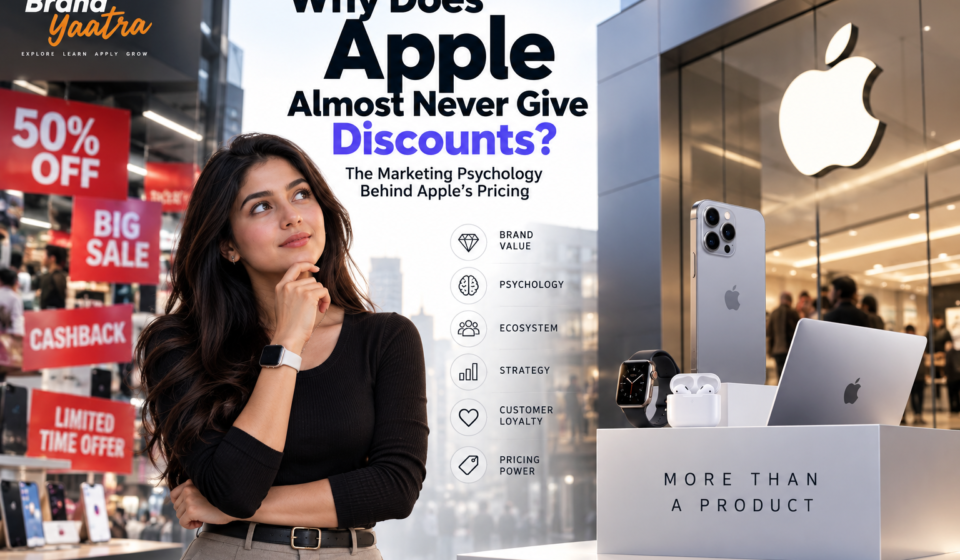
Why Does Apple Almost Never Give Discounts? The Marketing Psychology Behind Apple’s Pricing

Walk into almost any electronics store during a major sale.
50% OFF.
₹10,000 CASHBACK.
LIMITED-TIME DEAL.
BUY NOW.
BIGGEST SALE OF THE YEAR.
Everyone is screaming for your attention.
And then there is Apple.
No giant red banner saying “FLAT 40% OFF.”
No “BUY ONE, GET ONE.”
No desperate-looking countdown timer.
No constant race to make its products look cheaper.
Instead, Apple often does something that seems completely backward in a world obsessed with discounts:
It protects the price.
And that raises a fascinating marketing question:
If lowering the price can make a product easier to sell, why doesn’t one of the world’s biggest brands do it more aggressively?
The answer isn’t simply:
“Because Apple is expensive.”
It’s much more interesting than that.
Apple has spent decades building a brand where price is part of the product’s psychology.
The price tells you something.
The presentation tells you something.
The lack of constant discounts tells you something.
And together, they create one of the most powerful ideas in marketing:
If everyone is trying to convince you that their product is cheaper, Apple tries to convince you that its product is worth more.
Let’s unpack how that works.
First: Does Apple Really Never Give Discounts?
Let’s clear this up before we go any further.
No.
Saying “Apple never discounts” would be inaccurate.
Apple has multiple ways for customers to reduce the effective cost of its products.
In India, for example, Apple currently offers trade-in credits, No Cost EMI, cashback offers and other purchase options. Its education store also provides special pricing for eligible students and educators.
Apple’s Indian store currently lists specific promotional offers on products, and its 2026 education promotion includes products bundled with items such as AirPods or Apple Pencil rather than simply slashing the headline price.
Apple also operates a Trade In program that lets customers exchange eligible devices for credit toward a new purchase.
So the real question isn’t:
“Does Apple ever offer savings?”
The better question is:
“Why doesn’t Apple make constant headline price-cutting a central part of its brand?”
That’s where the marketing gets interesting.
1. Apple Isn’t Really Selling “A Phone”
This is probably the biggest thing to understand.
If two companies sell products that perform roughly the same basic function, price becomes much easier to compare.
Imagine two bottles of water.
Brand A: ₹20
Brand B: ₹50
Most people immediately ask:
“Why would I pay ₹30 more?”
Now imagine two products where the buyer sees completely different value.
That’s what powerful branding can do.
Apple isn’t simply selling:
A smartphone.
It is selling a combination of:
- Hardware
- Software
- Design
- Ecosystem
- Brand identity
- User experience
- Status
- Convenience
- Familiarity
- Trust
- Services
- Community
- Perceived quality
The iPhone is a physical product.
But the Apple experience is the product around the product.
That’s a much harder thing for competitors to compare on a spreadsheet.
2. The Discount Problem: What Happens When You Train Customers to Wait?
Here’s a simple thought experiment.
Imagine your favorite online store announces:
20% OFF EVERY WEEKEND!
The first weekend?
You might buy.
Second weekend?
You might wait.
Third weekend?
You definitely know there’s another sale coming.
Eventually, the customer starts thinking:
“Why should I pay full price?”
That’s the hidden danger of excessive discounting.
A discount can generate a sale today.
But repeated discounting can also teach customers that the normal price isn’t really the normal price.
The “real” price becomes the sale price.
That’s a dangerous habit for a premium brand.
Apple has an incentive to protect the idea that the displayed price represents the value of the product—not an inflated number waiting for a discount.
3. A ₹1,00,000 Product and a ₹1,00,000 Brand Are Not the Same Thing
This is where pricing meets psychology.
Suppose Brand A sells a smartphone for ₹1,00,000.
Then six months later:
20% OFF!
Now imagine Brand B keeps selling its flagship around the same price without making discounting the center of its communication.
The products may have similar specifications.
But consumers can develop different perceptions.
Brand A may start feeling like:
“Wait for the sale.”
Brand B may feel more like:
“This is what it costs.”
That difference matters.
Because price is not only a number.
Price is also a signal.
It can communicate:
- Positioning
- Quality
- Exclusivity
- Confidence
- Demand
- Brand strength
This doesn’t mean expensive products are automatically better.
They aren’t.
It means consumers often use price as one of many signals when forming an opinion about a product.
And Apple has spent decades building the rest of the story around that signal.
4. Apple Wants You to Compare Experiences, Not Just Specifications
Here’s another clever part of Apple’s strategy.
If the conversation is:
“Which phone has more RAM?”
or
“Which phone has a bigger battery?”
or
“Which phone has a faster charging speed?”
then you’re playing a specification game.
And specification games can become brutal.
One competitor adds more.
Another adds even more.
Then another launches something with a bigger number.
Suddenly the consumer is comparing spreadsheets.
Apple often tries to move the conversation somewhere else.
Instead of simply saying:
“Look how many features we have.”
Apple tends to emphasize the experience created by the combination of hardware, software and ecosystem.
That changes the question.
From:
“Which product has more?”
to:
“Which experience do I prefer?”
That’s a much more defensible position.
5. Apple’s Ecosystem Makes the Price Harder to Evaluate in Isolation
Let’s say someone already owns:
- An iPhone
- AirPods
- Apple Watch
- MacBook
- iCloud
- Apple services
Now the next Apple purchase isn’t happening in isolation.
It’s happening inside an existing ecosystem.
Your devices communicate.
Your files move between devices.
Your headphones connect.
Your photos sync.
Your passwords travel with you.
Your services follow you.
Your habits are already established.
The consumer isn’t just asking:
“Is this phone worth ₹80,000?”
They may also be subconsciously asking:
“How much value do I get from staying inside the system I already use?”
That is a very different calculation.
Apple’s 2025 financial reporting illustrates how large that ecosystem has become: Apple reported $109.2 billion in Services net sales in fiscal 2025, alongside $209.6 billion in iPhone net sales.
The important marketing lesson isn’t simply that Services is big.
It’s that the product ecosystem extends the relationship beyond the initial hardware purchase.
6. Apple Can Make the Purchase Feel Easier Without Making the Product Look Cheaper
This is one of the most interesting distinctions.
There are two ways to make a ₹1,00,000 product easier to buy.
Method A: Lower the price
₹1,00,000 → ₹80,000
Method B: Change how the payment feels
₹1,00,000 → ₹8,333/month
The psychological experience can be very different.
Apple’s India store currently offers EMI and No Cost EMI options, along with cashback offers and trade-in credits.
That means Apple can make the purchase more accessible without necessarily turning the product’s headline price into a permanent sale price.
That’s an important marketing distinction.
Affordability and discounting aren’t the same thing.
7. Trade-In Is a Brilliant Pricing Tool
Here’s where Apple gets particularly clever.
Instead of saying:
“We’ll reduce the iPhone’s price by ₹20,000.”
Apple can say:
“Trade in your old phone and get credit toward your new one.”
The customer’s final out-of-pocket cost can fall.
But the new product’s headline price remains intact.
Apple’s India Trade In program currently lets eligible customers exchange Apple and third-party devices for credit toward a new purchase.
From a marketing perspective, that’s powerful.
The customer thinks:
“My old phone is worth something.”
instead of:
“The new phone is being discounted.”
Same wallet.
Different psychology.
8. Apple Uses Targeted Savings Instead of Making “Cheap” Its Identity
Here’s an important principle:
Not every customer needs the same incentive.
Students may care about education pricing.
Existing owners may care about trade-in.
Price-sensitive buyers may care about EMI.
Credit-card users may care about cashback.
Someone upgrading every year may care about resale value.
Apple can therefore create specific ways to reduce the effective cost without turning its entire brand communication into a discount campaign.
Apple’s India education store, for example, offers special pricing for eligible students and educators and currently runs limited-time promotional bundles.
That’s very different from putting:
“EVERYTHING 30% OFF!”
on the homepage every weekend.
9. Discounting Can Destroy Price Anchoring
Here’s a concept every marketer should know:
Price anchoring
People don’t evaluate prices in a vacuum.
They compare them with something.
Suppose a premium headphone is introduced at:
₹30,000
Then it’s repeatedly sold at:
₹18,000
What eventually happens?
₹18,000 starts feeling like the “real” price.
The ₹30,000 number becomes an anchor that makes the discount look attractive.
But you’ve also created a problem:
Customers may stop believing ₹30,000 is the true value.
For a premium brand, that can be dangerous.
Because once customers internalize the discounted price, bringing them back to the original price can become difficult.
Apple’s pricing philosophy appears designed to avoid making permanent, broad-based discounting the primary reason to purchase.
10. Luxury Brands Use a Similar Idea
Think about luxury fashion.
Imagine walking into a luxury store and seeing:
70% OFF EVERYTHING.
It might sound amazing.
But something else happens psychologically.
You might start wondering:
“Why was it priced that high in the first place?”
Luxury brands depend heavily on scarcity, desirability, craftsmanship, status and controlled distribution.
Constant discounting can undermine those signals.
Apple isn’t a traditional luxury brand in the same sense as a high-fashion house.
But it shares an important principle with premium and luxury marketing:
Perceived value becomes harder to protect when the product is constantly presented as a bargain.
That’s why pricing strategy isn’t just about maximizing today’s sales.
It is also about protecting tomorrow’s perception of the brand.
11. Apple Has Another Advantage: People Expect the Next One
This is where Apple’s product launches become fascinating.
The company doesn’t need every customer to buy immediately.
A huge part of its marketing engine is anticipation.
People know:
A new iPhone is coming.
Rumors spread.
Leaks spread.
YouTube videos appear.
Creators speculate.
Social media debates begin.
People compare current models with the upcoming generation.
By the time launch day arrives, the product already has enormous cultural awareness.
Think about what that means.
A company that creates enough demand before launch has less reason to depend on aggressive discounts to create demand afterward.
The marketing starts before the product reaches the shelf.
12. Apple Has Something Most Brands Would Love: People Market the Product for Free
Search YouTube for an iPhone launch.
You’ll find:
- Reviews
- Comparisons
- Camera tests
- Drop tests
- Speed tests
- Unboxings
- “Should you upgrade?” videos
- Battery tests
- Photography challenges
- Accessories
- Memes
- Reactions
That’s an enormous amount of attention.
Not all of it is paid.
And that’s a huge advantage.
The product itself becomes content.
This is one reason strong products can reduce the burden on traditional advertising.
Instead of the brand constantly saying:
“Look at us.”
the internet starts saying:
“Have you seen this?”
That’s a marketing dream.
13. Apple Doesn’t Need to Win Every Customer
This is another lesson marketers often miss.
A premium brand doesn’t necessarily want:
Everyone.
It wants the right customers.
If you try to appeal to everyone, you often end up becoming less distinctive.
Apple’s positioning allows it to say, implicitly:
“This is what our product costs.”
Some people will pay.
Some won’t.
Some will wait.
Some will buy an older model.
Some will choose Android.
That’s okay.
Because strong positioning often requires knowing who you are willing not to be.
14. But Here’s the Part People Get Wrong About Apple
It would be easy to read this article and conclude:
“Apple never discounts because discounting is bad.”
That’s not true.
Discounting can be incredibly effective.
It can:
- Clear inventory
- Acquire new customers
- Increase conversion
- Create urgency
- Encourage upgrades
- Reactivate inactive users
- Defend market share
- Move older products
The question isn’t:
“Are discounts good or bad?”
The question is:
“What does discounting do to your particular brand?”
For a budget retailer, discounts may be the brand.
For a luxury company, constant discounts could be damaging.
For a startup trying to acquire customers, promotions might make sense.
For a premium technology company, selective incentives may be more useful than permanent price cuts.
Context matters.
15. Apple’s Strategy Is Less “Never Discount” and More “Don’t Train Customers to Wait for Discounts”
This is probably the most accurate way to summarize the entire strategy.
Apple does offer savings.
But the company can structure those savings through mechanisms such as:
- Trade-ins
- Cashback
- EMI
- Education pricing
- Limited-time promotions
- Product bundles
- Older-model positioning
rather than relying entirely on permanent headline-price reductions. Apple’s current India shopping pages explicitly show these mechanisms.
That distinction matters.
Because there’s a massive difference between:
“This product is ₹10,000 cheaper today.”
and:
“There are ways to make this purchase more affordable.”
The first changes the perceived price.
The second can change the purchase mechanics.
16. The Psychology Behind Apple’s Pricing Strategy
Let’s put everything together.
Apple’s pricing strategy works alongside several psychological principles.
Perceived value
People don’t buy specifications alone.
They buy the value they believe the overall experience provides.
Price as a quality signal
A high price can sometimes reinforce premium positioning when the rest of the brand supports it.
Scarcity
Limited availability and launch cycles can create anticipation.
Status
Some purchases communicate identity.
Consistency
Stable pricing can reinforce the idea that the product has an established value.
Switching costs
Once customers own several products and services in an ecosystem, leaving can become less convenient.
Familiarity
People often prefer brands and interfaces they already understand.
Social proof
Millions of users, creators, reviewers and communities constantly discuss the products.
None of these factors alone explains Apple’s pricing.
Together, they create a much stronger value proposition than a simple discount ever could.
17. The Numbers Tell an Interesting Story Too
Apple’s business isn’t built on one product.
In fiscal 2025, Apple reported approximately:
- $209.6 billion in iPhone net sales
- $109.2 billion in Services net sales
- $416.2 billion in total net sales
Apple also reported a 46.9% total gross margin for fiscal 2025, with Services at 75.4% and Products at 36.8%.
Those numbers don’t prove that Apple’s pricing strategy is the sole reason for its profitability.
They shouldn’t.
But they show something important:
Apple has built a business where the economics extend far beyond “sell as many phones as possible.”
The product brings customers into the ecosystem.
The ecosystem creates recurring relationships.
And the brand helps support the willingness to pay.
That’s a very different business model from:
“Let’s sell this product as cheaply as possible.”
18. Why Apple Can Get Away With It When Smaller Brands Can’t
Here’s the uncomfortable part.
If a new smartphone company launches tomorrow and says:
“We don’t discount. Pay full price because we’re premium.”
Nobody automatically believes it.
Why?
Because premium pricing has to be earned.
Apple has:
- Decades of brand recognition
- Massive installed base
- Global distribution
- Strong ecosystem integration
- Retail presence
- Product launches that attract enormous attention
- A huge developer ecosystem
- Strong consumer familiarity
- Significant marketing resources
A startup doesn’t automatically have these advantages.
So don’t copy Apple’s pricing.
Copy the principle.
Build enough value that your price makes sense.
19. What Smaller Brands Can Learn From Apple
Here’s where this becomes useful for marketers.
Lesson 1: Don’t automatically discount when sales slow
First ask:
Why aren’t people buying?
Maybe the problem is awareness.
Maybe positioning.
Maybe trust.
Maybe product-market fit.
Maybe the landing page.
Maybe the offer.
Maybe distribution.
A discount is only one possible solution.
Lesson 2: Make the product worth talking about
The best marketing asset can sometimes be the product itself.
If customers naturally want to:
- Review it
- Share it
- Compare it
- Show it
- Talk about it
your marketing gets easier.
Lesson 3: Separate affordability from perceived value
Instead of permanently cutting price, explore:
- Financing
- Bundles
- Trade-ins
- Loyalty rewards
- Limited offers
- Entry-level versions
- Free trials
- Upgrades
There are many ways to reduce purchase friction.
Lesson 4: Don’t destroy your own price
If you announce:
₹10,000
and immediately sell it for:
₹6,000
customers may eventually stop believing ₹10,000 is real.
Your “discount” becomes your price.
Lesson 5: Give customers a reason to stay
A great product isn’t just something people buy.
It’s something that becomes part of their routine.
That’s why ecosystems, subscriptions, communities and loyalty programs can be so powerful.
20. The Dark Side of Premium Pricing
There’s another side to this story.
Premium pricing isn’t magic.
If customers don’t believe the product is worth the price, the strategy collapses.
A brand cannot simply decide:
“We’re premium now.”
and increase prices.
If the experience doesn’t justify the price, consumers notice.
Competitors emerge.
Reviews spread.
Social media amplifies complaints.
Alternatives become easier to discover.
And eventually the premium becomes a tax rather than a value proposition.
That’s why the formula isn’t:
High price = premium brand
It’s closer to:
Strong value perception + trust + differentiation + experience + brand = ability to command a premium
The price comes at the end.
So, Why Does Apple Almost Never Give Discounts?
Now we can answer the question properly.
Apple does offer ways to save.
But its broader strategy is not built around constantly teaching customers:
“Wait for the next sale.”
Instead, Apple works to make the product feel valuable at its established price.
It uses:
- Brand power
- Product design
- Ecosystem
- User experience
- Status
- Product launches
- Customer loyalty
- Trade-ins
- Financing
- Targeted promotions
- Education pricing
- Services
to reduce friction and increase perceived value without making permanent price-cutting the centerpiece of the brand.
And that leads to one of the most important marketing lessons:
The strongest brands don’t always compete by becoming cheaper. Sometimes they compete by making the customer believe the product is worth more.
That’s the game Apple has been playing for years.
And whether you love Apple or can’t stand it, that’s a marketing strategy worth studying.
The Brand Yaatra Takeaway
Here’s the question I’d ask if I were sitting in a marketing meeting tomorrow:
Don’t ask:
“How much discount should we give?”
Ask:
“Why does the customer think we’re worth ₹X in the first place?”
Because if the answer is simply:
“We’ll make it cheaper.”
you may be solving today’s sales problem while creating tomorrow’s brand problem.
But if the answer is:
“Because customers genuinely see more value in us.”
Now you have a brand.
And that’s the difference between selling a product and building a brand.
Frequently Asked Questions
Does Apple never offer discounts?
No. Apple offers several forms of savings, including trade-in credits, cashback, No Cost EMI, education pricing and limited-time promotions. The more accurate statement is that Apple generally does not make broad, constant headline price discounting the core of its consumer positioning.
Why are Apple products so expensive?
Apple prices products based on a combination of product costs, product mix, positioning, ecosystem value, market demand and its broader business strategy. Price alone does not explain Apple’s premium positioning.
Does Apple use psychological pricing?
Apple’s pricing can be analyzed through concepts such as perceived value, price anchoring, premium positioning, status and ecosystem effects. However, these are marketing frameworks for interpreting the strategy rather than claims that Apple uses a single documented “psychological pricing formula.”
Does Apple give student discounts?
Yes. Apple offers education pricing to eligible students, parents purchasing for eligible students, teachers and education staff in India. Apple also runs limited-time education promotions.
Does Apple offer cashback?
Yes. Apple’s India store currently lists available cashback offers alongside EMI and No Cost EMI options, depending on eligibility and participating banks.
Does Apple have a trade-in program?
Yes. Apple Trade In allows eligible customers to exchange devices for credit that can reduce the cost of a new purchase.
Is discounting bad for brands?
No.
Discounting can be extremely useful when used strategically.
The problem occurs when customers become trained to believe that the regular price is not the real price.
The right discount strategy depends on the brand, product, customer, market and business objective.
Can small brands use Apple’s pricing strategy?
They can learn from the principles, but copying Apple’s prices without Apple’s brand strength is unlikely to work.
The real lesson is to build differentiation and perceived value before trying to command a premium.
The Bigger Marketing Lesson
Apple’s pricing strategy isn’t really about not giving discounts.
It’s about something much bigger:
Controlling what your price means.
A ₹1,00,000 product can mean:
“That’s overpriced.”
Or:
“That’s premium.”
Or:
“That’s worth it.”
Or:
“I’ll wait for the sale.”
The number is exactly the same.
The perception isn’t.
And in marketing, perception is often where the real battle happens.
Sources
- Apple’s India Store — Ways to Buy, EMI, cashback and current offers.
- Apple’s India Store — Trade In program.
- Apple’s India Store — Education pricing and current 2026 promotion.
- Apple’s India Store — Sales and price-reduction policy.
- Apple 2025 Form 10-K — Revenue and gross-margin data.