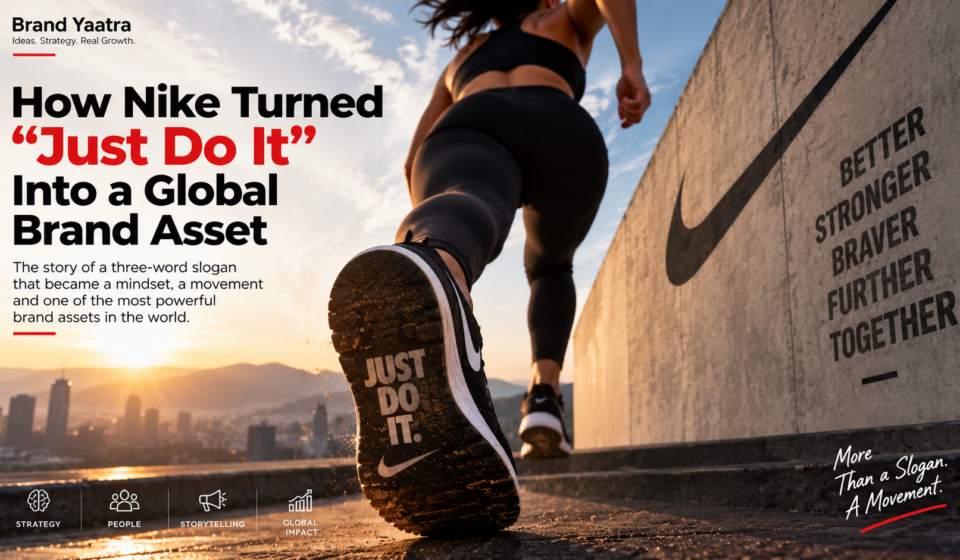

Three words.
That’s all Nike needed.
Just Do It.
No product description.
No technical specification.
No explanation of why Nike shoes were better.
Just three words that somehow became associated with sport, ambition, discipline, failure, comeback and the decision to keep moving.
And that’s what makes the story interesting.
“Just Do It” didn’t remain a slogan.
It became part of what Nike means.
Decades after it was introduced in 1988, Nike is still using the idea. In 2025, the company brought “Just Do It” to a new generation through its “Why Do It?” campaign, framing greatness as a choice and connecting the original idea with a new generation of athletes.
So how does a three-word advertising line survive for almost four decades?
The answer has less to do with the words themselves and more to do with what Nike built around them.
Before “Just Do It,” Nike Had a Marketing Problem
It is easy to look at Nike today and assume the brand was always destined to become a cultural giant.
It wasn’t.
In the late 1980s, Nike was competing in a rapidly changing sportswear market, while Reebok had gained significant attention through the aerobics boom.
Nike also had another problem.
Its advertising could feel fragmented.
Different sports.
Different athletes.
Different products.
Different campaigns.
There was plenty to say about Nike.
But the brand needed a broader idea that could connect all of it.
That was where “Just Do It” entered the picture.
Where Did “Just Do It” Come From?
The origin story is one of the strangest in advertising.
Dan Wieden, co-founder of the advertising agency Wieden+Kennedy, has said the phrase was inspired by the reported final words of Gary Gilmore, a convicted murderer executed in Utah in 1977.
Gilmore reportedly said, “Let’s do it.”
Wieden remembered the phrase years later while working on Nike’s advertising and turned it into something much simpler:
Just Do It.
The tagline first appeared in a Nike television advertisement in 1988 featuring 80-year-old runner Walt Stack running across San Francisco’s Golden Gate Bridge.
That first execution is important because it immediately demonstrated that Nike wasn’t defining athleticism only through elite professional athletes.
An 80-year-old runner could be part of the story too.
The message was bigger than a shoe.
It was about taking action.
Why Three Words Worked So Well
There is something deceptively powerful about “Just Do It.”
It is:
- Short
- Easy to remember
- Easy to say
- Easy to reproduce
- Easy to adapt
- Broad enough to apply to different situations
But simplicity alone doesn’t explain its success.
The real strength is that the phrase doesn’t tell you exactly what to do.
It leaves space for you to decide.
For a professional athlete, “Just Do It” might mean training harder.
For a beginner, it might mean going for the first run.
For someone recovering from an injury, it might mean starting again.
For an aspiring athlete, it might mean trying out for a team.
For someone who isn’t athletic at all, it can still mean taking action.
The customer completes the meaning.
That is a powerful property for a brand message.
Nike Didn’t Make the Customer Admire Nike
This is one of the biggest differences between product advertising and identity-driven brand marketing.
A conventional advertisement might say:
“Our shoes have better cushioning.”
That’s a product claim.
Nike’s broader communication often asks a different question:
“Who do you want to become?”
That changes the role of the brand.
Nike isn’t necessarily the hero of the story.
The athlete is.
Nike becomes the brand that accompanies the athlete on the journey.
That distinction is crucial.
“Just Do It” Turned Nike From a Product Into a Mindset
Sports shoes are functional products.
You wear them to run, jump, train or compete.
But brands can compete on more than function.
They can compete on meaning.
“Just Do It” helped Nike associate itself with a particular mindset:
- Action
- Determination
- Ambition
- Discipline
- Courage
- Persistence
Those aren’t features of a shoe.
They’re characteristics people can associate with themselves.
And that’s where the marketing gets powerful.
The Psychology Behind “Just Do It”
The phrase is an imperative.
It doesn’t say:
“Nike can help you become a better athlete.”
It says:
“Do it.”
That creates a tiny psychological push.
There is no complicated argument to evaluate.
No list of benefits to compare.
No technical information to process.
The message reduces the decision to action.
And because the instruction is so broad, people can attach their own goal to it.
That’s why the same three words can mean completely different things to different people.
Nike provides the trigger. The consumer supplies the personal meaning.
Then Nike Put Real People Behind the Words
A slogan by itself is fragile.
It becomes powerful when people can see it in action.
That’s what Nike did repeatedly.
The company connected the idea with athletes whose stories demonstrated different versions of determination.
Michael Jordan.
Serena Williams.
Kobe Bryant.
LeBron James.
And countless other athletes became part of a much larger Nike storytelling system.
The athlete changed.
The sport changed.
The cultural conversation changed.
But the underlying idea could remain.
Keep going.
Michael Jordan Helped Show How the System Could Work
Michael Jordan’s relationship with Nike became one of the most influential athlete-brand partnerships in marketing.
And the important lesson isn’t simply:
“Hire a famous athlete.”
That would be far too simplistic.
The deeper lesson is that Nike built stories around athletes whose identities reinforced the larger brand idea.
Jordan wasn’t simply presented as someone wearing Nike shoes.
His competitiveness, performance and personality became part of the mythology surrounding the brand.
The product appeared inside the story.
It wasn’t always the entire story.
That’s Why Nike Advertising Often Feels Different
Watch the structure of a traditional product advertisement.
It often looks something like:
Problem → Product → Features → Benefits → Buy
Nike’s strongest brand campaigns frequently work differently:
Human tension → Athlete → Emotion → Story → Brand
The shoe may appear.
But the emotional idea comes first.
That allows Nike to sell something larger than a physical product.
“Just Do It” Became a Flexible Brand Platform
This may be the most important strategic lesson.
Nike didn’t use “Just Do It” for one advertisement and then move on.
It became a platform.
That means different stories could live underneath the same idea.
A campaign about running could use it.
A campaign about basketball could use it.
A campaign about women’s sport could use it.
A campaign about an athlete overcoming failure could use it.
A campaign aimed at a new generation could reinterpret it.
The message remained recognizable while the execution changed.
That’s exactly what makes a strong brand asset useful.
Think of “Just Do It” Like a Container
The words don’t have to tell one story.
They can hold many stories.
“Just Do It”
+
Michael Jordan
creates one story.
“Just Do It”
+
Serena Williams
creates another.
“Just Do It”
+
an ordinary person starting their first run
creates another.
The executions are different.
The underlying brand meaning stays connected.
That’s how a slogan becomes a platform rather than a campaign line.
Consistency Made the Phrase More Valuable
Imagine Nike had changed its central message every two years.
One year:
Be Strong.
Then:
Own the Moment.
Then:
Push Further.
Then another completely unrelated message.
Each campaign might work individually.
But the brand would have to rebuild memory repeatedly.
Consistency works differently.
Every new execution reinforces previous associations.
Over time, the phrase becomes easier to recognize and harder to separate from the brand.
That’s one reason distinctive brand assets become valuable.
Repetition creates memory.
And memory creates recognition.
But Nike Didn’t Repeat the Same Advertisement
This distinction is important.
Consistency doesn’t mean repetition without change.
Nike kept changing the stories.
It changed the athletes.
It changed the cultural context.
It changed the visual style.
It changed the media.
But it repeatedly returned to a recognizable underlying idea.
Same strategic meaning. Different creative expression.
That’s a much more useful definition of consistency.
“Just Do It” Expanded Beyond Sport
Another reason the slogan survived is that it isn’t restricted to one narrow interpretation of sport.
Nike has repeatedly used its marketing to connect sport with broader cultural and social themes.
In 1995, for example, Nike’s “If You Let Me Play” campaign highlighted the potential impact of sports participation on girls’ lives.
In 2018, the brand’s “Dream Crazy” campaign extended its storytelling into themes of ambition, sacrifice and taking a stand.
These campaigns were different in subject and execution, but Nike continued using its larger brand platform to connect individual action with something bigger.
The result is that “Just Do It” can live beyond the literal act of exercising.
And Nike Is Still Evolving the Idea
In September 2025, Nike launched “Why Do It?”, a campaign aimed at a new generation of athletes.
Rather than abandoning “Just Do It,” Nike used the new question to reopen the conversation.
Why do it?
Why start?
Why compete?
Why keep going?
The campaign reframed greatness as a choice rather than simply an outcome.
That is strategically interesting because Nike is effectively updating the conversation without throwing away decades of brand memory.
The old asset becomes the foundation for a new interpretation.
This Is How Strong Brand Assets Work
A weak brand asset needs to be explained.
A strong one can trigger recognition by itself.
Think about:
- Nike’s Swoosh
- “Just Do It”
- Coca-Cola’s contour bottle
- McDonald’s Golden Arches
- Tiffany’s distinctive blue
These aren’t merely design elements or words.
Over years of consistent use, they accumulate associations.
That accumulated meaning is what makes a distinctive asset valuable.
For Nike, “Just Do It” became a verbal asset that could trigger the broader Nike world without requiring a complete explanation every time.
The Difference Between a Slogan and a Brand Asset
| Slogan | Brand Asset |
|---|---|
| Supports a campaign | Builds long-term memory |
| Can be temporary | Can survive across campaigns |
| Communicates a message | Triggers associations |
| Often tied to one idea | Can hold many stories |
| May change frequently | Benefits from consistency |
Not every slogan becomes a brand asset.
“Just Do It” did because Nike repeatedly connected the phrase with recognizable people, emotions, stories and experiences over decades.
Nike Didn’t Own the Words. It Owned the Meaning.
This is perhaps the biggest lesson.
The English language already contained the words:
Just.
Do.
It.
Nike didn’t invent those words.
It built associations around them.
That distinction matters.
Brands rarely create completely new human emotions.
They try to own a particular association with an existing human idea.
Nike didn’t invent ambition.
It didn’t invent athletic determination.
It didn’t invent perseverance.
It built a recognizable brand around those ideas.
The Nike Marketing Flywheel
We can simplify the strategy into a framework:
Insight → Brand Idea → Distinctive Asset → Stories → Athletes → Repetition → Memory → Meaning
1. Insight
Understand what motivates the audience.
2. Brand Idea
Turn that understanding into a simple, ownable idea.
3. Distinctive Asset
Create a recognizable verbal or visual expression of that idea.
4. Stories
Use real people and situations to demonstrate the idea.
5. Athletes
Connect the idea with people whose behavior makes it believable.
6. Repetition
Keep returning to the idea over time.
7. Memory
Repeated exposure builds recognition and associations.
8. Meaning
Eventually, the asset can trigger the larger brand idea almost by itself.
That’s the transformation:
Words → Association → Memory → Brand Meaning
What Marketers Can Learn From Nike
1. Don’t Try to Explain Everything in the Slogan
A strong brand idea doesn’t have to describe every product benefit.
It needs to give the audience a reason to understand what the brand stands for.
2. Make the Customer Part of the Meaning
The best brand ideas leave enough room for people to interpret them personally.
“Just Do It” works because Nike doesn’t tell every customer what “it” is.
The customer decides.
3. Build a Platform, Not Just a Campaign
A campaign has a beginning and an end.
A brand platform can generate campaigns for years.
Ask:
Can this idea support our next campaign, our campaign after that and campaigns we haven’t imagined yet?
4. Connect the Brand to People, Not Just Products
Products can demonstrate performance.
People can demonstrate meaning.
Nike repeatedly uses athletes and their stories to make abstract ideas feel real.
5. Consistency Does Not Mean Boring
You can keep the same strategic idea while completely changing the creative execution.
That’s what allows a brand to remain recognizable without becoming repetitive.
6. Give Your Brand Something People Can Remember
In a crowded market, customers won’t remember everything.
A distinctive phrase, symbol, color, character or sound can give them something simple to hold onto.
But the asset becomes valuable only when the brand uses it consistently enough to build associations.
What Would Happen If Nike Changed “Just Do It” Every Year?
This is a useful thought experiment.
Suppose Nike introduced a completely new brand line every year.
It might produce plenty of fresh creative.
But the accumulated meaning of the previous campaigns would become harder to build.
Every new message would effectively ask consumers to learn something new about Nike.
Instead, Nike has been able to use a familiar platform while telling new stories.
That’s a much more efficient way to build memory over time.
The Real Value of a Brand Asset Is What Happens Around It
“Just Do It” isn’t powerful because three words are inherently magical.
It’s powerful because Nike spent decades putting meaning behind them.
Every athlete.
Every campaign.
Every story.
Every product.
Every visual.
Every cultural moment.
Every repetition.
They all contributed to the association.
That’s why copying a famous slogan doesn’t copy the underlying advantage.
The words are only the visible layer.
The real asset is the accumulated memory behind the words.
Final Takeaway
Nike didn’t turn “Just Do It” into a powerful brand asset by finding three magical words.
It turned three ordinary words into something extraordinary through positioning, storytelling, athlete partnerships, repetition and decades of consistent meaning.
The slogan survived because Nike kept giving people new reasons to interpret it.
And that’s the deeper lesson for marketers.
A memorable brand isn’t built by saying the same thing forever.
It’s built by giving people new stories while making the underlying idea familiar.
That is what Nike did with “Just Do It.”
Three words became a memory.
The memory became an association.
And the association became part of the brand.
FAQs About Nike’s “Just Do It” Marketing Strategy
When did Nike launch “Just Do It”?
Nike launched “Just Do It” in 1988. The first advertisement featuring the tagline included 80-year-old runner Walt Stack running across San Francisco’s Golden Gate Bridge.
Who created Nike’s “Just Do It” slogan?
The slogan was created by advertising executive Dan Wieden, co-founder of Wieden+Kennedy, while working on Nike’s advertising in 1988.
What does “Just Do It” mean in Nike’s marketing?
Rather than describing a specific product benefit, “Just Do It” communicates a broader idea around action, determination and the willingness to begin or keep going. Its open-ended nature allows different audiences and athletes to give the phrase their own meaning.
Why is “Just Do It” considered a strong brand asset?
It has been used consistently across decades of Nike advertising while being connected to athletes, stories, cultural moments and different forms of sport. That repeated association has helped turn the phrase into a recognizable part of Nike’s brand identity.
Did “Just Do It” make Nike successful?
“Just Do It” became an important part of Nike’s marketing transformation, but it would be too simplistic to attribute Nike’s overall growth to the slogan alone. Product innovation, athlete partnerships, distribution, retail, brand strategy and many other factors also contributed to Nike’s development.
Is Nike still using “Just Do It”?
Yes. Nike continues to use the idea. In 2025, the company launched “Why Do It?”, a campaign that reintroduced “Just Do It” to a new generation while reframing greatness as a choice.