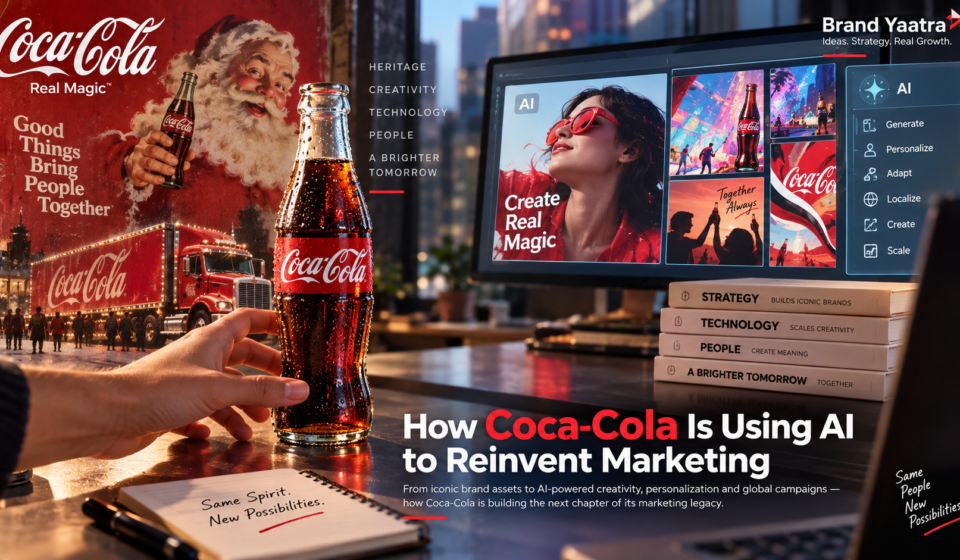

For a brand that has been around for nearly 140 years, Coca-Cola has something most companies would kill for:
A visual identity people can recognize almost instantly.
The contour bottle.
The Spencerian script.
The red-and-white world.
Santa Claus.
The Coca-Cola truck.
And decades of advertising that have turned those assets into cultural symbols.
So when generative AI arrived, Coca-Cola faced a fascinating marketing problem.
AI could suddenly create thousands of images, videos and variations at incredible speed.
But Coca-Cola couldn’t simply let AI create whatever it wanted.
Because for a brand like Coca-Cola, creativity without consistency can become chaos.
That tension sits at the heart of Coca-Cola’s AI strategy.
The company isn’t simply asking:
“How can AI make our marketing faster?”
It’s asking a much more interesting question:
“How can AI help us scale creativity without losing what makes Coca-Cola Coca-Cola?”
Coca-Cola Didn’t Start Using AI Yesterday
Coca-Cola’s AI experimentation goes back several years.
In 2023, the company launched Create Real Magic, an AI-powered platform that allowed people to create artwork using Coca-Cola’s iconic brand assets.
The platform combined generative AI technologies with Coca-Cola’s creative archive and invited artists and consumers to experiment with the brand.
That was an important strategic move.
Coca-Cola wasn’t simply using AI internally.
It was letting people play with the brand itself.
Users could reinterpret Coca-Cola’s visual assets and create something new from them.
In other words:
Coca-Cola turned its brand heritage into a creative playground.
The Interesting Part Wasn’t the AI
Generative AI itself wasn’t the real marketing innovation.
Lots of companies could generate an image.
The interesting part was what Coca-Cola gave the AI to work with.
Its archives already contained decades of recognizable visual assets.
The bottle.
The logo.
The polar bear.
Santa.
The holiday trucks.
Classic advertising imagery.
That meant AI wasn’t starting from a blank canvas.
It was being connected to an enormous existing brand world.
And that leads to one of the biggest lessons from Coca-Cola’s AI experiments:
AI becomes much more interesting for established brands when it is connected to distinctive brand assets.
From Create Real Magic to a Bigger AI Strategy
Coca-Cola’s experimentation didn’t stop with consumer-generated artwork.
The company began exploring AI across creative development, personalization, content creation, customer experiences and marketing operations.
In 2023, Coca-Cola said it was exploring AI applications including content creation, rapid creative iteration, personalized messaging and two-way consumer conversations.
By 2024, the company was using AI in holiday experiences that allowed consumers to interact with Coca-Cola’s Santa character and generate personalized digital experiences.
And Coca-Cola continued pushing the idea of combining its historical brand assets with newer technology.
That progression matters.
The strategy evolved from:
“Let’s experiment with generative AI.”
toward:
“How do we build AI into the marketing system?”
Then Coca-Cola Built Something Called Project Fizzion
This is where the story gets particularly interesting for marketers.
In 2025, Coca-Cola introduced Project Fizzion, an AI-enabled design intelligence system developed with Adobe.
The problem it was designed to address was not simply generating more creative.
It was scaling Coca-Cola’s brand system across an enormous global organization.
Coca-Cola operates hundreds of brands across more than 200 countries and territories.
Imagine trying to maintain brand consistency across:
- Different countries
- Different languages
- Different agencies
- Different campaigns
- Different screen sizes
- Different retail environments
- Different cultural contexts
- Different formats
Traditional brand guidelines can tell a designer what to do.
But guidelines are still documents.
Someone has to interpret them.
Someone has to apply them.
Someone has to check whether the final asset actually follows them.
Fizzion tries to turn those rules into something more intelligent.
What Does Fizzion Actually Do?
Coca-Cola describes Fizzion as a design-first system that learns from how designers work inside Adobe Creative Cloud.
The system uses something called a StyleID to encode elements of Coca-Cola’s design identity in a machine-readable way.
That allows brand rules to be applied more dynamically across creative assets.
In simple terms:
Instead of giving AI a giant brand guideline document and hoping it understands it, Coca-Cola is trying to make the brand system itself more intelligent.
That’s a major distinction.
Why This Matters More Than Generating Images
Imagine a global Coca-Cola campaign needs hundreds of localized versions.
Different countries might need:
- Different languages
- Different headlines
- Different product combinations
- Different cultural references
- Different dimensions
- Different media placements
Without an intelligent system, much of that work can become repetitive production.
AI can potentially accelerate that work.
But the real challenge is:
How do you scale without destroying the brand?
Fizzion is Coca-Cola’s attempt to solve that problem.
The company’s own description says the system can help creative teams produce content much faster while keeping designers in control.
That last part is important.
The goal isn’t simply AI replacing designers.
It’s AI handling more of the repetitive scaling problem while humans retain creative direction.
Coca-Cola’s AI Strategy Is Really About Scale
At first glance, AI and creativity sound like opposites.
Creativity feels human.
AI feels automated.
But for a company operating at Coca-Cola’s scale, the bigger opportunity isn’t necessarily replacing the creative idea.
It’s scaling the idea.
Think about the difference:
Old problem:
Create one excellent campaign.
Then adapt it manually for dozens or hundreds of markets and formats.
AI-enabled problem:
Create a strong creative system.
Then use technology to help generate and adapt many variations while preserving the underlying brand rules.
That changes where human effort can be spent.
Instead of spending enormous amounts of time resizing, reformatting and adapting assets, creative teams can potentially spend more time on:
- Ideas
- Storytelling
- Strategy
- Cultural insight
- Creative direction
- Brand building
That is a much more interesting AI marketing proposition than simply saying:
“AI makes content faster.”
Coca-Cola Is Also Using AI for Personalization
Another important part of Coca-Cola’s strategy is personalization.
The company has experimented with AI-powered experiences where consumers can interact with Coca-Cola’s brand world and create personalized content.
Its holiday campaigns have included AI-powered experiences that let consumers generate personalized digital cards and interact with Coca-Cola’s Santa character.
In 2026, Coca-Cola also described an AI-enabled campaign in China that used traditional Chinese paper-art inspiration to allow consumers to create personalized digital portraits of friends and family through connected Coca-Cola packaging.
Notice the pattern.
The company isn’t using AI only to produce advertisements.
It’s increasingly using AI to create experiences that the consumer participates in.
That’s a Big Difference
Traditional advertising says:
“Watch our story.”
Interactive AI marketing can say:
“Create your own version of the story.”
That changes the relationship between the brand and the audience.
The customer isn’t just receiving the creative.
They’re helping create it.
And that can make the interaction feel much more personal.
Coca-Cola Is Combining Heritage With Technology
This might actually be the smartest part of the strategy.
Coca-Cola isn’t abandoning its old brand assets to chase whatever the newest AI trend happens to be.
It’s doing almost the opposite.
It’s taking its existing brand heritage and putting new technology around it.
Think about Coca-Cola’s holiday identity.
The Santa.
The trucks.
The bottle.
The colors.
The typography.
Those things already mean something.
AI gives Coca-Cola new ways to make those assets interactive, personalized and adaptable.
So the strategy becomes:
Heritage + Technology + Participation
rather than:
Technology replacing Heritage.
Why Brand Consistency Becomes More Important in the AI Era
Generative AI creates a strange problem for brands.
It makes content creation easier.
But when everyone can create more content, distinctiveness becomes even more important.
Imagine a world where every company can generate:
- Beautiful advertisements
- Professional product photography
- Videos
- Social posts
- Illustrations
- Campaign concepts
If everyone can produce attractive creative, attractiveness alone becomes less valuable.
What separates one brand from another?
Its distinctive assets, ideas, voice, positioning and cultural meaning.
This is why Coca-Cola’s approach to AI is so interesting.
The company isn’t only trying to generate more creative.
It’s trying to make sure the creative still feels like Coca-Cola.
AI Can Increase Creative Volume. It Can’t Automatically Create Brand Meaning.
This distinction is crucial.
AI can help create:
- More variations
- More formats
- More concepts
- More localized assets
- More personalized experiences
But more content doesn’t automatically mean better marketing.
A brand can produce 10,000 AI-generated advertisements and still have nothing meaningful to say.
The difficult part remains:
What should the brand stand for?
Who is it speaking to?
What cultural insight is it using?
Why should anyone care?
AI can accelerate the execution.
The strategy still has to come first.
That’s Why Coca-Cola’s AI Story Is Really a Brand Strategy Story
AI is the technology layer.
But underneath it are classic marketing questions.
How do we stay distinctive?
How do we scale globally?
How do we remain locally relevant?
How do we create experiences?
How do we make people participate?
How do we protect our identity?
How do we move faster without sacrificing quality?
Those aren’t new marketing problems.
AI simply changes the tools available to solve them.
The Coca-Cola AI Marketing Flywheel
Put Coca-Cola’s approach together and a useful framework emerges:
Brand Assets → AI System → Creative Variations → Personalization → Consumer Participation → Cultural Conversation → More Brand Data → Better Experiences
Here’s how it works.
1. Start With Strong Brand Assets
Coca-Cola already has distinctive visual and cultural assets.
AI doesn’t create that foundation.
It amplifies it.
2. Encode the Brand Into the System
Project Fizzion represents an attempt to make brand rules more intelligent and usable within the creative workflow.
3. Increase Creative Velocity
Once the system can help interpret brand rules, teams can potentially produce and adapt creative much faster.
4. Localize
Global brands need local relevance.
AI can help create and adapt variations for different markets and contexts.
5. Personalize
Consumers can receive or create experiences that feel more directly relevant to them.
6. Encourage Participation
Instead of simply showing people advertising, Coca-Cola can give them tools to interact with the brand.
7. Create Conversation
When an experience is interesting enough, people can share it and extend the campaign beyond paid media.
What Marketers Can Learn From Coca-Cola’s AI Strategy
1. Don’t Start With AI. Start With the Marketing Problem.
One of the easiest mistakes marketers can make is asking:
“Where can we use AI?”
A better question is:
“What marketing problem are we trying to solve?”
For Coca-Cola, some of those problems involve scale, localization, creative production, personalization and consumer participation.
AI then becomes a tool for solving those problems.
2. Your Brand Assets Become More Valuable in an AI World
If anyone can generate an attractive image, distinctive assets become increasingly important.
Your logo isn’t enough.
Your colors aren’t enough.
Your brand needs recognizable ideas, symbols, stories and associations.
AI can help multiply those assets.
It cannot automatically give them meaning.
3. Build Systems, Not Just Prompts
There is a huge difference between:
“Write me a Coca-Cola-style advertisement.”
and building a system that understands how a brand’s visual identity, typography, layouts and creative rules work.
Coca-Cola’s Fizzion experiment points toward the second approach.
The future of enterprise AI marketing may be less about clever prompts and more about intelligent creative systems.
4. Human Creativity Still Matters
AI can generate options.
Humans still have to decide which option deserves to exist.
That’s especially important for brands with decades of accumulated meaning.
Speed is valuable.
But judgment is valuable too.
5. Use AI to Make Experiences, Not Just Ads
Some of Coca-Cola’s most interesting experiments invite consumers to interact with the brand.
That opens up a much larger opportunity.
Instead of asking:
“How can AI make our advertisement cheaper?”
ask:
“What could our customer do with AI that would make interacting with our brand genuinely interesting?”
6. Global Brands Need Both Consistency and Local Relevance
A global brand can’t look completely different in every market.
But it also can’t behave exactly the same everywhere.
AI creates the possibility of producing more localized variations while keeping the underlying brand system consistent.
That balance could become one of the most important applications of AI in global marketing.
Where Coca-Cola’s Strategy Gets Complicated
There is another side to the story.
AI-generated marketing creates genuine questions around originality, copyright, disclosure, creative quality and consumer trust.
There is also a creative risk.
If brands optimize too aggressively for speed and scale, marketing can become increasingly similar.
Thousands of variations do not automatically produce thousands of great ideas.
And if every brand uses the same AI tools with similar prompts and similar visual conventions, the internet could become filled with content that is technically impressive but culturally forgettable.
That makes brand strategy more important—not less.
The Future May Not Be AI-Generated Brands
It may be AI-amplified brands.
That’s an important difference.
The strongest brands may not be the ones that generate the most AI content.
They may be the ones with the clearest identity, strongest creative systems and best understanding of their customers—and then use AI to amplify those advantages.
Coca-Cola’s experiments point in that direction.
What Coca-Cola Is Really Trying to Build
Look beyond the individual campaigns.
Create Real Magic was an experiment in consumer participation.
AI-powered holiday experiences explored personalized interaction.
Project Fizzion tackles the problem of scaling brand design.
Localized AI experiences explore relevance at market level.
Put together, these initiatives suggest something bigger:
Coca-Cola is trying to build a marketing system where AI increases the speed and scale of creativity while the brand remains the organizing principle.
That’s very different from simply using ChatGPT to write social posts.
The Bigger Marketing Lesson
Every technological shift creates the same temptation.
When something new arrives, marketers rush to ask:
“How do we use it?”
But the better question is:
“What becomes possible now that wasn’t possible before?”
For Coca-Cola, AI potentially makes several things possible at a much larger scale:
- More creative variations
- Faster production
- More localization
- More personalization
- More interactive experiences
- More experimentation
- More ways for consumers to participate
But the technology only becomes valuable because Coca-Cola already has something worth scaling.
A brand.
That may be the biggest lesson of all.
Final Takeaway
Coca-Cola’s AI strategy isn’t really a story about a beverage company suddenly becoming a technology company.
It’s a story about what happens when one of the world’s most recognizable brands gets access to technology capable of creating and adapting content at unprecedented speed.
The opportunity is enormous.
But so is the risk.
If Coca-Cola uses AI only to make more content, it will simply produce more content.
If it uses AI to make its brand more useful, more relevant, more personal and more culturally connected, something much more interesting happens.
And that’s the real lesson for marketers:
AI can multiply what a brand creates. But the brand still determines whether any of it is worth remembering.
FAQs About Coca-Cola’s AI Marketing Strategy
How is Coca-Cola using AI in marketing?
Coca-Cola has experimented with AI for creative generation, personalized consumer experiences, localized content, interactive campaigns and creative production systems. Its initiatives include Create Real Magic and Project Fizzion.
What is Coca-Cola’s Create Real Magic?
Create Real Magic was an AI-powered Coca-Cola platform launched in 2023 that allowed users to create artwork using Coca-Cola’s iconic brand assets and generative AI technology.
What is Project Fizzion?
Project Fizzion is an AI-enabled design intelligence system Coca-Cola introduced with Adobe. It is designed to help translate brand design rules into an intelligent system that can assist creative teams in scaling branded assets while keeping designers involved in the process.
Why is Coca-Cola using AI?
Coca-Cola has described several potential applications for AI, including increasing creative speed, experimenting with new marketing experiences, personalizing content, localizing campaigns and improving creative production at global scale.
Does Coca-Cola use AI to replace creative teams?
Coca-Cola’s description of Project Fizzion emphasizes using AI to empower designers rather than simply replace them. The system is intended to help creative teams scale their work while keeping human designers involved in creative decisions.
What can marketers learn from Coca-Cola’s AI strategy?
The key lesson is that AI works best when connected to a clear marketing problem and a strong brand system. Marketers can use AI to increase creative speed and personalization, but distinctive brand strategy, human judgment and cultural understanding remain important.