
What Is Digital Marketing? The Complete Map of the Industry
Digital marketing is much bigger than SEO.
It is Google.
It is Instagram.
It is the email sitting in your inbox.
It is the YouTube video you watched before buying a phone.
It is the ad that somehow appeared after you searched for running shoes.
It is the reason Duolingo behaves like a meme account.
It is the reason Apple can launch a product without shouting about discounts.
And increasingly, it is also AI.
When someone asks ChatGPT for the best phone under ₹50,000, searches Google for a restaurant, discovers a brand on Instagram, watches a product review on YouTube, clicks an ad, reads reviews, visits a website and finally makes a purchase—digital marketing is happening at almost every step.
So what exactly is digital marketing?
More importantly, what actually comes under digital marketing in 2026?
SEO? Yes.
Social media? Obviously.
Google Ads? Absolutely.
But also content marketing, email, influencer marketing, affiliate marketing, conversion optimization, analytics, marketing automation, e-commerce, AI marketing, answer-engine optimization, brand building and much more.
This guide is your complete map of the digital marketing industry.
If you’re a student, beginner, business owner, marketer, creator or simply trying to understand how modern brands grow online, start here.
What Is Digital Marketing?
Digital marketing is the use of digital channels, platforms, technologies and data to attract, reach, engage, convert and retain customers.
In simpler words:
Digital marketing is how brands use the internet and digital technology to get attention, build relationships and drive business.
Search engines, websites, social media, email, digital advertising, apps, online marketplaces, video platforms and messaging platforms can all become part of a digital marketing strategy.
The important word here is strategy.
Posting on Instagram is not automatically a marketing strategy.
Running Google Ads is not automatically a marketing strategy.
Publishing 100 blog posts is not automatically a marketing strategy.
Digital marketing works when the different pieces are connected to a business objective—whether that objective is awareness, leads, sales, app installs, subscriptions, repeat purchases or brand loyalty.
That is why digital marketing is best understood as an ecosystem, not a single activity.
The Digital Marketing Map
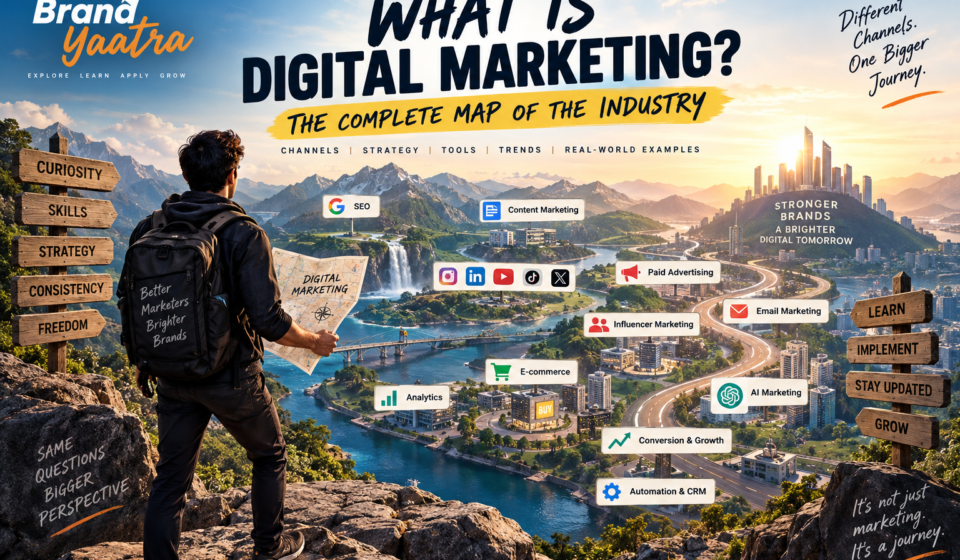
If the entire industry looks confusing, here’s the simplest way to visualize it:
DIGITAL MARKETING
→ Search Marketing
- SEO
- Local SEO
- Search Ads / PPC
- Answer Engine Optimization
- Generative Engine Optimization
→ Content Marketing
- Blogs
- Guides
- Videos
- Podcasts
- Newsletters
- Infographics
- Case studies
- Original research
→ Social Media Marketing
- YouTube
- TikTok
- X
- Communities
→ Paid Digital Advertising
- Search ads
- Display ads
- Social ads
- Video ads
- Shopping ads
- Retargeting
- Programmatic advertising
→ Email & Lifecycle Marketing
- Newsletters
- Lead nurturing
- Promotional campaigns
- Automated sequences
- Customer retention
→ Influencer & Creator Marketing
- Sponsored content
- Creator partnerships
- Affiliate creators
- UGC
→ Conversion & Growth
- CRO
- Landing pages
- A/B testing
- Funnels
- Product-led growth
- Retention
→ E-commerce Marketing
- Marketplace marketing
- Product feeds
- Shopping campaigns
- Reviews
- Remarketing
- Conversion optimization
→ Data & Analytics
- Web analytics
- Attribution
- Customer analytics
- Marketing dashboards
- ROI measurement
→ Marketing Technology
- CRM
- Automation
- CDPs
- Ad platforms
- Analytics platforms
- AI tools
→ AI Marketing
- AI content
- AI-assisted research
- AI personalization
- AI agents
- AI search
- GEO / AEO
- Predictive marketing
That’s the industry.
And every one of those branches can become an entire career.
Why Is Digital Marketing Important?
Here’s the biggest reason:
Your customers are already online.
They’re searching.
They’re scrolling.
They’re comparing.
They’re watching reviews.
They’re asking friends.
They’re asking creators.
They’re asking AI.
They’re reading comments.
They’re checking Reddit.
They’re comparing prices.
And they’re doing all of this before they ever speak to a salesperson.
Digital marketing allows businesses to participate in those moments.
It also gives marketers something traditional marketing often struggles with:
feedback.
You can see impressions, clicks, engagement, conversions, traffic, leads, purchases and dozens of other signals depending on the channel and measurement setup.
That doesn’t mean every digital activity is perfectly measurable—attribution is one of marketing’s biggest headaches—but digital channels generally give marketers far more observable data than many traditional channels.
Digital marketing can therefore become a continuous loop:
Launch → Measure → Learn → Improve → Repeat
And that loop is one of the reasons digital marketing has become so important to modern businesses.
The 12 Major Areas of Digital Marketing
Let’s break the giant map into something actually understandable.
1. Search Engine Optimization (SEO)
SEO stands for Search Engine Optimization.
It is the practice of improving a website and its content so that it can earn visibility in unpaid search results.
Think about what happens when you search:
“best running shoes”
or
“how to start investing”
or
“restaurants near me”
There are thousands of possible pages that could answer those questions.
SEO is about making your website a strong candidate to appear when people search for things relevant to your business.
SEO includes areas such as:
- Keyword research
- Search intent
- On-page SEO
- Technical SEO
- Internal linking
- Content optimization
- Digital PR
- Link building
- Local SEO
- Image SEO
- Video SEO
- Structured data
- Website experience
But here’s an important distinction:
SEO is not simply “put keywords into articles.”
Modern search is far more complicated than that.
Google evaluates many signals and systems when determining what content should appear for a query. Google’s own documentation increasingly emphasizes creating useful, reliable, people-first content rather than content created primarily to manipulate rankings.
So good SEO starts with a much simpler question:
What does the person searching actually need?
2. Search Engine Marketing & PPC
If SEO is about earning visibility organically, PPC is about buying visibility through advertising.
PPC means Pay-Per-Click, although modern paid advertising models aren’t limited strictly to paying for clicks.
Google Ads is one of the most recognizable examples.
Imagine someone searches:
“buy running shoes online”
A brand can compete for that search through paid advertising.
Other paid search opportunities include:
- Google Search Ads
- Shopping Ads
- Display campaigns
- YouTube advertising
- Microsoft Ads
- App campaigns
Paid search can produce visibility much faster than waiting for organic rankings.
But there is a catch:
The moment you stop paying, the paid visibility generally stops too.
That’s why strong businesses often combine paid acquisition with organic channels, content, brand building and retention.
3. Social Media Marketing
Social media marketing is the use of social platforms to build awareness, relationships, communities and business results.
And no, it isn’t just:
“Post three times a week.”
Social media has evolved into several different marketing functions.
Organic social
Building an audience without directly paying for every impression.
Examples:
- Instagram posts
- Reels
- LinkedIn posts
- YouTube videos
- X posts
- Community content
Paid social
Paying platforms to distribute content or advertisements to targeted audiences.
Examples include:
- Meta Ads
- LinkedIn Ads
- TikTok Ads
- YouTube Ads
Community marketing
Building relationships around a brand rather than simply broadcasting advertisements.
This is where things get interesting.
Some of the strongest brands don’t treat social media as a billboard.
They treat it as culture.
Duolingo is a great example.
Its social presence often behaves more like an internet personality than a traditional corporate marketing account.
That’s not an accident.
It’s positioning.
4. Content Marketing
Content marketing is the creation and distribution of useful or entertaining content designed to attract, educate, influence or retain an audience.
Content can include:
- Blog articles
- Videos
- Podcasts
- Newsletters
- Case studies
- Whitepapers
- Guides
- Research reports
- Infographics
- Social posts
- Webinars
- Interactive tools
Here’s the key:
Content marketing isn’t about creating content for the sake of creating content.
The best content answers a question, solves a problem, creates demand, builds trust or gives people a reason to remember the brand.
A company selling accounting software might publish:
“How to Calculate GST on Your Invoice”
A travel company might publish:
“The Complete 7-Day Rajasthan Itinerary”
A marketing website might publish:
“How Duolingo Built Its TikTok Strategy”
Different businesses.
Different audiences.
Same principle:
Give people something valuable before asking them to buy.
5. Email Marketing
Email marketing is one of the oldest major digital channels—and it is nowhere near dead.
In fact, email remains an important part of customer acquisition, nurturing and retention strategies.
Common email marketing campaigns include:
- Newsletters
- Welcome emails
- Product launches
- Promotional campaigns
- Abandoned-cart emails
- Educational sequences
- Lead nurturing
- Customer onboarding
- Re-engagement campaigns
The real power of email is not simply sending messages.
It is building an owned relationship with an audience.
You don’t have to rely entirely on an algorithm deciding who sees your content.
Someone gave you permission to enter their inbox.
That’s valuable.
6. Influencer & Creator Marketing
People don’t only trust brands.
They trust people.
That’s where influencer and creator marketing comes in.
A creator might:
- Review a product
- Demonstrate a product
- Mention a brand
- Create sponsored content
- Produce UGC
- Share an affiliate link
- Become a long-term brand ambassador
And “influencer” no longer necessarily means someone with millions of followers.
Micro and niche creators can sometimes provide something much more valuable:
relevance and trust.
A creator with 25,000 highly engaged followers in a specific niche may be more useful to a brand than a celebrity whose audience has little interest in the product.
7. Affiliate Marketing
Affiliate marketing turns other people and businesses into a potential sales force.
The basic model is simple:
Someone promotes your product → someone buys through their tracked link/code → the promoter earns a commission.
Affiliates can include:
- Bloggers
- YouTubers
- Creators
- Comparison websites
- Coupon websites
- Publishers
- Niche communities
It can be particularly attractive because brands can structure partnerships around measurable outcomes such as sales or leads.
But like every channel, affiliate marketing has its own challenges—from commission economics to attribution to brand safety.
8. Conversion Rate Optimization (CRO)
Getting people to your website is only half the battle.
What happens when they arrive?
Do they buy?
Sign up?
Book a demo?
Download something?
Or immediately leave?
Conversion Rate Optimization, or CRO, is the practice of improving the percentage of users who take a desired action.
For example:
10,000 people visit a landing page.
200 purchase.
That’s a 2% conversion rate.
If changes to the page increase that to 3%, the business now gets 300 purchases from the same 10,000 visitors.
No extra traffic required.
CRO can involve:
- Landing page design
- Copywriting
- Calls to action
- Forms
- Checkout experience
- Pricing presentation
- Social proof
- A/B testing
- Page speed
- User experience
This is why marketers shouldn’t obsess over traffic alone.
Traffic is not the finish line.
Business outcomes are.
9. Marketing Analytics
Here’s where marketing stops being guesswork.
Analytics helps marketers understand what happened.
Questions include:
- Where did visitors come from?
- Which campaign generated leads?
- Which ad generated sales?
- Which page converted best?
- What is our customer acquisition cost?
- Which channel has the best return?
- Where are customers dropping off?
- Which customers are most valuable?
Common marketing metrics include:
Impressions — How many times content or an ad was shown.
Reach — How many unique people were exposed to it.
CTR — Click-through rate.
CPC — Cost per click.
CPM — Cost per thousand impressions.
Conversion Rate — Percentage of users who complete a desired action.
CAC — Customer acquisition cost.
LTV / CLV — Customer lifetime value.
ROAS — Return on ad spend.
ROI — Return on investment.
The trick isn’t collecting 100 metrics.
It’s knowing which numbers actually matter to the business.
10. Marketing Automation & CRM
Imagine manually sending a welcome email to every new customer.
Fine if you have ten customers.
Not so fine if you have 100,000.
Marketing automation allows businesses to automate parts of the customer journey.
For example:
Someone downloads a guide
↓
They receive a welcome email.
↓
Two days later they receive a useful case study.
↓
They click a product link.
↓
They enter a different sequence.
↓
They request a demo.
↓
The sales team gets notified.
That’s marketing technology working behind the scenes.
CRM systems, email automation, lead scoring, customer journeys and lifecycle marketing all sit within this broader ecosystem.
11. E-commerce Marketing
Digital marketing and e-commerce have become deeply connected.
An e-commerce marketer may work on:
- Product SEO
- Google Shopping
- Marketplace advertising
- Meta Ads
- Product pages
- Retargeting
- Reviews
- Email campaigns
- Cart recovery
- Influencer marketing
- Conversion optimization
- Loyalty programs
And the journey can be incredibly short.
A person sees a Reel.
Clicks a product.
Reads reviews.
Adds it to cart.
Receives a reminder.
Purchases.
All within a few hours.
That’s why modern e-commerce marketing often requires multiple channels working together rather than one isolated tactic.
12. AI Marketing
And now we arrive at the part changing the industry fastest.
AI.
Artificial intelligence is already being used across marketing for:
- Research
- Content creation
- Data analysis
- Personalization
- Customer support
- Ad creative
- Campaign optimization
- Automation
- Forecasting
- Audience segmentation
- Search
- Recommendation systems
But the bigger change isn’t simply:
“AI can write blog posts.”
That’s the least interesting part.
The bigger shift is that people are increasingly using AI systems to discover information, compare products, research brands and make decisions.
Search itself is evolving.
Google has introduced AI Overviews into Search, while marketers are also paying increasing attention to how brands appear inside AI-generated answers and conversational search experiences.
That brings us to a rapidly developing area of marketing.
What Is GEO?
GEO stands for Generative Engine Optimization.
The basic idea is:
How do you make your brand, website or content more likely to be understood, surfaced or referenced by generative AI systems?
Traditional SEO asks:
“How do I appear in search results?”
GEO asks a newer question:
“How do I become part of the answer?”
Imagine someone asks an AI:
“What are the best digital marketing blogs for beginners?”
Traditional SEO focuses heavily on ranking for that query.
GEO adds another objective:
Can the AI understand Brand Yaatra well enough to mention or cite it?
This doesn’t mean SEO suddenly doesn’t matter.
Quite the opposite.
Search visibility, crawlability, useful content, authority, reputation, structured information and clear topical expertise can all remain important parts of the broader discoverability picture.
The exact mechanics of AI-generated answers are evolving rapidly, so marketers should treat GEO as an emerging discipline rather than a magic checklist.
And yes, this is going to be one of Brand Yaatra’s biggest areas of focus.
Digital Marketing vs Traditional Marketing
The easiest distinction is the medium.
Traditional marketing
Examples:
- Television
- Newspapers
- Magazines
- Billboards
- Radio
- Direct mail
- Physical events
Digital marketing
Examples:
- Search engines
- Websites
- Social media
- Apps
- Digital advertising
- Online video
- Digital communities
But the real difference isn’t simply offline vs online.
Modern marketing is increasingly connected.
A billboard might push someone to Google.
A YouTube video might create demand for a product.
A podcast might build brand awareness.
A Google search might capture the demand.
An email might convert it.
A CRM might retain the customer.
Marketing channels don’t live in separate boxes.
Customers move between them.
Owned, Earned and Paid Media
Another useful way to understand digital marketing is the Owned–Earned–Paid framework.
Owned Media
Channels you control.
Examples:
- Website
- Blog
- Email list
- App
- Brand social accounts
Earned Media
Attention you don’t directly buy.
Examples:
- Reviews
- Press coverage
- Organic mentions
- Backlinks
- Word of mouth
- Social shares
Paid Media
Visibility you pay for.
Examples:
- Search ads
- Social ads
- Display advertising
- Sponsored content
- Influencer campaigns
The strongest marketing strategies often combine all three.
For example:
Brand creates useful research
→ Publishes it on its website
→ Promotes it through paid social
→ Journalists discover it
→ Other websites link to it
→ People share it
→ Search visibility improves
→ New customers discover the brand
One piece of content.
Multiple channels.
That’s the ecosystem.
What Does a Digital Marketer Actually Do?
This is where the industry gets interesting.
There isn’t one single “digital marketer.”
There are specialists everywhere.
A digital marketer might work as a:
- SEO specialist
- SEO manager
- Content marketer
- Social media manager
- Performance marketer
- PPC specialist
- Growth marketer
- Email marketer
- CRM specialist
- Copywriter
- Content strategist
- Influencer marketing manager
- Affiliate manager
- CRO specialist
- Marketing analyst
- Marketing automation specialist
- Product marketer
- E-commerce marketer
- Digital strategist
- Brand marketer
- AI marketing specialist
At a small company, one person might do five of these jobs.
At a large company, five people might work on one tiny part of one channel.
That’s how broad digital marketing has become.
What Skills Do You Need for Digital Marketing?
You don’t need to master everything.
You need to understand how everything connects.
Some of the most useful skills include:
Marketing fundamentals
Understand audiences, positioning, value propositions, funnels and customer journeys.
Communication
Great marketers know how to explain ideas clearly.
Copywriting
Words still sell.
Data analysis
Learn to understand what the numbers are telling you.
Creativity
Algorithms can optimize campaigns.
They still struggle to replace genuinely interesting ideas.
Technology
You don’t need to become a software engineer, but marketers increasingly need to be comfortable with tools, platforms, automation and AI.
Curiosity
This might be the most underrated skill.
The best marketers constantly ask:
Why?
Why did this campaign work?
Why did that product fail?
Why did people click?
Why didn’t they buy?
Why did this brand become culturally relevant?
Why did the algorithm change?
Why did customers switch?
Marketing is basically curiosity with a business objective.
How Does Digital Marketing Work?
At the highest level, digital marketing can be viewed as a journey:
Attention
↓
Someone discovers you.
Interest
↓
They become curious.
Consideration
↓
They compare you with alternatives.
Conversion
↓
They buy, subscribe, register or take another desired action.
Retention
↓
You give them a reason to stay.
Advocacy
↓
They recommend you to someone else.
But don’t treat this as a perfectly straight line.
Real customers bounce around.
Someone might discover your brand on Instagram, search Google three weeks later, watch a YouTube review, ask ChatGPT about alternatives, read Reddit discussions, visit your website, leave, receive an email, return through a branded search and finally buy.
The customer journey is messy.
Good digital marketing accepts that.
What Is a Digital Marketing Strategy?
A digital marketing strategy is essentially the plan connecting:
Business goal → Audience → Positioning → Channels → Content/Offer → Distribution → Conversion → Measurement
Before asking:
“Should we run Instagram ads?”
ask:
“What are we trying to achieve?”
Then:
“Who are we trying to reach?”
Then:
“Why should they care?”
Then:
“Where do they spend their attention?”
Then:
“What should we say?”
Then:
“What action do we want?”
Then:
“How will we know if it worked?”
That’s strategy.
Choosing platforms comes after understanding the problem.
An Example: How a New D2C Brand Could Use Digital Marketing
Imagine you launch a premium coffee brand in India.
Here’s what your digital marketing ecosystem might look like.
SEO
Create content around:
- Best coffee beans in India
- How to brew pour-over coffee
- Arabica vs Robusta
- Coffee brewing guides
Social Media
Create:
- Reels
- Brewing videos
- Customer stories
- Behind-the-scenes content
Influencer Marketing
Partner with coffee creators.
Paid Ads
Run Meta and Google campaigns.
Build a subscriber list and send:
- Brewing tips
- New product announcements
- Offers
- Personalized recommendations
CRO
Test:
- Product page
- Pricing
- Reviews
- Bundles
- Checkout
Analytics
Measure:
- CAC
- Conversion rate
- AOV
- Repeat purchases
- LTV
Retention
Build subscriptions and loyalty programs.
AI
Use AI for research, creative testing, customer support, analysis and emerging search/discovery opportunities.
Now you can see why saying:
“We do digital marketing”
doesn’t tell you very much.
The real question is:
Which part of digital marketing are you using, for whom, and why?
Is Digital Marketing Only for Big Companies?
Absolutely not.
That’s one of its biggest advantages.
A solo creator can use:
- YouTube
- SEO
- AI tools
A local restaurant can use:
- Google Business Profile
- Local SEO
- Reviews
- Paid ads
A startup can use:
- Content
- SEO
- Performance marketing
- Product-led growth
- Referral marketing
A global corporation can use practically everything.
The budget changes.
The complexity changes.
The fundamental marketing questions don’t.
The Biggest Mistake Beginners Make
They learn tools before marketing.
They learn:
“How do I run a Meta campaign?”
before learning:
“Who am I trying to convince?”
They learn:
“How do I rank on Google?”
before learning:
“What does the searcher actually want?”
They learn:
“How do I use ChatGPT?”
before learning:
“What makes this content worth reading?”
Tools matter.
But tools are multipliers.
They don’t replace strategy.
Give a bad marketer 50 AI tools and you can create 50 times more bad marketing.
Give a great marketer better tools and you can dramatically increase their speed, scale and experimentation.
That’s the difference.
Where Is Digital Marketing Heading?
If the last decade was about brands learning to market through the internet, the next phase is about brands learning to market in an internet increasingly mediated by algorithms and AI systems.
Search is changing.
Social algorithms are changing.
Advertising platforms are becoming more automated.
AI is changing content production.
Consumers are using AI to research products.
Marketing teams are becoming increasingly data-driven.
Automation is reducing manual work.
And the distinction between marketing, technology and product is becoming blurrier.
In 2026, marketers aren’t just competing for:
Google rankings.
They’re competing for:
attention.
trust.
recommendations.
feeds.
search results.
AI answers.
communities.
memory.
That’s a much bigger game.
The Future of Digital Marketing: SEO → Search → AI → Everywhere
The old model looked something like:
Brand → Advertisement → Customer
The modern journey is closer to:
Brand → Content → Search/Social/AI → Discovery → Comparison → Trust → Conversion → Retention → Advocacy
And even that is an oversimplification.
Tomorrow’s customer might never visit your website before asking an AI about your company.
Someone might discover your brand through a creator.
Someone else might find you through Reddit.
Another customer might search Google.
Another might see you on Instagram.
Another might hear about you from a friend.
There is no single front door to a brand anymore.
That’s why digital marketing is becoming less about mastering one channel and more about building a brand that can be discovered, understood, trusted and remembered across many environments.
Frequently Asked Questions About Digital Marketing
What is digital marketing in simple words?
Digital marketing is the process of using digital channels such as search engines, websites, social media, email, online advertising and digital platforms to reach, engage and convert customers.
What are the main types of digital marketing?
The major areas include SEO, PPC/search advertising, social media marketing, content marketing, email marketing, influencer marketing, affiliate marketing, CRO, analytics, marketing automation, e-commerce marketing and AI-driven marketing.
Is SEO part of digital marketing?
Yes. SEO is one of the major disciplines within digital marketing. It focuses on improving a website’s organic visibility in search engines.
Is social media marketing digital marketing?
Yes. Both organic social media and paid social advertising are major components of digital marketing.
Is content marketing the same as digital marketing?
No.
Content marketing is one part of digital marketing.
Digital marketing is the broader ecosystem that includes content marketing, SEO, social media, advertising, email, analytics and many other disciplines.
Is digital marketing a good career?
Digital marketing offers a wide range of career paths because companies need people who can attract audiences, create content, manage advertising, analyze data, build communities, optimize conversions and use emerging technologies.
The best career path depends on your interests and strengths.
Do I need a degree to learn digital marketing?
Not necessarily.
Digital marketing has a strong practical component. You can learn through courses, books, experimentation, internships, projects and real campaigns.
What matters most is being able to demonstrate that you understand the fundamentals and can produce results.
How long does it take to learn digital marketing?
You can understand the fundamentals relatively quickly, but becoming genuinely good at digital marketing takes much longer.
The industry is too broad to “finish.”
The better approach is:
Learn the fundamentals → choose a specialization → practice → measure → experiment → expand.
Will AI replace digital marketers?
AI will automate many marketing tasks, but that doesn’t mean marketing itself disappears.
Research, content production, analysis, personalization and campaign execution are increasingly being assisted by AI.
But positioning, strategy, creativity, customer understanding, judgment and original ideas remain critical.
The more useful question isn’t:
“Will AI replace marketers?”
It’s:
“Which marketers will learn to work effectively with AI?”
The Digital Marketing Cheat Sheet
| Area | What It Does |
|---|---|
| SEO | Earns organic search visibility |
| PPC | Buys targeted digital traffic |
| Social Media | Builds attention, community and demand |
| Content Marketing | Educates, entertains and attracts audiences |
| Email Marketing | Nurtures and retains audiences |
| Influencer Marketing | Uses creator trust and distribution |
| Affiliate Marketing | Rewards partners for generating results |
| CRO | Turns more visitors into customers |
| Analytics | Measures and explains performance |
| CRM | Manages customer relationships |
| Marketing Automation | Automates repetitive customer journeys |
| E-commerce Marketing | Drives online product discovery and sales |
| Brand Marketing | Builds awareness, perception and preference |
| AI Marketing | Uses AI to improve research, creation, personalization and execution |
| GEO/AEO | Focuses on visibility in AI-generated and answer-based discovery |
So, What Exactly Is Digital Marketing?
If you remember only one thing from this entire article, remember this:
Digital marketing is not one channel, one tool or one job. It is the entire system businesses use to find, attract, influence, convert and retain customers through digital environments.
SEO is digital marketing.
Instagram is digital marketing.
Google Ads is digital marketing.
Email is digital marketing.
Influencers are digital marketing.
Content is digital marketing.
Analytics is digital marketing.
AI is becoming digital marketing.
But none of these things, individually, is digital marketing.
They’re pieces of the machine.
And the best marketers aren’t the people who know the most tools.
They’re the people who understand how the pieces work together.
Welcome to Brand Yaatra
This is where the journey gets interesting.
Because knowing what digital marketing is is only the beginning.
The real questions are:
Why does Apple almost never discount?
How did Duolingo turn a language-learning app into an internet personality?
How did Zomato build such a powerful digital brand?
Why does ₹999 feel cheaper than ₹1,000?
What happens to SEO when people start asking AI instead of Google?
How does a company turn a product into a category?
Which marketing strategies actually work—and which ones only look good on LinkedIn?
That’s what we’ll explore at Brand Yaatra.
Not just definitions.
Not just “10 tips.”
Not just another list of marketing buzzwords.
The strategy. The psychology. The technology. The experiments. The failures. The growth stories. The numbers. The people behind the campaigns. And the journey of the brands themselves.
Because every great brand has a story.
Brand Yaatra is here to decode it.
Sources & Further Reading
- Google Search Central — Search documentation and updates
- HubSpot — Digital Marketing fundamentals and channel frameworks
- HubSpot — State of Marketing 2026
This article is intended as an evolving Brand Yaatra reference guide. Digital marketing changes quickly, particularly in AI, search, advertising platforms and social media, so the page should be reviewed and updated regularly.