

Credit card bills are probably one of the least exciting things in the world.
You receive a notification.
You open your banking app.
You pay the bill.
Done.
Nobody posts on Instagram saying:
“Guys, I paid my credit card bill today.”
And yet, somehow, CRED managed to build a brand around exactly that behaviour.
Not by making bill payments dramatically faster.
Not by promising the biggest cashback in the market.
And definitely not by behaving like a typical fintech company.
Instead, CRED made something surprisingly powerful happen:
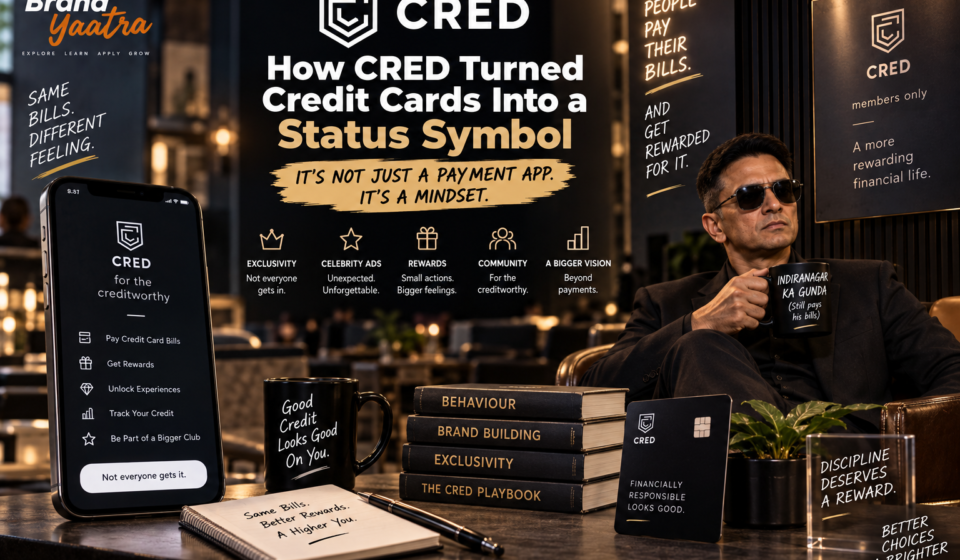
It made financial responsibility feel like a status symbol.
That is the real story behind CRED’s marketing strategy.
Because CRED wasn’t simply competing with other apps that let people pay bills.
It was trying to change what paying a credit-card bill meant.
And that is where things get interesting.
What Exactly Is CRED?
CRED started in 2018 with a simple proposition: reward people who pay their credit-card bills on time.
But there was an unusual condition.
Not everyone could join.
CRED built its proposition around creditworthiness. Its current membership criteria require a credit score of 750 or above, and the company describes itself as a members-only platform designed for financially responsible consumers.
That immediately created something most payment apps don’t have:
a gate.
And that gate became part of the marketing.
Today, CRED has expanded far beyond its original credit-card bill-payment proposition, with products and services spanning payments, lending, credit management, rewards, lifestyle and more. In June 2026, the company said 1.7 crore members engage with the platform monthly and that it processes more than 40% of India’s credit-card bill payments.
But the original insight remains incredibly important.
CRED didn’t ask:
“How can we make another payment app?”
It effectively asked:
“What if financially responsible people were treated like a premium community?”
That is a very different marketing question.
The Problem CRED Had to Solve
Imagine launching a new payment app in India.
You’re competing against brands that already own enormous pieces of consumer attention.
Google Pay.
PhonePe.
Paytm.
Banks.
Credit-card apps.
And countless other financial products.
Now imagine telling consumers:
“Our app also lets you pay your credit-card bill.”
That’s not exactly a category-defining proposition.
The basic functionality is a commodity.
If another app can perform the same transaction, functionality alone becomes difficult to differentiate.
So CRED needed something else.
It needed a reason for people to say:
“I want to use CRED.”
Not:
“I guess CRED also works.”
That difference is everything.
CRED’s First Big Marketing Move: Don’t Let Everyone In
One of the most fascinating things about CRED is that it didn’t treat accessibility as the only path to growth.
It introduced exclusivity.
The company’s own positioning repeatedly emphasizes phrases such as “members-only,” “creditworthy,” and “not everyone gets it.”
Think about how unusual that is.
Most apps say:
Download now.
CRED effectively said:
Prove you belong first.
That changes the psychology.
Why Exclusivity Is So Powerful
Humans don’t value everything equally.
Something that is available to everybody can feel ordinary.
Something that appears difficult to access can feel more valuable.
That’s why brands use:
- invite-only memberships
- limited editions
- VIP clubs
- waitlists
- exclusive launches
- premium tiers
- private communities
CRED applied the same principle to something as ordinary as bill payment.
Your credit score wasn’t merely a financial number anymore.
It became part of the story:
“I’m creditworthy enough to be inside.”
That creates an interesting psychological loop.
Credit score → eligibility → membership → rewards → identity
The product wasn’t just saying:
“You have a good credit score.”
It was saying:
“Your financial behaviour deserves better experiences.”
That is a much stronger emotional proposition.
CRED Didn’t Sell Bill Payments
This is probably the biggest lesson in the entire case study.
A conventional fintech advertisement might say:
Pay your credit-card bill quickly and securely.
Useful?
Yes.
Memorable?
Not particularly.
CRED’s communication was much more emotional.
Its brand language revolves around being creditworthy, rewarded, elevated and part of something selective.
So the mental equation became:
Paying bills → responsible behaviour → rewards → premium experience
The transaction stayed boring.
The meaning around the transaction changed.
And that is classic brand strategy.
Then CRED Did Something Even Crazier: It Made Fintech Advertising Entertaining
This is where CRED became impossible to ignore.
Most financial advertising tends to look familiar.
Smiling families.
Banks.
Charts.
People checking balances.
Someone saying:
“Secure your financial future.”
CRED went in almost the opposite direction.
It created bizarre, high-production advertisements featuring celebrities in unexpected situations.
And then came one of India’s most memorable examples.
Rahul Dravid Became “Indiranagar Ka Gunda”
Rahul Dravid had one of the safest public images in Indian cricket.
Calm.
Disciplined.
Polite.
Dependable.
Then CRED showed him completely losing his temper in traffic.
The contrast was the joke.
The 2021 advertisement became a cultural moment, with the phrase “Indiranagar ka gunda” spreading far beyond the original commercial. The Indian Express reported that the ad crossed more than 3 million views across social platforms in less than a day.
And this is where CRED’s advertising genius becomes easier to understand.
It didn’t merely put a celebrity into an advertisement.
It used the celebrity’s existing identity as the raw material for the joke.
Rahul Dravid being calm was already known.
So Rahul Dravid being angry became funny.
The advertising didn’t need to explain the joke.
The audience already knew the character.
That’s powerful creative strategy.
The CRED Formula: Familiar Person + Unexpected Behaviour
CRED repeatedly played with this structure.
Take a famous person.
Take the image people already have of them.
Then completely flip it.
That’s why the advertisements felt less like traditional product commercials and more like entertainment.
CRED worked with celebrities including Rahul Dravid, Jackie Shroff and others in campaigns built around unexpected behaviour and humour.
The result?
People didn’t just watch the advertisement.
They talked about the advertisement.
And that distinction matters.
CRED Understood Something Important About Advertising
People don’t hate advertising simply because it’s advertising.
They hate boring advertising.
If an advertisement is genuinely entertaining, people may voluntarily:
- watch it
- share it
- discuss it
- meme it
- quote it
- send it to friends
- search for it
- remember the brand behind it
Suddenly, advertising starts generating its own distribution.
That’s the dream of modern brand marketing.
Paid media → attention → conversation → earned media
Instead of buying every impression, you create something people want to talk about.
CRED’s campaigns became particularly visible through its IPL association. The BCCI announced CRED as an official IPL partner beginning with the 2020 season, in a three-season partnership.
That gave the brand access to one of India’s biggest attention environments.
But simply buying IPL visibility wasn’t enough.
CRED needed creative that people remembered.
That’s where the weirdness became a competitive advantage.
Why Did CRED Use So Many Celebrities?
There’s an obvious answer:
Attention.
But that’s only part of it.
Celebrity marketing can also transfer existing associations.
If people already recognize a celebrity, the brand doesn’t have to spend as much effort establishing familiarity.
CRED could then use the celebrity as a shortcut into a much bigger cultural conversation.
But there was another clever move:
CRED didn’t always use celebrities in predictable ways.
It didn’t simply show a celebrity smiling at the camera and saying:
“I use CRED. You should too.”
Instead:
The celebrity became the entertainment.
The brand became the reason the entertainment existed.
That’s much more memorable.
CRED’s Secret Weapon Wasn’t the Celebrity
This is an important distinction.
A lot of brands look at CRED and conclude:
“We need celebrities.”
That’s the wrong lesson.
If celebrities alone created great brands, every company with a Bollywood star would be iconic.
They aren’t.
The deeper lesson is:
CRED used celebrities to create distinctive situations.
Rahul Dravid being Rahul Dravid isn’t a strategy.
Rahul Dravid behaving completely unlike Rahul Dravid is a creative idea.
That’s the difference.
The Second Psychological Trick: Make the User Feel Smart
CRED’s brand positioning also taps into something deeper than exclusivity.
Self-image.
People like seeing themselves as:
- responsible
- intelligent
- financially disciplined
- sophisticated
- successful
- informed
CRED connected creditworthiness with those identities.
Instead of:
“You paid your bill.”
The emotional message becomes:
“You are the kind of person who handles money responsibly.”
That is a much more powerful reward.
Because now the product isn’t only rewarding an action.
It’s reinforcing an identity.
This Is Why Status Marketing Works
Luxury brands often don’t sell the functional object.
A watch tells time.
A luxury watch tells a story about the person wearing it.
A premium car moves you from A to B.
It can also communicate something about the person driving it.
A designer handbag carries things.
It can also communicate identity.
CRED did something similar at a smaller, more digital level.
Paying your credit-card bill is functional.
But being part of CRED could become symbolic.
That is the transformation:
Function → Identity
And identity is much harder for competitors to copy.
Then CRED Added Rewards
Of course, psychology alone doesn’t keep people using an app.
CRED needed a functional reason to return.
That’s where rewards came in.
Members can receive rewards, cashback, offers, experiences and access to partner brands for making payments and participating in the CRED ecosystem.
This creates another loop:
Pay bill → receive reward → feel rewarded → return next month
The boring transaction now has a small dopamine moment attached to it.
And that’s where gamification enters the picture.
CRED Turned a Monthly Chore Into a Small Game
Think about the normal credit-card payment experience.
You pay.
Nothing happens.
CRED added another layer:
What did I get?
Maybe cashback.
Maybe coins.
Maybe an offer.
Maybe an experience.
Maybe access to something interesting.
The exact reward matters less than the behavioural mechanism.
The payment becomes a moment of anticipation.
That’s a powerful shift.
The CRED Flywheel
Put everything together and you get something like this:
Good credit behaviour
↓
Eligibility
↓
CRED membership
↓
Exclusive identity
↓
Rewards
↓
Repeat payments
↓
More financial activity
↓
More data and engagement
↓
More products and offers
↓
Greater ecosystem value
↓
Stronger membership proposition
And the cycle continues.
This is much more sophisticated than:
“Download our bill-payment app.”
But CRED Didn’t Stop at Credit-Card Bills
This is where the company has evolved significantly.
The original product was narrow.
The broader ambition became much bigger:
Become a financial and lifestyle platform for creditworthy consumers.
CRED now operates across areas including payments, credit management, lending, rewards and lifestyle experiences. In 2026, the company launched features such as multibill payments and autopay, while continuing to expand its financial ecosystem.
In 2025, CRED also introduced Yosemite, including offerings around premium experiences, wealth tracking and an invite-only society called Sovereign.
That evolution is strategically important.
Because CRED’s original audience wasn’t simply:
“people who pay credit-card bills.”
It was:
“creditworthy consumers.”
That’s a much larger customer identity.
And it gives the company room to build multiple products around the same audience.
The Most Interesting Part: CRED Chose a Niche Before Going Broad
This is something many startups get backward.
They try to appeal to everyone immediately.
CRED did something different.
It started with a relatively specific audience:
people with good credit profiles and credit cards.
That gave the brand a sharper identity.
Instead of saying:
“We’re for everyone.”
It could say:
“We’re for people who make good financial decisions.”
That creates a much clearer brand.
And ironically, being selective can sometimes make people outside the target audience more curious.
The Psychology of “Not Everyone Gets It”
This phrase is almost a marketing weapon.
Not everyone gets it.
Read that again.
It doesn’t say:
“Everyone should download our app.”
It says:
“Not everyone qualifies.”
Suddenly, the audience has a question:
“Do I qualify?”
That question itself creates engagement.
And if someone qualifies?
They get a tiny psychological reward before they’ve even used the product.
That’s the power of a well-designed gate.
CRED’s Marketing Was Also Self-Aware
Another reason its advertising stood out was that it often didn’t behave like conventional advertising.
It understood that audiences know they’re watching an ad.
So instead of pretending otherwise, CRED leaned into entertainment, absurdity and self-awareness.
That’s especially useful in a world where consumers are surrounded by thousands of marketing messages.
If your advertisement looks exactly like every other advertisement, the brain has very little reason to remember it.
CRED’s creative often created a pattern interruption.
“Wait… what am I watching?”
And that pause is valuable.
Attention Is Not the Same as Brand Building
But here’s an important warning.
A funny advertisement can go viral and still fail.
People can remember:
“That Rahul Dravid ad!”
without remembering:
“That was CRED.”
This is one of the biggest risks of entertainment-led advertising.
Attention without attribution is wasted potential.
CRED generally tried to connect its distinctive entertainment with a consistent brand world, which helped solve some of this problem.
But the lesson applies to every marketer:
Viral ≠ successful.
You need:
Attention + attribution + relevance + action.
CRED’s Real Brand Moat: Distinctiveness
Think about fintech advertising.
A lot of brands talk about:
- speed
- convenience
- security
- cashback
- payments
- rewards
These are useful.
But they’re also easy to copy.
CRED built more distinctive assets around:
- premium membership
- creditworthiness
- unexpected celebrity casting
- absurd humour
- sophisticated visual identity
- rewards
- cultural moments
- the “not everyone gets it” attitude
That’s much harder to reproduce convincingly.
Because a competitor can copy the format.
It cannot instantly copy the brand memory.
The CRED Marketing Strategy in One Diagram
Here’s the strategy simplified:
| Layer | What CRED Did |
|---|---|
| Audience | Creditworthy consumers |
| Positioning | Premium members-only club |
| Functional product | Credit-card management & payments |
| Emotional benefit | Feel rewarded and financially responsible |
| Psychological lever | Exclusivity + status |
| Creative strategy | Unexpected celebrity humour |
| Distribution | IPL, digital, social, cultural moments |
| Retention | Rewards, offers, financial tools |
| Brand personality | Premium, witty, self-aware |
| Expansion | Payments, lending, lifestyle, wealth and experiences |
Notice what happened.
The product is at the centre.
But the brand gives the product meaning.
What CRED Did Better Than Most Fintech Brands
1. It created a category feeling
Instead of looking like another bill-payment tool, CRED created the feeling of a club.
2. It turned a weakness into a strength
The credit-score eligibility could have been perceived as restrictive.
CRED turned the restriction into part of the aspiration.
The gate became marketing.
3. It made financial behaviour emotional
Paying on time isn’t exciting.
Being rewarded for responsible behaviour can be.
4. It understood entertainment
People don’t owe brands their attention.
Brands have to earn it.
CRED often approached advertising like entertainment first and product communication second.
5. It made celebrities unpredictable
The celebrity wasn’t merely an endorsement.
The celebrity was part of the creative idea.
6. It built a recognizable personality
You could often recognize a CRED advertisement before someone even finished explaining what was happening.
That’s brand distinctiveness.
The Business Lesson Behind the Marketing
There is an even bigger lesson here.
CRED’s marketing wasn’t operating independently from its business model.
The company has been expanding its ecosystem around the same audience.
And that matters.
In June 2026, CRED announced a ₹8,550 crore Series H round led by Meta at a post-money valuation of about ₹43,239 crore, while saying 1.7 crore members engaged with the platform monthly. The company also said its platform processes more than 40% of India’s credit-card bill payments.
That tells us something important:
The original brand proposition created a valuable audience, not merely an app download.
Once you have a trusted relationship with a financially attractive audience, you can potentially build multiple products around that relationship.
That’s the strategic reason CRED’s positioning matters.
But CRED’s Strategy Isn’t Perfect
A good case study shouldn’t pretend everything is genius.
CRED’s brand-first approach has obvious risks.
High-quality advertising is expensive.
Celebrity campaigns, major sporting partnerships and premium creative production require serious investment.
And there’s another danger:
Entertainment can overpower the product.
If everyone remembers the joke but nobody remembers why they should use the app, the campaign has a problem.
There’s also the challenge of expanding beyond the original credit-card niche without diluting the brand.
If CRED becomes everything for everyone, the very exclusivity that made it distinctive could weaken.
That’s a tension the company now has to manage.
The 2026 CRED Chapter Is Especially Interesting
CRED is no longer simply the quirky app from the famous Rahul Dravid advertisement.
The company is entering a more mature phase.
Its 2026 announcements show expansion into broader payments, financial management, AI-assisted credit coaching, lending and community-style products.
And there has been a major leadership transition too.
In June 2026, CRED announced that founder Kunal Shah would step away from his operating role and transition to Meta, while Miten Sampat became interim CEO. The same announcement described CRED’s next phase as one focused on scaling the institution and moving toward a potential IPO.
That makes the next stage of CRED particularly interesting from a brand perspective.
Can a brand built around a very distinctive founder-era personality scale into a larger financial institution without losing what made it special?
That’s a story worth watching.
So, What Can Other Brands Learn From CRED?
You probably don’t have a billion-rupee advertising budget.
You probably can’t hire Rahul Dravid.
And you probably shouldn’t try to copy CRED’s advertisements.
But you can copy the thinking.
Lesson 1: Don’t compete only on functionality
If everyone offers the same feature, adding another feature may not differentiate you.
Change the meaning of the product.
Lesson 2: Make your customer feel something
Ask:
What does using my product say about the customer?
Smart?
Creative?
Responsible?
Adventurous?
Premium?
Environmentally conscious?
That answer can become your brand.
Lesson 3: Scarcity can be a positioning tool
You don’t necessarily need to reject customers.
But you can create:
- tiers
- memberships
- badges
- milestones
- premium access
- communities
- early access
People value belonging.
Lesson 4: Don’t copy the surface of viral marketing
Don’t say:
“CRED uses celebrities, so let’s hire celebrities.”
Ask:
“Why were people interested in the celebrity?”
Then ask:
“What unexpected thing can our brand make people want to talk about?”
That’s the transferable insight.
Lesson 5: Build something people can talk about
The best marketing doesn’t always end with:
“Buy now.”
Sometimes it ends with:
“Did you see that?”
That conversation can become distribution.
Lesson 6: Turn boring moments into branded moments
CRED had an extremely ordinary moment:
paying a bill.
What ordinary moment does your customer experience?
Maybe it’s:
- opening an email
- checking an invoice
- booking a service
- ordering food
- receiving a delivery
- using your software
- checking a dashboard
Can you make that moment better?
Or more memorable?
Or more rewarding?
That’s where marketing opportunities hide.
The CRED Playbook
If we reduce the entire strategy into a simple framework, it looks like this:
1. Find a boring category.
Something functional and commoditized.
2. Find an emotional identity.
What could using the product say about the customer?
3. Create a reason to belong.
Membership, community, status or recognition.
4. Build distinctive creative.
Don’t make advertisements that look like everyone else’s.
5. Make the audience want to share.
Give people something worth talking about.
6. Reward the behaviour.
Turn the desired action into something satisfying.
7. Build an ecosystem.
Once you own the relationship, find adjacent problems you can solve.
8. Protect the brand.
Growth should not destroy the positioning that created the growth.
The Biggest Lesson From CRED
CRED didn’t make credit-card payments inherently exciting.
It did something much smarter.
It changed what the payment represented.
Before CRED:
Paying your bill = responsibility.
After CRED:
Paying your bill = responsibility + reward + recognition + access.
And that is one of the most powerful things a brand can do.
Because products can be copied.
Features can be copied.
Cashback can be copied.
Even advertisements can be copied.
But when customers start thinking:
“This brand is for people like me.”
you’ve entered a much deeper layer of marketing.
Brand Yaatra Takeaway
CRED’s biggest marketing innovation wasn’t a celebrity advertisement.
It wasn’t IPL.
It wasn’t cashback.
It wasn’t even the 750+ credit-score gate.
It was the decision to turn a functional financial behaviour into an identity.
That’s the real journey:
Bill payment → responsible behaviour → creditworthiness → membership → status → rewards → lifestyle
CRED didn’t ask consumers to get excited about paying bills.
It gave them a reason to feel good about who they were when they paid them.
And that’s a lesson almost every brand can use:
Don’t just sell what your product does. Give people a better story about what using your product says about them.
That’s when a product starts becoming a brand.
And that’s when marketing gets interesting.
Frequently Asked Questions
What is CRED’s marketing strategy?
CRED’s marketing strategy combines premium positioning, credit-score-based membership, rewards, distinctive advertising, celebrity campaigns, humour, cultural marketing and an expanding financial ecosystem. Its core idea is to make financial responsibility feel rewarding and aspirational.
Why is CRED’s advertising so different?
CRED often uses unexpected celebrity situations, humour and entertainment instead of conventional financial advertising. The goal is to create memorable brand associations and generate conversation around the campaigns.
How did CRED use exclusivity in marketing?
CRED made membership dependent on creditworthiness, with its current site stating that applicants need a credit score of 750 or above. The restriction became part of the brand’s positioning rather than simply a product limitation.
What is the psychology behind CRED’s marketing?
CRED uses several psychological principles, including exclusivity, social identity, status signalling, rewards, anticipation and distinctiveness. It connects responsible financial behaviour with a desirable identity.
Why did the Rahul Dravid CRED advertisement become so popular?
The campaign exploited the contrast between Dravid’s widely recognized calm public image and his unusually aggressive behaviour in the advertisement. The unexpected role reversal made the commercial memorable and highly shareable.
Can small businesses copy CRED’s marketing strategy?
Yes—but they should copy the principles, not the budget. A small brand can create exclusivity, develop a distinctive personality, reward customers and create entertaining content without hiring celebrities or buying IPL advertising.
Is CRED still just a credit-card bill payment app?
No. CRED has expanded into a broader ecosystem covering payments, credit management, lending, rewards, wealth and lifestyle-related products. Its 2026 announcements show continued expansion beyond its original bill-payment proposition.
Who founded CRED?
CRED was founded by Kunal Shah in 2018. In June 2026, CRED announced that Shah would transition away from the CEO role and join Meta’s global leadership team, with Miten Sampat taking over as interim CEO.
Sources & Further Reading
- CRED — official company information and current positioning
- CRED Newsroom — 2026 Series H and leadership transition
- CRED Newsroom — multibill payments and autopay
- CRED Newsroom — Yosemite and premium ecosystem strategy
- IPL/BCCI — CRED’s IPL partnership announcement
- Indian Express — Rahul Dravid/CRED campaign analysis
- ETBrandEquity — CRED’s 2021 campaign featuring Jackie Shroff and Rahul Dravid
- Academic case study — CRED: A fintech unicorn’s journey and future path
Last updated: September 2026