
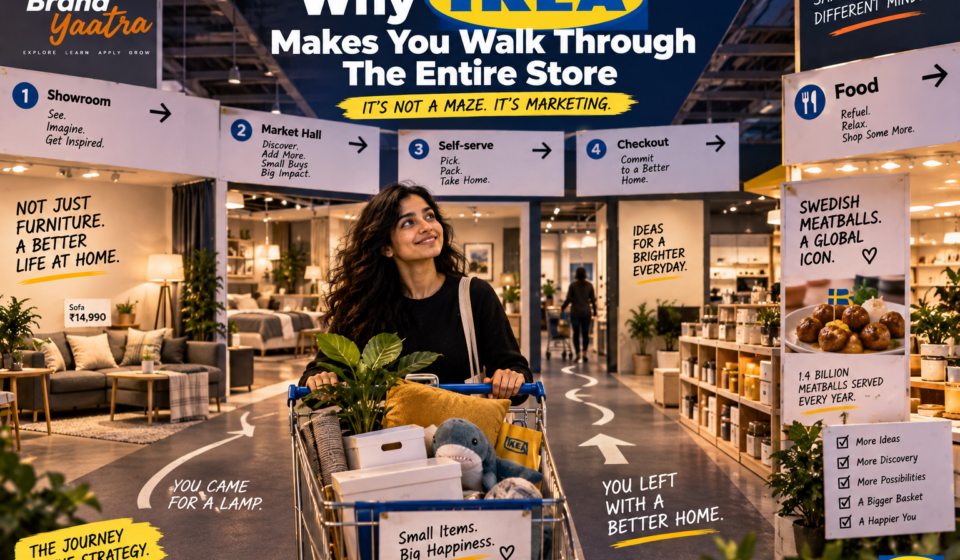

You went to IKEA for a lamp.
Just a lamp.
Twenty minutes later, you’re looking at sofas.
Then storage boxes.
Then candles.
Then kitchen organizers.
Then a plant.
Then you smell food.
Suddenly you’re eating Swedish meatballs.
And somehow, two hours later, you’re standing in the checkout line holding six things you never planned to buy.
You look at your shopping bag and think:
“How did this happen?”
Well…
It probably wasn’t entirely accidental.
IKEA has spent decades turning the simple act of buying furniture into something much bigger:
a journey.
And that journey is one of the most interesting examples of marketing psychology in the physical world.
Because IKEA isn’t simply selling furniture.
It’s designing:
what you see → what you imagine → what you consider → what you pick up → what you buy.
And once you understand the psychology behind the store, IKEA starts looking less like a furniture shop…
and more like a carefully designed marketing machine.
First: Does IKEA Actually Make You Walk Through the Whole Store?
This needs a little clarification.
IKEA’s classic large-format stores are organized into distinct areas including a Showroom, Market Hall and Self-serve area, with numbered routes and departments. IKEA India describes the showroom as a space where furniture is displayed in real-home environments, followed by the Market Hall for smaller accessories and the self-serve area for flat-pack furniture.
But IKEA isn’t locked into one format.
The company has increasingly introduced city-centre stores, plan-and-order points and other smaller formats designed for customers who want more convenient or targeted shopping experiences.
So the famous IKEA maze is best understood as the classic large-store experience, not a rule that every IKEA location forces every customer through exactly the same route.
And that distinction actually makes the strategy more interesting.
Because IKEA is adapting the journey depending on what the customer needs.
The Classic IKEA Journey
Walk into a traditional IKEA store and the sequence often looks something like this:
Entrance
↓
Showroom
↓
Room displays
↓
More room displays
↓
Market Hall
↓
Self-serve warehouse
↓
Checkout
And somewhere along the journey:
Food.
IKEA’s own store guides show the journey through numbered departments, moving from room environments in the showroom to accessories, self-serve furniture, checkout and food areas.
That’s not just a convenient way to arrange furniture.
It’s a way of sequencing decisions.
Why Not Just Put the Sofas Here and the Tables There?
A traditional furniture store might think:
“Customers want sofas. Put sofas together.”
Makes sense.
IKEA asks a different question:
“How do we help customers imagine a better home?”
That’s why you don’t simply see:
SOFA
TABLE
LAMP
BED
Instead, you see:
a room.
A living room.
A bedroom.
A kitchen.
A workspace.
A children’s room.
The products are placed inside a context.
And context changes everything.
IKEA Doesn’t Sell You a Sofa.
It Shows You a Life With the Sofa.
Imagine a sofa sitting alone on a white floor.
You see:
a sofa.
Now put the same sofa inside a beautifully designed living room.
Add:
- a rug
- cushions
- lighting
- coffee table
- books
- plants
- artwork
- storage
Suddenly you’re not looking at furniture.
You’re imagining:
your home.
That’s a huge psychological shift.
From Product to Possibility
This is one of IKEA’s strongest marketing ideas.
A product page says:
“Here is what this product is.”
A room display says:
“Here is what your life could look like.”
The second message is much more emotional.
And that’s why IKEA’s showroom isn’t simply a product display.
It’s a visualization engine.
IKEA’s Showroom Is Basically a Giant Pinterest Board You Can Walk Into
Think about what Pinterest does.
You see:
- beautiful rooms
- kitchens
- bedrooms
- desks
- storage ideas
- colour combinations
And you save things thinking:
“I want my house to look like this.”
IKEA turns that experience physical.
You don’t just scroll past the room.
You walk through it.
You can touch the sofa.
Open the cabinet.
Sit on the chair.
Look at the lamp.
Check the storage.
Imagine the dimensions.
And then think:
“Maybe I could actually do this.”
That’s much more persuasive than a product photo.
This Is Where Retail Psychology Gets Interesting
People don’t always know what they want before entering a store.
They may think they do.
But shopping can create new wants.
You walk in thinking:
“I need a desk.”
Then you see a beautiful workspace.
And suddenly you think:
“Maybe I need better storage too.”
Then:
“Maybe this lamp would look good.”
Then:
“Actually, I should reorganize the entire room.”
The store has changed the scope of the problem.
And that’s powerful.
IKEA Turns Shopping Into Discovery
This is the fundamental difference.
Traditional shopping:
Need → Search → Find → Buy
IKEA-style discovery:
Need → Explore → Imagine → Discover → Compare → Consider → Add → Buy
The second journey creates more opportunities for products to enter your mental shortlist.
And that’s exactly what a retailer wants.
The Psychology of “I Didn’t Know I Needed This”
You’ve probably experienced this.
You weren’t shopping for:
₹199 storage boxes.
But you saw them.
They looked useful.
They were inexpensive.
They were right there.
So into the bag they went.
This is where small products become incredibly important.
IKEA’s Market Hall contains categories such as lighting, plants, cooking and tableware, textiles, home organization and decoration.
These products don’t necessarily require a major decision.
They’re easy additions.
And when enough small additions happen…
The basket grows.
The “Small Purchase” Psychology
Buying a ₹200 accessory doesn’t feel like buying a ₹20,000 sofa.
The mental barrier is much lower.
So IKEA can expose you to lots of low-cost products throughout the journey.
A candle.
A storage box.
A kitchen tool.
A cushion.
A plant.
A hanger.
A decoration item.
Each one is a tiny decision.
But collectively?
They can materially increase the size of the basket.
The Journey Changes Your Reference Point
Here’s another interesting psychological effect.
Imagine entering IKEA and seeing:
₹12,999 sofa
You might think:
“That’s expensive.”
But then you see a room containing:
- sofa
- coffee table
- rug
- lamps
- cushions
- storage
Suddenly you’re evaluating the whole environment.
You may start thinking:
“Actually, the room looks affordable.”
The comparison has shifted.
You’re no longer asking:
“Is this sofa expensive?”
You’re asking:
“Could I create this room for this much?”
That’s a completely different question.
IKEA Sells the Bundle Without Always Calling It a Bundle
This is clever.
A room display naturally encourages complementary purchases.
The sofa works with the rug.
The rug works with the table.
The table works with the lamp.
The lamp works with the decor.
The decor works with the storage.
One product creates demand for another.
That’s cross-selling through environment design.
And unlike a salesperson saying:
“Would you also like this lamp?”
the room silently makes the suggestion.
The Room Does the Selling
That’s an important marketing lesson.
You don’t always need a salesperson to explain:
“This table goes nicely with this chair.”
If you put them together in a convincing environment…
the customer can make the connection themselves.
The environment becomes the salesperson.
This Is Why IKEA Shows Products at Actual Scale
IKEA’s own guidance emphasizes that its showroom layouts are designed to show products in room environments and at realistic scale. Its digital room-planning tools similarly aim to represent products according to room dimensions.
Why does that matter?
Because dimensions are difficult to imagine from a product photo.
A sofa can look:
small on a website.
Then enormous in your living room.
The showroom reduces that uncertainty.
You can physically experience:
“Okay. This actually fits.”
That increases confidence.
Physical Experience Reduces Perceived Risk
Furniture isn’t like buying a packet of biscuits.
It’s:
- expensive
- large
- difficult to return
- spatial
- functional
- highly visible in your home
People want confidence.
Can I sit on it?
Is it comfortable?
Is it too big?
Does the colour look right?
Does the drawer feel sturdy?
Can I reach the shelf?
A showroom lets people answer those questions.
And reducing uncertainty is itself a form of marketing.
Then IKEA Gives You the Price
Here’s another clever part.
You’re not simply seeing:
“Sofa — ₹X.”
You’re seeing:
a solution.
That makes it easier to evaluate the price in terms of value.
Instead of:
“Why should I pay ₹X for this sofa?”
your brain may move toward:
“Could this help me create a room like this?”
The perceived value changes because the product is attached to an outcome.
That’s a General Marketing Lesson
Don’t only show people:
what your product is.
Show them:
what their life looks like after buying it.
That’s why:
- fitness brands show transformations
- skincare brands show routines
- travel companies show experiences
- software companies show workflows
- furniture brands show rooms
People buy outcomes.
Products are simply the mechanism.
And Then Comes the Maze
Now let’s talk about the part everyone notices.
The route.
Traditional IKEA stores are famously structured as a journey through the showroom before the Market Hall and self-serve areas.
The exact layout varies by store, but IKEA’s own India store guide shows numbered routes through living spaces, dining, kitchens, bedrooms and workspaces before customers reach the Market Hall and self-serve sections.
Why organize it this way?
Because IKEA isn’t trying to show you one product.
It’s trying to expose you to an entire world of products and ideas.
More Exposure Creates More Opportunities
Imagine you enter a store and walk directly to the product you searched for.
You buy it.
You leave.
That’s efficient.
But you’ve seen almost nothing else.
Now imagine you walk through:
Living room
→
Storage
→
Kitchen
→
Dining
→
Bedroom
→
Workspace
By the time you reach the warehouse, you’ve encountered hundreds of products.
Some will be irrelevant.
Some will be interesting.
Some will trigger:
“Wait… I need that.”
That’s the power of exposure.
IKEA Turns “Browsing” Into the Product
This is one of the biggest differences between IKEA and a conventional furniture website.
On a website, browsing can feel like searching.
At IKEA, browsing is itself an experience.
You’re not necessarily looking for one thing.
You’re exploring.
And exploration creates discovery.
But There’s a Trade-Off
This strategy isn’t perfect.
The same journey that creates discovery can create frustration.
If you’re in a hurry and already know exactly what you want, walking through an enormous showroom can feel exhausting.
And that’s precisely why IKEA has been experimenting with smaller formats and targeted customer meeting points.
IKEA’s global retail strategy now includes city-centre locations, traditional stores, online shopping, home delivery and plan-and-order formats.
This is a very important evolution.
The company is essentially saying:
Different shopping missions need different journeys.
That’s Smart Retail Strategy
Someone shopping for inspiration wants:
discovery.
Someone replacing one broken shelf wants:
speed.
Someone planning an entire kitchen wants:
expertise.
Someone browsing online wants:
convenience.
One store format can’t optimize equally for all four.
So IKEA increasingly creates different ways to meet the customer.
Now Let’s Talk About the Food
Why does a furniture company have a restaurant?
And why are meatballs so associated with IKEA?
Because food is not completely separate from the shopping experience.
IKEA itself says its food story began in 1958 with coffee and biscuits, with an in-store restaurant following in 1960. The company explains that founder Ingvar Kamprad wanted customers to have somewhere to eat rather than shop for furniture hungry.
Think about the psychology.
You’re tired.
You’ve been walking.
You’ve been looking at rooms.
You’ve been making decisions.
Then:
Food.
You stop.
You sit.
You recharge.
Then continue.
Food Changes the Shopping Experience
A tired customer thinks:
“Let’s get out of here.”
A comfortable customer thinks:
“Let’s look around a little more.”
That doesn’t mean IKEA created restaurants simply to keep people shopping longer.
The food experience has its own role in the brand.
But it also makes the overall store visit more human.
And IKEA has been doing this for decades.
The Meatball Became a Brand Asset
The famous Swedish meatball isn’t just food anymore.
It’s part of the IKEA identity.
IKEA says the iconic meatball was developed in 1985 and has since become a global part of the restaurant experience. The company says around 1.4 billion meatballs are sold annually across its global business.
That’s extraordinary.
A furniture company has a food product that became culturally recognizable.
Think about the marketing lesson.
A brand can create memory through unexpected touchpoints.
You might forget the shelf.
You might remember the meatballs.
IKEA Doesn’t Just Sell Furniture.
It Sells an Experience Around the Furniture.
Think about the full journey:
See
↓
Imagine
↓
Touch
↓
Explore
↓
Eat
↓
Choose
↓
Collect
↓
Assemble
↓
Use
That’s a story.
And stories are easier to remember than transactions.
Even Assembly Becomes Part of the Psychology
There’s another fascinating element.
You don’t simply buy some IKEA furniture.
You often take it home in a flat pack.
Then you assemble it yourself.
At first, that sounds like a disadvantage.
Why should customers do the work?
But there’s an interesting psychological possibility here.
When people invest effort into creating something, they can develop a stronger attachment to it.
This phenomenon is known in behavioural research as the IKEA effect—the tendency for people to value things more when they’ve contributed labour toward creating them.
And the irony is beautiful:
IKEA’s famous assembly requirement became part of a broader consumer psychology story.
You didn’t just buy the table.
You built the table.
The Product Becomes “Mine”
That word matters.
Mine.
You chose it.
You carried it.
You assembled it.
You placed it.
You lived with it.
That sequence can create emotional ownership.
And emotional ownership is powerful.
Because you’re no longer thinking:
“That’s an IKEA table.”
You’re thinking:
“That’s my table.”
IKEA Understands the Difference Between Product and Ownership
This is one of the strongest lessons from the brand.
The transaction ends at checkout.
But the relationship doesn’t.
The real experience continues:
unboxing → assembly → placement → usage → memory
That’s why product experience matters so much.
IKEA Is Also Selling a Feeling of Control
There’s another subtle psychological layer.
Traditional furniture can feel intimidating.
You buy something finished.
You accept it.
IKEA gives you modularity.
You can:
- choose
- combine
- configure
- customize
- assemble
- rearrange
The customer participates in creating the final environment.
That can create a sense of agency.
And agency can increase attachment.
Now Look at the Entire IKEA Funnel
We can map the experience like a marketing funnel.
Stage 1: Inspiration
“Wow, that room looks good.”
↓
Stage 2: Imagination
“Could my home look like this?”
↓
Stage 3: Interaction
“Let me sit on it.”
↓
Stage 4: Discovery
“Oh, they have this too.”
↓
Stage 5: Consideration
“Maybe I should get this.”
↓
Stage 6: Basket Expansion
“I’ll take the lamp too.”
↓
Stage 7: Purchase
“Let’s get everything.”
↓
Stage 8: Ownership
“I built this.”
That’s a remarkable customer journey.
And Notice Something Important
Not one stage screams:
“ADVERTISEMENT.”
That’s the brilliance.
Marketing is embedded inside:
- architecture
- layout
- product placement
- room design
- food
- signage
- packaging
- assembly
- experience
The store itself is the marketing channel.
This Is Why Physical Retail Still Matters
We’re often told:
“Everything is moving online.”
But physical stores can do something websites struggle to replicate.
They can create:
sensory experience.
You can:
- touch
- sit
- walk
- smell
- compare
- experience scale
- see combinations
- feel materials
That’s extremely valuable for categories where physical experience reduces uncertainty.
IKEA isn’t fighting digital.
Its current retail strategy explicitly combines physical stores with online shopping, delivery and other customer meeting formats.
It’s building an omnichannel journey.
And IKEA Is Still Huge
The strategy clearly hasn’t disappeared.
In FY2025, IKEA reported 915 million store visits globally, up from 899 million the previous year. The broader IKEA retail business generated €44.6 billion in sales, while IKEA said its sales volumes increased after price reductions.
That doesn’t prove that the store journey itself causes sales.
But it shows something important:
the physical retail experience remains strategically significant at enormous scale.
The Store Is a Recommendation Engine
Think about this.
An algorithm recommends:
“You might also like this lamp.”
IKEA does something similar physically.
It puts:
lamp → sofa → rug → table → plant
in the same environment.
You don’t need an algorithm to tell you they’re related.
The room tells you.
That’s physical recommendation architecture.
This Is Choice Architecture
Choice architecture is the idea that the way choices are presented can influence how people make decisions.
You don’t force the decision.
You design the environment around it.
IKEA does this through:
- sequencing
- displays
- product grouping
- signage
- room environments
- pricing information
- navigation
- product placement
The customer remains free to say no.
But the environment influences what they notice.
And That’s a Crucial Marketing Distinction
Bad marketing asks:
“How do I manipulate the customer?”
Good marketing asks:
“How do I make the desired decision easier, clearer and more compelling?”
IKEA’s best retail design isn’t about forcing you to buy.
It’s about helping you imagine possibilities.
And then making those possibilities easy to purchase.
The IKEA Strategy in One Sentence
If we had to reduce everything to one sentence:
IKEA doesn’t simply bring products to customers; it brings customers into a carefully designed world where the products make sense.
That’s powerful.
What Other Brands Can Learn From IKEA
You don’t need a 300,000-square-foot furniture store to steal the strategy.
The underlying principles work online too.
1. Don’t Show Products in Isolation
Show them in context.
Instead of:
“CRM software.”
Show:
“Here’s how a sales team uses it every Monday morning.”
2. Sell the Outcome
Don’t show:
running shoes.
Show:
someone completing their first 10K.
Don’t show:
camera.
Show:
the photographs someone created with it.
3. Design the Customer Journey
Ask:
What should the customer discover first?
Then:
What should they see next?
Then:
What should they understand before purchasing?
4. Create Cross-Selling Through Context
Don’t simply say:
“Buy this too.”
Show why the products belong together.
5. Reduce Uncertainty
Let customers:
- try
- preview
- compare
- visualize
- simulate
- calculate
- experience
The less uncertainty, the easier the purchase.
6. Give People Inspiration
Sometimes customers don’t know what they want until you show them a possibility.
That’s why examples matter.
7. Turn the Product Into an Experience
The transaction is only one moment.
Think about:
discovery → purchase → delivery → setup → usage → ownership
Every stage can build the brand.
What E-Commerce Can Steal From IKEA
This is where the case study gets especially useful.
Your website can become an IKEA-style journey.
Imagine an e-commerce homepage.
Instead of:
Product → Product → Product → Product
you create:
“Build a Minimalist Home Office”
Then show:
- desk
- chair
- lamp
- organizer
- monitor stand
- plant
Now you’re not browsing products.
You’re exploring a solution.
Your Website Can Become a Showroom
Create pages like:
The Beginner’s Home Gym
The ₹10,000 Work-From-Home Setup
The Complete Skincare Routine
The New Creator’s Camera Kit
The Small-Balcony Garden
Now the customer isn’t asking:
“What products do you sell?”
They’re asking:
“Which setup is right for me?”
That’s a much better question.
And AI Search Is Moving in the Same Direction
There’s an interesting connection to our previous Brand Yaatra article on GEO.
Traditional search:
“Best office chair.”
A more contextual AI experience:
“I’m setting up a comfortable home office under ₹20,000. What should I buy?”
The second question is much closer to IKEA’s showroom philosophy.
It’s not about individual products.
It’s about:
solutions.
And that’s where modern marketing is heading.
The Biggest IKEA Lesson
IKEA’s brilliance isn’t simply that it makes you walk.
It’s that it gives your walking a purpose.
You’re not wandering through random furniture.
You’re moving through:
possible lives.
A living room.
A kitchen.
A bedroom.
A workspace.
A children’s room.
A home.
And every room quietly asks:
“Could this be yours?”
That’s marketing.
Brand Yaatra Takeaway
The most interesting thing about IKEA isn’t the furniture.
It’s the journey.
You enter with a problem.
The store gives you inspiration.
Inspiration creates imagination.
Imagination creates desire.
Desire creates discovery.
Discovery expands the basket.
The purchase creates ownership.
And ownership creates a memory of the brand.
That’s why IKEA is such a fascinating marketing case study.
Because the store isn’t just where the product is sold.
The store is part of the product.
And that leads to a much bigger marketing lesson:
Don’t just design what customers buy. Design the journey that helps them decide to buy it.
Whether you’re running a furniture store, an e-commerce website, a SaaS product or a tiny Instagram business, the question is the same:
What does your customer’s journey feel like?
Because sometimes…
the journey is the marketing.
Frequently Asked Questions
Why does IKEA make customers walk through the store?
Traditional large IKEA stores use a guided showroom and department sequence to expose customers to room environments, products and ideas before they reach the Market Hall and self-serve areas. The exact layout varies, and IKEA increasingly offers smaller formats for more targeted shopping trips.
What is the psychology behind IKEA’s store layout?
The layout can encourage exploration, product discovery, contextual visualization and cross-selling. Instead of presenting products individually, IKEA places many products inside complete room environments, helping shoppers imagine how they could use them.
Why does IKEA display furniture in rooms?
Room displays provide context. Customers can see combinations of products, understand scale and imagine how furniture might work in a real home. IKEA explicitly describes its showroom as a place to display products in real-home environments.
Why does IKEA have a restaurant?
IKEA’s food operation dates back to 1958, when the company began serving coffee and biscuits, followed by an in-store restaurant in 1960. IKEA says the original motivation included ensuring customers didn’t have to shop for furniture hungry.
Why are IKEA meatballs so famous?
The Swedish meatball became a distinctive part of IKEA’s global food experience after being introduced in 1985. IKEA says roughly 1.4 billion meatballs are sold annually across its global business.
What is the IKEA effect?
The IKEA effect is a behavioural phenomenon in which people can place greater value on objects they have helped create. The concept became associated with IKEA because customers commonly assemble its furniture themselves.
Does every IKEA store use the same layout?
No. IKEA says many stores share similar areas and facilities, but the company also operates city stores, plan-and-order points and other formats designed for different customer needs.
Is IKEA’s store layout manipulative?
It’s better understood as choice architecture: the environment influences what customers notice and consider without forcing them to purchase anything. The same principle appears in online shopping, restaurant menus and app interfaces.
How can online businesses use IKEA’s marketing strategy?
They can present products in context, create solution-based collections, show real use cases, recommend complementary products, reduce uncertainty and design a customer journey rather than simply displaying a catalogue.
Final Thought
The next time you walk into IKEA and think:
“Why am I still walking?”
Look around.
The sofa isn’t just a sofa.
The room isn’t just a room.
The restaurant isn’t just a restaurant.
The warehouse isn’t just a warehouse.
Every part of the journey is helping you move from:
“I need something.”
to:
“I can imagine something better.”
And once you’ve imagined it…
buying it becomes much easier.
That’s the psychology of IKEA.
And that’s why, in marketing, the path to the purchase can be just as important as the product at the end of it.
Sources & Further Reading
- IKEA India — store layout and shopping journey.
- IKEA India — official store guide showing showroom, Market Hall and self-serve route.
- IKEA Global — retail strategy and evolving customer meeting formats.
- IKEA Global — history of the restaurant and Swedish meatball.
- IKEA Global — FY2025 retail sales and store visitation.
- Academic research on IKEA store-format evolution and customer perceptions.