
Imagine you have ₹20 lakh to spend on marketing.
Your product is good.
Your website works.
Your sales team is ready.
So you launch a campaign.
The headline says:
“Our product is for everyone.”
You run ads across Instagram, Google, YouTube and LinkedIn.
You target students, working professionals, parents, founders, retirees and basically anyone who might possibly buy.
You spend the money.
And then you wonder why the campaign didn’t perform.
The problem may not have been the creative.
It may not have been the media buying.
It may not even have been the product.
You may simply have tried to market to everyone.
This is where STP marketing comes in.
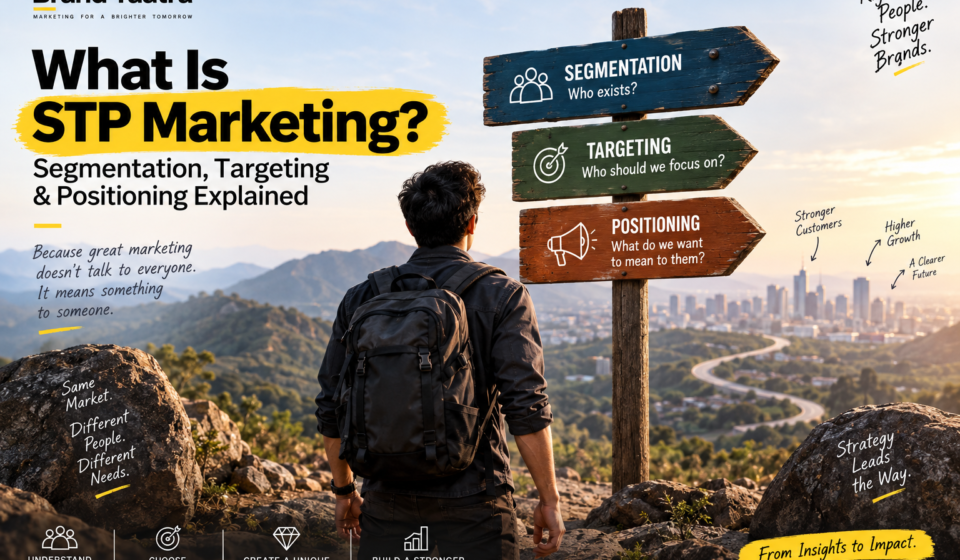
STP stands for:
Segmentation → Targeting → Positioning
It is a framework that helps marketers answer three fundamental questions:
- Who exists in this market?
- Who should we focus on?
- What should we mean to those people?
In simple terms:
STP helps you stop treating the entire market as one audience and start making deliberate decisions about who you want to serve and why they should choose you.
And that makes STP one of the most useful bridges between marketing strategy and actual execution.
What Is STP Marketing?
STP marketing is a strategic marketing framework based on three steps: segmenting a market, selecting the segments worth targeting, and positioning the offering for those chosen customers.
The three stages are:
| Stage | What it means | The question it answers |
|---|---|---|
| Segmentation | Divide a broad market into meaningful groups. | Who are the different types of customers? |
| Targeting | Choose which segment or segments to focus on. | Who should we prioritize? |
| Positioning | Define how the offering should be perceived by the chosen audience. | Why should they choose us? |
The important word here is choice.
STP isn’t just about collecting customer data.
It is about making decisions.
You don’t segment the market so you can create 100 different customer groups and then target all 100.
You segment so you can understand differences.
You target so you can prioritize.
And you position so your offer has a clear reason to matter to the people you chose.
Why Does STP Marketing Matter?
Markets are rarely made up of identical customers.
Two people can buy the same product for completely different reasons.
Take a fitness app.
One customer might want to lose weight.
Another might want to train for a marathon.
Another might want short workouts because they have two children and very little free time.
Another might simply want to track daily activity.
They all belong to the broad “fitness” market.
But they are not necessarily the same marketing audience.
Their:
- needs,
- motivations,
- budgets,
- behaviour,
- objections,
- and expectations
can be very different.
STP helps a marketer recognize those differences and decide what to do about them.
STP helps marketing become more focused
Instead of saying:
“Let’s advertise to people who might buy.”
You can say:
“Let’s focus this campaign on urban professionals aged 25–40 who want convenient home workouts and are willing to pay for a structured program.”
That’s a much more useful starting point.
STP can improve relevance
The more clearly you understand an audience, the easier it becomes to develop a message that actually speaks to its situation.
A marathon runner doesn’t necessarily respond to the same message as someone looking for a 15-minute home workout.
STP helps allocate resources
Marketing budgets are finite.
People are finite.
Sales capacity is finite.
Attention is finite.
STP forces the business to think about where those resources should go.
That doesn’t mean ignoring everyone else forever.
It means deciding who deserves priority now.
The Three Parts of STP
Let’s break down each part.
1. Segmentation: Divide the Market
Segmentation is the first step.
It means dividing a broad market into smaller groups of customers who share meaningful characteristics, needs or behaviours.
Think of a giant audience as a huge bowl of mixed fruit.
You could treat the entire bowl as one thing.
Or you could separate:
- apples,
- bananas,
- oranges,
- grapes,
- and berries.
The point isn’t that one fruit is better than another.
The point is that they are different.
Customers work the same way.
The market may contain people with different needs and behaviours, even though they technically belong to the same category.
What are the main types of market segmentation?
Marketers commonly use several segmentation bases.
Demographic segmentation
This groups people according to characteristics such as:
- age,
- income,
- occupation,
- education,
- family status,
- or other demographic variables.
Example:
A financial product might distinguish between students, early-career professionals and high-income professionals.
But demographics alone don’t always explain behaviour.
Two 30-year-olds can have completely different financial goals.
Geographic segmentation
This groups customers by location.
For example:
- country,
- state,
- city,
- neighbourhood,
- climate,
- or urban versus rural areas.
A food delivery business obviously cares about geography because customers need to be within its serviceable area.
But geography can also affect preferences, culture, language and purchasing behaviour.
Psychographic segmentation
This looks at how people think and what they value.
It can include:
- lifestyle,
- interests,
- values,
- attitudes,
- motivations,
- and personality-related characteristics.
Consider two customers with identical income and age.
One may prioritize sustainability.
The other may prioritize convenience.
Demographically they look similar.
Psychographically they may be very different.
Behavioural segmentation
This looks at what customers actually do.
For example:
- purchase frequency,
- usage level,
- brand loyalty,
- benefits sought,
- purchase occasion,
- product usage,
- or interaction with a brand.
Behavioural data can be particularly useful because it focuses on actions rather than assumptions.
Needs-based segmentation
This asks a more fundamental question:
“What job is this customer trying to get done?”
Imagine two people buying a laptop.
One wants:
“Something lightweight that I can carry to meetings.”
Another wants:
“Maximum processing power for video editing.”
They may look similar in demographic data.
But their underlying needs are different.
Strong segmentation often becomes more useful when marketers go beyond surface characteristics and understand what customers actually need.
Don’t Confuse Segmentation With Personas
This happens frequently.
A segment is a group of customers with meaningful similarities.
A persona is a more detailed representation of a particular customer type within an audience or segment.
For example:
Segment: Small-business owners who need simple accounting software.
Persona: Priya, a 34-year-old founder running a six-person consulting company, who handles finances herself and wants software that takes less than an hour a week to manage.
The persona makes the audience easier to imagine.
The segment is the strategic grouping.
Both can be useful, but they serve different purposes.
How Do You Know if a Segment Is Useful?
Not every difference deserves its own segment.
You don’t want to create:
- people who like blue shoes,
- people who like black shoes,
- people who like white shoes,
- people who like blue and black shoes,
- and people who sometimes like white shoes.
That’s not strategic segmentation.
Useful segments should have meaningful differences that can affect marketing, product, pricing, distribution or communication decisions.
A practical segment should be sufficiently:
- meaningful — the customers actually differ in relevant ways,
- identifiable — you can recognize the group,
- reachable — you can actually communicate with them,
- valuable — the segment has meaningful potential,
- actionable — you can do something different for it.
Segmentation is therefore not about creating as many groups as possible.
It is about finding differences that matter.
2. Targeting: Choose Who You Want to Serve
Now comes the difficult part.
You have identified several segments.
Which ones should you actually pursue?
That’s targeting.
Targeting means evaluating different market segments and deciding which ones the business will focus its resources on.
And this is where many marketers make a mistake.
They assume:
“If a segment is attractive, we should target it.”
Not necessarily.
A segment can be attractive and still be a terrible target for your particular business.
Imagine three segments
| Segment | Market potential | Competition | Your capabilities | Fit |
|---|---|---|---|---|
| Budget buyers | Large | Very high | Strong | Moderate |
| Premium buyers | Medium | Medium | Very strong | High |
| Enterprise buyers | Large | High | Weak | Low |
The largest segment isn’t automatically the best target.
You need to consider both market attractiveness and your ability to win.
Questions to ask when choosing a target segment
- How large is the opportunity?
- Is the segment growing?
- How much competition exists?
- How expensive is it to reach?
- What does the segment value?
- How strong is the customer’s need?
- Can our product genuinely solve the problem?
- Do we have the resources to serve them?
- Can we differentiate?
- Does the segment fit our broader business strategy?
Targeting is therefore a resource-allocation decision.
You are deciding where to place your bets.
Different Targeting Strategies
Businesses don’t all target markets in the same way.
Undifferentiated targeting
The business treats the broader market as one audience and uses a relatively broad offering and message.
This approach can work when customer needs are relatively similar or when the product has broad appeal.
Differentiated targeting
The business targets multiple segments with different propositions or marketing approaches.
For example, a software company might have different offerings for:
- individual users,
- small businesses,
- and enterprise customers.
Concentrated targeting
The business focuses heavily on one particular segment or a narrow group of segments.
This can be especially relevant for smaller businesses that don’t have the resources to compete everywhere.
Micromarketing
This takes targeting to a more granular level, adapting offerings or communication for specific individuals or highly localized groups.
Digital technology has made this much more practical than it was in traditional mass media.
Target Audience vs. Target Market
These terms are often used as if they mean exactly the same thing.
They’re related, but context matters.
A target market is the broader group of customers a business decides to serve.
A target audience is often used more specifically in communication and advertising to describe the people a particular message or campaign is intended to reach.
For example:
Target market: Young professionals looking for affordable fitness solutions.
Target audience for one campaign: Young professionals in Mumbai who recently searched for home workout equipment.
The campaign audience can therefore be narrower than the overall market.
3. Positioning: Decide What You Want to Mean
Now we reach the third part of STP.
You’ve divided the market.
You’ve chosen who you want to focus on.
Now you need to answer:
“Why should this audience choose us?”
That’s positioning.
Positioning is about creating a clear, distinctive and valuable perception of the offering relative to alternatives.
This is closely related to the brand positioning framework we explored separately.
The difference is that STP gives positioning a specific context:
Positioning for the target segment.
Imagine a crowded market
Suppose ten companies sell productivity software.
All ten say:
“We’re easy to use.”
All ten say:
“We’re powerful.”
All ten say:
“We’re built for modern teams.”
Those statements don’t create much distinction.
Positioning asks you to go deeper.
What specific value can you own?
For whom?
Compared with what alternative?
And why should the customer believe you?
STP in One Sentence
Here’s the simplest way to remember the whole framework:
Segmentation tells you who exists. Targeting tells you who matters most right now. Positioning tells you why those people should choose you.
That’s STP.
A Complete STP Example: Launching a New Fitness App
Let’s make this practical.
Imagine you are launching a new fitness app called Move30.
The app provides guided workouts that can be completed in 30 minutes at home.
You have a ₹20 lakh launch budget.
How would you use STP?
Step 1: Segment the market
You research the broader fitness market and identify several groups:
| Segment | Main need | Potential motivation |
|---|---|---|
| College students | Affordable fitness | Looks, energy, social motivation |
| Young professionals | Convenience | Fitness despite busy schedules |
| Parents | Flexible routines | Health and family responsibilities |
| Serious athletes | Performance | Training improvement |
| Older adults | Safe movement | Mobility and health |
Now you have a market map.
Step 2: Evaluate the segments
You discover that Move30 has limited advanced training functionality.
So serious athletes may not be a strong initial target.
You also discover that the product’s biggest advantage is convenience.
That makes busy professionals particularly interesting.
Step 3: Choose the target
You decide to focus initially on:
Urban professionals aged roughly 25–40 who want convenient home workouts but struggle to maintain a consistent routine.
Now the marketing becomes much more focused.
Step 4: Define the positioning
Instead of:
“A complete fitness app for everyone.”
You could build the proposition around:
“A realistic 30-minute fitness routine for busy professionals who don’t have time for the gym.”
Notice what happened.
The product didn’t necessarily change.
The strategic clarity did.
Step 5: Build the marketing around the position
Now your advertising might show:
- people finishing a workout before work,
- 30-minute routines between meetings,
- home workouts without gym equipment,
- simple progress tracking,
- and messaging around consistency rather than extreme fitness.
Your channels might also change.
You could prioritize platforms where this audience spends time rather than spending the same amount everywhere.
That’s the practical power of STP.
One decision improves dozens of downstream decisions.
STP vs. Marketing Strategy
STP is not the entire marketing strategy.
It is one important part of it.
Think about it this way:
Marketing strategy is the broader system of decisions about how the business will create, communicate and capture value.
STP helps determine who the strategy is for and how the offering should be positioned for them.
A simplified relationship might look like:
Business Situation → Market Understanding → STP → Value Proposition → Channels → Customer Journey → Execution → Measurement
That is why STP fits naturally inside a broader marketing strategy rather than replacing it.
STP vs. Brand Positioning
There is also an important connection with brand strategy.
STP uses positioning as the final step.
Brand positioning can go deeper into the meaning a brand wants to own over time.
Think of it this way:
STP asks:
“For this target customer, how should we position our offering against alternatives?”
Brand strategy asks:
“What should this brand ultimately mean and stand for?”
They overlap, but they are not interchangeable.
Common STP Marketing Mistakes
1. Saying “everyone” is the target
If everyone is your target, your strategy probably hasn’t made a targeting decision yet.
A product can have broad appeal.
But a campaign still needs an audience.
2. Segmenting only by age and gender
Demographics can be useful.
But they don’t automatically explain motivation.
Two 25-year-old professionals can have completely different needs.
Behaviour, psychographics and needs can reveal much more.
3. Creating too many segments
More segments don’t automatically mean better strategy.
If every customer becomes their own segment, you’ve created complexity rather than insight.
4. Choosing the biggest segment automatically
The largest segment may have enormous competition, low margins or poor fit with your capabilities.
Market size is one consideration, not the entire decision.
5. Targeting a segment you cannot serve well
A segment may look attractive on paper.
But if your product cannot solve its problem better than alternatives, targeting it won’t magically fix the problem.
6. Confusing positioning with advertising copy
A catchy campaign line isn’t necessarily positioning.
Positioning is the strategic idea underneath the communication.
7. Changing the target every week
Experimentation is healthy.
Strategic chaos isn’t.
If every campaign targets a completely different customer, you may struggle to build a coherent market position.
8. Treating STP as a one-time exercise
Markets change.
Customer behaviour changes.
Competitors change.
Technology changes.
STP should therefore be revisited when the business, market or customer context materially changes.
How to Build an STP Strategy in Practice
If you’re a marketer actually sitting down to build an STP strategy, use this process.
Step 1: Start with the market
Don’t start with your favourite customer.
Start by understanding the market.
Look at:
- market size,
- competitors,
- customer needs,
- purchase behaviour,
- trends,
- price points,
- distribution,
- and unmet needs.
Step 2: Find meaningful differences
Ask:
“Which customer differences actually change the marketing decision?”
If two groups need the same product, respond to the same message and behave similarly, separating them may not add much value.
Step 3: Create segment profiles
For each meaningful segment, document:
- who they are,
- what they need,
- what they value,
- what they currently use,
- what frustrates them,
- how they buy,
- and what might prevent purchase.
Step 4: Score the segments
You can create a simple scoring system using criteria such as:
| Criteria | Question |
|---|---|
| Size | How large is the opportunity? |
| Growth | Is the segment expanding? |
| Need | How strong is the problem? |
| Competition | How difficult is it to win? |
| Reachability | Can we efficiently reach them? |
| Fit | Does the segment fit our capabilities? |
| Economics | Can we build a sustainable business serving them? |
Don’t treat the score as a magic answer.
Use it to make your assumptions visible.
Step 5: Select your target
Choose the segment or segments you are genuinely prepared to serve.
And be explicit about who you are not prioritizing.
This is often where strategy becomes uncomfortable.
But strategic focus requires trade-offs.
Step 6: Define your positioning
Answer:
- Who is this for?
- What problem are we solving?
- What benefit matters most?
- What makes us different?
- Compared with what alternative?
- Why should customers believe us?
Step 7: Translate it into execution
Now connect STP to:
- product,
- pricing,
- promotion,
- distribution,
- content,
- paid media,
- sales,
- customer experience,
- and measurement.
This is where strategy becomes action.
The STP Marketing Template
Use this as a practical starting point.
| STP Question | Your Answer |
|---|---|
| What market are we entering? | |
| What major customer groups exist? | |
| How are those groups meaningfully different? | |
| Which segments have the strongest needs? | |
| Which segments are commercially attractive? | |
| Which segments fit our capabilities? | |
| Which segment(s) will we target? | |
| Who are we deliberately not prioritizing? | |
| What problem are we solving? | |
| What benefit matters most? | |
| What makes us different? | |
| Why should customers believe us? | |
| What should our target audience remember about us? |
How STP Works With Digital Marketing
STP becomes particularly useful in digital marketing because digital channels provide marketers with many ways to identify, reach and learn about different audiences.
For example, segmentation can use signals such as:
- website behaviour,
- search behaviour,
- content engagement,
- purchase history,
- customer lifecycle stage,
- interests,
- location,
- and product usage.
Targeting then influences decisions about which audiences receive particular campaigns.
Positioning influences what those campaigns actually say.
So you can think of the flow as:
Audience insight → Target selection → Message → Channel → Experience → Measurement
This is one reason STP remains relevant even as digital marketing changes.
The tools evolve.
The strategic question remains:
Who are we trying to create value for, and why should they choose us?
STP in the Age of AI
AI is changing how marketers can approach segmentation and targeting.
Instead of relying only on broad demographic groups, marketers can increasingly analyze large amounts of behavioural and contextual information to identify patterns.
AI can help with tasks such as:
- customer clustering,
- audience analysis,
- review analysis,
- customer feedback classification,
- content personalization,
- predictive modelling,
- and campaign experimentation.
But there is an important distinction:
AI can help identify patterns. It doesn’t automatically make the strategic decision for you.
A model may discover ten customer clusters.
That doesn’t mean you should build ten businesses.
A marketer still needs to decide:
- which differences matter,
- which customers are strategically important,
- what the business can actually serve,
- and what position the brand can credibly own.
In other words:
More data doesn’t eliminate the need for strategy.
It can make strategic decisions better informed.
Is STP Still Relevant?
Yes — but it should not be treated as a rigid three-box exercise.
Customers are increasingly fluid.
People move between platforms.
They can belong to multiple communities.
Their preferences can change.
And digital platforms make targeting much more dynamic.
That doesn’t make STP obsolete.
It makes the underlying questions more important.
Modern marketers can think of STP as a strategic discipline rather than a one-time spreadsheet.
Understand differences. Prioritize intelligently. Create relevant value.
Frequently Asked Questions About STP Marketing
What does STP stand for in marketing?
STP stands for Segmentation, Targeting and Positioning.
What is STP marketing in simple words?
STP marketing is a framework for dividing a broad market into meaningful groups, choosing which groups to focus on, and deciding how your product or brand should be perceived by those customers.
What are the three stages of STP?
The three stages are Segmentation, Targeting and Positioning.
What is market segmentation?
Market segmentation is the process of dividing a broad market into smaller groups of customers with meaningful similarities in needs, characteristics or behaviour.
What is targeting in marketing?
Targeting is the process of evaluating different customer segments and deciding which segment or segments the business will prioritize.
What is positioning in STP?
Positioning is deciding how an offering should be perceived by a chosen target audience relative to competing alternatives.
What is an example of STP marketing?
A fitness app could segment the market into students, busy professionals, parents, athletes and older adults. It might then target busy professionals because convenience is a strong need and the product is well suited to that segment. Its positioning could focus on practical 30-minute workouts for people with demanding schedules.
Is STP the same as marketing strategy?
No. STP is a strategic framework within the broader marketing process. A complete marketing strategy also includes objectives, resources, channels, customer journey, execution and measurement.
What is the difference between STP and a buyer persona?
STP is a strategic framework for understanding, selecting and positioning for market segments. A buyer persona is a more detailed representation of a particular customer type and can be used to make the selected audience easier to understand and communicate with.
Can small businesses use STP marketing?
Yes. Small businesses can benefit significantly from focus because they often have fewer resources than larger competitors. STP can help them identify customers with a strong need and concentrate resources where they have a realistic opportunity to compete.
Does AI replace STP?
No. AI can help marketers analyze customer data and identify patterns, but strategic decisions about which customers to prioritize and what value to offer still require business judgment.
Final Thought: Good Marketing Starts With Choosing Who Matters
A lot of marketing conversations start too late.
They start with:
“Which platform should we use?”
“What should the ad say?”
“Should we run Google Ads or Meta Ads?”
“What content should we create?”
Those are important questions.
But they come after something more fundamental.
Who are we actually trying to serve?
STP forces marketers to answer that question before jumping into execution.
First, understand the market.
Then identify meaningful customer groups.
Then choose where to focus.
Then decide what you want those customers to understand about your offering.
Only after that should you start asking how to reach them.
Because the best campaign in the world cannot rescue a strategy that doesn’t know who it is for.
Segmentation gives you clarity.
Targeting gives you focus.
Positioning gives you meaning.
Put the three together, and marketing stops being a collection of tactics.
It starts becoming a strategy.