
Most businesses don’t actually have a marketing strategy.
They have Instagram.
They have a website.
They run Google Ads.
They post on LinkedIn.
They send an occasional email.
Someone creates a reel when the marketing team says, “We need something to post today.”
That’s marketing activity.
It isn’t necessarily marketing strategy.
A strategy answers a much harder question:
Why are we doing these things in the first place?
A good marketing strategy connects the business goal, the customer, the market, the brand, the offer, the channels, the budget and the measurement into one coherent direction.
Without it, marketing can become a collection of disconnected activities.
With it, every channel has a job.
In this guide, we’ll break down what a marketing strategy actually is, how it differs from a marketing plan and tactics, the core components of a strong strategy, real examples, a practical framework, and a template you can use to build your own.
What Is a Marketing Strategy?
A marketing strategy is a long-term approach that defines how a business will reach the right customers, create and communicate value, differentiate itself, and achieve its marketing and business objectives.
The American Marketing Association describes marketing strategy as a coordinated plan of action that guides marketing efforts, tactics and resources. It connects marketing activity to the broader business strategy.
In simpler words:
A marketing strategy decides where you’re going, who you’re trying to reach, why they should choose you, and how marketing will help you get there.
It answers questions such as:
- What are we trying to achieve?
- Who are we trying to reach?
- What problem are we solving?
- Why should customers choose us?
- How are we different?
- What should we say?
- Where should we reach people?
- How much should we invest?
- What should we measure?
- What should we change when the data tells us we’re wrong?
That’s strategy.
The individual Instagram post, Google ad, email or influencer collaboration comes later.
Marketing Strategy vs Marketing Plan vs Tactics
These three are often confused.
They’re related, but they aren’t the same thing.
Marketing Strategy
The strategic direction.
It answers:
What are we trying to achieve, for whom, and how will we compete?
Marketing Plan
The execution roadmap.
It answers:
What are we going to do, when, with what resources and who is responsible?
Marketing Tactics
The individual actions.
Examples:
- Publish a blog post
- Run a Meta ad
- Send an email
- Collaborate with an influencer
- Launch a webinar
- Create a YouTube video
- Offer a discount
Think of it this way:
Strategy → Plan → Tactics
Or:
Direction → Execution roadmap → Individual actions
A company can have hundreds of tactics and still have no coherent strategy.
A Simple Example
Imagine a new coffee brand.
Its team says:
“Let’s post on Instagram.”
That’s a tactic.
Then someone says:
“Let’s run Instagram ads for three months.”
That’s a plan.
But strategy asks:
Who are we targeting?
Maybe the answer is:
Young urban professionals who want high-quality coffee without the intimidating culture surrounding specialty coffee.
Now the decisions start connecting.
Positioning
Specialty coffee made approachable.
Product
High-quality beans with simple preparation guidance.
Personality
Knowledgeable but not pretentious.
Content
Coffee education without complicated jargon.
Distribution
D2C website + selected urban retail locations.
Social
Short educational videos, coffee rituals and customer stories.
Advertising
Target people interested in coffee, premium food and lifestyle.
Now Instagram isn’t the strategy.
It’s one part of the strategy.
That’s the difference.
Why Do Businesses Need a Marketing Strategy?
Because marketing resources are limited.
You have limited:
- Money
- Time
- People
- Attention
- Creative capacity
- Data
- Distribution
A strategy helps decide where those resources should go.
Without one, businesses often fall into this cycle:
New platform → new campaign → new trend → new agency → new tool → new campaign
But nothing connects.
A strategy creates a filter.
Before doing something, you can ask:
Does this help us move toward the objective we’ve chosen?
If the answer is no, don’t do it simply because everyone else is doing it.
The Marketing Strategy Framework
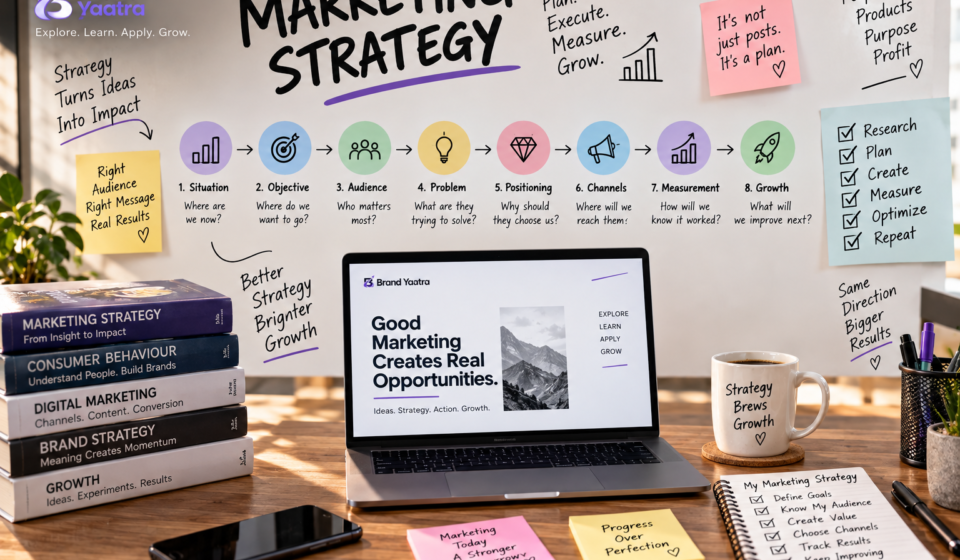
Here’s the Brand Yaatra framework we’ll use throughout this article:
1. Situation
Where are we now?
↓
2. Objective
Where do we want to go?
↓
3. Audience
Who matters most?
↓
4. Problem
What are they trying to solve?
↓
5. Positioning
Why should they choose us?
↓
6. Offer
What exactly are we giving them?
↓
7. Channels
Where will we reach them?
↓
8. Customer Journey
How do we move them from awareness to action and retention?
↓
9. Resources
What budget, people and technology do we have?
↓
10. Measurement
How will we know whether it’s working?
↓
11. Learning
What will we change based on evidence?
This is marketing strategy in motion.
1. Start With the Business Objective
Marketing shouldn’t exist in isolation.
The business might want to:
- Increase revenue
- Enter a new market
- Launch a product
- Increase market share
- Generate qualified leads
- Improve retention
- Increase repeat purchases
- Build brand awareness
- Increase customer lifetime value
- Create a new category
Your marketing objective should support that business objective.
For example:
Business goal
Increase annual revenue from ₹5 crore to ₹7 crore.
That’s not yet a marketing strategy.
Now ask:
Where will the additional revenue come from?
Maybe:
- More customers
- Higher average order value
- More repeat purchases
- Expansion into a new geography
- A new product
- Better conversion
Now marketing has something specific to work with.
2. Understand the Situation
Before deciding what to do, understand where you are.
Look at:
Market
- Market size
- Growth
- Trends
- Regulations
- Customer behavior
- Emerging competitors
Customers
- Needs
- Frustrations
- Buying behavior
- Decision criteria
- Objections
- Motivations
Competitors
- Positioning
- Pricing
- Products
- Distribution
- Content
- Advertising
- Strengths
- Weaknesses
Your business
- Product quality
- Brand awareness
- Distribution
- Budget
- Team
- Technology
- Existing customers
- Existing assets
You don’t need a 100-page strategy document.
You need enough understanding to make better decisions.
3. Define Your Target Audience
One of the biggest strategic mistakes is saying:
“Our target audience is everyone.”
Everyone is not a target audience.
A target audience is a group of people with a meaningful reason to care about what you offer.
You can define them using:
Demographics
- Age
- Location
- Income
- Occupation
Psychographics
- Values
- Interests
- Attitudes
- Lifestyle
- Aspirations
Behavioral characteristics
- What they buy
- What they search for
- Where they spend time
- What triggers purchase
- What makes them hesitate
But don’t create fictional personas simply because a template asks for them.
Real customer conversations, sales calls, reviews, search behavior and purchase data are often more useful.
The important question is:
Who has the strongest reason to choose us?
4. Understand the Customer Problem
Customers rarely buy products simply because products exist.
They buy outcomes.
A person doesn’t necessarily want:
“Accounting software.”
They might want:
“To stop wasting six hours every month managing invoices.”
A person doesn’t necessarily want:
“A language-learning app.”
They might want:
“To finally become comfortable speaking another language.”
A customer may have several layers of need.
Functional
What do they need to accomplish?
Emotional
How do they want to feel?
Social
What do they want others to think about them?
Strong marketing strategies understand all three.
5. Find the Customer Insight
A customer need is not always an insight.
Consider:
“People want convenient food.”
That’s a need.
A deeper observation might be:
“People don’t necessarily hate cooking. They hate deciding what to cook when they’re exhausted.”
Now you have a more useful strategic insight.
Insights often live inside contradictions:
“I want premium quality, but I don’t want to feel like I’m wasting money.”
“I want to exercise, but I don’t want my life to revolve around the gym.”
“I want to learn, but I don’t want learning to feel like studying.”
These tensions can reveal opportunities for positioning and product design.
6. Define Your Positioning
Positioning answers:
What should people associate with us when they compare us with alternatives?
Your positioning should connect:
- Target audience
- Category
- Customer need
- Competitive context
- Difference
- Benefit
- Reason to believe
A useful starting structure is:
For [target audience] who [problem/need], [brand] is the [category] that [key benefit/difference] because [reason to believe].
For example:
For busy professionals who want convenient healthy meals, Brand X is a meal-delivery service that makes weekday eating easier through ready-to-eat meals designed around real working schedules.
That’s a strategic statement.
It’s not necessarily the final advertising copy.
7. Decide How You Will Be Different
Being “better” isn’t enough.
Better quality.
Better service.
Better technology.
Better price.
Better experience.
Everyone says these things.
Ask:
Better in what way that matters to the customer?
Your differentiation might come from:
- Product
- Technology
- Price
- Convenience
- Experience
- Distribution
- Community
- Expertise
- Personality
- Design
- Business model
- Audience specialization
But don’t try to own everything.
If your strategy says you’re:
Premium + cheapest + fastest + most luxurious + most accessible
something is probably wrong.
Strategic choices require trade-offs.
8. Define Your Value Proposition
Your value proposition explains why someone should choose your offering.
A useful value proposition communicates:
Customer + Problem + Benefit + Difference
For example:
“Design professional presentations in minutes, even if you aren’t a designer.”
Notice what this does.
It identifies:
- The task
- The audience
- The desired outcome
- The barrier being removed
A good value proposition is not a list of every feature.
It’s a reason to care.
9. Build the Marketing Mix
One of the classic frameworks in marketing is the 4 Ps:
Product
What are you offering?
Price
What does the customer pay, and what does that price communicate?
Place
Where and how can customers access it?
Promotion
How will you communicate and stimulate demand?
The 4 Ps are still useful because they remind marketers that promotion is only one part of marketing.
If your product is wrong, advertising cannot permanently solve the problem.
If your pricing doesn’t match the positioning, customers may become confused.
If distribution is inconvenient, awareness won’t necessarily create sales.
Marketing strategy needs to consider the whole system.
10. Choose the Right Marketing Channels
Now we get to the question marketers often ask first:
“Which channel should we use?”
The answer is:
It depends.
Different audiences behave differently.
Different businesses have different economics.
Different stages of the customer journey require different channels.
Possible channels include:
Search
- SEO
- Google Ads
- Local search
- AI search visibility
Social
- YouTube
- TikTok
- X
Content
- Blogs
- Videos
- Podcasts
- Newsletters
- Research
- Guides
Direct
- SMS
- Sales outreach
Partnerships
- Influencers
- Affiliates
- Creators
- Strategic partnerships
Offline
- Events
- Retail
- Outdoor advertising
- Sponsorships
- Experiential marketing
The mistake is choosing channels because they’re fashionable.
Instead ask:
Where does our audience already pay attention, and where can we realistically compete?
11. Give Every Channel a Job
This is a major strategic improvement.
Don’t simply say:
“We’re active on Instagram.”
Define its role.
For example:
| Channel | Strategic Job |
|---|---|
| SEO | Capture existing demand |
| Blog | Build authority and educate |
| Build attention and personality | |
| YouTube | Demonstrate expertise |
| Retain and nurture | |
| Google Ads | Capture high-intent demand |
| Reach professional audiences | |
| Influencers | Borrow attention and credibility |
| Events | Create trust and experience |
Now your marketing system starts making sense.
One channel doesn’t have to do everything.
12. Map the Customer Journey
Customers rarely go directly from:
Never heard of us → Buy
There may be several stages.
Awareness
“I’ve never heard of this.”
Interest
“This looks interesting.”
Consideration
“Could this solve my problem?”
Intent
“Maybe I should buy.”
Conversion
“I’ll do it.”
Retention
“I’ll use it again.”
Advocacy
“I’ll recommend it.”
Different marketing activities can support different stages.
For example:
Content → Awareness
Case studies → Consideration
Demo → Intent
Offer → Conversion
Email → Retention
Referral → Advocacy
This is why thinking only about “getting traffic” is insufficient.
Traffic is not the destination.
13. Create the Message Strategy
Your marketing should not communicate 25 unrelated things.
Decide:
Core message
What is the main thing we want people to understand?
Supporting messages
What proof or benefits reinforce it?
Reasons to believe
Why should customers believe us?
Objection handling
Why might someone hesitate?
Emotional territory
What should the brand make people feel?
Your message should adapt to the channel without becoming a different brand every time.
14. Decide the Content Strategy
Content should have a strategic job.
You might use content to:
- Build awareness
- Educate
- Capture search demand
- Demonstrate expertise
- Create trust
- Generate leads
- Support sales
- Retain customers
- Build community
For example, a B2B software company might create:
Top of funnel
“What Is Inventory Management?”
Middle of funnel
“Inventory Management Software vs Spreadsheets”
Bottom of funnel
“How Brand X Reduced Inventory Errors by 38%”
Retention
“How to Get More From Your Brand X Account”
Same business.
Different customer needs.
That’s strategic content.
15. Decide the Budget
A strategy without resources is only an intention.
Your budget might need to cover:
- Advertising
- Content
- Design
- Technology
- People
- Agencies
- Creators
- Research
- Events
- Software
But don’t ask only:
“How much should we spend?”
Ask:
“What outcome are we trying to buy, and what economics make sense?”
A ₹5 Lakh Marketing Budget Example
Imagine a new D2C skincare brand has ₹5 lakh available for a three-month launch.
A simplistic plan might be:
₹5 lakh on Meta Ads.
That’s not necessarily a strategy.
A more thoughtful approach could be:
| Activity | Budget | Strategic Role |
|---|---|---|
| Meta/Instagram ads | ₹2,00,000 | Demand generation |
| Creator partnerships | ₹75,000 | Trust + awareness |
| Search Ads | ₹75,000 | Capture high-intent demand |
| Content production | ₹60,000 | Education + brand building |
| Testing/experiments | ₹40,000 | Learn what works |
| Retention/email/CRM | ₹25,000 | Repeat purchase |
| Measurement/tools | ₹25,000 | Performance visibility |
| Total | ₹5,00,000 |
The exact allocation would depend on the category, margins, audience and existing brand awareness.
The important point is the thinking.
Budget follows strategy.
Not the other way around.
16. Set Your KPIs
Not every metric is equally important.
Your KPI should connect to your objective.
Awareness objective
Possible metrics:
- Reach
- Qualified impressions
- Brand searches
- Video completion
- Direct traffic
Lead-generation objective
Possible metrics:
- Qualified leads
- Cost per qualified lead
- Lead-to-customer rate
E-commerce objective
Possible metrics:
- Revenue
- Conversion rate
- Customer acquisition cost
- Average order value
- Repeat purchase rate
- Customer lifetime value
Retention objective
Possible metrics:
- Repeat purchase rate
- Churn
- Retention rate
- Active customers
- Revenue per customer
The question isn’t:
“What numbers can we report?”
It’s:
“Which numbers tell us whether the strategy is working?”
Vanity Metrics vs Business Metrics
Suppose an Instagram post gets:
500,000 views.
Sounds great.
But imagine:
- 0 qualified leads
- 0 sales
- no meaningful increase in brand searches
- no measurable business impact
The result might still have value, but the view count alone doesn’t prove success.
Now imagine another post gets:
20,000 views
but generates:
- 400 qualified visits
- 60 leads
- 10 customers
The second result might be strategically much more valuable.
Metrics need context.
17. Build Measurement Into the Strategy
Measurement shouldn’t be something you think about after the campaign.
Decide before launching:
What action matters?
How will we measure it?
Where will the data come from?
What would success look like?
For digital businesses, analytics can help connect interactions across the customer journey and understand which channels and actions contribute to outcomes.
That makes measurement part of strategy rather than simply reporting.
18. Test, Learn and Adapt
A marketing strategy isn’t a stone tablet.
Markets change.
Customers change.
Competitors change.
Platforms change.
Technology changes.
Your own data changes.
So the strategy should have a learning loop:
Hypothesis → Execute → Measure → Learn → Improve
For example:
We believe short educational videos will generate more qualified traffic than promotional videos.
Test it.
Measure it.
Compare.
Learn.
Adjust.
This is especially important in digital marketing because experimentation can happen much faster than in traditional channels.
Strategy vs Tactics: A Real Example
Imagine a company wants to acquire more customers.
Strategy
Become the easiest accounting platform for small businesses that don’t have an in-house finance team.
Plan
Over six months:
- Build educational search content
- Create comparison pages
- Run high-intent search campaigns
- Develop partner relationships
- Build an email nurture sequence
- Publish customer case studies
Tactics
- Publish “How to Create an Invoice”
- Run Google Ads for “small business accounting software”
- Send a three-email onboarding sequence
- Create a customer testimonial video
Now the tactics make sense because they serve a strategic direction.
Three Types of Marketing Strategy You Should Know
Marketing strategy can take many forms, but several common strategic approaches appear across businesses.
1. Market Penetration
Sell more of an existing offering in an existing market.
Examples:
- Increase awareness
- Increase frequency
- Improve conversion
- Win customers from competitors
2. Market Development
Take an existing offering into a new market.
For example:
- New geography
- New customer segment
- New use case
3. Product Development
Create new offerings for an existing customer base.
For example:
A fitness company that already sells memberships launches nutrition coaching for its existing audience.
4. Diversification
Move into a new offering and a new market.
This generally involves greater uncertainty and should be approached carefully.
These strategic choices are different from individual marketing channels.
“Instagram strategy” is not the same thing as “market development strategy.”
Marketing Strategy vs Brand Strategy
These are closely connected.
But they aren’t identical.
Brand strategy asks:
What should this brand mean to people?
Marketing strategy asks:
How will we create, communicate and deliver value to customers while achieving our business objectives?
For example:
Brand strategy
Premium, design-led technology for people who value simplicity.
Marketing strategy
Reach design-conscious professionals through search, creators, content, retail experiences and product-led demonstrations.
Brand strategy helps define the meaning.
Marketing strategy determines how the business competes and grows.
They should reinforce each other.
Marketing Strategy vs Digital Marketing Strategy
Digital marketing strategy is a subset of broader marketing strategy.
A complete marketing strategy can include:
- Retail
- Sales
- Events
- Partnerships
- Packaging
- Distribution
- PR
- Advertising
- Digital channels
Digital marketing focuses specifically on digital environments and technologies.
That includes:
- SEO
- Search advertising
- Social media
- Content
- Websites
- Marketing automation
- Digital analytics
- Influencer marketing
- AI-driven channels
A business can have a digital marketing strategy without having a strong overall marketing strategy.
That’s one reason companies sometimes become extremely good at generating online traffic without building a strong business.
Common Marketing Strategy Mistakes
1. Starting With Channels
“Let’s do Instagram.”
“Let’s do SEO.”
“Let’s do LinkedIn.”
Start with the customer and objective.
Then choose channels.
2. Trying to Be Everywhere
Being present on every platform doesn’t mean being effective.
Choose channels where:
- Your audience exists
- Your message fits
- You can produce good work
- The economics make sense
3. Confusing Activity With Progress
Publishing 30 posts isn’t a strategy.
Running 20 campaigns isn’t a strategy.
Sending 100 emails isn’t a strategy.
Activity is not automatically progress.
4. Copying Competitors
Your competitor runs influencer campaigns.
So you do too.
Your competitor launches a podcast.
So you launch one.
Your competitor uses short videos.
So you make short videos.
This is imitation, not strategy.
Ask:
What should we do because it makes sense for our customer and our competitive position?
5. Changing Direction Too Quickly
One campaign underperforms.
The team changes the entire strategy.
Another campaign works.
The team doubles everything.
This creates noise.
A strategy needs enough time and evidence to evaluate properly.
6. Ignoring the Product
Marketing can create attention.
It cannot permanently compensate for a poor product.
If customers try the product and hate it, more advertising may simply accelerate the problem.
7. Measuring Everything
More dashboards don’t necessarily mean better decisions.
Choose the metrics that connect to the objective.
8. Having No Learning Loop
A strategy should evolve with evidence.
If the data repeatedly contradicts your assumptions, change the assumption.
The Brand Yaatra Marketing Strategy Map
Here’s the practical framework in one view:
| Stage | Key Question |
|---|---|
| Situation | Where are we now? |
| Objective | Where do we want to go? |
| Audience | Who matters most? |
| Problem | What are they trying to solve? |
| Insight | What deeper truth do we understand? |
| Positioning | Why should they choose us? |
| Value Proposition | What value are we offering? |
| Offer | What exactly are we asking them to buy/do? |
| Channels | Where will we reach them? |
| Customer Journey | How will they move toward action and loyalty? |
| Budget | What resources can we deploy? |
| KPIs | What will success look like? |
| Measurement | How will we know? |
| Learning | What should we change? |
This is the difference between a list of marketing activities and an actual marketing system.
A Practical Marketing Strategy Template
You can copy this and build your own strategy.
1. Business Objective
What does the business need to achieve?
Answer:
2. Marketing Objective
What must marketing contribute?
Answer:
3. Current Situation
What is happening in the market right now?
Answer:
4. Target Audience
Who has the strongest reason to care?
Answer:
5. Customer Problem
What problem are they trying to solve?
Answer:
6. Customer Insight
What deeper truth or tension can we understand?
Answer:
7. Competitive Landscape
Who are the main alternatives?
Answer:
8. Positioning
What should we be known for?
Answer:
9. Value Proposition
Why should customers choose us?
Answer:
10. Offer
What exactly are we giving customers?
Answer:
11. Channel Strategy
Where will we reach them?
Answer:
12. Content Strategy
What information, stories or proof do they need?
Answer:
13. Budget
What resources can we realistically invest?
Answer:
14. KPIs
What numbers will tell us whether we’re progressing?
Answer:
15. Testing Plan
What assumptions should we test?
Answer:
16. Review Cycle
When will we evaluate and adjust the strategy?
Answer:
How AI Is Changing Marketing Strategy
AI is changing marketing execution very quickly.
Marketers can now use AI to accelerate:
- Research
- Content production
- Customer analysis
- Creative development
- Personalization
- Data analysis
- Campaign ideation
- Automation
- Testing
But this creates an important strategic question.
If everyone can produce more content faster, does content production remain a major differentiator?
Not necessarily.
When execution becomes easier, the quality of the decisions behind the execution becomes more important.
AI can help you generate ten campaign ideas.
It doesn’t automatically know which idea your brand should own.
It can write a positioning statement.
It doesn’t automatically know whether customers will believe it.
It can analyze competitors.
It doesn’t automatically tell you which competitive gap is strategically valuable.
So the role of the marketer is changing.
Less:
“How quickly can I produce this?”
More:
“What should we produce, why, for whom, and what evidence would prove we’re right?”
AI can accelerate marketing strategy.
It shouldn’t replace strategic thinking.
What Does a Good Marketing Strategy Look Like?
A good strategy doesn’t need to be complicated.
It needs to be coherent.
You should be able to explain:
Who we want
→ what they need
→ why they should choose us
→ what we’re trying to achieve
→ where we’ll reach them
→ what we’ll say
→ what we’ll offer
→ how we’ll measure success
→ what we’ll learn
If those pieces connect, you have the foundation of a strategy.
If they don’t, adding another channel probably won’t solve the problem.
Final Takeaway
Marketing strategy isn’t about doing more marketing.
It’s about making better marketing decisions.
Before asking:
“Should we run Instagram ads?”
Ask:
What are we trying to achieve?
Before asking:
“What should we post?”
Ask:
Who are we trying to help, and what do they need to believe?
Before asking:
“Which platform should we use?”
Ask:
Where does our audience actually pay attention?
Before asking:
“Did the campaign get enough likes?”
Ask:
Did it move the business closer to its objective?
That shift in thinking is the difference between marketing activity and marketing strategy.
The strongest marketing strategies aren’t necessarily the ones with the most channels, the biggest budgets or the most complicated dashboards.
They’re the ones where the decisions connect.
Business objective → Customer → Insight → Positioning → Offer → Channels → Experience → Measurement → Learning
That’s the strategy.
Everything else is execution.
Frequently Asked Questions About Marketing Strategy
What is a marketing strategy in simple words?
A marketing strategy is a plan for deciding who you want to reach, what value you want to provide, how you will compete, which channels you’ll use, and how marketing will help achieve business objectives.
What are the main components of a marketing strategy?
A practical marketing strategy usually includes the business objective, market situation, target audience, customer problem, insight, positioning, value proposition, offer, channels, customer journey, resources, KPIs and measurement.
What is the difference between marketing strategy and marketing plan?
Marketing strategy defines the overall direction and strategic choices. A marketing plan translates those choices into specific activities, timelines, budgets and responsibilities.
What is the difference between strategy and tactics in marketing?
Strategy defines what you are trying to achieve and how you intend to compete. Tactics are the individual actions used to execute that strategy, such as publishing an article, running an advertisement or sending an email.
Is digital marketing strategy the same as marketing strategy?
No. Digital marketing strategy focuses on digital channels and technologies. A broader marketing strategy can also include offline advertising, retail, events, sales, partnerships, distribution and other activities.
How do I create a marketing strategy?
Start with the business objective, analyze the market, define the target audience, understand the customer problem, identify an insight, establish positioning and value proposition, choose channels, allocate resources, define KPIs and create a measurement and learning loop.
How long should a marketing strategy be?
There is no ideal page count. A strategy should be as detailed as necessary to make important decisions clear. A concise strategy that guides action is more useful than a 100-page document nobody uses.
What are the 4 Ps of marketing?
The traditional 4 Ps are Product, Price, Place and Promotion. They provide a framework for considering the offering, pricing, distribution and promotional elements of marketing.
Can a small business have a marketing strategy?
Yes. In fact, strategic focus can be especially valuable for small businesses because resources are limited. A smaller company can compete by focusing on a specific audience, problem, position or experience rather than trying to reach everyone.
Can AI create a marketing strategy?
AI can assist with research, analysis, idea generation, customer-language analysis, content planning and experimentation. However, a useful strategy still requires human judgment, business context, customer evidence and decisions about where the company should compete and how it should create value.
What is the most important part of a marketing strategy?
There isn’t one universally most important component. A strong strategy depends on the pieces working together. However, clarity about the target customer, business objective and competitive positioning provides a critical foundation for the rest of the strategy.
Sources & Further Reading
- American Marketing Association — Marketing Strategy
- American Marketing Association — Definition of Marketing
- American Marketing Association — How to Develop an Effective Marketing Strategy
- Google Analytics — Measurement and customer journey guidance



Comments are closed.
[…] is why Apple’s marketing strategy cannot be separated completely from its brand […]