
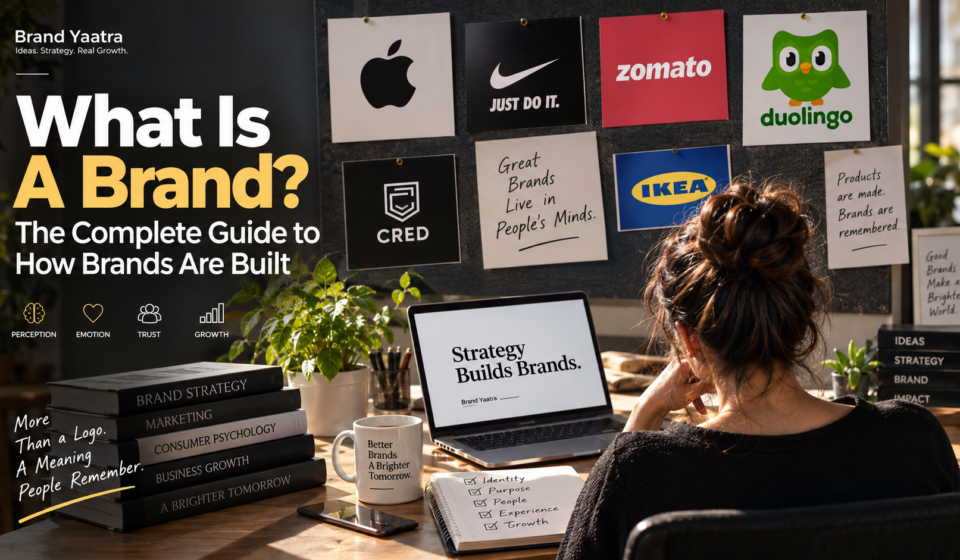

What comes to mind when you hear the word Apple?
Maybe the bitten apple logo.
Maybe a clean white product box.
Maybe an iPhone.
Maybe premium pricing.
Maybe simplicity.
Maybe the feeling that Apple is somehow different from the hundreds of companies selling technology.
Now think about Nike.
You probably don’t need to see the word “Nike” to recognize the swoosh.
Think of Zomato and you may immediately picture red, food, witty notifications and a certain tone of voice.
Think of Duolingo and the green owl probably appears in your head before you even finish reading the name.
That is the interesting thing about brands.
A brand is not simply the thing a company sells.
It is the meaning, memory, expectations and associations that build around that company, product or service in people’s minds.
And that leads to one of the most important ideas in marketing:
Your company creates products. Your marketing communicates them. But your brand is what people come to remember and associate with you.
What Is a Brand?
A brand is the set of associations, perceptions, memories, expectations and experiences people connect with a company, product or service.
In simple terms:
A brand is the meaning people attach to something.
That meaning can come from many places.
- The product itself
- The name
- The logo
- The packaging
- The price
- The advertising
- The customer experience
- The people behind the company
- The way the company speaks
- The opinions of other customers
- The stories associated with the company
- The memories people build through repeated interactions
For example, two coffee shops can sell almost identical coffee.
One may feel like a cheap place to grab caffeine.
Another may feel premium, modern and aspirational.
The physical product may not be dramatically different.
But the meaning surrounding the product is different.
That difference is where branding becomes powerful.
Brand vs Product: They Are Not the Same Thing
This distinction is fundamental.
A product is what a company makes or sells.
A brand is what people associate with that product.
Consider smartphones.
Many companies can build phones with powerful processors, good cameras, high-resolution displays and long battery life.
Those are product features.
But people do not make purchasing decisions based only on technical specifications.
They also consider what the brand represents.
Is it premium?
Reliable?
Innovative?
Affordable?
Cool?
Trustworthy?
Safe?
For some buyers, the product is functional.
For others, the brand becomes part of how they express themselves.
That is why two products with similar functional capabilities can command very different prices and attract very different customers.
Brand vs Branding vs Brand Strategy
These three terms are often used interchangeably, but they describe different things.
Brand
The brand is the meaning and associations people hold about the company, product or service.
Branding
Branding is the process of deliberately shaping and expressing that meaning.
It includes things such as identity, messaging, design, communication, customer experience and distinctive assets.
Brand Strategy
Brand strategy is the strategic thinking behind the brand.
It answers questions such as:
- Who are we trying to matter to?
- What problem are we solving?
- Why should people choose us?
- What should we stand for?
- How should we be different?
- What should people remember about us?
If you want to go deeper into that strategic layer, read our complete guide to brand strategy.
Think of it this way:
Brand = what exists in people’s minds.
Branding = what you do to shape and express it.
Brand strategy = the thinking that guides those decisions.
Why Does a Brand Matter?
Imagine that every time someone wanted to buy something, they had to evaluate every available option from scratch.
Every toothpaste.
Every smartphone.
Every hotel.
Every coffee shop.
Every payment app.
Every pair of shoes.
That would be exhausting.
Brands help reduce that uncertainty.
When people recognize a brand, they already have some expectations about what they are going to get.
Those expectations may come from previous experience, advertising, reviews, recommendations or simply repeated exposure.
A strong brand therefore helps create several forms of value.
1. Recognition
A recognizable brand can stand out in a crowded environment.
Think about how quickly people can recognize certain logos, colours, packaging styles, characters or sounds.
2. Trust
If someone has had a good experience with a company before, they may be more comfortable choosing it again.
Trust reduces perceived risk.
3. Preference
When several products appear similar, brand associations can influence which one a person prefers.
4. Memory
People cannot buy what they do not remember.
A brand gives marketing communications something to connect to over time.
5. Meaning
Some brands become associated with ideas far beyond the functional product.
That can include status, identity, belonging, performance, adventure, simplicity, creativity or convenience.
A Brand Lives in People’s Minds
This is where many businesses misunderstand branding.
A company can decide what it wants its brand to mean.
But it cannot completely control what people actually think.
There is a difference between brand identity and brand perception.
Brand Identity
Brand identity is what the company deliberately creates and communicates.
It includes:
- Name
- Logo
- Colours
- Typography
- Visual style
- Voice
- Messaging
- Personality
- Values
- Positioning
Brand Perception
Brand perception is how people actually interpret the brand.
A company might describe itself as innovative.
Customers might think it is expensive.
A company might describe itself as customer-first.
Customers might think its support is terrible.
A company might want to feel premium.
Customers might simply think it is overpriced.
That gap matters.
Good branding is not simply saying what you want people to think. It is creating enough consistent evidence for people to actually believe it.
The Five Layers of a Brand
One useful way to understand a brand is to think of it as having multiple layers.
Layer 1: Functional Value
What does the product actually do?
Does it save time?
Does it solve a problem?
Does it perform better?
Does it make something easier?
Layer 2: Experience
What does it feel like to interact with the company?
Think about the website, packaging, onboarding, app, store, delivery and customer support.
Layer 3: Emotional Associations
What does the brand make people feel?
Safe?
Excited?
Confident?
Smart?
Entertained?
Inspired?
Layer 4: Social Meaning
What does choosing the brand communicate to other people?
This is particularly important in categories where products can become signals of identity or status.
Our case study on how CRED turned credit cards into a status symbol is a useful example of this idea.
Layer 5: Memory
What does someone immediately associate with the brand when they encounter a category, situation or visual cue?
Strong brands build these associations repeatedly over time.
What Makes a Brand Memorable?
Being good is not always enough.
A company can have a fantastic product and still struggle to become memorable.
Why?
Because consumers are surrounded by thousands of commercial messages.
Brands therefore need recognizable signals.
These can include:
- Colours
- Logos
- Characters
- Packaging
- Shapes
- Typography
- Taglines
- Sounds
- Visual styles
- Distinctive advertising formats
Marketing researchers often refer to strong examples of these as distinctive brand assets.
Research from the Ehrenberg-Bass Institute emphasizes two important dimensions: how strongly an element is associated with a brand and how uniquely it identifies that brand. :contentReference[oaicite:0]{index=0}
Think about Nike’s swoosh.
McDonald’s Golden Arches.
Coca-Cola’s distinctive visual identity.
Or Duolingo’s green owl.
These assets can help people identify the brand without needing to see the full brand name.
Distinctive Does Not Mean Complicated
A common mistake is thinking that a brand needs an elaborate identity system to become memorable.
Usually, the more important question is:
Can people recognize this consistently?
A distinctive asset becomes valuable when repeated exposure builds a strong association between the asset and the brand.
That is why constantly redesigning logos, colours, packaging and visual systems can sometimes work against a brand.
Consistency gives memory something to build on.
The Ehrenberg-Bass Institute specifically emphasizes the importance of consistently using distinctive assets rather than constantly changing them. :contentReference[oaicite:1]{index=1}
How Brands Build Meaning Over Time
A brand is rarely created by one advertisement.
It is accumulated.
Imagine someone discovers a company today.
They see an advertisement.
Then they visit the website.
They see a social media post.
They hear a friend mention the company.
They buy the product.
They receive the package.
They contact customer support.
They use the product.
They tell someone else about it.
Each interaction adds another piece to the overall perception.
That is why branding is not just a marketing department problem.
The product is part of the brand.
The customer service is part of the brand.
The website is part of the brand.
The sales experience is part of the brand.
The advertising is part of the brand.
The employee interaction can even become part of the brand.
Every interaction is evidence for or against the meaning a company is trying to create.
Brand Positioning: What Do You Want to Be Known For?
If branding is about meaning, positioning is about focus.
A brand cannot realistically own every idea in someone’s mind.
It needs a reason to be chosen.
That reason becomes clearer when a company answers four questions:
- Who are we trying to serve?
- What problem or need matters to them?
- What alternative are we competing against?
- Why should they choose us?
For example, a company might compete on convenience.
Another might compete on premium craftsmanship.
Another might compete on affordability.
Another might compete on status.
Another might compete on simplicity.
The important thing is not simply choosing a nice-sounding positioning statement.
The company must be able to prove the position through what it actually does.
Brand Promise: What Are You Asking People to Expect?
A brand promise is the expectation a company wants to create consistently.
It is not necessarily a slogan.
It is closer to a commitment.
If a brand positions itself around convenience, the entire experience should make life easier.
If it positions itself around premium quality, the product, packaging, service and communication should support that expectation.
If the promise and experience disagree, the brand becomes weaker.
People believe experiences more than slogans.
Brand Personality: If Your Brand Were a Person
Imagine two brands walking into a room.
One is formal, serious and precise.
The other is playful, sarcastic and energetic.
Even if both sell the same product, they would feel completely different.
That is brand personality.
Common personality dimensions include:
- Playful vs serious
- Premium vs accessible
- Bold vs conservative
- Expert vs friendly
- Traditional vs experimental
- Minimal vs expressive
Brand personality affects everything from copywriting to advertising to social media.
That is why Zomato’s recognizable digital personality is strategically interesting.
The personality is not simply decoration.
It helps the brand become recognizable in a crowded category.
Brand Experience: The Brand Is Bigger Than Advertising
Suppose a company runs beautiful advertisements promising effortless service.
Then the website is confusing.
The checkout fails.
The delivery arrives late.
Customer support takes three days to respond.
The advertisement may have been excellent.
The brand experience was not.
This is why a brand should be viewed across the entire customer journey.
Awareness.
Consideration.
Purchase.
Onboarding.
Usage.
Support.
Retention.
Advocacy.
Each stage can strengthen or weaken the brand.
For a deeper look at how this connects with the broader customer journey, see our complete guide to the digital marketing funnel.
How Digital Marketing Builds a Brand
Digital marketing gives brands more opportunities to create repeated interactions.
Search.
Social media.
Email.
Video.
Content.
Paid advertising.
Communities.
Influencers.
Websites and apps.
But digital marketing should not become a collection of disconnected campaigns.
The strongest brands make their identity recognizable across channels.
The visual language changes slightly depending on the platform.
The format changes.
The message changes.
But the underlying brand remains recognizable.
That is one reason it is useful to understand what digital marketing actually includes rather than treating it as simply social media or online advertising.
Why Some Brands Feel Premium
Premium perception is not created by putting a higher price on a product.
Price is only one signal among many.
Premium brands often build an ecosystem of signals around scarcity, design, service, distribution, experience, storytelling and consistency.
Apple is a useful example.
Its products, retail experience, advertising, packaging, ecosystem and pricing all contribute to a particular perception.
We explored the pricing side of this in our article on why Apple almost never uses broad headline discounts.
The broader lesson is important:
A brand is built by the total system of signals, not by one isolated marketing tactic.
Can a Brand Be Built Without a Huge Budget?
Yes.
Money can buy reach.
It cannot automatically buy meaning.
A smaller company can still build a recognizable brand through:
- A clear point of view
- A specific audience
- Consistent messaging
- Distinctive visual elements
- Strong customer experience
- Useful content
- Memorable stories
- Community
- Consistent repetition
The challenge for smaller businesses is often not lack of creativity.
It is lack of consistency.
One month the brand sounds premium.
The next month it sounds cheap.
One campaign uses one colour.
The next campaign uses five different visual styles.
The website says one thing.
The salesperson says another.
The social media account sounds like a completely different company.
Over time, the customer receives a blurry picture.
Strong brands make that picture clearer.
Brand Consistency Does Not Mean Repeating the Same Advertisement
This is another common misunderstanding.
Consistency does not mean every post must look identical.
It means the important underlying signals remain recognizable.
A brand can create different campaigns.
It can experiment with formats.
It can use humour.
It can tell different stories.
It can adapt to different platforms.
But the audience should still be able to answer:
“Who made this?”
before seeing the brand name.
How Strong Brands Become Memorable
Let’s simplify everything so far.
A strong brand usually has several things working together:
| Brand Element | Question It Answers |
|---|---|
| Audience | Who are we trying to matter to? |
| Problem | What important need are we solving? |
| Positioning | What do we want to be known for? |
| Promise | What should customers expect from us? |
| Personality | How should the brand feel and behave? |
| Identity | How should the brand look and sound? |
| Distinctive Assets | What helps people recognize us? |
| Experience | Does reality match the promise? |
| Consistency | Do these signals reinforce each other over time? |
A Simple Brand-Building Framework
If you are building a brand from scratch, you do not need to begin with a logo.
Start with meaning.
Step 1: Define Your Audience
Be specific about who you are trying to serve.
Not simply “everyone.”
Understand their needs, motivations, frustrations and alternatives.
Step 2: Identify the Problem
What problem are you solving?
Why does that problem matter?
Step 3: Find Your Position
Decide what you want the brand to stand for relative to alternatives.
Step 4: Create the Promise
Define the expectation customers should associate with choosing you.
Step 5: Build the Personality
Decide how the brand should speak, behave and feel.
Step 6: Create the Identity
Develop the visual and verbal systems that make the brand recognizable.
Step 7: Develop Distinctive Assets
Identify the colours, shapes, characters, sounds, typography, packaging or other elements that could become strongly associated with the brand.
Step 8: Deliver the Promise
Make sure the actual product and customer experience support what the brand claims.
Step 9: Repeat
Use the important brand signals consistently across campaigns, channels and customer touchpoints.
Step 10: Learn and Strengthen
Measure recognition, preference, customer response and business performance.
Then strengthen what works instead of changing everything every few months.
Brand Building Is a Long Game
This may be the most important lesson.
Brands are not built in a weekend.
They are built through repeated exposure and repeated experiences.
A company publishes one great advertisement.
That does not create a powerful brand.
A company changes its logo.
That does not create a powerful brand.
A company hires a celebrity.
That does not create a powerful brand.
A company goes viral.
That does not necessarily create a powerful brand.
Brand building happens when many signals accumulate in the same direction.
The product delivers.
The message reinforces the positioning.
The visual identity is recognizable.
The experience supports the promise.
The distinctive assets become familiar.
The company keeps showing up.
Over time, those interactions create memory.
And memory can eventually become preference.
Common Branding Mistakes
1. Starting With the Logo
A logo is an important identity element.
It is not a brand strategy.
2. Trying to Appeal to Everyone
If a brand tries to mean everything to everyone, it often becomes difficult for anyone to remember what it stands for.
3. Changing the Identity Too Often
Constant redesigns can destroy the associations a brand has been building.
4. Confusing Virality With Brand Building
A viral post can generate enormous attention without creating lasting brand associations.
5. Making Promises the Product Cannot Deliver
Marketing can create expectations.
The experience has to fulfil them.
6. Copying Competitors
Looking at competitors is useful.
Becoming indistinguishable from them is not.
7. Treating Branding as Only a Design Problem
Branding involves design, but it also involves positioning, psychology, experience, communication, product and strategy.
Real-World Examples of Brands With Strong Associations
Apple — Simplicity and Premium Technology
Apple has built a broad set of associations around design, simplicity, ecosystem, premium technology and controlled experience.
The lesson is not “copy Apple.”
The lesson is that multiple business and marketing decisions can reinforce the same perception.
Duolingo — Learning With Personality
Duolingo could have presented itself as another educational technology company.
Instead, its distinctive green owl, playful personality and social-media behaviour helped make the brand culturally recognizable.
Our Duolingo marketing case study explores how that personality became a major part of the brand.
Zomato — Food With a Voice
Zomato operates in a category where functional differences can become difficult for consumers to distinguish.
Its personality, visual identity, notifications, cultural references and communication style helped make the brand more recognizable.
That is a useful reminder that differentiation does not always have to come from the core product alone.
IKEA — More Than Furniture
IKEA sells furniture, but its experience is much larger than individual products.
The store journey, room displays, self-service model, food, packaging and overall experience contribute to the meaning surrounding the brand.
You can see this in our analysis of why IKEA designs its store journey the way it does.
Brand Equity: When the Brand Itself Becomes Valuable
Over time, strong associations can create what marketers call brand equity.
In simple terms, brand equity is the additional value associated with having a recognizable and meaningful brand.
Imagine two companies selling broadly similar products.
If customers consistently prefer one, search for it by name, recommend it to others and trust it more easily, the brand itself is contributing economic value.
That value can influence:
- Customer preference
- Price tolerance
- Repeat purchase
- Word of mouth
- Customer acquisition
- Distribution opportunities
- Partnerships
- Long-term growth
But brand equity should not be treated as a magic premium you can charge simply because you have a recognizable logo.
The underlying product and experience still matter.
So, What Is a Brand Really?
After everything we’ve covered, we can return to the simplest definition.
A brand is the meaning people remember and associate with a company, product or service.
The logo is part of it.
The name is part of it.
The advertising is part of it.
The product is part of it.
The customer experience is part of it.
The stories are part of it.
The reputation is part of it.
The distinctive assets are part of it.
But none of these elements alone is the entire brand.
The brand emerges from the connections between them.
The Brand Yaatra Brand-Building Model
Here’s a simple model you can use whenever you think about a brand:
Audience → Problem → Positioning → Promise → Personality → Identity → Distinctive Assets → Experience → Memory → Preference
Start with the audience.
Understand the problem.
Choose what you want to stand for.
Create a promise.
Give the brand a personality.
Build recognizable identity elements.
Strengthen distinctive assets.
Deliver the promise through the actual experience.
Repeat the important signals.
Let memory accumulate.
And eventually, that memory can influence preference.
That is how a company moves from being known to being remembered.
And from being remembered to being chosen.
Frequently Asked Questions About Brands
What is a brand in marketing?
A brand in marketing is the collection of associations, perceptions, memories and expectations people connect with a company, product or service. Marketing helps create and reinforce those associations through communication, experience and repeated exposure.
Is a brand the same as a logo?
No. A logo is one element of a brand identity. A brand is much broader and includes the associations, experiences, expectations and memories people connect with the company or product.
What is the difference between a brand and branding?
A brand is the meaning and associations people hold. Branding is the deliberate process of shaping and expressing that meaning through strategy, identity, communication and experience.
What is brand strategy?
Brand strategy is the strategic framework that defines who a brand wants to matter to, what it should stand for, how it should be positioned and why people should choose and remember it.
How long does it take to build a brand?
There is no universal timeline. A brand can become recognizable quickly, but strong brand associations generally require consistent exposure and experience over time. Brand building is a long-term process rather than a one-time campaign.
Can a small business build a strong brand?
Yes. A small business can build a strong brand by having a clear audience, differentiated positioning, consistent communication, memorable identity elements and a customer experience that delivers on its promise. Large advertising budgets can increase reach, but they do not automatically create strong brand meaning.
What makes a brand memorable?
Memorable brands tend to use clear positioning, consistent communication, recognizable identity elements and distinctive assets repeatedly over time. The goal is to make the brand easier to recognize and remember in buying situations.
Why is consistency important in branding?
Consistency gives people repeated signals that can become associated with the brand. Constantly changing names, colours, visual systems, messaging or personality can make it harder for those associations to strengthen.
Final Takeaway
A brand is not what you put on a business card.
It is not just your logo.
It is not your colour palette.
It is not your Instagram feed.
And it is certainly not just your advertising.
A brand is the meaning that accumulates around your business in people’s minds.
Every product interaction contributes to it.
Every advertisement contributes to it.
Every customer experience contributes to it.
Every distinctive visual or verbal signal contributes to it.
And every repeated experience either strengthens or weakens what people remember.
That is why the best brands are rarely built through one brilliant campaign.
They are built through hundreds of decisions that keep pointing in the same direction.
Products give people something to buy. Marketing gives them reasons to notice it. A brand gives them something to remember.