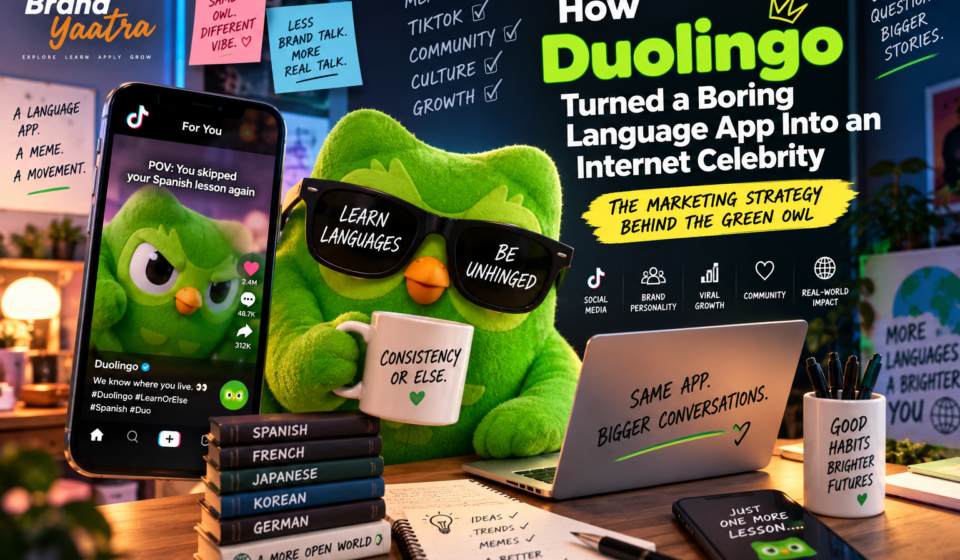
How Duolingo Became an Internet Celebrity: The Marketing Strategy Behind the Green Owl

Nobody wakes up thinking:
“I really hope a language-learning app posts something hilarious today.”
And yet, millions of people have watched Duolingo’s green owl dance, threaten users, crash into pop-culture moments, flirt with celebrities, appear in ridiculous situations and generally behave like the most unhinged character on their feed.
That’s the strange thing about Duolingo.
It sells language learning.
But its social media often feels like it has absolutely nothing to do with studying a language.
And somehow…
that’s exactly why it works.
Duolingo didn’t just market an app.
It turned the brand itself into content.
The green owl became a character.
The character became a meme.
The meme became a community.
And the community became one of Duolingo’s most powerful marketing engines.
As of Q2 2026, Duolingo reported that daily active users were growing 23% year over year. At the end of 2025, the company had 52.7 million daily active users, 133.1 million monthly active users and 12.2 million paid subscribers.
That’s not proof that every viral TikTok directly caused those numbers.
It isn’t.
But it does show the scale of the company behind one of the internet’s most recognizable marketing personalities.
So how did a language-learning app get here?
And more importantly:
What can marketers actually learn from Duolingo?
Let’s go on the journey.
First, Duolingo Wasn’t Supposed to Be Cool
Language learning has a marketing problem.
It’s useful.
It’s educational.
It’s good for you.
But let’s be honest:
“Learn Spanish today!”
isn’t exactly the most exciting message on the internet.
Compare that with:
“Duo is coming for you because you skipped your Spanish lesson.”
Now you’ve got something.
That’s the genius of what Duolingo eventually figured out.
It didn’t need to make language learning exciting in every piece of communication.
It could make Duolingo exciting.
That’s a completely different problem to solve.
The Green Owl Was Always More Than a Logo
Duo isn’t just an icon sitting inside the app.
Duolingo has deliberately developed Duo as a character.
The company’s own design team describes Duo as an expressive, quirky owl whose personality can be communicated through different poses and emotions. Duolingo has also built an entire cast of characters around the same visual world.
That’s important.
Because there is a huge difference between:
Logo
and
Character.
A logo identifies a company.
A character can behave.
A logo can’t threaten you for missing your Spanish lesson.
Duo can.
A logo can’t fall in love with a celebrity.
Duo can.
A logo can’t dance badly on TikTok.
Duo absolutely can.
And that opens an enormous creative playground.
The Secret Weapon Wasn’t TikTok
This might surprise you.
The real secret weapon wasn’t TikTok.
It was personality.
TikTok simply gave that personality somewhere to live.
Imagine Duolingo’s social account without Duo.
It could post:
“Learn 10 new Spanish words today!”
“Here are 5 benefits of learning French.”
“Did you know our new lesson feature is available?”
Useful?
Sure.
Interesting?
Not necessarily.
Now put Duo in the picture.
Suddenly the brand can have:
- Opinions
- Relationships
- Running jokes
- Drama
- Reactions
- Emotions
- Personality
- Enemies
- Friends
- Celebrity crushes
- Memes
The brand stops behaving like a company.
It starts behaving like a character.
And characters are much easier to follow than corporations.
The Moment Duolingo Started Playing a Different Game
Duolingo began experimenting with TikTok around 2021.
According to ADWEEK’s reporting on the strategy, the company initially treated TikTok as an experiment rather than a giant formal campaign. Zaria Parvez, who took over Duolingo’s dormant TikTok account, helped push Duo into the role of a creator-like personality.
And that “experiment” mindset mattered.
Because the team wasn’t trying to make every post look like it came from a polished corporate advertising department.
They were trying things.
Reacting.
Watching what people liked.
Joining conversations.
Making jokes.
Testing the character.
And gradually…
Duo found his voice.
Duolingo Stopped Talking Like a Brand
This is probably the biggest lesson in the entire case study.
Most brands talk like brands.
You know the language.
“We are excited to announce…”
“We’re thrilled to share…”
“At [Company], we believe…”
“Our customers are at the heart of everything we do…”
There’s nothing technically wrong with that.
It’s just…
boring.
Duolingo went in the opposite direction.
Its social content became conversational, reactive, weird and deliberately entertaining.
ADWEEK reported that Duolingo’s social team uses the comment section as a major source of creative direction and focuses on placing the brand at the center of culture rather than simply broadcasting promotional messages.
That’s a huge shift.
Instead of asking:
“What should our brand announce today?”
the question becomes:
“What’s happening on the internet today—and how can Duo participate?”
That is a completely different content strategy.
The Comment Section Became the Brief
Think about the traditional marketing process.
Someone writes a brief.
Then:
Marketing approves it.
Legal approves it.
Brand approves it.
Design creates it.
Someone schedules it.
Finally…
it gets posted.
Duolingo’s social-first model is much more reactive.
The audience itself becomes a source of ideas.
Someone comments something funny.
Another person responds.
A trend starts.
A celebrity does something.
A movie launches.
A meme appears.
Duo enters the conversation.
That’s why social media can feel alive instead of scheduled.
And Duolingo has explicitly said its social strategy is built around reactivity and community engagement.
Duolingo Didn’t Try to Create Every Trend
This is another subtle lesson.
Brands often try to invent viral moments.
That’s incredibly difficult.
Duolingo often does something easier:
It hijacks existing attention.
A movie becomes popular.
Duo appears.
A celebrity trends.
Duo reacts.
A meme takes over TikTok.
Duo joins it.
A cultural moment happens.
Duo finds a way into it.
This is smart because the audience has already done the hard part.
Attention already exists.
The brand simply needs to become relevant to it.
The Squid Game Example
One of the clearest examples came when Duolingo partnered with Netflix around Squid Game.
Duo became a Pink Guard and the campaign played on Duolingo’s familiar threatening personality:
Learn Korean or else.
The campaign extended across YouTube, TikTok and Instagram and included videos, music, a TikTok interactive filter and other social-first elements.
Notice what happened.
Duolingo didn’t randomly advertise Korean lessons.
It found a massive cultural conversation.
Then it connected:
Squid Game + Korean language + Duo + humor
into one idea.
That’s contextual marketing.
And contextual marketing can feel much more natural than an advertisement interrupting the conversation.
The Genius of the Threat
Let’s talk about Duo’s slightly terrifying personality.
For years, Duolingo has used reminders and notifications to push users toward daily practice.
The app itself is built around habits and streaks, with Duo becoming part of the motivational system. Duolingo describes daily practice and the streak as central elements of its learning experience.
Social media took that existing product behavior…
and exaggerated it.
Duo became:
The owl who wants you to do your lesson.
That’s brilliant because the marketing personality isn’t completely disconnected from the product.
It’s an exaggerated version of something users already know.
The joke works because there’s a little truth underneath it.
Why This Is So Much Better Than Inventing a Random Brand Personality
Imagine a bank suddenly trying to become a meme account.
It could work.
But the personality might feel completely manufactured.
Duolingo had an advantage:
Duo already existed.
Users already knew him.
They already associated him with reminders.
They already understood the joke.
So social media didn’t invent the character from nothing.
It amplified a character that already had a role inside the product.
That’s an important lesson:
The strongest brand personalities often grow from something real inside the customer experience.
Duolingo Turned the Mascot Into an Influencer
This is where things get really interesting.
Duolingo wasn’t simply putting Duo into advertisements.
It started treating Duo more like an internet creator.
The character could:
- React
- Comment
- Participate in trends
- Appear in collaborations
- Have relationships
- Make jokes
- Create drama
- Respond to fans
- Become part of cultural moments
ADWEEK reported that Duolingo’s team intentionally built narratives around Duo and treated him like an influencer.
That changes the entire content model.
Instead of:
Brand → Advertisement
you get:
Character → Content → Audience → Community
And the brand sits underneath it all.
The Difference Between “Funny Marketing” and a Real Strategy
Here’s where marketers can get this completely wrong.
They see Duolingo and think:
“We should make funny posts.”
No.
That’s not the strategy.
The strategy is much deeper.
Duolingo has built a recognizable character with:
- A consistent visual identity
- A recognizable personality
- Distinctive behavior
- Recurring jokes
- Cultural relevance
- Community interaction
- A clear connection to the product
The randomness has structure.
That’s why it works.
Duo can do something ridiculous…
but you still know it’s Duo.
“Unhinged” Doesn’t Mean Random
This is an important distinction.
Duolingo’s content can look chaotic.
But the brand underneath remains surprisingly consistent.
Duo is:
quirky
dramatic
slightly threatening
attention-seeking
fun
internet-native
And the broader brand promise remains:
Learning should be fun.
Duolingo itself has described its social approach as a combination of reactivity, community engagement and alignment with its mission that learning should be fun.
So even the weirdest post is still reinforcing the same idea.
That’s good brand strategy.
The Product and Marketing Feed Each Other
This is perhaps the most important thing to understand.
Duolingo’s marketing isn’t operating separately from the product.
The product creates habits.
Habits create streaks.
Streaks create notifications.
Notifications reinforce Duo.
Duo becomes recognizable.
Social media turns Duo into entertainment.
Entertainment generates attention.
Attention brings more people into the product.
New users experience Duo.
The cycle repeats.
That’s a marketing flywheel.
The Duolingo Flywheel
Good product
↓
Daily habit
↓
Recognizable character
↓
Social content
↓
Community interaction
↓
Sharing & word of mouth
↓
New users
↓
More product usage
↓
More stories and content
↓
Repeat
And Duolingo itself says the majority of its growth over the past decade has come through word of mouth, with brand marketing and social sharing helping amplify that organic model.
This Is Why Duolingo’s Marketing Is Bigger Than TikTok
It’s easy to look at Duolingo and say:
“TikTok made them famous.”
But that misses the bigger picture.
The company has built an ecosystem around:
- Product engagement
- Freemium access
- Gamification
- Streaks
- Characters
- Social media
- Community
- Word of mouth
- Push notifications
- Brand campaigns
- Influencer-style content
- Paid acquisition
Its own filings describe brand building, owned-media marketing, paid acquisition and localized influencer/social campaigns as parts of its broader marketing strategy.
TikTok is a major distribution channel.
It isn’t the entire strategy.
Why the Free Product Matters
Here’s something marketers shouldn’t overlook.
Duolingo’s freemium model means people can start using the product without immediately paying.
That lowers the barrier to entry.
And if the product is good enough, users can become:
users → fans → advocates
That is much easier when people can experience the product before being asked for a subscription.
As of Q4 2025, Duolingo reported 52.7 million daily active users, 133.1 million monthly active users and 12.2 million paid subscribers. The company explicitly says its scale wouldn’t be possible with a hard paywall.
Again, the important marketing lesson isn’t:
“Every business should become freemium.”
It’s:
Reduce the friction between discovery and experience when your business model allows it.
The Crazy Content Has a Serious Business Purpose
Let’s say Duo posts something ridiculous.
Someone sees it.
They laugh.
They tag a friend.
The friend recognizes the owl.
They click the profile.
They discover Duolingo.
Maybe they install the app.
Maybe they don’t.
But the brand has won something valuable:
attention.
The next time that person sees the Duolingo name, it’s no longer an unknown company.
It’s:
“Oh, that’s the crazy green owl.”
That’s brand memory.
And brand memory compounds.
Duolingo Doesn’t Always Sell in Its Content
This is one of the most important differences between Duolingo and conventional advertising.
A traditional advertisement often asks:
“How do we get this person to buy?”
Duolingo’s social content often asks:
“How do we get this person to watch?”
That’s not the same thing.
But attention can create future demand.
The company itself says its brand marketing is designed to drive press, social sharing and word-of-mouth virality, while its social strategy emphasizes entertaining content rather than promotional content.
That’s a huge insight:
Sometimes the best marketing doesn’t look like marketing.
But Does Being Funny Actually Sell?
This is where we need to be careful.
It would be lazy to say:
“Duolingo went viral, therefore TikTok made them successful.”
Marketing rarely works that cleanly.
Duolingo’s growth comes from many factors:
- Product quality
- Gamification
- Free access
- Habit formation
- Word of mouth
- Localization
- Brand
- Social media
- Paid acquisition
- Product experimentation
- Subscription conversion
- Expansion into new subjects
The company itself says its growth has historically been driven heavily by organic word of mouth and product-focused experimentation, while paid acquisition and brand marketing supplement that model.
So the correct conclusion isn’t:
“Make memes and you’ll grow.”
It’s:
“A strong product plus a memorable brand plus distribution plus community can create a powerful growth loop.”
That’s much more useful.
Duolingo Is Also Obsessed With Experimentation
Here’s the part that gets lost behind the memes.
Duolingo has a strong experimentation culture.
The company has described running hundreds of experiments and using A/B testing to improve the product.
That’s fascinating because the same mindset appears in its marketing:
Try something.
Watch what happens.
Learn.
Try again.
The outside world sees:
“Haha, Duolingo posted something insane.”
Inside a growth organization, the mindset is much closer to:
“Interesting. People reacted strongly to this. What did we learn?”
That is marketing experimentation.
The “Comment Section as a Brief” Idea Is Genius
Most companies treat comments as something to moderate.
Duolingo treats them as research.
What are people saying?
What jokes are they making?
What do they want Duo to do?
What trends are they discussing?
Which characters do they like?
Which posts get reactions?
This creates a feedback loop:
Audience → Content → Audience → More Content
And because social platforms move incredibly quickly, that feedback can happen much faster than traditional market research.
Duolingo’s Brand Isn’t Just Duo
Another subtle point.
Duo is the hero.
But Duolingo has created an entire character universe.
The company has deliberately developed characters such as Lily, Zari, Junior and others around the same visual language. Its own design team has written about creating characters that feel like they belong in the same world as Duo.
Why does this matter?
Because characters create storytelling infrastructure.
Now you can have:
Duo + Lily.
Duo + Junior.
Duo + celebrity.
Duo + another brand.
Duo + pop culture.
Suddenly your content possibilities multiply.
Duolingo’s Marketing Is a Lesson in Brand Distinctiveness
Think about how many educational apps exist.
Now imagine someone sees a bright green owl.
They probably don’t need to read:
“Duolingo — language-learning application.”
The character does the work.
That’s brand distinctiveness.
The goal isn’t simply to make people remember your name.
It’s to make people recognize you before they even read the name.
Colors help.
Shapes help.
Characters help.
Sounds help.
Taglines help.
Visual systems help.
Repeated behavior helps.
Duo has become a shortcut for the brand.
Why Other Brands Can’t Simply Copy Duolingo
This is probably the biggest trap.
A bank sees Duolingo.
Posts a meme.
Nobody cares.
A B2B software company tries to act “unhinged.”
It feels forced.
A hospital starts threatening users for missing appointments.
Probably not a great idea.
Why?
Because brand personality has to fit the category, audience and product.
Duolingo can be ridiculous because learning a language is compatible with playfulness.
A cybersecurity company might need a very different personality.
A luxury brand might need another.
A financial institution another.
The lesson isn’t:
“Be weird.”
The lesson is:
“Find the personality that makes sense for your brand—and commit to it.”
What Duolingo Got Right
Let’s boil the strategy down.
1. It created a character
Not just a logo.
A personality.
2. It gave the character a voice
Duo behaves consistently enough that people recognize him immediately.
3. It made the audience part of the content
Comments and community became inputs.
4. It reacted quickly
Instead of planning every post weeks ahead, the brand could participate in culture while it was happening.
5. It entertained before selling
The content often exists to make people laugh or engage rather than immediately push a purchase.
6. It connected marketing to the product
Duo’s threatening personality isn’t completely random.
It exaggerates a real part of the Duolingo experience.
7. It built for sharing
The content is designed to travel beyond existing users.
8. It made the brand recognizable
Green owl.
Big eyes.
Chaotic personality.
You know who it is.
9. It experimented
The strategy evolved through testing rather than appearing fully formed overnight.
10. It stayed culturally relevant
Movies.
Music.
Celebrities.
Memes.
Internet trends.
Duo keeps showing up where attention already exists.
The Duolingo Marketing Playbook
If you wanted to turn the entire case study into a framework, here’s the simplest version:
Step 1: Find your character
What human personality could your brand have?
Step 2: Give it a voice
How does it talk?
What does it never say?
Step 3: Find your native platform
Where does your audience naturally spend time?
Step 4: Stop treating every post like an advertisement
Make people want to consume the content.
Step 5: Listen
Read comments.
Watch reactions.
Track what your audience cares about.
Step 6: React
Don’t only publish planned campaigns.
Participate in culture.
Step 7: Build recurring jokes
A recognizable universe is more powerful than random one-off jokes.
Step 8: Connect it back to the product
Your personality should ultimately reinforce what the brand stands for.
Step 9: Experiment
Don’t assume you know what will work.
Test.
Step 10: Make people want to talk about you
Because the most powerful marketing channel is still:
another person telling another person.
The Biggest Lesson: Don’t Build a Social Media Account. Build a Character.
This might be the single most useful takeaway from Duolingo.
A social media account is a distribution channel.
A character is an asset.
One depends on algorithms.
The other can survive across platforms.
Today it’s TikTok.
Tomorrow it’s Instagram.
Then YouTube.
Then an advertisement.
Then a product feature.
Then a collaboration.
Then a billboard.
The character travels.
That’s why great brand characters can become much more valuable than a successful campaign.
A campaign ends.
A character can keep going.
And That’s Why Duolingo Feels Different
Most companies ask:
“How do we make our marketing more interesting?”
Duolingo effectively asked:
“How do we make Duolingo itself interesting?”
That’s a much bigger question.
Because once the brand becomes interesting, everything becomes easier:
Content.
PR.
Social media.
Memes.
Influencer partnerships.
Community.
Word of mouth.
Campaigns.
And even product engagement.
That’s the real Duolingo lesson.
So, How Did Duolingo Become an Internet Celebrity?
Not by simply posting memes.
Not because TikTok magically made it viral.
And definitely not because someone discovered a secret hashtag.
Duolingo built a system.
A useful product.
A memorable character.
A distinctive personality.
A social-first content strategy.
A willingness to experiment.
A community that participates.
A product built around habits.
And a marketing team willing to behave less like a corporation and more like an internet creator.
The green owl became recognizable.
Recognizability became attention.
Attention became conversation.
Conversation became word of mouth.
And word of mouth became growth.
That’s a much more interesting marketing lesson than:
“Post consistently on TikTok.”
Brand Yaatra Takeaway
Here’s the question I’d ask every brand after studying Duolingo:
If you removed your logo from your social media post, would anyone still know it was you?
If the answer is no…
You may have a content strategy.
But you probably don’t have a distinctive brand voice yet.
Duolingo can remove the name.
Remove the caption.
Sometimes even remove the app itself.
Put the green owl on screen…
and you know.
That’s brand power.
And in a world where everyone has access to the same AI tools, the same social platforms and increasingly the same content-generation capabilities, being recognizable may become even more valuable.
Because when everyone can create content…
the brands people remember will win.
Frequently Asked Questions
What is Duolingo’s marketing strategy?
Duolingo combines product-led growth, word-of-mouth, brand building, social media, entertaining content, community engagement, paid acquisition and owned-media marketing. Its social strategy is particularly known for using Duo the Owl as a recognizable character and participating in internet culture rather than relying mainly on promotional posts.
Why is Duolingo so popular on TikTok?
Duolingo uses Duo as a creator-like character and publishes reactive, humorous and culturally relevant content. The company has said its social strategy focuses on reactivity, community engagement and entertaining content.
Who is the Duolingo mascot?
Duo is Duolingo’s green owl mascot and one of the central visual and brand characters of the company. Duolingo’s own design guidelines describe Duo as an expressive, quirky owl.
Why does Duolingo threaten users?
The joke comes from the app’s focus on daily learning habits and streaks. Duo’s social-media personality exaggerates the familiar reminders users already associate with completing their lessons.
Did TikTok make Duolingo successful?
TikTok played an important role in Duolingo’s brand visibility, but it would be inaccurate to attribute the company’s overall success to TikTok alone. Duolingo identifies product-led growth, word of mouth, brand building, paid acquisition and owned media as parts of its broader growth strategy.
How many users does Duolingo have?
At the end of 2025, Duolingo reported 52.7 million daily active users, 133.1 million monthly active users and 12.2 million paid subscribers. In Q2 2026, the company reported daily active user growth of 23% year over year.
Can other brands copy Duolingo’s strategy?
They can learn from it, but copying the exact tone is unlikely to work. The useful principles are creating a distinctive personality, listening to the community, creating entertaining content, participating in culture and building a recognizable brand asset.
What is the biggest lesson from Duolingo’s marketing?
Don’t just turn your social media into an advertising channel. Turn your brand into something people want to follow.
Sources & Further Reading
- Duolingo Investor Relations — Company strategy and growth model.
- Duolingo 2025 Annual Report — Brand building, social strategy, word-of-mouth and marketing model.
- Duolingo Q2 2026 Results — Latest user-growth update.
- Duolingo — Brand and character design documentation.
- ADWEEK — Reporting on Duolingo’s social-first marketing strategy.
- Duolingo — Technology and experimentation.
- Duolingo × Netflix — Squid Game campaign case.
Last updated: September 2026



[…] Duolingo marketing case study explores how that personality became a major part of the […]