
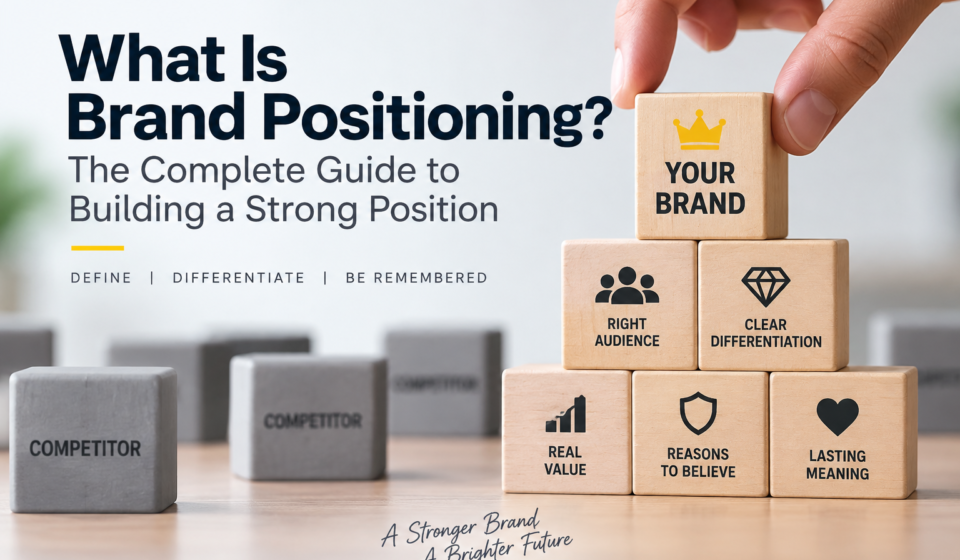

Why do people think of Volvo and immediately associate it with safety?
Why does IKEA mean affordable, functional design for millions of people?
Why can a three-word phrase like “Just Do It” instantly bring Nike to mind?
And why do some brands become the first name people remember in a category while others remain almost invisible?
The answer is not simply advertising.
It is not the logo.
And it is definitely not just the tagline.
It is positioning.
Brand positioning is the strategic decision about what you want your brand to mean, who you want it to mean something to, and how you want it to be different from the alternatives.
In simple terms:
Brand positioning is the place you aim to own in the customer’s mind.
And that makes it one of the most important parts of brand strategy.
What Is Brand Positioning?
Brand positioning is the process of defining how a brand should be perceived by a specific audience relative to competing alternatives.
It answers a deceptively simple question:
“Why should this customer think of us instead of someone else?”
A positioning strategy brings together several decisions:
- Who is the brand for?
- What problem or need does it address?
- What category does it compete in?
- What does it offer that matters?
- What makes it meaningfully different?
- Why should customers believe the difference?
- What should customers remember about it?
Strong positioning doesn’t try to make a brand everything to everyone.
It does the opposite.
It gives the brand a clear territory to own.
A simple definition
If you remember only one definition from this article, remember this:
Brand positioning is the deliberate choice of the place a brand wants to occupy in the minds of its target customers.
That place is not necessarily a physical location or a market-share position.
It is a mental position.
When a customer hears your brand name, what should immediately come to mind?
That is the real positioning question.
Brand Positioning Is Not the Same as Branding
These terms are often used interchangeably, but they are not the same thing.
| Concept | What it means | Simple question |
|---|---|---|
| Brand | The meaning and associations people hold about a company, product or organization. | “What do people think of us?” |
| Branding | The activities and systems used to shape how the brand is experienced and remembered. | “How do we build and express the brand?” |
| Brand Strategy | The broader strategic framework defining the audience, positioning, promise, personality and direction of the brand. | “What are we trying to build?” |
| Brand Positioning | The specific territory and perception the brand aims to own relative to alternatives. | “What should we be known for?” |
| Brand Identity | The visual and verbal system used to express the brand. | “How should we look and sound?” |
| Tagline | A short phrase used to communicate or reinforce an idea associated with the brand. | “What phrase can reinforce the idea?” |
This distinction matters because a company can have beautiful branding and still have weak positioning.
You can have:
- a great logo,
- a sophisticated website,
- excellent advertising,
- a memorable tagline,
- strong social media,
and still leave customers wondering:
“But why this brand?”
That’s a positioning problem.
Why Brand Positioning Matters
Customers rarely have unlimited time or attention.
They simplify.
They categorize.
They create shortcuts.
When someone thinks about buying something, they don’t usually build a spreadsheet containing every possible brand and compare every feature.
They often start with a mental shortlist.
Positioning helps determine whether your brand gets onto that shortlist — and what role it plays once it gets there.
1. Positioning creates clarity
A clear position tells the organization what it should emphasize.
If a brand tries to simultaneously be:
- the cheapest,
- the most premium,
- the most innovative,
- the most traditional,
- the fastest,
- the most personalized,
- and the most sustainable,
the message can become meaningless.
Positioning forces prioritization.
2. Positioning creates differentiation
Most markets are crowded.
Customers often have multiple alternatives offering broadly similar products.
Positioning gives the brand a reason to occupy a distinct space.
The difference doesn’t have to mean inventing something nobody has ever seen.
It can mean owning a particular combination of:
- audience,
- need,
- benefit,
- experience,
- personality,
- price,
- or category.
3. Positioning improves consistency
When positioning is clear, advertising, content, product decisions, partnerships, design and customer experience can reinforce the same idea.
Instead of every campaign inventing a new story, the brand keeps building the same mental association from different angles.
4. Positioning can reduce price-only competition
If two brands look interchangeable, price can become an easy comparison.
A meaningful difference gives customers another reason to choose.
That does not mean positioning automatically creates premium pricing. But a brand with a clear and valued difference has more than price to communicate.
5. Positioning gives marketing a strategic direction
Marketing should not simply ask:
“What should we post this week?”
It should also ask:
“What perception are we repeatedly building?”
That is where positioning connects strategy with execution.
The Core Elements of Brand Positioning
A useful positioning strategy can be broken into several connected parts.
1. Target audience
You cannot position a brand meaningfully without knowing who you are trying to influence.
“Everyone” is rarely a useful positioning audience.
A better definition considers:
- Who they are
- What they need
- What they value
- What they currently use
- What frustrates them
- What influences their decisions
Positioning becomes stronger when the audience is specific enough to have a recognizable problem or desire.
2. Category
Customers need some mental context for what you are.
Are you:
- a search engine?
- a productivity platform?
- a luxury fashion house?
- a fast-food chain?
- a home-furnishing retailer?
- a financial service?
Your category gives customers a frame for comparison.
Sometimes, however, a brand can change the frame entirely by creating or redefining a category.
3. Customer problem
Strong positioning starts with the customer’s reality, not the company’s product catalogue.
What problem are you helping solve?
And what does that problem actually mean to the customer?
A functional problem might be:
“I need furniture for a small apartment.”
The deeper problem might be:
“I want my small home to feel like it reflects me.”
The better a brand understands the problem beneath the product, the more meaningful its positioning can become.
4. Value proposition
What valuable outcome does the customer get?
This is broader than a list of features.
A feature describes what the product has.
A benefit describes what it does.
Value explains why that matters to the customer.
5. Differentiation
This is the heart of positioning.
What makes your brand meaningfully different?
Difference alone isn’t enough.
A difference needs to matter to the target audience.
Being different in a way customers don’t care about isn’t strong positioning.
6. Reasons to believe
If you claim something, customers need evidence.
That evidence can come from:
- product performance,
- technology,
- heritage,
- customer reviews,
- expertise,
- distribution,
- partnerships,
- proof points,
- or actual customer experience.
Positioning is not simply what a brand says about itself.
It needs support from what the brand actually does.
7. Emotional meaning
The strongest positions often operate beyond functional benefits.
A product might provide transportation.
A brand might represent freedom.
A shoe might provide performance.
A brand might represent determination.
A home-furnishing retailer might sell furniture while representing a particular idea of everyday life.
The emotional layer often makes positioning more memorable.
Brand Positioning vs. USP: What’s the Difference?
Another common confusion is treating positioning and the Unique Selling Proposition (USP) as the same thing.
They overlap, but they aren’t identical.
A USP usually focuses on a distinctive reason to buy.
Positioning is broader.
It defines the overall place the brand wants to occupy relative to competitors and in the customer’s mind.
For example, a product might have a specific functional USP.
But the brand’s positioning could encompass:
- who it is for,
- what category it wants to own,
- its personality,
- its value proposition,
- its competitive frame,
- and the emotional meaning surrounding the product.
So:
USP = a distinctive selling reason.
Positioning = the broader strategic territory the brand wants to own.
Brand Positioning Examples
Positioning becomes much easier to understand when you look at real brands.
Volvo: Safety
Volvo is one of the clearest examples of a brand building a strong association around safety.
Volvo itself describes safety as a guiding principle dating back to its founding, and its current brand communication continues to emphasize protecting people. :contentReference[oaicite:2]{index=2}
Notice what makes this powerful.
Volvo doesn’t simply say “we care about safety.”
Its product development, safety innovations and communication have repeatedly reinforced the association.
That is the difference between a slogan and a position.
IKEA: Democratic design and accessible home furnishing
IKEA’s positioning is more nuanced than simply “cheap furniture.”
Its concept combines design, function, quality, sustainability and low price under its idea of Democratic Design. IKEA says this approach is intended to make good home furnishing accessible to many people. :contentReference[oaicite:3]{index=3}
And IKEA’s positioning can evolve.
In 2026, IKEA India announced a new brand position, “It All Starts at Home,” shifting its emotional focus toward the role Indian homes play in people’s lives and aspirations. :contentReference[oaicite:4]{index=4}
This is an important lesson:
Positioning is strategic, but it is not necessarily permanent.
A brand can evolve its position as customers, markets and culture change while still maintaining recognizable brand foundations.
Nike: Achievement and athletic inspiration
Nike’s positioning is not simply “we sell sports shoes.”
The company’s current mission focuses on bringing inspiration and innovation to every athlete in the world. :contentReference[oaicite:5]{index=5}
That creates a much larger territory than footwear.
It gives Nike room to build stories around:
- athletes,
- ambition,
- performance,
- culture,
- sport,
- and human potential.
That is also why Nike’s “Just Do It” became such a powerful brand asset.
The phrase reinforces the broader idea rather than functioning as an isolated advertising line.
Zomato: Food discovery, convenience and personality
Zomato offers another useful example because its positioning has evolved alongside the product.
What began primarily around restaurant discovery expanded into reviews, ordering, delivery and a much broader food-related digital experience.
Its distinctive communication style then added another layer: personality.
Our Zomato brand case study explores how utility, data, cultural relevance and personality combined to create a recognizable digital brand.
The lesson is important:
Positioning isn’t just what you sell. It is the meaning that accumulates around what you do.
How to Build a Brand Positioning Strategy
Now let’s move from theory to practice.
Here’s a simple framework you can use to develop positioning for a real brand.
Step 1: Define your target audience
Start with a specific group of people.
Don’t begin with:
“Our product is for everyone.”
Ask:
- Who has the strongest need?
- Who benefits most?
- Who is currently underserved?
- Who is most likely to choose us?
Step 2: Understand the customer’s problem
Talk to customers.
Read reviews.
Study search behaviour.
Look at complaints.
Study competitors.
Then ask:
“What is the customer actually trying to accomplish?”
Step 3: Map the competitive landscape
List the alternatives customers already have.
These aren’t necessarily only direct competitors.
Your real competitor may be:
- another brand,
- a different category,
- a cheaper solution,
- doing nothing,
- or solving the problem manually.
Ask:
“If our brand disappeared tomorrow, what would customers choose instead?”
That question can reveal your actual competitive environment.
Step 4: Identify your meaningful difference
Now ask:
“What can we credibly own that matters to this audience?”
Look for intersections between:
- what customers value,
- what competitors underdeliver,
- what your brand can genuinely provide,
- and what you can consistently prove.
Step 5: Choose your territory
This is the difficult part.
You cannot own every possible association.
You have to decide what you want to be known for.
Think of positioning as choosing a territory on a map.
Once you choose the territory, your product, messaging, campaigns and experiences should help you become more strongly associated with it.
Step 6: Build your reasons to believe
Write down the evidence behind your position.
If your positioning is about speed, prove speed.
If it is about safety, build safety into the product.
If it is about expertise, demonstrate expertise.
If it is about affordability, make the economics visible.
A position without proof eventually becomes advertising noise.
Step 7: Translate positioning into execution
Your positioning should influence:
- product development,
- pricing,
- distribution,
- content,
- advertising,
- social media,
- customer experience,
- partnerships,
- visual identity,
- and even what you choose not to do.
This is where positioning connects with your broader marketing strategy.
The Brand Positioning Statement
Once you’ve worked through the strategy, you can summarize it in a positioning statement.
A practical structure is:
For [target audience], [brand] is the [category/frame of reference] that [key benefit/difference] because [reason to believe].
For example, imagine a fictional skincare brand:
For urban professionals with sensitive skin, Brand X is the everyday skincare brand that combines dermatologist-informed formulas with simple routines because its products are designed around sensitive-skin needs without unnecessary complexity.
The point isn’t to publish this exact sentence as advertising.
A positioning statement is primarily a strategic alignment tool.
It helps the organization stay clear about who it serves, what it stands for and why it deserves consideration.
Positioning Map: A Simple Way to See Competitive Space
One useful positioning exercise is a perceptual map.
Imagine two dimensions that matter to customers.
For example:
| Low Price | High Price | |
|---|---|---|
| Functional | Budget option | Premium functional option |
| Emotional | Accessible lifestyle option | Luxury lifestyle option |
Now place competitors on the map.
You may discover:
- a crowded area,
- an underserved audience,
- an opportunity for differentiation,
- or a position that sounds attractive but has no real customer demand.
But don’t make the mistake of assuming that an empty space automatically equals an opportunity.
An empty position may be empty because nobody wants it.
Good positioning combines customer demand with competitive differentiation and organizational capability.
Positioning Is About What You Don’t Say Too
This is one of the most underrated parts of positioning.
Every brand has limited attention.
If you try to communicate ten different reasons to believe, customers may remember none of them.
Strong positioning therefore involves trade-offs.
Choosing what you will emphasize also means choosing what you won’t emphasize.
For example, a brand that wants to own premium craftsmanship may not want every communication to scream discount.
A brand positioned around simplicity may not want an overly complicated product experience.
A brand positioned around innovation needs more than futuristic advertising if the actual product experience feels outdated.
Positioning becomes real when strategic choices reinforce it.
Common Brand Positioning Mistakes
1. Trying to appeal to everyone
“We offer high quality, affordable prices, premium service, innovation and something for everyone” sounds safe.
It is also difficult to remember.
Specificity creates meaning.
2. Confusing a tagline with positioning
A tagline can express positioning.
It is not positioning itself.
3. Choosing a difference customers don’t care about
Being different is not automatically valuable.
The difference must matter.
4. Positioning based on internal opinions
Your team may think your brand is innovative.
Your customers may think it is complicated.
Positioning should be grounded in customer reality, not only internal belief.
5. Copying a competitor
If your positioning is essentially:
“We are like Competitor X, but slightly cheaper,”
you haven’t created a strong strategic identity.
6. Making a claim you cannot prove
“The best.”
“The fastest.”
“The most innovative.”
“The number one.”
These statements are easy to make.
They are much harder to own.
7. Changing position every few months
Brands need consistency for associations to build.
That doesn’t mean never evolving.
It means distinguishing between evolution and constant reinvention.
Can a Brand Have More Than One Position?
Yes — but there is an important distinction.
A large brand can serve multiple segments, markets and product categories.
It may therefore communicate different benefits to different audiences.
But if every communication creates a completely different perception, the brand can become fragmented.
The goal is usually to maintain a coherent central meaning while adapting how that meaning is expressed across audiences and contexts.
Think of it as a tree:
One strong trunk. Multiple branches.
Can Brand Positioning Change?
Absolutely.
Markets change.
Customers change.
Competitors change.
Technology changes.
Culture changes.
And brands sometimes need to change with them.
But repositioning is not simply changing a tagline.
It can involve changes to:
- target audience,
- product portfolio,
- pricing,
- distribution,
- customer experience,
- visual identity,
- communication,
- and even the category the brand competes in.
IKEA’s 2026 India positioning shift toward “It All Starts at Home” is a useful contemporary example of a brand evolving its emotional positioning while continuing to operate from established product and brand foundations. :contentReference[oaicite:6]{index=6}
The key question isn’t:
“Can we change our positioning?”
It is:
“What should change, what should remain recognizable, and why?”
How Positioning Connects With Brand Strategy
Positioning doesn’t exist in isolation.
It sits inside a larger strategic system.
A useful way to think about it is:
Audience → Problem → Insight → Positioning → Promise → Personality → Proof → Experience → Growth
Positioning acts like a bridge between understanding the customer and deciding how the brand should compete.
That is why a good brand strategy needs positioning at its center.
A Practical Brand Positioning Framework
Use this framework when working on a real brand.
| Question | Your answer |
|---|---|
| Who is our primary audience? | |
| What problem matters most to them? | |
| What alternatives do they currently have? | |
| What category are we competing in? | |
| What benefit matters most? | |
| What makes us meaningfully different? | |
| Why should customers believe us? | |
| What emotional association do we want to create? | |
| What should customers remember first? | |
| What will we deliberately NOT try to own? |
Once you’ve answered these questions, turn them into one clear positioning statement.
Brand Positioning in the Age of AI Search
There is another reason positioning is becoming increasingly important.
People are no longer discovering brands only through traditional search results.
They are asking AI systems questions such as:
- “Which project management tool is best for a small team?”
- “What brands are known for affordable Scandinavian design?”
- “Which CRM is best for startups?”
- “What companies are known for sustainable fashion?”
That means brands increasingly need to be understandable not only to people, but also to systems that summarize information about them.
This connects with the emerging discipline of Generative Engine Optimization (GEO).
But the fundamental principle remains the same:
If your brand is difficult to understand, it becomes difficult to describe.
Clear positioning gives your website, content, product pages, PR, reviews and other signals a coherent story to reinforce.
GEO does not replace positioning.
If anything, the growth of AI-generated answers makes clarity even more valuable.
Brand Positioning Checklist
Before finalizing your positioning, ask:
- Can we clearly describe our target audience?
- Do we understand the problem we’re solving?
- Do we know the alternatives customers compare us with?
- Is our difference meaningful?
- Can customers understand our value quickly?
- Can we prove our positioning?
- Does our product actually deliver what we claim?
- Does our communication consistently reinforce the position?
- Is the position distinctive enough to remember?
- Are we trying to own too many things?
- Does our positioning give marketing a clear direction?
If the answer to most of these is yes, you are moving from “branding” into actual strategic positioning.
Frequently Asked Questions About Brand Positioning
What is brand positioning in simple words?
Brand positioning is deciding what you want your brand to be known for in the minds of a specific group of customers compared with competing alternatives.
What is an example of brand positioning?
Volvo is a classic example because safety has been a long-standing part of how the company describes and develops its brand. IKEA is another example, combining design, function, quality, sustainability and affordability through its Democratic Design approach. :contentReference[oaicite:7]{index=7}
What is the difference between branding and positioning?
Branding is the broader process of building and expressing a brand. Positioning is the strategic choice of the distinct place the brand wants to occupy in the customer’s mind relative to alternatives.
What is a positioning statement?
A positioning statement is a concise internal description of the target audience, competitive frame, key benefit or difference and reason to believe. It helps align marketing and brand decisions around a common strategic idea.
Is a tagline the same as positioning?
No. A tagline is a communication device. Positioning is the underlying strategic idea the tagline may help communicate.
Can a small business use brand positioning?
Absolutely. In fact, smaller businesses can benefit from clarity because they usually cannot outspend larger competitors. A specific audience, problem and differentiated value proposition can give a small business a clearer reason to be considered.
Can brand positioning change over time?
Yes. Brands can reposition as customer needs, markets, competitors and business strategies change. The challenge is changing deliberately without destroying useful associations the brand has already built.
Why is differentiation important in brand positioning?
Because customers need a reason to choose one option over another. Differentiation gives the brand a meaningful basis for preference instead of forcing every decision into price or convenience.
Does brand positioning affect digital marketing?
Yes. Positioning influences what topics a brand creates content around, how campaigns are framed, what audiences are targeted, which channels are prioritized and what messages appear repeatedly across the customer journey.
Final Thought: Don’t Try to Be Everything
One of the biggest mistakes brands make is trying to communicate everything they can do.
But customers don’t remember everything.
They remember associations.
A brand becomes powerful when those associations become clear, relevant and consistent.
That is why positioning matters.
You are not simply deciding what your brand says.
You are deciding what you want people to remember when your brand is mentioned.
And that decision influences almost everything that comes afterward — your identity, messaging, campaigns, products, experiences and ultimately your brand strategy.
The strongest brands don’t necessarily own the entire market.
They own something meaningful in people’s minds.
And that is the real power of brand positioning.



Laser247club… sounds exclusive! Signed up and the bonuses were decent. Website’s alright, needs a bit of glam. Worth a look-see? Possibly: laser247club!