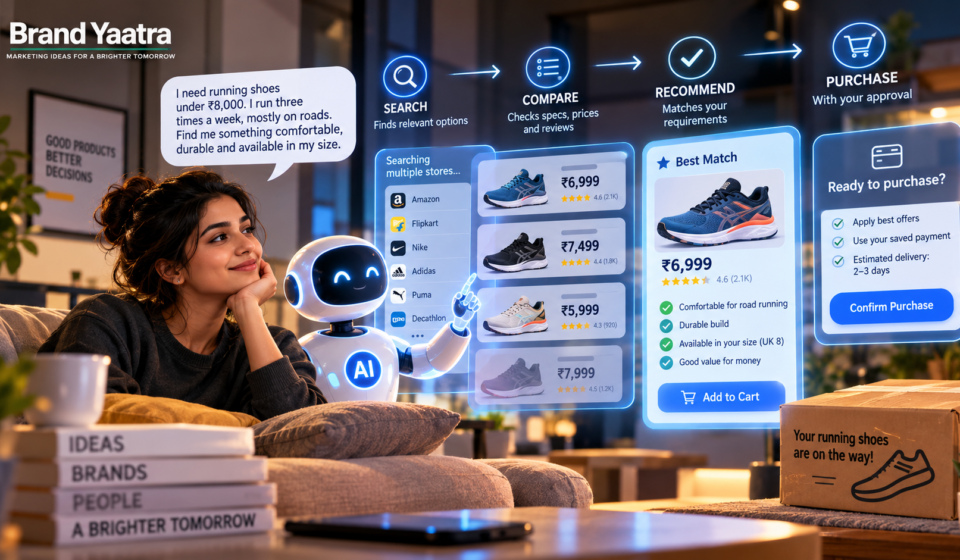

Imagine telling an AI:
“I need running shoes under ₹8,000. I run three times a week, mostly on roads. Find me something comfortable, durable and available in my size.”
Today, you might expect the AI to give you a list.
Tomorrow, the more interesting possibility is that it could do much more.
It could search.
Compare.
Check availability.
Consider your preferences.
Look at prices.
Apply your loyalty benefits.
Ask for your approval.
And potentially complete the purchase.
That is the basic idea behind agentic commerce.
And it could change one of the most fundamental assumptions in digital marketing:
What happens when the person browsing your website is no longer the only decision-maker in the buying journey?
Because an AI agent could become part researcher, part comparison engine, part personal shopper and eventually part transaction assistant.
This isn’t just a futuristic idea anymore.
In 2026, Google is building its Universal Commerce Protocol and Universal Cart, OpenAI is expanding product discovery through its Agentic Commerce Protocol, and payment networks including Visa and Mastercard are developing infrastructure for AI-initiated transactions.
The technology is still evolving.
But the marketing implications are already worth understanding.
What Is Agentic Commerce?
Agentic commerce is commerce in which AI agents can help perform parts of the shopping journey on behalf of a person or business.
That can include:
- Discovering products
- Understanding requirements
- Comparing alternatives
- Checking product information
- Finding prices or offers
- Checking availability
- Building a cart
- Initiating checkout
- Completing transactions with appropriate authorization
The important word is agent.
A traditional search engine waits for you to search.
A chatbot answers your question.
An agent can potentially take a goal and perform multiple steps to accomplish it.
So the shift looks something like this:
Search: “Best running shoes under ₹8,000”
↓
AI assistant: “Here are five options.”
↓
AI agent: “I found three options that match your requirements, checked availability, compared them and prepared the best match for your approval.”
That is a very different shopping experience.
We Have Already Moved Beyond the Search Box
For years, digital marketing was built around the idea that customers would visit platforms and websites themselves.
They would:
- Open Google
- Search for something
- Click a result
- Visit a website
- Compare products
- Add something to a cart
- Checkout
Then search became more conversational.
People started asking AI systems questions rather than simply typing keywords.
Our article on how Google Search is changing in the age of AI search explores that transition.
But agentic commerce takes the idea one step further.
The AI doesn’t necessarily stop at:
“Here are some products you might like.”
It can potentially continue toward:
“I’ve found the relevant options. Here’s what I recommend based on your requirements. Would you like me to proceed?”
The interface changes from searching to delegating.
Google Is Building for This Future
In January 2026, Google introduced the Universal Commerce Protocol (UCP), an open standard designed to help AI agents, retailers and commerce systems communicate across the shopping journey.
Google has described UCP as a common language for agentic commerce, with support for capabilities such as product information, cart operations, identity linking and checkout.
Then in May 2026, Google introduced Universal Cart.
The concept is bigger than a normal shopping cart.
Google says shoppers can add products while using Search, Gemini, YouTube and even Gmail, with the cart able to work in the background by finding deals, tracking price changes, checking availability and helping with product compatibility.
That is important because the shopping journey is no longer necessarily:
Search → Website → Cart
It can become:
Conversation → Discovery → Comparison → Cart → Decision → Checkout
And much of that can happen without the consumer manually moving between traditional web pages.
OpenAI Is Building a Similar Layer
OpenAI has also been developing infrastructure for commerce.
Its Agentic Commerce Protocol (ACP) is designed to connect merchants and shoppers inside ChatGPT.
OpenAI has expanded product discovery so users can visually browse products, compare options and receive current product information in conversation.
It has also introduced Instant Checkout for supported commerce experiences.
That creates an important distinction.
AI isn’t only becoming another place where people discover products.
It can become another environment in which the transaction itself happens.
For marketers, that distinction is enormous.
Because the Customer May Not Visit Your Website First
Think about traditional ecommerce.
A customer searches for:
“Best noise cancelling headphones under ₹20,000.”
They see search results.
They click an article.
They open Amazon.
They visit a brand website.
They watch a YouTube review.
They compare prices.
They read reviews.
They return to the product page.
Then they buy.
Now imagine the same person asking an AI agent:
“I travel frequently, need strong noise cancellation, have an Android phone and don’t want to spend more than ₹20,000. Compare the best options.”
The AI could potentially do much of that research before the customer ever sees a brand website.
This means the first battle may no longer be:
“Can I get the customer to click my link?”
It could become:
“Can the AI understand my product well enough to include it in the consideration set?”
This Changes What “Discovery” Means
Traditional search discovery is heavily page-oriented.
You create a page.
You optimize it.
You try to rank.
The user clicks.
Agentic discovery is more information-oriented.
The system needs to understand:
- What the product is
- Who it is for
- What it costs
- What variants exist
- Whether it is available
- What makes it different
- What evidence supports the claims
- How it compares with alternatives
- Whether it satisfies the user’s specific requirements
That means product information becomes more important.
Structured data becomes more important.
Product feeds become more important.
Inventory accuracy becomes more important.
Reviews become more important.
Brand positioning becomes more important.
And the consistency of information across the web becomes more important.
The New Marketing Question: Can an AI Understand Your Product?
This is one of the biggest changes marketers should start thinking about.
Historically, marketers asked:
“Will customers understand our product?”
Increasingly, there may be another question:
“Will AI systems understand our product accurately enough to recommend it?”
Those are related—but not identical—questions.
A product page might say:
“The ultimate solution for modern professionals.”
That sounds like marketing.
But it doesn’t tell an AI agent much.
What does the product actually do?
Who is it for?
What problem does it solve?
What are the specifications?
What are the limitations?
What makes it different?
What does it cost?
What versions exist?
Good agentic commerce requires useful information, not just persuasive adjectives.
Product Data Could Become a Marketing Asset
For years, product data was treated as operational information.
SKU.
Price.
Size.
Colour.
Inventory.
Availability.
Specifications.
But if AI agents become shopping intermediaries, that information becomes part of discoverability.
Google’s UCP developments already include capabilities for agents to retrieve relevant product information such as variants, inventory and pricing.
That means marketers and ecommerce teams increasingly need to work together.
Marketing can no longer treat the product feed as somebody else’s technical problem.
Why Brand Positioning May Become Even More Important
Here’s the paradox.
AI can compare hundreds of products extremely quickly.
That sounds like a win for consumers.
But it creates a problem for brands.
If every product is reduced to:
- Price
- Rating
- Features
- Specifications
- Discount
then differentiation can become increasingly difficult.
This is where brand positioning becomes important.
A strong brand needs to be understandable as something more than a collection of specifications.
Why should the AI consider your product relevant for this particular customer?
What territory does the brand occupy?
What audience does it serve?
What meaningful difference does it offer?
What evidence supports that difference?
Those questions don’t disappear because AI is doing the shopping.
They may become more important.
Imagine Two Brands Selling Almost the Same Product
Brand A says:
“Premium quality. Innovative technology. Designed for modern lifestyles.”
Brand B says:
“Designed specifically for commuters who spend 90+ minutes a day travelling by train. Lightweight construction, replaceable components and a two-year service program.”
Which one gives an AI system more useful information?
More importantly, which one gives the AI a clearer reason to match the product to a specific person’s requirements?
This is why vague positioning becomes increasingly dangerous in an AI-mediated marketplace.
AI Agents Could Change Advertising Too
Traditional advertising works by influencing people.
A billboard says:
“Try us.”
An influencer says:
“I love this.”
A search ad says:
“Click here.”
But an AI shopping agent may operate differently.
It could be asking:
“Which product best satisfies the user’s requirements?”
That creates a different competitive environment.
The winning signal may not simply be the loudest advertising.
It may be:
- Relevance
- Product fit
- Price
- Availability
- Quality of information
- Customer reviews
- Brand trust
- Compatibility
- Service terms
- Historical performance
Advertising doesn’t disappear.
But the path from advertising to purchase could become less direct.
The New Battle Could Be for the AI’s Shortlist
For years, marketers fought for:
Page 1.
Then:
Position 1.
Then:
AI citation.
Agentic commerce introduces another possible battleground:
Recommendation shortlist.
Imagine a customer asks:
“Find me a laptop for video editing under ₹1 lakh.”
The agent may consider dozens of possibilities.
But the user might only see three.
Your brand doesn’t necessarily need to be visible everywhere.
It needs to be relevant enough to enter the consideration set.
That makes discoverability a different kind of marketing problem.
This Could Also Reduce Impulse Buying
There is another interesting psychological consequence.
AI agents can potentially slow down certain decisions by introducing comparison.
Imagine seeing an advertisement for a ₹15,000 gadget at midnight.
Traditional ecommerce makes it incredibly easy:
See → Click → Add to cart → Buy.
An AI assistant might instead say:
“You already own a similar product. Here are three alternatives, and one is currently ₹4,000 cheaper.”
Now the system isn’t simply facilitating the purchase.
It is evaluating whether the purchase makes sense.
That changes the role of persuasion.
The question becomes less about creating an impulse and more about becoming the best answer to a need.
But Agents Don’t Automatically Make Better Decisions
This is important.
AI agents are not neutral or infallible decision-makers.
They depend on:
- The information they can access
- The quality of product data
- Their underlying models
- The instructions given by the user
- The integrations available
- The ranking or recommendation logic
- The commercial relationships involved
An agent can therefore make a recommendation that looks rational while still being incomplete or wrong.
That creates an entirely new trust problem.
Who Is Responsible When the Agent Gets It Wrong?
Imagine you tell an AI agent:
“Buy me the cheapest flight that arrives before 9 PM.”
It makes the purchase.
Then something goes wrong.
Who do you contact?
The airline?
The travel platform?
The AI company?
The payment provider?
The developer of the agent?
This isn’t merely a technical question.
It is a trust and accountability question.
And that is why payment companies are investing heavily in agentic commerce infrastructure.
Trust Becomes the Infrastructure
Visa describes its Intelligent Commerce work around the idea of securing AI-initiated transactions with payment credentials, controls, authentication and protections.
Mastercard has developed Agent Pay around concepts including registered agents, tokenized transactions and Verifiable Intent, which is designed to establish that an action was authorized by the user.
Mastercard has also expanded its merchant tooling in 2026 to help businesses make products discoverable across AI ecosystems while maintaining controls over how agents interact with their commerce systems.
In other words:
AI needs permission to act.
And businesses need mechanisms to control what it can do.
The “Buy Everything For Me” Future Is Not the Point
It’s easy to imagine an exaggerated future.
“My AI will buy everything for me.”
That may happen in some categories.
But agentic commerce doesn’t require complete autonomy.
There can be different levels of delegation.
Level 1: Discover
“Find options.”
Level 2: Compare
“Compare these options for me.”
Level 3: Recommend
“Which one fits my requirements?”
Level 4: Prepare
“Put the best one in my cart.”
Level 5: Ask
“Ask me before purchasing.”
Level 6: Delegate
“Buy it if it meets these conditions.”
The amount of autonomy can vary by person, product and transaction.
That is probably much more realistic than assuming everyone will immediately hand over complete purchasing control.
Recurring Purchases Could Be Especially Interesting
Think about products people buy repeatedly.
- Groceries
- Pet food
- Household supplies
- Office supplies
- Beauty products
- Supplements
- Replacement parts
These purchases don’t always require extensive emotional decision-making.
A person might eventually tell an agent:
“Keep this stocked and reorder when I’m likely to run out, but don’t spend more than ₹2,000 without asking.”
Now marketing isn’t necessarily trying to win a fresh click every month.
The brand is trying to become the trusted default inside an ongoing relationship.
That makes retention even more valuable.
Our guide to Customer Lifetime Value explains why the economics of a customer relationship can matter far beyond the first purchase.
This Could Change Customer Acquisition Economics
Imagine two ecommerce brands.
Brand A spends heavily to acquire every transaction through paid advertising.
Brand B becomes a trusted default for customers who have already purchased.
If an AI agent is later instructed to reorder the product, Brand B may not need to win the customer again from scratch.
The relationship already exists.
That means customer acquisition and retention could become even more tightly connected.
The marketer’s job becomes:
Win the customer → earn trust → become the preferred option → remain useful.
That’s a very different mindset from:
Run ad → get click → get sale → repeat.
What Happens to Brand Websites?
Some people see agentic commerce and conclude:
“Websites won’t matter anymore.”
That is far too early a conclusion.
In fact, the opposite may be true in important ways.
Your website can become the underlying source of:
- Product information
- Brand positioning
- Pricing
- Specifications
- Policies
- Reviews
- Service information
- Trust signals
- Original content
- First-party customer relationships
The interface may move elsewhere.
The underlying information still has to come from somewhere.
And merchants will still need ownership of their customer relationships, data and brand experience.
That is one reason the emerging commerce protocols emphasize connecting agents with merchant systems rather than simply replacing merchants’ infrastructure.
The Website May Become More Like an Information Layer
This is a useful way to think about it.
Today:
Website = storefront + information + transaction
Tomorrow, for some journeys:
Website = trusted source + product system + brand experience + transaction infrastructure
The customer-facing interface might be:
- ChatGPT
- Gemini
- A retailer’s app
- A personal AI assistant
- A voice interface
- A specialized shopping agent
Your website doesn’t necessarily disappear.
The number of interfaces that can sit between the customer and your website increases.
This Is Where SEO and GEO Start Connecting With Commerce
Traditional SEO is largely about being discoverable through search.
GEO focuses on improving how brands and information are understood and surfaced within generative AI experiences.
Agentic commerce adds another layer:
Can your products be discovered, understood, evaluated and acted upon by AI systems?
That doesn’t mean marketers should abandon SEO.
It means discoverability is expanding.
A useful modern framework might look like:
Search visibility + AI visibility + Product data + Brand authority + Trust + Transaction readiness
Each piece solves a different problem.
The Product Feed Could Become the New SEO Frontier
Consider what an AI agent needs when deciding whether to recommend a product.
It may need current:
- Price
- Availability
- Variants
- Specifications
- Delivery information
- Return policy
- Compatibility
- Merchant identity
If your product feed is inaccurate, your marketing can suffer even if your advertising creative is brilliant.
This creates a fascinating shift.
Operational accuracy becomes part of marketing performance.
Marketing and Ecommerce Teams May Need to Work Differently
Traditionally, teams can operate in silos.
Marketing handles:
- Campaigns
- Content
- Brand
- Acquisition
Ecommerce handles:
- Catalog
- Inventory
- Pricing
- Checkout
Technology handles:
- APIs
- Integrations
- Data
- Security
Agentic commerce connects all three.
An AI system can’t recommend a product accurately if marketing says one thing, the product feed says another and the inventory system says something else.
Consistency becomes infrastructure.
So What Should Marketers Do Now?
Don’t panic.
And don’t rebuild your entire ecommerce operation around an AI trend tomorrow morning.
Instead, start with the fundamentals.
1. Make your product information extremely clear
Don’t rely on vague marketing language.
Explain:
- What the product is
- Who it is for
- What it does
- What it doesn’t do
- What makes it different
- What versions exist
- What it costs
- What the customer needs to know before buying
2. Keep product data accurate
Prices, inventory, variants and specifications should agree across your commerce ecosystem.
3. Strengthen your positioning
If your brand sounds like everyone else, an AI comparison environment won’t magically make you distinctive.
Know what you want to be known for.
4. Build evidence
AI systems need information to work with.
Customers do too.
Build:
- Reviews
- Case studies
- Demonstrations
- Original research
- Expert content
- Useful comparisons
- Detailed product information
5. Think beyond clicks
Your product may increasingly be discovered without a traditional website click.
Start thinking about:
“How do we become the recommended option?”
not just:
“How do we get more traffic?”
6. Protect customer trust
If an AI agent represents your brand or transacts with customers, the rules around authorization, privacy, refunds, pricing and customer service become even more important.
7. Don’t abandon your brand
This might be the most important one.
AI can compare features.
AI can retrieve prices.
AI can summarize reviews.
But customers still need reasons to trust a brand.
Brand building doesn’t become irrelevant because AI enters the buying journey.
It may become more important.
What Happens to the Marketing Funnel?
The traditional funnel looked something like:
Awareness → Interest → Consideration → Intent → Conversion → Retention → Advocacy
Agentic commerce could compress some of those steps.
A customer might go:
Need → AI research → Recommendation → Purchase
But that doesn’t mean the funnel disappears.
The underlying questions remain:
- Did the customer discover you?
- Did they understand you?
- Did they trust you?
- Did you meet their requirements?
- Did they choose you?
- Were they satisfied?
- Would they choose you again?
The interface changes.
The psychology doesn’t disappear.
Our digital marketing funnel guide explains the broader journey from awareness to advocacy.
The Biggest Shift May Be From “Persuasion” to “Qualification”
This is where things get really interesting.
Traditional marketing often asks:
“How do we persuade the customer to choose us?”
Agentic commerce may increasingly ask:
“Can we prove that we’re the right choice for this customer’s specific situation?”
Those sound similar.
They’re not.
Persuasion is about influence.
Qualification is about fit.
If an AI agent is comparing options on behalf of a user, the brand needs to provide enough evidence for that system to understand why the product fits.
That could make relevance more important than raw promotional volume.
But Brands Still Need Humans
There’s another misconception worth challenging.
If AI agents do the comparison, marketers don’t need to understand people anymore.
Quite the opposite.
Someone still has to decide:
- Which customer problems matter?
- Which products should exist?
- What should the brand stand for?
- What experience should customers receive?
- What trade-offs are acceptable?
- What should the company refuse to do?
- How should the brand behave when something goes wrong?
Those are strategic questions.
AI can accelerate the work.
It doesn’t remove the need for judgment.
Our marketing strategy framework makes the same distinction: execution can become faster without making the underlying strategic decisions automatically better.
Agentic Commerce Is Also a New Competition for Platforms
There’s a bigger battle happening underneath all of this.
Who owns the customer relationship?
The retailer?
The marketplace?
The search engine?
The AI assistant?
The payment network?
The operating system?
The answer isn’t settled.
And that’s one reason so many companies are building protocols and integrations right now.
Everyone wants to participate in the new layer between intent and transaction.
For brands, that means another strategic question:
“Where will our customers meet us when the interface changes?”
What Agentic Commerce Could Mean for Smaller Brands
This isn’t necessarily only a game for Amazon-sized businesses.
In theory, smaller brands could benefit from AI agents because the agent can help match a niche product to a very specific need.
Imagine:
“I need a backpack for a 14-inch laptop, frequent train travel, one-day trips and heavy rain.”
A highly specialized product may not have the biggest advertising budget.
But if its product information is strong and its offering genuinely fits the requirements, an AI system may have a reason to surface it.
That doesn’t guarantee discovery.
And it certainly doesn’t eliminate competition.
But it creates the possibility that relevance can travel further than advertising reach.
The Risk: Commoditization
There is also a darker side.
If AI agents increasingly reduce products to comparable attributes, brands could become easier to substitute.
Imagine an AI saying:
“These four products meet your requirements. Product A is ₹2,000 cheaper.”
If the customer sees the products as interchangeable, the cheapest acceptable option can win.
That is a dangerous place for a brand.
It turns marketing into a spreadsheet.
And spreadsheets don’t create emotional preference very well.
That is why brand, reputation, distinctive assets and customer experience remain important.
If everything else looks similar, people need a reason to care.
The Opportunity: Becoming the Default
The opposite outcome is more interesting.
Imagine a customer telling their AI:
“Use the same brand I bought last time unless there is a strong reason not to.”
Now the brand has earned something incredibly valuable:
default status.
The customer doesn’t need to rediscover the category every time.
The AI doesn’t need to evaluate every competitor from scratch.
The relationship creates efficiency.
That is the intersection of:
Brand trust + customer satisfaction + data + convenience.
The Future of Marketing May Be Less About Getting Picked and More About Staying Picked
That may be one of the biggest implications of agentic commerce.
Winning the first purchase still matters.
But if AI agents become capable of managing repeat decisions, the value of being the customer’s trusted default could increase.
That makes:
- Product quality
- Customer experience
- Retention
- Reliability
- Brand trust
- Accurate information
- Consistent pricing and availability
marketing concerns—not just operational concerns.
What We Should Not Assume Yet
Agentic commerce is developing quickly, but several things remain uncertain.
We don’t yet know exactly how much shopping consumers will delegate to AI agents.
We don’t know which protocols will become dominant.
We don’t know how regulators will approach autonomous purchasing.
We don’t know how advertising economics will change if agents become major intermediaries.
We don’t know how much control consumers will want to give agents.
And we don’t know whether consumers will prefer one general-purpose agent or multiple specialized agents.
So marketers should avoid treating every prediction about “the future of shopping” as fact.
The infrastructure is being built.
The behaviour is still being shaped.
But One Thing Is Already Clear
The customer journey is becoming less dependent on a person manually visiting every digital destination.
Search engines are becoming more conversational.
AI assistants are becoming more capable of research and comparison.
Commerce platforms are building agent integrations.
Payment companies are building authorization and security layers.
Retailers are preparing product data for AI discovery.
The pieces are beginning to connect.
And that means marketers need to start thinking about a world where the customer interface is not always a screen full of products.
Sometimes it might be a conversation.
Sometimes it might be an AI recommendation.
Sometimes it might be an agent acting on a standing instruction.
Sometimes the customer may never see the individual product page before deciding.
Brand Yaatra Takeaway
Agentic commerce isn’t simply “AI shopping.”
It’s a potential shift in who—or what—participates in the buying decision.
For decades, marketers learned how to persuade people.
Now they may also need to learn how to make their products understandable to the AI systems helping those people make decisions.
That means the fundamentals become surprisingly important:
Clear positioning.
Accurate product information.
Strong customer experience.
Trust.
Useful evidence.
Good product data.
Distinctive brands.
AI may change the interface.
It may change the path to purchase.
It may even automate parts of the transaction.
But the fundamental marketing question remains:
Why should this customer choose you?
The difference is that, increasingly, you may have to make that answer clear not only to the customer—but also to the intelligent systems helping them choose.
Frequently Asked Questions About Agentic Commerce
What is agentic commerce?
Agentic commerce is commerce in which AI agents can perform parts of the buying journey on behalf of a person or business, such as discovering products, comparing options, preparing a cart or completing an authorized transaction.
Is agentic commerce the same as AI shopping?
Not exactly. AI shopping can simply mean using AI to discover or compare products. Agentic commerce goes further by allowing AI systems to perform actions within the commerce journey, potentially including transactions.
How is agentic commerce different from traditional ecommerce?
Traditional ecommerce usually requires the shopper to manually search, compare, navigate websites and complete checkout. Agentic commerce can delegate some of those steps to an AI agent operating according to the shopper’s instructions and permissions.
Will AI agents replace ecommerce websites?
There is currently no basis for saying that they will. Websites and commerce systems remain important sources of product information, brand experience, customer relationships and transactions. AI agents may become an additional interface between customers and those systems.
Why does product data matter for agentic commerce?
AI agents need accurate information to evaluate products. Pricing, availability, specifications, variants, compatibility and other product details can influence whether a product is considered relevant to a customer’s request.
Will SEO still matter in agentic commerce?
SEO is likely to remain relevant because search, websites, content and authority continue to influence digital discoverability. But marketers may increasingly need to think beyond traditional rankings toward broader AI and product discoverability.
What does agentic commerce mean for brands?
Brands may need to become easier for AI systems to understand, compare and evaluate while also maintaining strong positioning, trustworthy evidence, accurate product information and distinctive customer experiences.
Is agentic commerce already happening?
Yes, elements of it are already being deployed. Google is developing UCP and Universal Cart, OpenAI has introduced commerce infrastructure and product discovery capabilities, and payment companies such as Visa and Mastercard are developing systems for AI-initiated transactions. The scale and long-term consumer adoption of agentic commerce, however, are still developing.
What should marketers do about agentic commerce today?
Start with fundamentals: make product information clear and accurate, strengthen brand positioning, improve product feeds, build trustworthy evidence, understand AI-driven discovery and ensure your ecommerce systems can provide reliable information to emerging AI interfaces.



[…] means establishes one part of that territory. Our articles on AI becoming the product finder and AI becoming the shopper explore what happens further down the customer […]