
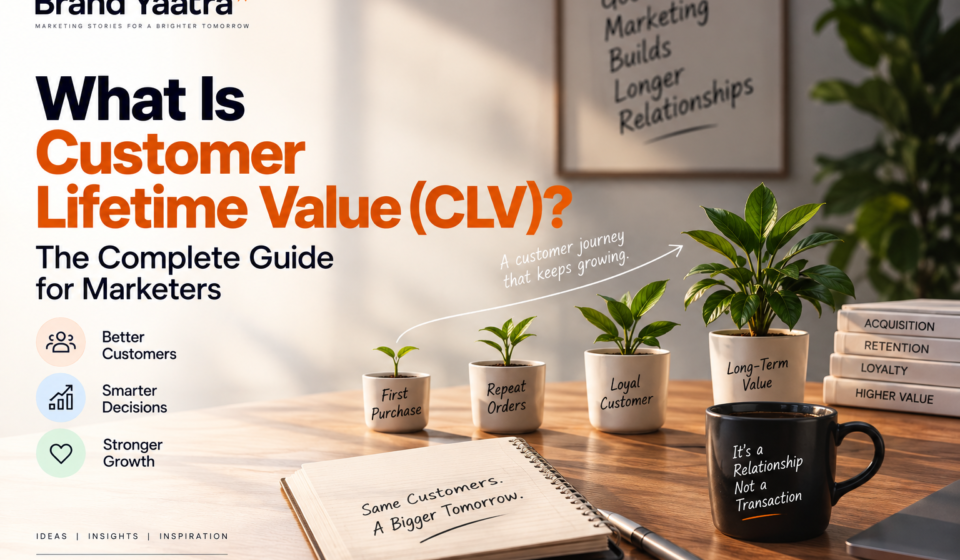

Imagine two customers walk into the same online store.
Customer A buys something for ₹2,000 and never comes back.
Customer B also spends ₹2,000 today—but comes back every few months, tries new products, upgrades occasionally and recommends the brand to friends.
Which customer is more valuable?
The first purchase doesn’t tell you.
That’s where Customer Lifetime Value (CLV) becomes useful.
CLV shifts the question from:
“How much did this customer spend today?”
to:
“How much value could this customer generate over the entire relationship with the business?”
For marketers, that change in perspective can affect how much a company is willing to spend to acquire customers, how it approaches retention, how it segments audiences and where it invests its marketing budget.
What Is Customer Lifetime Value?
Customer Lifetime Value (CLV) is an estimate of the value a customer generates for a business over the duration of their relationship with that business.
Depending on the formula being used, CLV can refer to expected revenue or expected profit from a customer. That distinction matters.
A simple revenue-based calculation looks at:
Average Purchase Value × Purchase Frequency × Average Customer Lifespan
For example, suppose a customer:
- spends ₹1,500 per purchase,
- buys four times a year, and
- remains an active customer for three years.
The simple revenue-based CLV would be:
₹1,500 × 4 × 3 = ₹18,000
That does not mean the company earns ₹18,000 in profit.
It means the customer’s estimated revenue contribution over that period is ₹18,000 under those assumptions.
More advanced CLV models can incorporate gross margin, retention probability, discount rates and other factors.
Why Does Customer Lifetime Value Matter?
Marketing can become dangerously short-term when every decision is judged by the immediate transaction.
A campaign generates 500 purchases.
Another campaign generates 300.
It is tempting to assume the first campaign was better.
But what if the 500 customers purchased once and disappeared?
And what if the 300 customers kept purchasing for three years?
Looking only at the first transaction can hide the difference.
CLV introduces a longer-term perspective.
It helps businesses think about customers not simply as individual transactions, but as relationships that can generate value over time.
That makes CLV particularly relevant to:
- customer acquisition
- retention
- loyalty programs
- personalization
- customer segmentation
- budget allocation
- product strategy
- customer experience
The Simple Customer Lifetime Value Formula
For many businesses, a practical starting formula is:
CLV = Average Order Value × Purchase Frequency × Average Customer Lifespan
Let’s break that down.
1. Average Order Value
Average Order Value, or AOV, tells you how much customers typically spend per transaction.
A simple formula is:
AOV = Total Revenue ÷ Number of Orders
For example:
If a store generates ₹10 lakh from 5,000 orders:
₹10,00,000 ÷ 5,000 = ₹200
The average order value is ₹200.
2. Purchase Frequency
Next, estimate how often the average customer purchases during a defined period.
Suppose your customers place an average of four orders per year.
Your annual purchase frequency is therefore:
4 purchases per year
3. Average Customer Lifespan
Finally, estimate how long the average customer remains active.
If the average customer stays for three years:
Average lifespan = 3 years
Putting It Together
If:
- AOV = ₹1,500
- Purchase frequency = 4 times per year
- Average lifespan = 3 years
Then:
CLV = ₹1,500 × 4 × 3 = ₹18,000
Again, this is a simplified revenue-based CLV.
A business interested in actual profitability would need to account for costs and margins rather than treating all ₹18,000 as profit.
CLV Is an Estimate, Not a Crystal Ball
This is one of the most important things to understand about CLV.
It is not a guaranteed amount of money a customer will generate.
It is an estimate based on historical or predicted behaviour.
Imagine a subscription company calculates that its average customer stays for 24 months.
That doesn’t mean every customer will stay for exactly 24 months.
Some will cancel after one month.
Some will stay for five years.
The number represents a pattern across a customer population or segment.
That means CLV becomes more useful when marketers understand how the number was calculated and what assumptions sit behind it.
Customer Lifetime Value vs Customer Acquisition Cost
CLV becomes particularly powerful when viewed alongside Customer Acquisition Cost (CAC).
CAC asks:
“How much does it cost us to acquire a customer?”
CLV asks:
“How much value might that customer generate over the relationship?”
Now imagine two businesses.
Business A
- Acquisition cost: ₹1,000
- Estimated customer value: ₹1,200
Business B
- Acquisition cost: ₹1,500
- Estimated customer value: ₹8,000
Looking only at acquisition cost could make Business A look cheaper.
But looking at the relationship between acquisition cost and customer value creates a very different picture.
That is why marketers often examine LTV:CAC—the relationship between lifetime value and customer acquisition cost.
There is no universal ratio that guarantees a healthy business across every industry or business model. The appropriate level depends on margins, growth stage, payback period, retention and many other factors.
Why Retention Can Change CLV So Dramatically
Consider a subscription business.
Suppose the average customer pays ₹500 per month.
If customers stay for six months, the simple revenue value is:
₹500 × 6 = ₹3,000
Now suppose the company improves the customer experience and average lifespan rises to 18 months.
The same customer relationship now represents:
₹500 × 18 = ₹9,000
The company didn’t necessarily need to triple the acquisition volume.
It changed the duration of the relationship.
That’s why retention is not merely a customer-service issue.
Retention can directly change the economics of marketing.
CLV and the Marketing Funnel
Most marketers are familiar with the idea of moving customers from awareness toward conversion.
But the relationship shouldn’t end at the purchase.
As we explored in the digital marketing funnel, the customer journey can continue into retention and advocacy.
CLV makes that later part economically visible.
A simplified journey might look like:
Awareness → Interest → Consideration → Conversion → Retention → Advocacy
The first conversion creates a customer.
Retention creates repeated opportunities to generate value.
Advocacy can create another layer through referrals, recommendations and word of mouth.
So a marketer who only optimizes the conversion stage may be optimizing one part of a much larger customer relationship.
CLV Changes How Marketers Think About Acquisition
Suppose you run an ecommerce business.
You have two advertising campaigns.
Campaign A attracts customers at ₹600 each.
Campaign B attracts customers at ₹900 each.
At first glance, Campaign A looks better.
But now examine the customers each campaign attracts.
| Metric | Campaign A | Campaign B |
|---|---|---|
| Customer acquisition cost | ₹600 | ₹900 |
| Average order value | ₹1,200 | ₹1,800 |
| Purchase frequency | 2 times/year | 4 times/year |
| Average lifespan | 1.5 years | 3 years |
| Simple revenue-based CLV | ₹3,600 | ₹21,600 |
Campaign B costs more to acquire a customer.
But the customers it attracts behave very differently after acquisition.
That’s the strategic value of CLV.
The cheapest customer to acquire isn’t necessarily the most valuable customer to acquire.
CLV Can Help With Customer Segmentation
Not every customer behaves in the same way.
A business might discover that it has:
- high-value repeat customers
- high-spending but infrequent customers
- frequent low-value customers
- discount-dependent customers
- one-time buyers
- customers who are becoming inactive
Looking at these groups separately can reveal patterns that disappear when everyone is treated as one average customer.
For example, a brand might discover that customers who purchase a particular product during their first order have significantly higher repeat-purchase rates.
That insight could influence:
- recommendations
- onboarding
- email campaigns
- bundles
- cross-selling
- loyalty programs
CLV therefore becomes more useful when combined with behavioural data rather than treated as a single number sitting inside a dashboard.
Why Discounts Can Be More Complicated Than They Look
Imagine a brand offers a large discount to attract new customers.
Sales increase.
Acquisition numbers look excellent.
But what happens afterwards?
If those customers only purchase when deep discounts are available, the initial acquisition may not create the same long-term value as a customer who buys at regular prices.
This is why marketers should be careful when evaluating promotional campaigns.
A discount can generate a conversion without necessarily creating a strong customer relationship.
Similarly, a free product can reduce the barrier to trial, but the real question is what happens after the trial. As we explored in why brands give away free products, the strategic logic depends on what the free experience eventually leads to.
Acquisition is only the beginning of the CLV story.
CLV and Customer Experience
Customer lifetime value can also change how companies think about customer experience.
Suppose a company knows that customers who receive faster support are significantly more likely to remain active.
Customer service may initially look like a cost centre.
But if better service increases retention, the company can potentially create additional customer value.
The same logic can apply to:
- faster delivery
- better onboarding
- product education
- personalized recommendations
- loyalty rewards
- simpler returns
- better customer support
The important question becomes:
Does this experience improve the relationship enough to create measurable long-term value?
CLV and Loyalty Programs
Loyalty programs are often designed around repeat behaviour.
A customer buys.
They earn points.
Points encourage another purchase.
Another purchase creates another reward.
The cycle continues.
But marketers should not assume that every loyalty program automatically increases CLV.
The program has to change behaviour enough to justify its cost.
If customers would have purchased anyway, the additional rewards may simply reduce margin without creating incremental value.
That’s why CLV analysis should ideally be combined with experiments or comparisons between customer groups.
Reviews, Trust and Lifetime Value
There is also a connection between CLV and trust.
A customer who trusts a brand may be more willing to return, explore additional products and recommend the company to others.
That doesn’t mean trust automatically produces a specific CLV increase. It means customer relationships contain more than the first transaction.
Our article on why we trust reviews from strangers explores one mechanism through which social proof can reduce uncertainty during purchase decisions.
The broader lesson is that customer value can be influenced by many stages of the relationship—not just the acquisition click.
Revenue-Based CLV vs Profit-Based CLV
This distinction deserves its own section because it is frequently misunderstood.
Suppose a customer generates ₹20,000 in revenue over three years.
That does not mean the customer generated ₹20,000 in profit.
The business may have incurred costs for:
- products
- shipping
- payment processing
- customer support
- returns
- discounts
- marketing
A more financially meaningful model may therefore incorporate contribution margin or profit rather than simply revenue.
For example:
Revenue-based CLV asks how much revenue the customer generates.
Profit-based CLV asks how much profit or contribution the customer generates after relevant costs.
Which version should you use?
That depends on the business decision you’re trying to make.
For an early marketing analysis, a simple revenue-based model can be useful.
For serious budget allocation, profitability matters much more.
How AI Is Changing CLV Analysis
Modern marketing systems can collect much more behavioural data than traditional marketers had access to.
That means CLV doesn’t necessarily have to remain a simple historical average.
Analytics platforms can use customer-level behaviour to estimate lifetime value and identify higher-value audiences.
Google Analytics, for example, includes lifetime value metrics based on purchase-related revenue and allows marketers to use LTV-related conditions when creating audiences.
AI and predictive analytics can take this further by identifying patterns across behaviours such as:
- purchase frequency
- product preferences
- engagement
- recency
- channel behaviour
- subscription activity
- churn signals
But there is an important limitation.
A more sophisticated model isn’t automatically a more accurate model.
If the underlying customer data is incomplete or the assumptions are wrong, a highly complex prediction can simply produce a more complicated version of the wrong answer.
Common Mistakes Marketers Make With CLV
1. Treating CLV as guaranteed revenue
CLV is an estimate based on assumptions and observed behaviour.
2. Confusing revenue with profit
₹10,000 in customer revenue does not equal ₹10,000 in customer profit.
3. Using one CLV for everyone
Different customer segments can have dramatically different purchasing behaviour.
4. Ignoring retention
If customers leave earlier than expected, the calculated CLV can become unrealistic.
5. Looking only at acquisition
A low CAC can look impressive until you discover that the acquired customers have very low repeat value.
6. Assuming every retention tactic works
Retention programs cost money too. Their incremental value should be measured rather than assumed.
7. Forgetting time
₹10,000 earned today and ₹10,000 expected several years from now are not necessarily financially equivalent. More advanced CLV models can account for the time value of money.
A Simple CLV Framework for Marketers
If you’re just beginning to use CLV, don’t start with a giant predictive model.
Start with five questions.
1. What is our average order value?
How much does a typical customer spend per transaction?
2. How often do customers purchase?
Look at purchase frequency over a defined period.
3. How long do customers stay active?
Estimate the average customer lifespan or retention period.
4. What does it cost to acquire them?
Calculate CAC using the relevant acquisition costs.
5. Which customer groups are most valuable?
Compare CLV across meaningful segments instead of relying only on one overall average.
That alone can give a marketing team a much better starting point.
What CLV Changes About Marketing Strategy
A good marketing strategy isn’t simply about getting more customers.
It is about deciding:
- which customers to pursue
- what value to offer them
- how to acquire them
- how to convert them
- how to retain them
- how to measure the relationship
CLV adds an economic lens to those decisions.
It can help marketers move from:
“How many customers did we acquire?”
toward:
“What kind of customer relationships are we actually building?”
That is a much more strategic question.
Frequently Asked Questions About Customer Lifetime Value
What does CLV stand for?
CLV stands for Customer Lifetime Value. It estimates the value a customer generates for a business over the duration of the customer relationship.
What is the basic CLV formula?
A common simple formula is:
CLV = Average Order Value × Purchase Frequency × Average Customer Lifespan
More advanced models can incorporate margin, retention probability and discount rates.
Is CLV the same as LTV?
The terms Customer Lifetime Value (CLV) and Lifetime Value (LTV) are often used interchangeably in marketing. The exact definition can vary by company or analytics system, so marketers should always check what their chosen formula actually measures.
What is the difference between CLV and CAC?
CLV estimates the value generated by a customer over the relationship. CAC measures the cost of acquiring that customer. Looking at both helps marketers understand the economics of customer acquisition.
Why is CLV important in digital marketing?
Digital marketing makes it possible to track customer behaviour across acquisition, purchase and subsequent interactions. CLV can therefore help marketers evaluate customers beyond the initial conversion and make better decisions about acquisition, retention and segmentation.
Can CLV increase?
Yes. CLV can increase when customers purchase more frequently, spend more per transaction, remain customers for longer, or become more profitable to serve. The exact drivers depend on the business model.
Is a higher CLV always better?
Not necessarily. A customer can generate high revenue while also being expensive to serve. CLV should therefore be interpreted alongside margins, acquisition costs, service costs and other relevant business economics.
Final Takeaway
The easiest way to understand Customer Lifetime Value is to stop looking at customers as transactions.
A transaction happens today.
A customer relationship can continue for months or years.
That difference matters.
A customer who spends ₹1,000 today might eventually generate ₹5,000, ₹10,000 or much more in revenue depending on the business model and relationship.
But the real value of CLV isn’t the number itself.
It’s the change in thinking.
Instead of asking only how much a customer is worth today, marketers can ask how valuable the entire relationship could become.
And once you start thinking that way, acquisition, retention, customer experience, loyalty, personalization and marketing budgets start looking like parts of the same system.



[…] This is why trial strategy connects directly with Customer Lifetime Value. […]
Alright, alright, alright! King33casino, huh? I’ve dabbled there a bit. The layout is pretty clean and easy to navigate. They have a decent selection of games, and I managed to snag a small win last week. Worth a look if you’re in the market! Check out king33casino yourself!