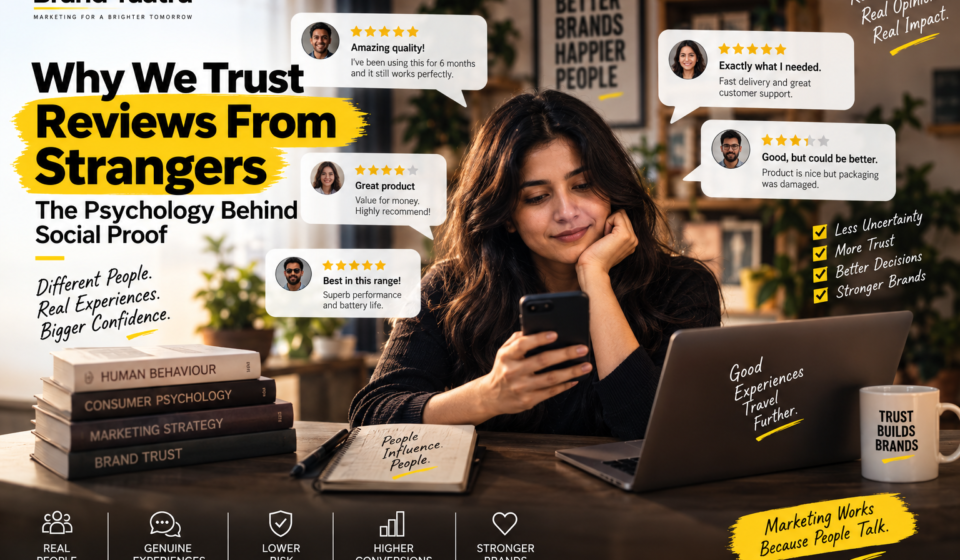

You are about to buy a ₹2,000 pair of headphones.
You have never heard of the brand.
The product page looks good. The specifications look impressive. The photos are great.
Then you notice something:
4.6 ★ from 18,000+ reviews.
Suddenly, the product feels safer.
Nothing about the headphones physically changed.
The price didn’t change.
The specifications didn’t change.
But your perception did.
Why?
Because thousands of strangers have already made the decision you are trying to make.
And that is the power of social proof.
We often look at what other people are doing when we are uncertain about what we should do ourselves.
That simple psychological tendency has become one of the most powerful forces in modern marketing.
Reviews, ratings, testimonials, “bestseller” badges, influencer recommendations, customer photos, waiting lists and even phrases such as “10,000+ marketers use this” are all variations of the same idea:
Other people have already chosen this. Maybe I should too.
What Is Social Proof?
Social proof is the tendency to use other people’s behaviour, opinions or experiences as information when deciding what to do.
It becomes particularly powerful when we are uncertain.
Imagine walking into two restaurants in a new city.
Restaurant A is almost empty.
Restaurant B has people waiting outside.
You know nothing else about either restaurant.
Which one feels safer?
Many people will instinctively interpret the crowd as a signal:
“If so many people are eating here, it is probably good.”
The crowd has become information.
That is social proof.
Why Do We Trust Other People’s Behaviour?
At its core, social proof helps us deal with uncertainty.
We cannot personally test every restaurant, hotel, phone, software product, doctor, course, investment or pair of shoes before making a decision.
So we look for shortcuts.
One of the most useful shortcuts is:
“What are other people doing?”
If thousands of people appear to have had a good experience with something, the perceived risk can fall.
This is particularly important for products or services where the customer cannot easily judge quality before buying.
Think about:
- Hotels
- Restaurants
- SaaS products
- Online courses
- Beauty products
- Electronics
- Apps
- Financial services
- Travel experiences
- Professional services
You often have to trust a promise before you can experience the product.
Social proof helps reduce that uncertainty.
The Psychology Behind Social Proof
Imagine your brain has two broad options when evaluating an unfamiliar product.
Option 1: Investigate everything yourself.
Compare competitors. Read specifications. Research the company. Analyse reviews. Look at alternatives. Search Reddit. Watch videos. Compare prices.
Option 2: Notice that thousands of people already bought it and many of them seem happy.
The second option requires much less mental effort.
This doesn’t mean consumers blindly copy everyone else.
It means other people’s behaviour can become an additional piece of evidence.
The psychological sequence often looks like this:
Uncertainty → Observe others → Interpret their behaviour → Reduce perceived risk → Feel more confident → Take action.
And marketers have become very good at placing social proof exactly where uncertainty is highest.
1. Reviews: “People Like Me Have Tried This”
Reviews are probably the most obvious form of social proof in digital commerce.
When you read:
“I’ve been using this for six months and the battery still lasts all day.”
you are not simply reading an opinion.
You are getting information from someone who has already experienced the product.
That can be more useful than a brand saying:
“Our battery technology is revolutionary.”
The brand has something to sell.
The customer appears to have something to report.
That difference matters.
Research on online reviews has found that characteristics such as concrete details and specific descriptions can contribute to perceptions of review trustworthiness.
In other words, this:
“Amazing product. Loved it!”
can feel less informative than:
“I bought this for a three-day trek. The battery lasted the entire trip and the GPS worked even when I had no signal.”
The second review gives your brain more information to work with.
2. Star Ratings: Turning Thousands of Opinions Into One Number
There is something fascinating about a star rating.
Thousands of individual experiences can be compressed into a single visual signal:
4.7 ★
That number gives us a quick answer to a difficult question:
“Is this probably good?”
But ratings are only useful when combined with context.
Consider two products:
Product A: 5.0 stars from 7 reviews.
Product B: 4.6 stars from 18,000 reviews.
The perfect score looks impressive.
But the second product may feel more credible because the sample is much larger.
This is why social proof is not simply about getting the highest number.
It is about making the evidence believable.
3. Negative Reviews Can Actually Make Reviews More Believable
This is one of the most interesting parts of social proof.
A product with nothing but perfect reviews can sometimes feel suspicious.
Real people are rarely completely aligned.
Someone will love the product.
Someone will dislike the colour.
Someone will complain about delivery.
Someone will say the product is excellent but too expensive.
Another customer will say exactly the opposite.
That variation can make the overall collection feel more authentic.
The important distinction is between negative reviews and bad experiences being ignored.
A negative review can provide useful information.
Suppressing legitimate criticism can destroy trust.
In fact, modern consumers increasingly look at the details inside reviews rather than simply accepting the overall star rating.
4. Testimonials: Let Your Customers Sell For You
Imagine a software company saying:
“Our platform helps businesses save time.”
Now imagine a customer saying:
“We reduced the time our team spends preparing reports from four hours to forty minutes.”
The second statement feels different.
It is specific.
It describes an outcome.
And most importantly, it comes from someone who supposedly experienced the result.
That is why testimonials are so common in marketing.
The brand is no longer making the entire argument by itself.
The customer becomes part of the argument.
5. “10,000+ Customers” Is Also Social Proof
Social proof doesn’t always require a testimonial.
Sometimes the number itself is the message.
You have probably seen phrases such as:
- 10,000+ customers
- 1 million downloads
- 500,000 creators use our platform
- Best-selling product
- Most popular plan
- Used by leading companies
Each statement answers a slightly different version of the same question:
“Has anyone else chosen this?”
And the answer is:
Yes. Lots of people.
That can reduce the psychological risk of being the first person to try something.
6. The Bestseller Badge
Imagine two identical-looking products.
One simply says:
Wireless Headphones
The other says:
#1 Bestseller
The second product has gained something that isn’t a technical feature.
Popularity.
The bestseller label tells you that other customers have already selected it.
That creates a shortcut:
“If many people chose this, there is probably a reason.”
This is especially useful when consumers are overwhelmed by choice.
Instead of evaluating 50 options independently, people can use social signals to narrow the field.
7. Influencers Turn Social Proof Into Personality
Reviews give you evidence from strangers.
Influencers add something else:
familiarity.
You may have never met the creator, but after watching hundreds of videos from them, they can feel familiar.
That creates a different psychological relationship from an anonymous five-star review.
The influencer becomes a recognisable person making the recommendation.
And that is why creator marketing can work particularly well when the creator’s audience believes the creator understands their interests.
But there is an important catch.
The moment audiences believe the recommendation is artificial, paid without transparency, or disconnected from the creator’s real experience, the social proof can weaken.
Credibility is the foundation.
8. User-Generated Content Makes Social Proof Feel Real
Suppose a skincare brand shows you a professionally photographed product.
Now imagine seeing 300 customers posting their own photos using it.
The second experience can feel more authentic because the product appears in normal environments rather than only in controlled advertising.
This is why user-generated content has become such a valuable marketing asset.
Customers are effectively demonstrating:
“This product exists in the real world, and people like me actually use it.”
That can be particularly powerful for products where appearance, lifestyle or experience matters.
9. Airbnb Built an Entire Trust System Around Social Proof
Consider a marketplace such as Airbnb.
Before booking a stranger’s home in another city, you face enormous uncertainty.
Is the place actually like the photos?
Is the host reliable?
Is the neighbourhood accurate?
Will the experience match the promise?
Reviews help answer these questions.
But Airbnb’s trust system goes beyond reviews.
Photos, host profiles, ratings, guest reviews, verification and other information all contribute to reducing uncertainty.
That creates an important marketing lesson:
Social proof works best when it is part of a larger trust system.
A five-star rating cannot compensate for a completely confusing product experience.
Trust is cumulative.
10. Why We Sometimes Follow the Crowd Even When We Don’t Know Why
Imagine you are walking through a shopping street and notice a huge crowd outside a café.
You don’t know whether the food is good.
You don’t know whether it is expensive.
You don’t know whether the service is fast.
But the crowd itself gives you information.
It suggests:
“Something is happening here.”
That can trigger curiosity.
And curiosity can lead to investigation.
This is why popularity signals don’t always need to directly say “buy this.”
Sometimes their job is simply to make something appear worthy of attention.
11. Social Proof Works Best When We Are Uncertain
This is the key principle marketers should remember.
If you are already an expert in a category, you may need very little social proof.
But if you are unfamiliar with the category, social proof becomes more useful.
Think about buying:
- Your first camera
- Your first CRM
- Your first investment software
- A restaurant in an unfamiliar city
- A hotel in a country you’ve never visited
- A skincare product you’ve never tried
The more uncertain the decision feels, the more useful other people’s experiences can become.
This is why social proof often appears close to the point of decision.
Right when the customer is asking:
“Should I actually do this?”
12. Social Proof and the Digital Marketing Funnel
Social proof can appear at almost every stage of the digital marketing funnel.
| Stage | Example of Social Proof |
|---|---|
| Awareness | Viral content, follower numbers, creator mentions |
| Interest | Customer stories, community activity |
| Consideration | Reviews, ratings, comparisons, testimonials |
| Intent | Bestseller labels, “most popular” plans |
| Conversion | Recent purchases, customer count, testimonials |
| Retention | Community, user stories, customer achievements |
| Advocacy | Reviews, referrals, UGC and recommendations |
So social proof isn’t just a conversion tactic.
It can become part of the entire customer journey.
13. Why “People Like You” Is More Powerful Than “Lots of People”
Here is another important distinction.
Not all social proof is equally persuasive.
Imagine you are buying running shoes.
A celebrity saying:
“These shoes are incredible.”
may catch your attention.
But a runner with your same problem saying:
“I have wide feet and usually struggle with this brand. These were comfortable even after a 15 km run.”
may feel much more relevant.
The second person appears closer to your situation.
This is why brands should not only ask:
“How many customers can we show?”
They should also ask:
“Can customers see themselves in those customers?”
Relevance can matter as much as volume.
14. The Power of Specificity
Compare these two testimonials:
“Great product. Highly recommended!”
versus:
“We used the platform to automate our weekly reporting and cut the process from half a day to less than an hour.”
The second one gives you something to evaluate.
It contains context.
It describes a problem.
It describes an outcome.
And it gives you a reason to believe the customer actually used the product.
Good social proof isn’t simply enthusiastic.
It is informative.
15. Why Fake Reviews Destroy the Entire System
Social proof depends on one thing:
belief.
If consumers stop believing reviews, ratings and testimonials, the mechanism becomes much weaker.
That is why fake reviews are more damaging than simply being dishonest.
They contaminate the information people use to make decisions.
The U.S. Federal Trade Commission’s final rule on consumer reviews and testimonials, which took effect in October 2024, addresses practices including fake or false reviews, buying or selling reviews, certain undisclosed insider testimonials, review suppression and fake social-media indicators.
The broader marketing lesson is simple:
Never manufacture the evidence that is supposed to create trust.
If customers are genuinely happy, the job of marketing is to make their real experiences easier to discover.
16. Why Some Brands Should Show Their Bad Reviews
This sounds counterintuitive.
Why would a company voluntarily show negative feedback?
Because transparency can itself become a trust signal.
A product with hundreds of reviews containing both positive and negative experiences may feel more believable than a product that somehow has nothing but perfect praise.
The goal should not be:
“Make every customer say something positive.”
The goal should be:
“Create experiences customers genuinely want to talk about.”
That is a much healthier marketing strategy.
17. Social Proof Can Become a Brand Asset
When a company consistently delivers good experiences, customer advocacy can become part of its brand.
Think about brands where you regularly hear:
- “Everyone uses it.”
- “My friends recommended it.”
- “You should try this.”
- “I keep seeing people talk about it.”
At that point, the marketing isn’t coming only from the company.
The market itself is reinforcing the brand.
This is one reason strong brands can develop momentum.
Customer experiences generate stories.
Stories generate conversations.
Conversations generate discovery.
Discovery creates new customers.
And those customers can create more experiences.
The brand starts feeding its own word-of-mouth loop.
18. Social Proof Meets AI
There is an interesting new development happening here.
Consumers are increasingly using AI tools to research products, services and businesses.
That means the traditional review isn’t only being read by a human anymore.
Reviews can become part of the information that AI systems summarise when helping someone make a decision.
This makes authentic customer experiences even more important.
Instead of thinking only about:
“How do we get five-star reviews?”
brands increasingly need to think about:
“What do real customers consistently say about us?”
That distinction matters.
Artificially generating hundreds of generic positive sentences may create volume, but it doesn’t necessarily create useful evidence.
Specific, authentic customer experiences are far more meaningful.
19. Social Proof Is Not the Same as Popularity
Here is an important warning for marketers.
More social proof does not automatically mean a better product.
A product can be popular and still be wrong for you.
A restaurant can have thousands of reviews and still not match your preferences.
A SaaS product can have millions of users and still be unsuitable for your company.
Social proof is information.
It is not a substitute for judgment.
That is why smart marketing uses social proof to reduce uncertainty without pretending that popularity proves everything.
The Social Proof Formula
A useful way to think about social proof is:
Evidence + Relevance + Authenticity + Context = Stronger Trust
Let’s break that down.
Evidence: Are there real experiences behind the claim?
Relevance: Does the customer resemble the person making the decision?
Authenticity: Does the evidence feel genuine rather than manufactured?
Context: Does the customer understand why the product worked?
When all four are present, social proof becomes much more powerful.
How Brands Can Use Social Proof Better
1. Show real customers
Don’t rely only on polished brand photography. Let customers demonstrate what the product looks like in real life.
2. Collect specific testimonials
Ask customers what problem they had, what they changed and what happened afterward.
3. Don’t hide all criticism
Legitimate negative feedback can provide useful information and make the review environment feel more authentic.
4. Match social proof to the customer
Show examples that are relevant to the audience’s situation, industry, lifestyle or problem.
5. Use numbers carefully
“100,000 users” sounds impressive, but explain what the number actually represents when context matters.
6. Put proof close to uncertainty
If customers hesitate at a particular point in the journey, that is where useful evidence should appear.
7. Never manufacture trust
Fake reviews may create a short-term appearance of credibility while destroying the very thing the strategy depends on: trust.
What Social Proof Teaches Us About Marketing
Social proof reveals something deeper about how marketing works.
People don’t make decisions using information alone.
They also look for signals.
They ask:
- Has anyone tried this?
- Did it work for them?
- Do people like me use it?
- What happens after I buy it?
- Can I trust the company?
- What are other people saying?
Good marketing doesn’t simply answer these questions with claims from the brand.
It creates an environment where customers can discover credible answers from other people.
That is why social proof is much more than putting five stars beside a product.
It is the marketing system that lets customer experience become evidence.
Final Thought
The strange thing about social proof is that the people influencing your decision may be complete strangers.
You don’t know their names.
You don’t know their lives.
You may never meet them.
Yet their experiences can change whether you click Buy Now.
That is because marketing isn’t only about what a brand says about itself.
It is also about what the market says about the brand.
And when enough real customers start saying the same thing, marketing becomes something much more powerful than advertising.
It becomes social proof.
Frequently Asked Questions
What is social proof in marketing?
Social proof in marketing is the use of other people’s behaviour, opinions, experiences or choices to reduce uncertainty and influence how potential customers perceive a product, service or brand.
Why do people trust online reviews?
Reviews provide information from people who appear to have already experienced the product or service. This can help potential customers reduce uncertainty and judge whether an offering may be suitable for them.
What are examples of social proof?
Common examples include customer reviews, star ratings, testimonials, influencer recommendations, user-generated content, bestseller badges, customer numbers, case studies, expert endorsements and community activity.
Can negative reviews increase trust?
They can contribute to perceived authenticity because completely perfect feedback may appear less realistic. More importantly, detailed negative reviews can give potential customers useful information about limitations and suitability.
Is social proof the same as word-of-mouth marketing?
They overlap but are not identical. Word-of-mouth is the broader process of people sharing information about brands and products. Social proof is the psychological influence that other people’s behaviour or opinions can have on our own decisions.
How can brands use social proof ethically?
Brands can use genuine customer experiences, transparent testimonials, authentic reviews, relevant case studies and real user-generated content. The key is to make genuine evidence easier to discover rather than manufacturing it.



[…] That’s where this topic connects with social proof. […]