
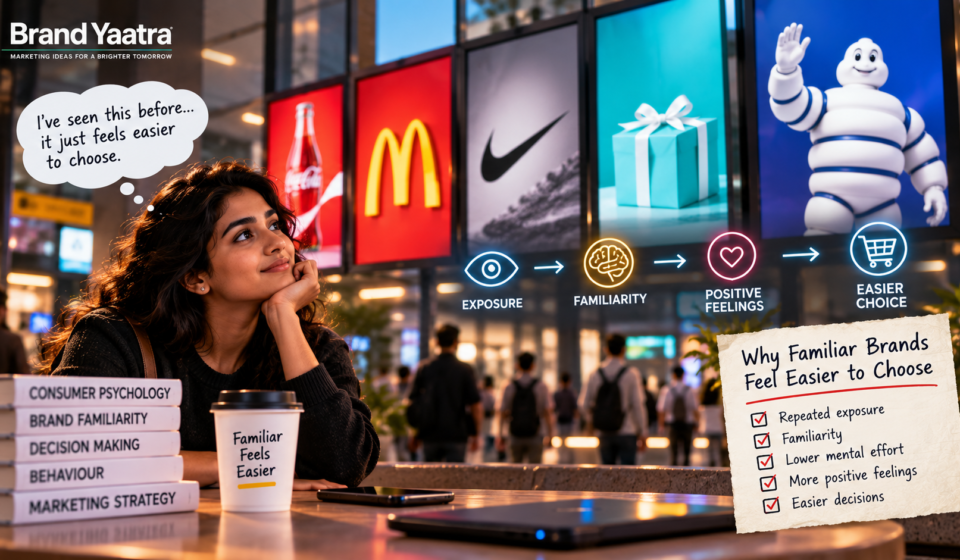

Have you ever picked a brand simply because it felt familiar?
Maybe you had never bought it before.
Maybe you couldn’t explain exactly why you trusted it.
Maybe you didn’t even remember seeing its advertisement.
But when you saw it sitting next to five unfamiliar options, one thought appeared almost automatically:
“I’ve seen this before.”
And somehow, that made the decision feel easier.
This is where one of the most interesting ideas in consumer psychology enters marketing:
The mere exposure effect.
In simple terms, repeated exposure to something can increase people’s familiarity with it and, under some conditions, make them evaluate it more positively.
It sounds almost too simple.
But think about what modern brands spend enormous amounts of money trying to achieve.
Recognition.
Familiarity.
Memory.
And eventually, preference.
So why does seeing something repeatedly sometimes make it feel more appealing?
And more importantly:
How much repetition is useful before marketing simply becomes noise?
What Is the Mere Exposure Effect?
The mere exposure effect describes a psychological phenomenon in which repeated exposure to a stimulus can increase positive feelings toward that stimulus.
The idea became especially influential through the work of psychologist Robert Zajonc, whose experiments found that repeated exposure could influence evaluations even when people were not deliberately studying the stimuli.
Later research extended the idea into consumer contexts, including products, brand names and advertising.
One important study published in Acta Psychologica found that attractiveness ratings for unfamiliar consumer products increased with exposure frequency under controlled conditions. The researchers also found that the effect was influenced by how much attention people paid to the products. :contentReference[oaicite:2]{index=2}
So the basic idea is:
Exposure → Familiarity → Potentially more positive evaluation
But there is an important word in that sentence:
Potentially.
Mere exposure does not mean:
“Show an advertisement 100 times and people will definitely buy.”
Marketing is much more complicated than that.
Why Does Familiarity Feel Good?
Imagine walking into a supermarket you’ve never visited.
You see twenty brands you’ve never heard of.
Then you notice one brand you recognise from advertisements, social media or previous shopping trips.
You may not know whether it is objectively better.
But it feels less unknown.
That matters.
Unknown products create uncertainty.
Familiar products reduce some of that uncertainty.
This doesn’t necessarily mean the familiar brand is objectively safer, better or more trustworthy.
It means your brain already has some information about it.
You’ve encountered it before.
That familiarity can make the brand easier to process.
And when something is easier to recognise and process, it can feel less mentally demanding.
The Important Difference Between Familiarity and Trust
Marketers sometimes say:
“People trust brands they know.”
That’s directionally understandable, but psychologically it is too simplistic.
Familiarity and trust are not identical.
You can be very familiar with a brand you don’t trust.
You can also trust a relatively unfamiliar brand because someone you trust recommended it.
That’s where this topic connects with social proof.
If someone recommends a brand to you, your evaluation can change because another person’s behaviour or opinion provides information.
Mere exposure is different.
You may simply have encountered the brand repeatedly.
That distinction matters because marketers shouldn’t treat every form of familiarity as proof of trust.
Why Seeing a Brand Repeatedly Can Make It Feel Less “New”
Imagine two products sitting next to each other.
Product A:
You’ve seen the name several times.
Product B:
You’ve never seen it before.
Even before you investigate their features, Product A has an advantage that Product B doesn’t:
It isn’t completely new to you.
That can change the mental starting point of the decision.
You don’t have to spend your first few seconds asking:
“What is this?”
“Who makes it?”
“Have I heard of this before?”
Instead, the brain can begin with:
“Oh, I’ve seen this.”
That tiny difference can matter in environments where consumers are making quick decisions.
This Is Why Brand Building Needs Repetition
One of the biggest misunderstandings about marketing is that every advertisement needs to be completely new.
New headline.
New colour.
New visual identity.
New tone.
New campaign idea.
New message.
New everything.
That can create a problem.
If every piece of communication introduces a completely different brand, consumers have to keep learning the brand again.
Brand building is partly about creating memories.
And memories need reinforcement.
This is why branding is much more than creating a logo or choosing a colour palette.
It is about repeatedly creating associations that people can recognise and remember.
But Doesn’t Repetition Become Annoying?
Absolutely.
And this is where the mere exposure effect becomes much more interesting.
More exposure isn’t automatically better.
There is a difference between:
“I’ve seen this before.”
and:
“I’ve seen this way too many times.”
Advertising repetition can become irritating when consumers feel bombarded, especially when the execution is intrusive or the message offers little additional value.
So marketers are balancing two forces:
Familiarity
versus
Fatigue.
The goal isn’t maximum repetition.
The goal is useful familiarity.
The Difference Between Repetition and Redundancy
Here’s a subtle but important distinction.
A brand can repeat its core assets without repeating the exact same advertisement.
For example, imagine a brand consistently uses:
- The same distinctive colour
- The same visual personality
- A recognisable character
- A recurring slogan
- A consistent tone of voice
The individual advertisements can still tell different stories.
The brand remains familiar.
The creative doesn’t have to become identical.
This is one reason strong brand systems are so valuable.
They allow brands to create variety without completely abandoning recognition.
Familiarity Can Work Before You Consciously Think About It
One of the fascinating parts of mere exposure research is that people don’t always need to consciously remember the earlier exposure for an effect to occur.
Research published in the Journal of Consumer Research found that exposure to brand names or product packages could influence attitudes even when the initial exposure was incidental rather than deliberately processed. :contentReference[oaicite:3]{index=3}
Other research has also examined unconscious familiarity and found that repeated exposure can influence attitudes independently of conscious recognition under experimental conditions. :contentReference[oaicite:4]{index=4}
That gives marketers an interesting lesson.
Your advertisement doesn’t always need to produce the thought:
“I remember seeing this advertisement.”
Sometimes the more subtle outcome is:
“This feels familiar.”
That is a very different marketing effect.
Why This Matters in a Crowded Category
Imagine you’re launching a new protein bar.
There are already dozens of products competing for attention.
Consumers may recognise:
- The established sports nutrition brands
- The supermarket brands
- The influencer-backed brands
- The brands they’ve seen on Instagram
- The brands they’ve seen at the gym
Your product may actually be better.
But consumers don’t automatically know that.
Before they can evaluate your superior ingredients, formulation or price, they first need to notice and recognise you.
That is why familiarity can be strategically valuable.
It can give a brand a chance to enter the consideration set.
But entering the consideration set isn’t the same as winning the sale.
That’s an important boundary.
Mere Exposure Is Not a Substitute for a Good Product
This is where marketers sometimes misuse psychology.
They learn about familiarity and conclude:
“We just need more advertising.”
Not necessarily.
Exposure can increase familiarity.
But familiarity doesn’t magically fix:
- A bad product
- A poor customer experience
- An uncompetitive offer
- Weak distribution
- Low perceived value
- A credibility problem
- A positioning problem
In fact, research on mere exposure and consumer decision-making has found that increased preference and increased valuation are not necessarily the same thing. :contentReference[oaicite:5]{index=5}
And research examining television advertising exposure found that exposure time alone had limited predictive value for short-term purchase behaviour compared with demographic information. :contentReference[oaicite:6]{index=6}
So:
Familiarity can help.
It isn’t the entire marketing strategy.
The Familiarity Effect Can Be Especially Interesting for New Brands
Established brands already have something new brands desperately want:
memory.
A new brand starts with almost nothing.
No recognition.
No associations.
No mental shortcuts.
No history.
That means every piece of communication has to work harder.
Repeated exposure can begin building the basic foundation:
“I’ve encountered this brand before.”
That may sound insignificant.
It isn’t.
Because recognition can be the beginning of a much larger journey.
Exposure
↓
Recognition
↓
Familiarity
↓
Consideration
↓
Evaluation
↓
Choice
The arrows aren’t automatic.
But familiarity can become one part of the system.
Why Distinctive Brand Assets Make Repetition More Useful
Suppose a brand appears in ten advertisements.
But every advertisement looks completely different.
Different colours.
Different typography.
Different tone.
Different visual style.
Different message.
Different personality.
The consumer may see the brand ten times without building a coherent memory structure.
Now imagine another brand whose advertising changes creatively but consistently carries recognisable cues.
The repeated exposure has something to attach itself to.
That is where the ideas of familiarity and distinctive brand assets begin to connect.
One creates repeated encounters.
The other helps those encounters feel like they belong to the same brand.
That is much more powerful than simply increasing impressions.
Why Some Ads Work Even When You Don’t Click Them
Digital marketers often evaluate advertising through immediate actions.
- Clicks
- Conversions
- Leads
- Purchases
- Cost per acquisition
Those metrics matter.
But they don’t capture everything advertising can do.
An advertisement can also:
- Build recognition
- Increase familiarity
- Strengthen memory
- Associate a brand with a category
- Reinforce existing brand cues
That doesn’t mean every impression is valuable.
It means marketers need to understand that some communication effects happen before the click.
A person might see a brand today.
Search for it three weeks later.
Encounter it again while shopping.
And finally choose it.
The final conversion event may not tell the whole story of how the brand became mentally available.
The Problem With “I’ve Seen It Everywhere”
There is another interesting psychological trap.
A brand can feel popular simply because you personally keep encountering it.
That doesn’t necessarily mean everyone is seeing it equally.
Your social feeds are personalised.
Your search results are personalised.
Your media consumption is personalised.
Your physical environment is different from someone else’s.
So marketers should be careful about assuming:
“I keep seeing this brand, therefore everyone knows it.”
That’s not a reliable conclusion.
Familiarity is partly personal.
It can also vary by audience, category, geography and media consumption.
How Mere Exposure Connects With Choice Overload
Now consider a consumer facing fifty options.
Most are unfamiliar.
Three are familiar.
Which ones are more likely to feel mentally accessible?
This doesn’t mean familiarity guarantees selection.
But familiarity can become particularly useful when consumers are trying to simplify a complicated choice.
That connects with what we explored in our article on choice overload.
When consumers face many alternatives, the decision itself can become cognitively demanding.
A familiar brand can sometimes reduce one piece of that uncertainty:
“At least I know this one.”
That doesn’t mean the familiar option is objectively better.
It means the mental starting point is different.
Familiarity Can Also Make Marketing Feel More Natural
Think about a brand you have encountered for years.
Eventually its advertising can feel almost like part of the environment.
You recognise the tone.
You recognise the visual language.
You recognise the product.
You may even recognise the campaign before reading the brand name.
That is a sign that repeated communication has created mental familiarity.
The brand no longer feels completely new.
And that is one of the long-term advantages of consistent brand building.
So How Often Should a Brand Advertise?
There is no universal number that works for every brand, audience, channel and campaign.
That is an important point.
Anyone promising a magical frequency number is oversimplifying the problem.
The right level depends on:
- Audience size
- Campaign objective
- Creative quality
- Media environment
- Purchase cycle
- Category involvement
- Competitive intensity
- Audience fatigue
Instead of asking:
“How many times should someone see this?”
A better question is:
“How can we create enough exposure to build familiarity without turning the communication into irritation?”
That’s a much more useful marketing question.
What Marketers Should Actually Repeat
If every advertisement needs to be different, what should remain consistent?
Start with the things you want people to remember.
1. Your Core Brand Idea
What should the brand stand for?
2. Distinctive Cues
What visual, verbal or sensory elements should trigger recognition?
3. Your Brand Voice
How should the brand sound?
4. Your Key Associations
What should people think or feel when they encounter the brand?
5. The Customer Promise
What does the brand repeatedly deliver?
The creative execution can change.
The underlying memory structure shouldn’t have to.
Five Marketing Mistakes Around Familiarity
1. Confusing Exposure With Preference
Seeing a brand repeatedly doesn’t guarantee that consumers will like it.
2. Confusing Familiarity With Trust
Knowing a brand exists isn’t the same as believing it is credible.
3. Repeating the Exact Same Advertisement Forever
Consistency doesn’t require creative stagnation.
4. Changing Every Brand Cue With Every Campaign
Creative variety is useful, but destroying recognition every time can make brand building harder.
5. Measuring Only Immediate Conversions
Some brand effects happen before a consumer clicks, searches or buys.
How Small Brands Can Use the Idea
A small brand doesn’t need a billion-dollar advertising budget to learn from mere exposure.
It can start by becoming consistent.
Use a recognisable visual identity.
Develop a clear point of view.
Repeat important ideas.
Show up in the places where the target audience actually spends time.
Keep the core brand cues consistent while allowing the creative execution to evolve.
And don’t expect one campaign to create decades of familiarity.
Brand memory compounds.
It takes time.
A Simple Familiarity Test for Marketers
Here’s a useful experiment for your next campaign review.
Step 1: Remove the Brand Name
Take several advertisements and hide the logo and brand name.
Step 2: Show Them to Your Target Audience
Ask:
“Which brand do you think this is?”
Step 3: Measure Recognition
Don’t just ask whether people liked the advertisement.
Ask whether they knew who it came from.
Step 4: Compare Campaigns
Look at whether recognisable brand cues remain consistent across different campaigns.
Step 5: Track Over Time
Brand familiarity isn’t built in one campaign.
Look for changes across repeated measurement rather than judging everything from one exposure.
The Bigger Lesson: Marketing Is Often Building Memory Before It Builds Demand
This is the part marketers sometimes forget.
A consumer doesn’t wake up every morning thinking:
“Which brand should I buy today?”
Most brands are competing for mental availability long before the purchase moment arrives.
When the need appears, consumers draw from what they already know.
That’s why familiar brands can sometimes start the decision with an advantage.
Not because familiarity proves quality.
Not because repeated advertising guarantees sales.
But because the brand has already occupied some space in memory.
And memory matters when attention is limited.
Final Takeaway
The next time you see an advertisement and think:
“I’ve seen this brand before.”
Don’t dismiss that reaction as meaningless.
It may be one small part of how brands become familiar.
Repeated exposure can influence how people evaluate previously unfamiliar stimuli, including consumer products and brand-related cues. But the effect is not unlimited, automatic or sufficient on its own to create purchase. :contentReference[oaicite:7]{index=7}
That’s why smart marketers don’t simply chase more impressions.
They try to make repeated exposure recognisable, relevant and coherent.
They give consumers something worth remembering.
Then they show up again.
And again.
And again.
Until the brand stops feeling like a stranger.
Because sometimes the first step toward choosing a brand isn’t loving it.
It isn’t trusting it.
It isn’t even wanting it.
Sometimes it’s simply this:
“I’ve seen this before.”
Frequently Asked Questions About the Mere Exposure Effect
What is the mere exposure effect in marketing?
The mere exposure effect is the psychological phenomenon in which repeated exposure to a stimulus can increase positive evaluation of that stimulus. In marketing, researchers have studied how repeated exposure can influence evaluations of products, brand names and advertising.
Does seeing an advertisement repeatedly make people buy the product?
Not necessarily. Mere exposure can influence familiarity and preference under some conditions, but repeated advertising alone does not guarantee purchase. Product quality, price, positioning, trust, competition and many other factors also influence consumer decisions.
What is the difference between familiarity and trust?
Familiarity means that a person recognises or has encountered something before. Trust involves a belief that the brand or company is credible, reliable or worthy of confidence. A familiar brand is not automatically a trusted brand.
Why is familiarity important for brands?
Familiarity can make a brand easier to recognise and mentally accessible when consumers encounter it again. This can be particularly useful in crowded categories where consumers have many unfamiliar alternatives.
Can too much advertising hurt a brand?
Yes. Repetition can eventually become irritating or create advertising fatigue, depending on the audience, creative execution, media environment and campaign frequency. The goal is not simply maximum exposure.
Is mere exposure the same as brand awareness?
No. Brand awareness is a broader concept involving whether consumers know or recognise a brand. Mere exposure is a psychological mechanism that can contribute to familiarity and evaluation under certain conditions.
How can small businesses use the mere exposure effect?
Small businesses can focus on consistent brand cues, repeated communication, a clear brand idea and regular presence in relevant channels. The goal is to build recognition over time rather than constantly changing the brand identity.