
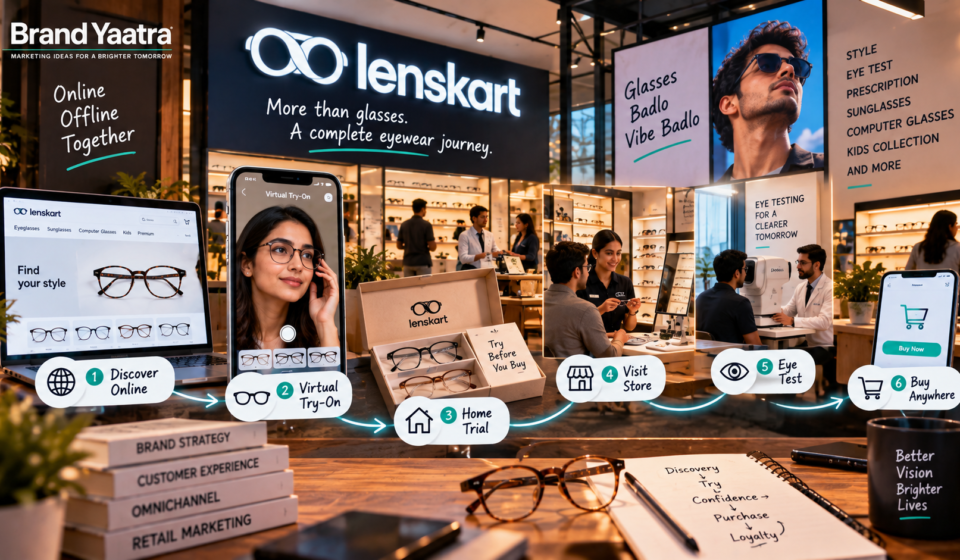

Buying glasses sounds simple.
Find a frame.
Try it.
Check whether it looks good.
Get the right prescription.
Pay.
Done.
Except it isn’t always that simple.
Eyewear is one of those products where customers often want to see, touch and try before buying.
At the same time, they want the convenience of browsing hundreds of options online, comparing styles, checking prices and ordering from home.
That creates an interesting marketing problem:
How do you make something that traditionally depends on physical experience easy to buy digitally?
Lenskart built much of its strategy around answering that question.
It didn’t simply move eyewear from stores to a website.
It built a system where digital and physical experiences could work together.
Virtual try-on.
Home trials.
Physical stores.
Eye testing.
Integrated inventory.
Digital browsing inside stores.
AI-powered recommendations.
And increasingly, technology that connects different parts of the customer journey.
That makes Lenskart an interesting marketing case study because the marketing isn’t limited to advertising.
The customer experience itself became part of the marketing strategy.
The Problem Lenskart Had to Solve
Imagine buying a pair of sunglasses online.
That can feel relatively easy.
You like the design.
You know your size.
You place the order.
But prescription eyewear introduces more uncertainty.
Will the frame fit?
Will it look good on my face?
Is the size right?
Will the prescription be correct?
What kind of lenses should I choose?
Do I need an eye test?
What if I don’t like the frame after receiving it?
The challenge isn’t simply getting people to discover glasses online.
The challenge is removing the uncertainty between discovery and purchase.
That distinction is central to understanding Lenskart’s strategy.
Lenskart Didn’t Treat Online and Offline as Separate Worlds
Traditional retail often thinks in channels.
Online.
Offline.
Store.
Website.
App.
But customers don’t necessarily think that way.
A customer might:
- Discover a frame on Instagram
- Browse it on the app
- Visit a store to try it
- Check another frame online
- Return home
- Complete the purchase digitally
Or the journey could happen in the opposite direction.
Someone might first visit a store for an eye test, then make a later purchase online.
Lenskart has explicitly described this kind of behaviour in its shareholder communications, noting that customers can move between online and store experiences rather than following one fixed channel. :contentReference[oaicite:1]{index=1}
That leads to a useful strategic idea:
The customer journey matters more than the channel.
And that is where Lenskart’s omnichannel strategy becomes interesting.
What Is Lenskart’s Omnichannel Strategy?
At a simple level, Lenskart connects several parts of the eyewear journey:
- Website
- Mobile app
- Physical stores
- Virtual try-on
- Home trial
- Eye testing
- Home eye testing
- Integrated inventory
- Digital browsing inside stores
- Personalised recommendations
The company describes its technology as integrating online and offline shopping into an uninterrupted customer journey. It also says its store and online inventories are integrated, allowing customers to browse digitally and complete purchases through different touchpoints. :contentReference[oaicite:2]{index=2}
That is more than simply having both a website and stores.
It means the channels are designed to work together.
The Genius Wasn’t “Online + Stores”
Lots of retailers have websites and physical stores.
That alone isn’t particularly unusual.
The more interesting question is:
What does each channel solve?
Digital can solve:
- Discovery
- Comparison
- Convenience
- Large product selection
- Personalisation
Stores can solve:
- Physical trial
- Fit
- Eye testing
- Human assistance
- Immediate reassurance
Home trial can solve:
- Convenience
- Physical uncertainty
- Decision confidence
Technology can connect all of them.
Instead of forcing customers into one journey, Lenskart can give them multiple ways to move toward the same outcome.
Finding the right eyewear.
Virtual Try-On Removed One of the Biggest Online Problems
There is a fundamental problem with buying glasses online:
You can’t see yourself wearing them.
At least, not physically.
Lenskart’s virtual try-on uses augmented reality to let customers see how frames look on their face in real time. The company positions this as part of its technology-led customer experience. :contentReference[oaicite:3]{index=3}
That changes the question from:
“Will these glasses look good on me?”
to:
“Let me see.”
That is a major reduction in decision friction.
The technology isn’t merely a cool feature.
It solves a specific customer problem.
And that’s an important lesson in marketing technology:
The best technology is often the technology that removes uncertainty.
Then Lenskart Added the Physical Trial Back In
Here’s where the strategy becomes even more interesting.
If technology can help you try glasses virtually, why offer physical home trials?
Because virtual confidence and physical confidence aren’t identical.
Lenskart’s home-trial service allows customers in supported cities to select up to five frames and try them at home before finalising a purchase. :contentReference[oaicite:4]{index=4}
Think about what that does psychologically.
The customer doesn’t have to make the decision based entirely on imagination.
They can physically see the frames.
Ask someone nearby.
Check the fit.
Compare options.
Then decide.
Again, the marketing lesson isn’t:
“Home delivery is cool.”
The lesson is:
Find the uncertainty preventing the purchase and design the experience around removing it.
Lenskart Turned Eyewear From a Need Into a Style Choice
There is another strategic shift happening here.
Glasses are functional.
You need them to see.
But they are also sitting directly on your face.
That makes them highly visible.
They can communicate:
- Style
- Personality
- Mood
- Professional identity
- Fashion preferences
Lenskart’s communication increasingly leaned into this idea.
Its 2024 “Glasses Badlo, Vibe Badlo” campaign with Karan Johar and Kiara Advani positioned changing eyewear as a way to change your style or vibe, encouraging consumers to think of frames as something they could vary across moods and occasions. :contentReference[oaicite:5]{index=5}
That is a very different proposition from:
“We sell prescription glasses.”
The product hasn’t fundamentally changed.
The meaning around the product has.
From One Pair of Glasses to a Collection
This is where the positioning becomes particularly interesting.
If glasses are purely functional, one pair may be enough.
But if glasses are part of personal style, different situations can justify different frames.
Work.
Casual.
Travel.
Parties.
Different outfits.
Different moods.
The 2024 campaign explicitly played with the idea of building a collection suited to different moods and occasions. :contentReference[oaicite:6]{index=6}
That expands the category opportunity.
The customer isn’t simply replacing a broken pair.
They can now have a reason to buy another.
This is an important branding principle:
Sometimes growth comes from changing the role a product plays in people’s lives.
Lenskart Made the Store Part of the Digital Experience
An omnichannel strategy doesn’t mean sending customers to a store whenever digital fails.
The store itself can become digitally connected.
Lenskart says its technology integrates store inventory with online inventory and enables digital browsing inside stores. It also uses technology for parts of store operations and queue management. :contentReference[oaicite:7]{index=7}
That creates an interesting reversal.
Instead of:
Online vs Offline
the model becomes:
Online + Offline.
The customer doesn’t have to care where the information lives.
They simply want the journey to work.
Technology Became Part of the Brand Experience
This is one of the biggest lessons from Lenskart.
Technology isn’t hidden somewhere in the backend.
The customer can experience it directly.
Virtual try-on.
Digital product browsing.
Home trials.
Eye-test access.
AI-powered assistance.
Lenskart’s current technology platform describes virtual try-on, omnichannel buying, remote optometry, self eye testing and integrated store operations. :contentReference[oaicite:8]{index=8}
Its FY26 shareholder communication also describes an AI-powered eyewear stylist that can analyse facial structure and style preferences and assist customers through video interaction. :contentReference[oaicite:9]{index=9}
That means the technology isn’t simply improving operational efficiency.
It is becoming part of the customer’s perception of the brand.
And that is powerful.
Convenience Became the Product Experience
This is where Lenskart connects with a broader pattern we’ve seen in other successful digital brands.
In our analysis of Swiggy’s marketing strategy, convenience became more than an advertising message because the product itself delivered it.
Lenskart follows a related principle.
The brand doesn’t only tell customers that shopping for eyewear can be easier.
It builds mechanisms that make it easier.
Browse online.
Try virtually.
Try at home.
Visit a store.
Get an eye test.
Compare.
Order.
Repeat.
Marketing communicates the promise.
The product experience proves it.
Lenskart’s Strategy Is Bigger Than Advertising
This is an important point because it is easy to look at a celebrity campaign and call it the marketing strategy.
But advertising is only one layer.
Consider the complete system:
Technology
↓
Better discovery and trial
↓
Lower uncertainty
↓
Higher purchase confidence
↓
More customer interactions
↓
More data and learning
↓
Better personalisation and experience
↓
Stronger customer relationship
Advertising then gives the system a public voice.
It makes the brand culturally visible.
It gives people a reason to think about eyewear differently.
But the experience underneath has to support the promise.
That Is Where Brand Strategy Enters the Picture
A useful way to understand Lenskart is through the lens of brand strategy.
A brand strategy asks:
- Who are we trying to matter to?
- What problem are we solving?
- What should we be known for?
- How are we different?
- Why should people believe us?
Lenskart’s customer experience gives those questions practical answers.
The problem isn’t merely “people need glasses.”
The experience is built around making eyewear easier to discover, try, choose and buy.
That is a much more interesting strategic territory.
It Also Changes the Positioning of the Category
There is an important difference between:
“We sell eyewear.”
and:
“We make finding the right eyewear easier and more expressive.”
The first describes a category.
The second starts to create a position.
That is why brand positioning matters.
A company can sell the same physical category as its competitors while competing around a different customer experience.
That experience then becomes part of the reason to choose the brand.
Lenskart’s Technology Flywheel
We can simplify the strategy into a flywheel:
More digital discovery
↓
More customer interaction
↓
More opportunities to reduce uncertainty
↓
More convenient purchase experiences
↓
More customers and repeat behaviour
↓
More data and learning
↓
Better personalisation and technology
↓
Better customer experience
↓
More reasons to choose the brand
That is much more defensible than simply buying more advertising.
And Lenskart Is Still Moving Beyond Eyewear Retail
The company’s technology ambitions are now extending into new areas.
Lenskart has invested in smart-glasses technology and described a broader push toward AI-driven products, personalised experiences and technology across its value chain. In 2025, it announced an investment in Mumbai-based deep-tech company Ajna Lens to accelerate work on AI-powered smart glasses. :contentReference[oaicite:10]{index=10}
Its FY26 shareholder communication also describes a strategic shift toward becoming more AI-driven, with AI being applied across customer experience, operations, product development and decision-making. :contentReference[oaicite:11]{index=11}
That doesn’t mean every new technology will automatically succeed.
It does show how the company’s definition of eyewear is expanding.
From:
Frames + lenses
toward:
Vision + technology + lifestyle + experience.
The Most Interesting Part Isn’t the AI
AI gets a lot of attention because it is new.
But the deeper lesson from Lenskart started much earlier.
Remove friction.
That is the thread connecting much of the experience.
Can’t imagine how the glasses look?
Try them virtually.
Still uncertain?
Try them at home.
Want professional assistance?
Visit a store.
Need an eye test?
Use the available testing options.
Want more choice?
Browse digitally.
Want convenience?
Move between digital and physical touchpoints.
Technology becomes valuable because it attacks friction.
Five Marketing Lessons From Lenskart
1. Don’t Just Digitise the Old Journey
Putting a traditional retail catalogue on a website isn’t necessarily digital transformation.
Ask what problems become possible to solve because the customer is digital.
2. Find the Real Purchase Friction
Customers don’t always abandon a purchase because they don’t want the product.
Sometimes they’re simply uncertain.
Find the uncertainty.
Then remove it.
3. Make Technology Solve a Human Problem
Virtual try-on matters because people want to know how they look.
Home trial matters because people want confidence.
AI recommendations matter if they make selection easier.
The technology is secondary.
The human problem is primary.
4. Turn Product Function Into Brand Meaning
Eyewear can correct vision.
But it can also express identity.
That creates a larger emotional and cultural territory for the brand.
5. Make the Experience Prove the Marketing
If advertising promises convenience but the buying journey is complicated, the brand loses credibility.
The strongest marketing claims are often the ones the product can demonstrate.
What Lenskart Teaches Marketers About Omnichannel Marketing
Omnichannel isn’t simply:
“We have a website and stores.”
It is:
“The customer can move between our touchpoints without feeling like they are starting over.”
That is a much higher standard.
The customer should not have to think:
“I’m now in the offline channel.”
or:
“I’m switching back to online.”
They should simply feel:
“I’m shopping with this brand.”
That is the real promise of an integrated customer journey.
The Bigger Lesson
Lenskart’s story isn’t really about selling glasses online.
It is about changing the way a category can be bought.
The company combined:
- Digital discovery
- Physical retail
- Virtual trial
- Home trial
- Eye testing
- Integrated inventory
- Technology
- Personalisation
- Brand communication
Each piece solves a different part of the customer journey.
Together, they reduce friction.
And that creates a powerful marketing principle:
Sometimes the best marketing strategy is to make the product easier to choose.
Not louder.
Not necessarily more aggressive.
Just easier.
Final Takeaway
Lenskart didn’t build its brand simply by advertising eyewear.
It built an ecosystem around the problems people face when buying eyewear.
How will these frames look?
Can I try them?
Do I need to visit a store?
Can I get an eye test?
Can I compare more options?
Can I order from home?
Can technology make this easier?
Each question represents friction.
And each piece of the Lenskart experience attempts to remove some of it.
That is what makes the case study interesting.
The marketing isn’t sitting separately from the product.
The customer experience is part of the marketing.
And that may be the biggest lesson of all:
Don’t just tell customers that your brand is convenient.
Build the journey so they can feel it.
Frequently Asked Questions About Lenskart’s Marketing Strategy
What is Lenskart’s marketing strategy?
Lenskart’s marketing strategy combines brand communication with technology, omnichannel retail, convenience, personalisation and customer-experience initiatives. Rather than relying only on advertising, the company uses its product and retail ecosystem to reduce friction in buying eyewear.
What makes Lenskart’s strategy different?
A major part of the strategy is the connection between digital and physical experiences. Customers can discover products online, use virtual try-on, visit stores, use supported home-trial services and access eye-testing options across different parts of the journey.
How does Lenskart use technology in marketing?
Technology is integrated into the customer experience through features such as virtual try-on, digital browsing, integrated inventory and increasingly AI-powered assistance and recommendations.
How does Lenskart use omnichannel marketing?
Lenskart connects its app, website, stores and other customer touchpoints rather than treating them as completely separate channels. The company says its online and store inventory are integrated to support a connected shopping experience.
What is Lenskart’s virtual try-on?
Lenskart’s virtual try-on uses augmented-reality technology to let customers see how selected frames look on their face before purchasing.
Does Lenskart offer home trials?
Yes. Lenskart currently offers a home-trial service in supported cities where customers can select up to five frames to try at home before placing the final order.
How did Lenskart make eyewear more fashionable?
Lenskart’s communication has increasingly positioned eyewear as an element of personal style rather than only a functional vision product. Campaigns such as “Glasses Badlo, Vibe Badlo” connected different frames with moods, occasions and personality.
What can other brands learn from Lenskart?
The broader lesson is to identify the friction preventing customers from buying and design the product, technology, retail experience and communication around removing it. Marketing becomes stronger when the customer experience can actually prove the brand promise.