
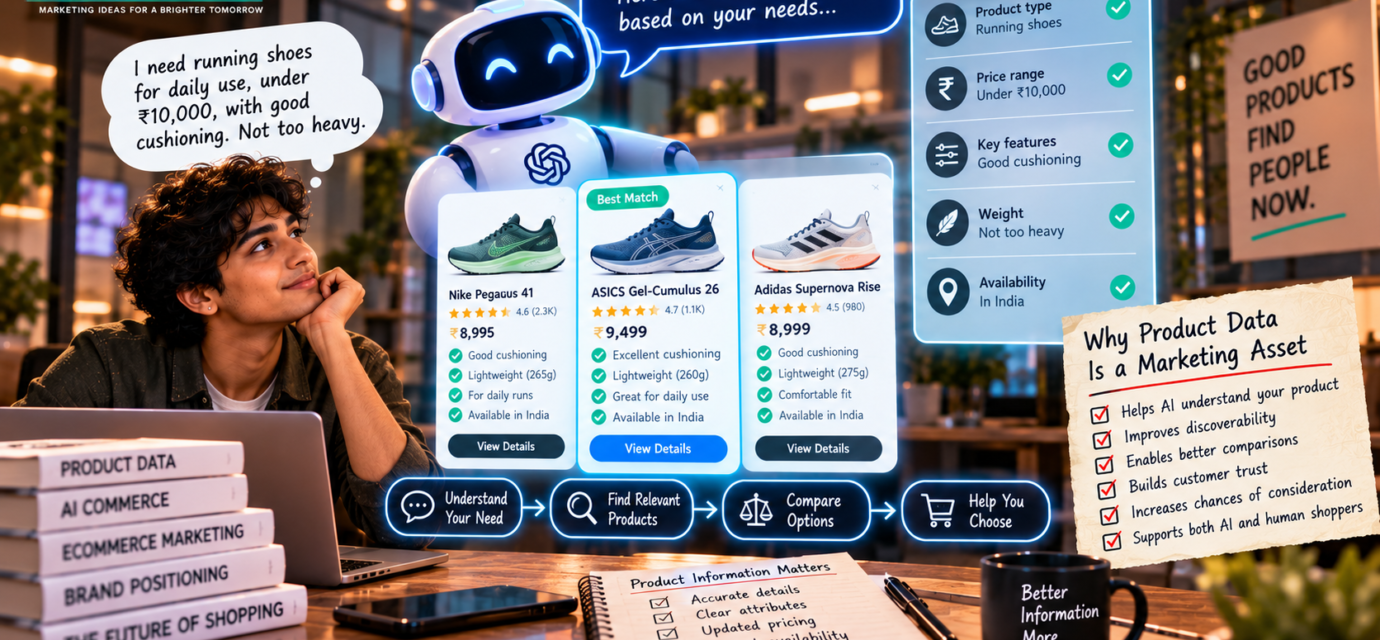

Imagine asking an AI:
“I need running shoes for daily use, under ₹10,000, with good cushioning, available in India, and I don’t want something too heavy.”
You aren’t really searching for a website anymore.
You’re describing a problem.
The AI can help interpret the problem, narrow the options, compare products and explain the trade-offs.
Now imagine you’re the brand selling one of those shoes.
Your marketing problem has changed.
It is no longer only:
“How do I get the customer to my product page?”
It increasingly becomes:
“Does the system helping the customer understand my product have enough accurate information to understand it correctly?”
That is a very different question.
And it is why product data is quietly becoming a marketing asset.
The Product Page Used to Be the Destination
For years, ecommerce marketing followed a relatively familiar journey:
Search → Click → Product Page → Compare → Buy
The marketer’s job was to get the customer to the product page.
SEO helped with discovery.
Paid advertising created demand.
Social media created attention.
Product pages provided information.
Reviews built confidence.
Checkout completed the transaction.
But AI-assisted shopping can compress several of those steps.
A customer can describe what they want conversationally.
The system can interpret the requirements.
Products can be compared side by side.
Features, prices, reviews and other details can be brought together.
The customer may therefore spend less time visiting individual product pages before narrowing the decision.
OpenAI’s current shopping experience explicitly describes product discovery around conversational requirements, visual browsing and side-by-side comparison, while its merchant documentation describes structured product feeds as the catalog information used to understand products accurately. :contentReference[oaicite:1]{index=1}
The implication is important:
Your product information may increasingly need to travel to the customer, rather than waiting for the customer to travel to your website.
What Exactly Is Product Data?
Product data sounds technical.
But most of it is simply the information a customer needs to understand what you’re selling.
That can include:
- Product name
- Brand
- Category
- Price
- Availability
- Colour
- Size
- Material
- Dimensions
- Features
- Specifications
- Images
- Reviews
- Variants
- Delivery information
- Returns information
- Product documentation
For a human, this might simply be a product page.
For a machine, it becomes structured information that helps it understand what the product actually is.
And that distinction is becoming increasingly important.
AI Doesn’t Need Your Product to Be “Creative”
This is where marketers sometimes approach the problem incorrectly.
They think:
“We need more AI content.”
Maybe.
But if an AI is helping someone choose between products, it first needs accurate facts.
Imagine two headphones.
Brand A’s information says:
- Weight: 250g
- Battery: 40 hours
- Active noise cancellation: Yes
- Water resistance: IPX4
- Price: ₹8,999
Brand B’s information says:
- Premium headphones
- Immersive sound
- Long battery life
- Designed for modern lifestyles
Brand B may have excellent advertising.
But when a customer asks:
“Which lightweight headphones under ₹10,000 have active noise cancellation?”
Specific information becomes much more useful than vague marketing language.
That doesn’t make brand storytelling less important.
It means factual product information becomes another layer of marketing infrastructure.
AI Shopping Is More About Matching Than Matching Keywords
Traditional search often starts with words.
A person types:
“best running shoes under 10000”
AI-assisted shopping can start with intent.
The customer might say:
“I run three times a week, mostly on roads. I have slightly wider feet, want good cushioning, and don’t want a heavy shoe. My budget is ₹10,000.”
That’s not just a keyword.
It’s a collection of constraints.
Budget.
Use case.
Frequency.
Terrain.
Fit.
Preference.
Weight.
The system needs product information detailed enough to match those requirements.
That changes the importance of product attributes.
The Hidden Marketing Problem: Incomplete Information
Now imagine your product has an excellent feature.
But the information isn’t clearly stated anywhere.
Your running shoe is lightweight.
But you never publish the weight.
Your laptop has a great battery.
But you don’t clearly specify the battery capacity or expected runtime.
Your skincare product is fragrance-free.
But the product data doesn’t clearly state it.
Your sofa is made from a particular material.
But the product description simply says “premium fabric.”
A human might discover the information through a salesperson, review or detailed research.
A machine may have less reliable evidence to work with.
That creates a marketing problem:
If an important product attribute isn’t clearly represented in your data, it becomes harder for a system to use that attribute when helping someone choose.
Google’s current Merchant Center documentation makes a similar practical point: accurate, correctly formatted product information is important for matching products to queries and for eligibility across Google’s shopping experiences. :contentReference[oaicite:2]{index=2}
Product Data Is Becoming Part of Discoverability
SEO taught marketers something important:
If search engines cannot understand your content, ranking becomes difficult.
AI shopping introduces a related challenge.
If an AI system cannot accurately understand your product, product discovery becomes harder.
That doesn’t mean traditional SEO is disappearing.
It means another layer of machine-readable information is becoming increasingly relevant.
Think about the evolution:
Website content
↓
Search engine understanding
↓
Product structured data
↓
AI-assisted discovery
↓
Conversational comparison
The interface changes.
The underlying need remains:
Machines need reliable information to understand what you’re offering.
Google Is Already Treating Product Data as AI Infrastructure
This isn’t only a theoretical future.
Google’s current Merchant Center documentation explicitly says product data is a foundational input for ads and AI-powered formats and experiences.
Google also provides product attributes designed for conversational experiences. For example, its current documentation for the document_link attribute says product documentation can be used primarily in conversational AI experiences to answer detailed product questions and guide research and buying decisions. :contentReference[oaicite:3]{index=3}
That is a revealing shift.
Product information isn’t only being used to display a shopping card.
It can increasingly help answer questions.
And answering questions is exactly where AI interfaces become powerful.
OpenAI Is Moving in a Similar Direction
OpenAI’s current commerce documentation describes product feeds as a way for merchants to provide structured catalog information to ChatGPT.
The feed can include information such as:
- Product identifiers
- Descriptions
- Pricing
- Inventory
- Media
- Fulfillment information
OpenAI says this information helps ChatGPT understand product attributes and present accurate product information in shopping experiences. :contentReference[oaicite:4]{index=4}
And its current shopping experience can use merchant and product metadata when selecting products and merchants relevant to a user’s intent. :contentReference[oaicite:5]{index=5}
Again, the important lesson isn’t:
“Everyone needs an OpenAI product feed tomorrow.”
The more useful lesson is:
Commerce interfaces are becoming increasingly dependent on structured product information.
This Changes What “Marketing Copy” Means
For years, product descriptions were often treated as copywriting exercises.
Make it persuasive.
Add benefits.
Use emotional language.
Include keywords.
Improve conversion.
Those things still matter.
But now there is another question:
Can the description be understood precisely?
Consider this:
Weak:
“Experience next-level performance with our powerful laptop built for today’s ambitious professionals.”
More useful:
“14-inch laptop with Intel Core Ultra 7 processor, 16GB RAM, 512GB SSD, 1.4kg weight and up to 15 hours of claimed battery life.”
The second version isn’t necessarily better advertising.
It is better product information.
And AI shopping systems need product information to make useful comparisons.
The strongest product page may therefore need both:
Persuasion + precision.
Reviews Become Even More Interesting
Imagine asking:
“Which of these three headphones are best for long flights?”
Product specifications can answer part of that question.
But reviews can reveal something specifications often cannot:
- Comfort over long periods
- Real-world battery performance
- Fit
- Durability
- Sound preferences
- Common complaints
That means customer-generated information can become increasingly useful to AI-assisted product research.
OpenAI’s current commerce documentation specifically lists reviews among recommended product-feed attributes that can improve relevance and user trust. :contentReference[oaicite:6]{index=6}
For marketers, this creates an interesting implication:
Reviews aren’t just social proof for humans. They can also become part of the information environment surrounding your products.
Availability Suddenly Matters More
Imagine the AI recommends a product.
The customer wants it.
Then discovers it’s unavailable.
That’s a terrible experience.
For AI-assisted shopping, stale inventory can therefore become especially problematic.
A recommendation needs to be useful at the moment the customer is making the decision.
That is why current commerce systems place significant importance on accurate availability and pricing data.
OpenAI’s commerce documentation describes regularly refreshed feeds containing pricing, inventory and fulfillment information, while Google’s Merchant Center documentation similarly emphasizes accurate availability and other product attributes. :contentReference[oaicite:7]{index=7}
The marketing lesson is surprisingly simple:
Don’t market a product as available if your machine-readable product information says otherwise.
The Product Feed Is Becoming a Marketing Channel
This is probably the biggest conceptual shift.
Marketers traditionally think about channels like:
- YouTube
- Influencers
- Retail
But product feeds are increasingly becoming part of the infrastructure that allows products to appear in machine-mediated shopping experiences.
The feed itself isn’t a marketing campaign.
It doesn’t replace advertising.
But it can determine whether your products are represented accurately inside those experiences.
That makes product data strategically important.
Think of Product Data as Your Brand’s Machine-Readable Shelf
Walk into a physical store.
A shelf communicates a lot.
Product name.
Price.
Packaging.
Size.
Colour.
Features.
Availability.
Promotions.
Everything helps the shopper make a decision.
Now imagine an AI shopping interface.
It needs a digital equivalent of that shelf.
Product data is part of that shelf.
It tells the system:
“Here is what this product is.”
“Here is who it may be suitable for.”
“Here is what it costs.”
“Here is what is available.”
Here is how it differs from alternatives.
This Also Changes the Role of Ecommerce Teams
Product data has historically been treated as an operational responsibility.
Someone uploads the catalogue.
Someone updates prices.
Someone changes stock.
Someone adds images.
Done.
But when product information becomes part of discovery, ecommerce data quality becomes a marketing concern too.
Marketing teams should care about:
- Whether product attributes are complete
- Whether descriptions are accurate
- Whether product variants are correctly represented
- Whether images match the actual product
- Whether pricing is current
- Whether availability is accurate
- Whether reviews are connected correctly
- Whether important product differences are clearly documented
In other words:
Product information is no longer just back-office data.
It can influence how the market understands the product.
AI Makes Bad Product Information More Dangerous
There is another side to this.
If an AI system relies on inaccurate information, it can produce an inaccurate recommendation.
Imagine:
Your product is actually available.
But your feed says out of stock.
Your product weighs 1.2kg.
But the catalogue says 1.8kg.
Your product comes in three sizes.
But only one variant is represented.
Your latest price is ₹7,999.
But an old feed still says ₹8,999.
Now the problem isn’t simply poor SEO.
It is poor machine-mediated customer experience.
Google’s Merchant Center documentation explicitly warns that inaccurate, missing or conflicting product information can result in incorrect displays, limited eligibility or other product-data problems. :contentReference[oaicite:8]{index=8}
Accuracy therefore becomes a marketing discipline.
AI Doesn’t Remove the Need for Brand Positioning
This is important.
Some marketers might hear all of this and conclude:
“Fine. We’ll just optimise product attributes.”
But products don’t exist in isolation.
Imagine an AI asks:
“Which running shoe is best for someone who wants a premium daily trainer?”
Technical specifications matter.
But so does how the brand is understood.
Is it performance-oriented?
Premium?
Affordable?
Minimalist?
Fashion-forward?
Specialised?
Beginner-friendly?
This is where brand positioning remains important.
AI can compare facts.
Brands still need meaning.
The New Product Discovery Journey
The traditional journey might look like:
Search → Website → Product Page → Compare → Buy
The emerging AI-assisted journey can look more like:
Need → Conversation → Requirements → Product Discovery → Comparison → Decision → Purchase
Notice what’s changed.
The starting point isn’t necessarily a keyword.
It’s a need.
The middle isn’t necessarily ten browser tabs.
It can be a conversation.
And the comparison can happen before the customer visits the merchant.
That makes the information surrounding your product more important.
This Is Why AI Changes More Than Search
We explored the changing consumer journey in our article on how AI is changing the way people buy.
The important shift is that AI can increasingly participate in the consideration process.
It can help answer:
- What should I buy?
- Which option fits my needs?
- What’s the difference between these products?
- Which one is within my budget?
- What are the trade-offs?
- What do customers say about them?
Once the interface starts answering these questions, product data becomes part of the decision-making infrastructure.
What Marketers Should Start Auditing
You don’t need to rebuild your entire ecommerce operation overnight.
Start with a product-data audit.
1. Product Titles
Are they specific enough to identify exactly what the product is?
2. Product Attributes
Are important specifications clearly documented?
3. Variants
Are colour, size, material and other variations represented accurately?
4. Pricing
Does the displayed price match the current price?
5. Availability
Is inventory information current?
6. Images
Do the images accurately represent the product?
7. Reviews
Are genuine customer reviews accessible and correctly associated with the product?
8. Product Documentation
For technical products, are manuals, specifications and supporting documents available where appropriate?
9. Consistency
Does your website say the same thing as your product feed, marketplace listings and other distribution channels?
10. Machine Readability
Can systems reliably interpret the information you are publishing?
What About AI-Generated Product Descriptions?
AI can obviously help create product descriptions faster.
But speed creates another problem:
Scale can multiply mistakes.
If an AI generates descriptions for 50,000 products and invents, exaggerates or misstates even a small percentage of attributes, the resulting catalogue can become unreliable.
Google’s current Merchant Center documentation specifically includes requirements for identifying certain AI-generated product titles, descriptions and images in product data. :contentReference[oaicite:9]{index=9}
That doesn’t mean AI-generated product content is forbidden.
It means marketers need governance.
Use AI to accelerate.
Verify the facts.
Don’t let the machine manufacture product specifications.
Product Data and Marketing Campaigns Will Start Working Together
Product data doesn’t replace campaigns.
It supports them.
Imagine launching a new product.
Your marketing campaign creates awareness.
Creators demonstrate the product.
Search captures demand.
Social creates conversation.
Reviews create evidence.
Product data gives machines and platforms the factual foundation to understand what is being sold.
All of those layers need to agree.
If the campaign says:
“Lightweight running shoe.”
but the product data suggests something else, you have a consistency problem.
If the campaign says:
“Available now.”
but inventory says otherwise, you have a customer-experience problem.
If your advertising positions the product as premium but your product information is vague and incomplete, you have a positioning problem.
Marketing becomes stronger when all the layers tell the same story.
The Bigger Opportunity: Become Easier for Machines to Understand
This phrase might sound strange.
But it is increasingly useful.
Brands have spent decades trying to become:
- Easier for customers to notice
- Easier for customers to remember
- Easier for customers to trust
- Easier for customers to buy
Now there is another layer:
Easier for machines to understand.
That doesn’t mean writing robotic content.
It means being clear.
Structured.
Consistent.
Specific.
Accurate.
Well documented.
Easy to verify.
Those qualities are useful to humans too.
And that is what makes this shift interesting.
Five Marketing Lessons From the Rise of AI Product Discovery
1. Product Data Is Part of Marketing Infrastructure
Product information can influence how platforms and AI systems understand what you sell.
2. Specificity Beats Vague Marketing Language When Customers Need Comparisons
“Premium performance” tells you less than a clear specification.
3. Accuracy Becomes More Important as Machines Mediate Decisions
An incorrect fact can become an incorrect recommendation.
4. Brand Meaning Still Matters
Specifications can explain a product.
Positioning helps explain why the brand belongs in the consideration set.
5. The Best Product Information Serves Both Humans and Machines
Clear titles, useful attributes, strong images, accurate pricing, availability and genuine reviews help customers whether the interface is a website, search engine or AI assistant.
A Practical AI-Commerce Readiness Checklist
| Area | Question |
|---|---|
| Product titles | Can someone immediately understand what the product is? |
| Attributes | Are important specifications complete and accurate? |
| Variants | Are sizes, colours and other variants clearly represented? |
| Pricing | Does the product data match the current price? |
| Availability | Is stock information current? |
| Images | Do images accurately represent the product? |
| Reviews | Can customers find genuine evidence from other buyers? |
| Documentation | Are manuals and supporting information available where useful? |
| Brand | Is the product’s role in the brand clearly communicated? |
| Consistency | Do your website, feeds and other listings agree? |
Final Takeaway
The next generation of product discovery may not always begin with:
“Search Google.”
It may begin with:
“I need something that does this.”
And then an AI helps work out what fits.
When that happens, the brand needs more than a clever advertisement.
It needs accurate information.
Clear product attributes.
Current pricing.
Reliable availability.
Useful reviews.
Good imagery.
Strong documentation.
Consistent positioning.
And a product experience that actually matches the promise.
Because if AI increasingly becomes part of the path between need and purchase, then product data is no longer just catalogue administration.
It becomes part of how the market understands your product.
And that makes it a marketing asset.
The future of product marketing may not just be about being seen.
It may be about being correctly understood.
Frequently Asked Questions About AI Product Discovery
What is AI product discovery?
AI product discovery is the use of AI-powered interfaces to help people find, understand and compare products based on natural-language needs, preferences and constraints.
Why is product data important for AI shopping?
AI systems need accurate information about products to understand attributes such as price, features, availability, variants and other details. Better product information can make product discovery and comparison more useful.
What product information should brands provide?
Important information can include accurate titles, descriptions, specifications, variants, prices, availability, images, reviews, delivery details and supporting documentation where relevant.
Is AI shopping replacing Google Search?
There is not enough evidence to say that AI shopping will replace traditional search. The more useful observation is that consumers now have additional ways to discover and compare products, including conversational AI experiences.
Does AI product discovery mean SEO is dead?
No. Traditional search remains important. AI product discovery adds another layer in which clear, accurate and structured information can help machines understand products and brands.
Can AI-generated product descriptions be used?
AI can help create product descriptions at scale, but businesses still need to verify factual accuracy and follow the requirements of the platforms where product information is submitted.
How can ecommerce brands prepare for AI shopping?
Start by auditing product titles, attributes, variants, pricing, availability, images, reviews, documentation and consistency across your website and product feeds. The goal is to make the catalogue accurate, complete and easy for both people and machines to understand.
Does product data replace brand positioning?
No. Product data helps explain what a product is and what it offers. Brand positioning addresses what the brand should mean to its target audience relative to alternatives. Both can matter in the consideration process.