What Is a Marketing Campaign? The Complete Guide to Planning, Running & Measuring One

You’ve probably heard a marketer say:
“We need a campaign.”
And then the team starts discussing ads, Instagram posts, emails, landing pages, influencers, offers and budgets.
But there’s a problem.
Those things are parts of a campaign.
They aren’t the campaign itself.
A marketing campaign is the bigger idea that connects them.
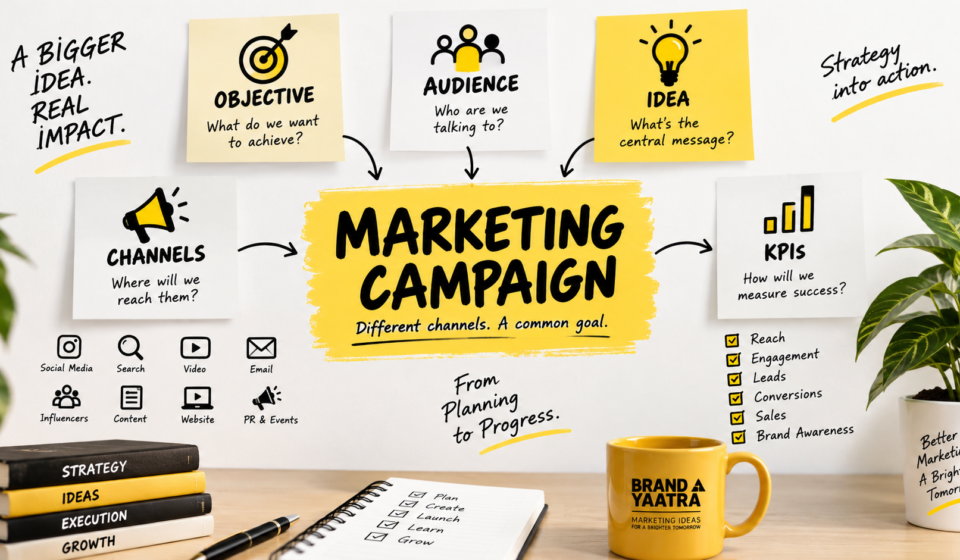
It gives different marketing activities a common objective, audience, message, timeframe and way to measure whether the effort actually worked.
That distinction matters because without a campaign structure, marketing can quickly become a collection of disconnected activities:
- One social media post here.
- A paid ad there.
- An email next week.
- A discount at the end of the month.
- A landing page nobody remembers to update.
Each activity might be perfectly fine on its own.
But if they aren’t working toward something together, you’re not necessarily running a campaign.
So, what is a marketing campaign? How is it different from a marketing strategy? What makes a campaign successful? And how do you actually build one?
Let’s break it down.
What Is a Marketing Campaign?
A marketing campaign is a coordinated set of marketing activities designed to achieve a specific objective for a defined audience, usually around a central message or idea and within a particular timeframe.
In simple terms:
A campaign is a focused marketing effort where multiple activities work together toward a common goal.
That goal could be:
- Launching a new product
- Building awareness
- Generating leads
- Increasing sales
- Getting people to download an app
- Increasing trial or subscriptions
- Changing how people perceive a brand
- Re-engaging existing customers
- Driving attendance to an event
A campaign doesn’t have to use every marketing channel.
A campaign could run entirely through email.
Or it could combine television, YouTube, social media, influencers, search, outdoor advertising, PR, events and a website.
The important thing isn’t the number of channels.
The important thing is that the activities are connected by a common purpose.
The 5 Things That Make Something a Marketing Campaign
Most campaigns have five important ingredients.
1. A Clear Objective
First, you need to know what the campaign is supposed to accomplish.
“We want more attention” isn’t particularly useful.
“Generate 10,000 product trials in three months” gives the team something much clearer to work toward.
Your objective influences almost everything that follows:
- Who you target
- What you say
- Where you say it
- How much you spend
- What you measure
2. A Defined Audience
A campaign needs someone to communicate with.
That doesn’t necessarily mean a tiny audience.
A mass-market campaign can target millions of people.
But the team should still understand who those people are and why the campaign should matter to them.
This is where segmentation, targeting and positioning become useful.
3. A Central Message or Idea
Good campaigns usually have something that ties the different executions together.
It might be a promise.
A story.
A cultural observation.
A product benefit.
A problem the brand wants to solve.
Or simply a memorable creative idea.
The individual advertisements, posts and videos can look different while still feeling like they’re part of the same campaign.
4. Coordinated Marketing Activities
A campaign can include many different tactics:
- Paid advertising
- Organic social media
- SEO
- Influencer marketing
- Content marketing
- PR
- Events
- Partnerships
- Landing pages
- Promotions
The tactics are the execution.
The campaign is the coordinated initiative that gives those tactics direction.
5. Measurement
A campaign needs a way to determine whether it achieved its objective.
That doesn’t mean every campaign should be judged by sales immediately.
An awareness campaign might focus on reach, brand awareness or consideration.
A lead-generation campaign might focus on qualified leads and cost per lead.
A product launch might focus on adoption, sales or trial.
The key is to decide what success means before the campaign starts.
Marketing Campaign vs Marketing Strategy vs Marketing Plan vs Tactics
This is where many marketers get confused.
The four terms are related, but they aren’t interchangeable.
| Concept | What it answers | Example |
|---|---|---|
| Marketing Strategy | Where are we going and how will marketing help us win? | Target young urban professionals with a premium convenience proposition. |
| Marketing Plan | What are we going to do and when? | Quarterly content, paid media, partnerships, email and launch activities. |
| Marketing Campaign | What focused initiative are we running to achieve a specific objective? | A six-week campaign to drive trial of a new product. |
| Marketing Tactic | What specific action are we taking? | Instagram Reel, Google Search ad, email or influencer post. |
Think of it as a hierarchy:
Strategy → Plan → Campaign → Tactics
Your marketing strategy provides the broader direction.
Your campaign turns part of that strategy into a focused initiative.
Your tactics are the individual things you execute.
Is a Marketing Campaign the Same as an Advertisement?
No.
An advertisement is usually one piece of communication.
A campaign can contain dozens or even hundreds of pieces of communication.
Imagine a brand launching a new running shoe.
One 30-second video ad isn’t necessarily the entire campaign.
The campaign might include:
- A hero film
- YouTube advertising
- Search ads
- Instagram content
- A landing page
- A creator partnership
- Retail displays
- Email communication
- PR coverage
- A launch event
All of these could carry the same campaign idea.
The ad is an execution. The campaign is the coordinated system around the idea.
Types of Marketing Campaigns
There isn’t one universal list of campaign types because campaigns can be classified by their objective, channel, audience, product or business model.
But these are some of the most common categories marketers encounter.
1. Brand Awareness Campaigns
The goal is to increase awareness, recognition or familiarity with a brand.
These campaigns are usually less focused on immediate conversion and more focused on getting the brand into people’s consideration set.
2. Product Launch Campaigns
A launch campaign introduces a new product, service or feature.
It might begin before the launch with teasers, build anticipation around launch day, and continue afterward with demonstrations, reviews, creator content and conversion activity.
3. Lead Generation Campaigns
The goal is to encourage potential customers to provide their contact information or take another qualifying action.
Examples include:
- Webinar registrations
- Free consultations
- Downloadable guides
- Demo requests
- Free trials
4. Sales or Acquisition Campaigns
These campaigns are designed to drive purchases, sign-ups or another direct conversion.
They might use offers, paid advertising, remarketing, email, landing pages and sales enablement.
5. Seasonal Campaigns
These campaigns are built around a particular period or cultural moment.
Examples include:
- Diwali campaigns
- Christmas campaigns
- Back-to-school campaigns
- Summer campaigns
- Black Friday campaigns
The opportunity is often not simply the calendar date itself, but the consumer behaviour and cultural meaning surrounding it.
6. Retention and Loyalty Campaigns
Not every campaign needs to acquire a new customer.
Brands can run campaigns designed to increase repeat purchases, engagement, loyalty or reactivation.
7. Social or Cultural Campaigns
Some campaigns are designed to participate in a broader conversation.
These campaigns can be particularly powerful when a brand has a clear point of view and understands the cultural context in which it is communicating.
How to Create a Marketing Campaign
Here’s a practical framework you can use to build a campaign from scratch.
Step 1: Start With the Business Problem
Don’t begin with:
“Let’s run Instagram ads.”
Begin with:
“What problem are we trying to solve?”
Maybe sales are declining.
Maybe a new product isn’t getting enough trial.
Maybe awareness is low.
Maybe customers aren’t returning.
Maybe the brand is entering a new market.
The campaign should exist because there is a problem or opportunity worth addressing.
Step 2: Define One Primary Objective
Choose one primary objective.
For example:
Weak: Increase awareness, engagement, leads and sales.
Better: Generate 5,000 qualified trial sign-ups within eight weeks.
You may have secondary outcomes, but one primary objective gives the campaign focus.
Step 3: Define the Audience
Ask:
- Who are we trying to reach?
- What problem do they have?
- What do they currently believe?
- What might stop them from taking action?
- Where do they spend attention?
- What would make the campaign relevant to them?
This is where your broader STP framework can help turn a broad market into a more useful target audience.
Step 4: Find the Consumer Insight
This is where campaigns become interesting.
A campaign shouldn’t simply repeat what the brand wants to say.
It should connect with something the audience already thinks, feels, wants or struggles with.
For example:
A fitness app might say:
“We have 5,000 workouts.”
That’s a product fact.
But the audience insight might be:
“People don’t necessarily struggle to find workouts. They struggle to stay consistent.”
Now the campaign can be built around consistency rather than a giant feature list.
Step 5: Develop the Campaign Idea
Turn the objective and insight into a central idea.
A strong campaign idea should be capable of travelling across different formats.
It should work in:
- A headline
- A video
- A social post
- A landing page
- An email
- A physical experience
That doesn’t mean every execution needs to look identical.
It means the audience should recognize the same underlying idea.
Step 6: Choose the Right Channels
Don’t start by asking:
“Which channels are popular right now?”
Ask:
“Where can this audience realistically be reached in a way that makes sense for this objective?”
A B2B software campaign might lean heavily on LinkedIn, search, email, webinars and industry publications.
A consumer product launch might use creators, social video, retail, search, outdoor media and experiential marketing.
A campaign doesn’t become better because it uses more channels.
More channels can simply create more ways to waste money.
Step 7: Build the Customer Journey
A person who has never heard of your brand probably shouldn’t receive the same message as someone who has already visited your website three times.
Map the journey:
Awareness → Interest → Consideration → Intent → Conversion → Retention
Your digital marketing funnel can help you understand what the audience needs at different stages.
For example:
| Stage | Possible Campaign Activity |
|---|---|
| Awareness | Video, social, PR, creators |
| Interest | Educational content, landing page |
| Consideration | Reviews, demonstrations, comparisons |
| Intent | Offer, trial, consultation, product page |
| Conversion | Checkout, sign-up or purchase |
| Retention | Email, loyalty, onboarding, remarketing |
Step 8: Set the Budget and Timeline
Campaigns need boundaries.
Set:
- Total budget
- Channel budgets
- Production costs
- Media costs
- Creator or partnership costs
- Campaign start date
- Campaign end date
- Measurement windows
Not every campaign needs a huge budget.
A smaller campaign with a clear objective can teach a team more than a massive campaign with no measurement discipline.
Step 9: Define Your KPIs
Your KPIs should connect to the campaign objective.
| Campaign Objective | Possible KPIs |
|---|---|
| Awareness | Reach, qualified reach, brand awareness, video completion |
| Engagement | Meaningful interactions, engagement rate, content consumption |
| Lead Generation | Leads, qualified leads, cost per lead |
| Acquisition | Conversions, conversion rate, customer acquisition cost |
| Sales | Revenue, orders, return on ad spend |
| Retention | Repeat purchase, retention rate, reactivation |
Be careful with vanity metrics.
A campaign can generate millions of impressions without creating meaningful business impact.
Impressions aren’t useless. They simply answer a different question.
The right KPI depends on what the campaign is trying to accomplish.
Step 10: Launch, Learn and Optimize
A campaign shouldn’t necessarily be treated as something you create once and only evaluate after it ends.
Monitor the signals that matter.
Test creative variations.
Compare audiences.
Identify where people drop out.
Look for unexpected behaviour.
Then adjust.
Marketing campaigns are not only distribution mechanisms.
They are learning systems.
A Simple Marketing Campaign Example
Let’s imagine a fictional Indian skincare brand launching a new sunscreen for urban professionals.
The Business Problem
The brand has a strong product but low awareness among people aged 22–35.
The Objective
Generate 20,000 product trials within three months.
The Audience
Urban professionals who spend significant time outdoors or commuting but don’t consistently use sunscreen.
The Insight
They understand that sunscreen is important, but they often think of it as an extra step rather than something that belongs in their everyday routine.
The Campaign Idea
“Make SPF part of leaving the house.”
The Execution
- Short-form social videos showing everyday situations where sunscreen fits naturally into the routine
- Creator demonstrations
- Search campaigns around sunscreen-related intent
- Educational content explaining everyday sun exposure
- Trial-size product offers
- Email follow-ups for people who request samples
- Retargeting for visitors who explored the product but didn’t purchase
The Measurement
The team could measure:
- Trial sign-ups
- Cost per trial
- Landing-page conversion rate
- First purchase
- Repeat purchase
Notice what happened here.
We didn’t begin with:
“Let’s make ten Instagram Reels.”
We began with:
Problem → Objective → Audience → Insight → Idea → Channels → Measurement
That’s campaign thinking.
What Makes a Marketing Campaign Successful?
There is no universal formula that guarantees a campaign will work.
But strong campaigns tend to share several characteristics.
1. They Solve a Real Problem
The campaign exists for a reason beyond “we need to market something.”
2. They Understand the Audience
The campaign speaks to a specific audience rather than trying to sound relevant to everyone.
3. They Have One Strong Idea
The campaign is easier to remember when the audience can understand the central idea quickly.
4. The Channels Work Together
The audience shouldn’t feel like they’re seeing five completely unrelated campaigns from the same brand.
5. The Measurement Matches the Objective
A campaign shouldn’t be declared successful simply because one number looks impressive.
6. The Team Learns
The best campaigns produce insights that can influence the next campaign, product decision, customer experience or marketing strategy.
Common Marketing Campaign Mistakes
Starting With Channels Instead of the Problem
“Let’s do Instagram.”
“Let’s run Google Ads.”
“Let’s get influencers.”
These are execution decisions.
Start with the business problem and audience first.
Trying to Achieve Everything at Once
A campaign designed simultaneously to build awareness, generate leads, increase sales, improve loyalty and change brand perception can quickly lose focus.
Choose one primary objective.
Confusing Activity With Results
Publishing 30 posts is an activity.
Generating 5,000 qualified leads is an outcome.
Running 20 ads is an activity.
Generating profitable customers is an outcome.
Don’t confuse the amount of marketing activity with marketing effectiveness.
Making Every Channel Do the Same Job
Different channels have different strengths.
A YouTube video, search ad, email and product page don’t need to perform identical roles.
They need to work together across the customer journey.
Forgetting What Happens After the Campaign
What happens after someone clicks?
What happens after they sign up?
What happens after they purchase?
A campaign shouldn’t end at the conversion if the business depends on retention and repeat behaviour.
Marketing Campaigns in the Age of AI
AI is changing how campaigns are planned, produced, personalized and measured.
Marketers can now use AI to assist with:
- Audience research
- Creative ideation
- Copy variations
- Content production
- Campaign analysis
- Personalization
- Testing
- Customer journey analysis
But there’s an important distinction.
AI can make campaign execution faster. It doesn’t automatically make the campaign strategically better.
You can generate 100 headlines in seconds.
That doesn’t tell you which problem matters.
You can create dozens of creative variations.
That doesn’t tell you what your audience actually believes.
You can automate personalization.
That doesn’t automatically create a meaningful customer experience.
The strategic work still matters:
Problem → Audience → Insight → Positioning → Idea → Execution → Measurement
AI can increasingly help marketers move faster through the execution layers. The quality of the underlying thinking still determines what the machine is being asked to produce.
Marketing Campaign vs Marketing Strategy: A Simple Way to Remember It
If you’re still confused between the two, use this analogy.
Marketing strategy is the route.
A campaign is one focused journey along that route.
Tactics are the individual actions you take along the way.
Your strategy might say:
“We want to become the preferred premium skincare brand for urban professionals.”
A campaign might say:
“For the next eight weeks, we’ll build awareness and trial for our new sunscreen among urban professionals.”
A tactic might be:
“Run YouTube creator ads targeting people interested in skincare.”
Different levels.
Different jobs.
A Practical Marketing Campaign Template
Before launching your next campaign, fill in these 12 fields:
| Campaign Element | Your Answer |
|---|---|
| Business problem | What are we trying to solve? |
| Primary objective | What single outcome matters most? |
| Target audience | Who are we trying to influence? |
| Audience problem | What problem or need matters to them? |
| Insight | What human truth can the campaign build around? |
| Core message | What should people understand or believe? |
| Campaign idea | What is the central creative idea? |
| Channels | Where will the campaign reach people? |
| Customer journey | What happens after each interaction? |
| Budget | What resources are available? |
| Timeline | When does the campaign start and end? |
| KPIs | How will we know whether it worked? |
Frequently Asked Questions About Marketing Campaigns
What is a marketing campaign in simple words?
A marketing campaign is a coordinated set of marketing activities designed to achieve a specific objective for a defined audience, usually around a common idea or message and within a particular timeframe.
What is an example of a marketing campaign?
A product launch campaign is a common example. A brand might combine advertising, social media, creators, email, PR, a landing page and an offer to generate awareness and drive adoption of a new product.
What is the difference between a marketing campaign and a marketing strategy?
A marketing strategy defines the broader direction and choices a business makes to achieve its marketing goals. A campaign is a focused, usually time-bound initiative that executes part of that broader strategy.
Is social media a marketing campaign?
Social media is a channel, not automatically a campaign. A campaign can use social media as one of its channels. A collection of unrelated social posts does not necessarily constitute a campaign.
How long should a marketing campaign run?
There is no universal ideal duration. A campaign can last days, weeks, months or longer depending on its objective, audience, channel mix and buying cycle. What matters is having a clear timeframe and measurement plan.
What are the most important marketing campaign KPIs?
The right KPIs depend on the campaign objective. Awareness campaigns may focus on reach and awareness measures, while lead-generation campaigns may focus on qualified leads and cost per lead. Sales campaigns may focus on conversions, revenue, customer acquisition cost and profitability.
Can a marketing campaign use multiple channels?
Yes. Many campaigns combine multiple channels. The important part is that the channels work toward a common objective and communicate a coherent idea rather than operating as disconnected activities.
Can AI create a marketing campaign?
AI can assist with campaign research, ideas, content, creative variations, analysis and personalization. But a useful campaign still requires human decisions about the business problem, audience, insight, objective, positioning and measurement.
Final Takeaway
A marketing campaign is not simply an advertisement.
It isn’t a social media post.
It isn’t a Google Ads account.
And it isn’t every marketing activity a company happens to be doing at the same time.
A campaign is a focused, coordinated marketing initiative built around a clear objective, audience, message, channels, timeframe and measurement approach.
The best way to think about it is:
Strategy decides the direction.
The campaign turns part of that strategy into a focused mission.
Tactics execute the mission.
Once you understand that difference, marketing becomes much easier to organize.
Instead of asking:
“What should we post this week?”
You can start asking a much better question:
“What are we trying to achieve, who are we trying to influence, and how should everything we do work together to get there?”
That’s where campaign thinking begins.