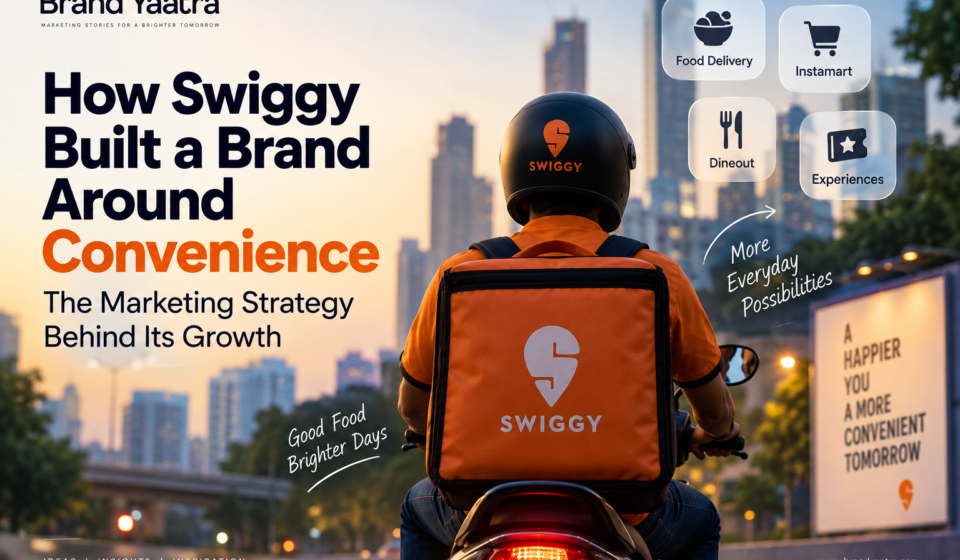
How Swiggy Built a Brand Around Convenience: The Marketing Strategy Behind Its Growth

Think about the last time you opened Swiggy.
You may have wanted dinner.
Or groceries.
Or a restaurant recommendation.
Or something you suddenly realized you needed immediately.
That is what makes Swiggy interesting from a marketing perspective.
It started with a relatively simple promise: helping people get food delivered.
But over time, the brand became associated with something much bigger.
Convenience.
Food delivery was the entry point. The broader opportunity was becoming part of everyday life.
And that shift tells us something important about modern marketing:
Sometimes the strongest brand idea isn’t what you sell. It’s the problem you repeatedly solve for people.
Swiggy’s evolution is a useful marketing case study because its growth has not depended on advertising alone.
It has combined product experience, technology, personalization, brand communication, convenience, ecosystem expansion and customer behaviour into one increasingly connected system.
So how did Swiggy build that brand?
Let’s break it down.
What Is Swiggy’s Marketing Strategy?
Swiggy’s marketing strategy can be understood as a combination of:
- Building around convenience
- Reducing friction in everyday consumption
- Using personalization to improve discovery
- Creating memorable and culturally relevant communication
- Expanding from one use case into multiple everyday needs
- Using technology and data to strengthen customer experience
- Building an ecosystem that encourages repeat behaviour
The important part is that these elements don’t operate independently.
The product creates convenience.
Convenience creates usage.
Usage creates data.
Data can improve discovery and personalization.
Better discovery can create more transactions.
More transactions strengthen the ecosystem.
And the brand communicates that ecosystem in ways people can recognize and remember.
That creates a marketing system rather than simply a collection of campaigns.
Swiggy Didn’t Just Sell Food Delivery
At first glance, food delivery sounds like a logistics business.
You choose a restaurant.
You order food.
A delivery partner brings it to you.
But from the customer’s perspective, something else is happening.
Swiggy is removing friction.
You don’t have to travel.
You don’t have to call the restaurant.
You don’t have to figure out whether it is open.
You don’t have to physically collect the food.
The entire process becomes a few taps on a screen.
That is a marketing insight hiding inside a product experience.
The customer isn’t really buying delivery.
They are buying saved time, reduced effort and convenience.
That distinction matters.
A brand that understands the deeper job its product performs can build much stronger positioning than a brand that simply describes its product.
1. Convenience Became the Core Brand Idea
Convenience is easy to say.
It is much harder to build into the entire customer journey.
Swiggy has increasingly done exactly that.
The company describes its broader proposition around convenience, discovery, personalization and loyalty. Its annual report also highlights technology, network effects and customer engagement as important parts of its business model.
Instead of treating convenience as an advertising message, the product can demonstrate it every time someone orders.
That creates an important marketing advantage:
The product itself becomes part of the brand promise.
Advertising can say that something is convenient.
A good product can prove it.
And when customers repeatedly experience the same benefit, the association becomes stronger.
2. Swiggy Turned Food Discovery Into Part of the Experience
Food delivery could have been designed as a simple transaction:
Restaurant → Menu → Order → Delivery.
But food isn’t purely functional.
People don’t always know what they want to eat.
They browse.
They compare.
They discover restaurants.
They search for something different.
They change their mind.
They order based on mood.
This makes discovery an important part of the customer experience.
Instead of simply helping someone complete an existing decision, a platform can influence the decision itself.
That creates a much more interesting role for marketing.
The brand is no longer only trying to persuade someone to choose Swiggy.
It is also helping the customer decide what to choose.
That gives the platform more opportunities to become part of the customer’s decision-making process.
3. Personalization Became a Marketing Advantage
Imagine opening a platform and seeing exactly the same restaurants, products and recommendations as every other user.
It would work.
But it wouldn’t feel particularly personal.
Swiggy’s business increasingly uses data and personalization to improve discovery and conversion.
Its corporate materials describe data analytics and personalized recommendations as part of its growth approach.
This is where product and marketing start becoming difficult to separate.
Traditional marketing often asks:
How do we communicate the right message to the customer?
Personalized products introduce another question:
How do we create an experience that feels more relevant to this customer?
That difference is significant.
A personalized recommendation can influence behaviour without looking like an advertisement.
It is part of the product.
And that makes product experience one of the most powerful forms of modern marketing.
4. Swiggy’s Marketing Isn’t Just Performance Marketing
When people think about digital businesses, it is easy to imagine that growth comes mainly from performance marketing.
Run ads.
Track conversions.
Optimize acquisition.
Repeat.
But Swiggy has also invested heavily in brand communication.
Its own marketing team has spoken about experimentation, customer focus and the importance of creating communication that cuts through the clutter.
One example is the company’s early “Gulab Jamun Uncle” campaign from 2018, which Swiggy’s brand marketing team identifies as its first brand marketing campaign.
The interesting lesson isn’t the campaign itself.
It is the philosophy behind it.
Being remembered is different from simply being seen.
A digital platform can buy impressions.
A brand has to earn memory.
5. Swiggy Uses Culture Instead of Talking Like a Technology Company
Food is emotional.
People have favourite dishes.
They have food rituals.
They argue about restaurants.
They celebrate with food.
They order when they are tired.
They order when they are happy.
They order when they don’t want to cook.
That gives Swiggy a huge cultural canvas.
Instead of communicating like a logistics platform, the brand can participate in everyday conversations around food, occasions, habits and Indian culture.
This is one reason brand personality matters.
A company can provide exactly the same functional service as a competitor while feeling completely different.
That difference is often created through tone, humour, cultural understanding and consistency.
6. The Product Became Bigger Than Food Delivery
This is perhaps the most strategically interesting part of Swiggy’s evolution.
If a company defines itself too narrowly, growth becomes constrained by the original category.
If the deeper customer need is convenience, however, the opportunity becomes much larger.
Swiggy expanded beyond food delivery into areas including quick commerce through Instamart and out-of-home consumption through services such as Dineout and Scenes.
Its FY2024–25 annual report describes food delivery as its core business while highlighting quick commerce and out-of-home consumption as major parts of the broader ecosystem.
This creates a powerful strategic question:
What else can we help the same customer do?
That is very different from asking:
“What completely new audience can we sell to?”
The first approach builds around an existing relationship.
The second starts from scratch.
7. Instamart Changed the Meaning of Convenience
Food delivery solves one kind of problem:
I want something to eat, but I don’t want to go get it.
Quick commerce solves a broader set of problems:
I need something now.
That could be groceries.
Household essentials.
Snacks.
Personal-care products.
Or something you suddenly realize you forgot to buy.
Swiggy launched Instamart in 2020 and has continued expanding the business.
In FY2024–25, Swiggy reported that Instamart had expanded to 124 cities, with 1,021 active dark stores at that point.
The strategic significance is larger than the numbers.
It gives the brand another reason to exist in a customer’s daily life.
And the more frequently a brand solves useful everyday problems, the more opportunities it has to become habitual.
8. The Swiggy Ecosystem Creates More Reasons to Return
Imagine three different brands:
Brand A solves one problem once a month.
Brand B solves one problem once a week.
Brand C can solve several small problems throughout the week.
All three may have strong products.
But Brand C has more opportunities to become part of the customer’s routine.
This is where an ecosystem becomes valuable.
Swiggy’s businesses can potentially reinforce one another because they operate around overlapping consumer needs.
Food delivery.
Quick commerce.
Dining out.
Entertainment and experiences.
The more useful the ecosystem becomes, the more reasons the customer has to stay inside it.
That can strengthen retention and increase the amount of customer behaviour the platform can learn from.
9. Swiggy Understands That Notifications Are Part of Marketing
There is another interesting part of the Swiggy experience that marketers can easily overlook.
Notifications.
A notification isn’t automatically marketing.
But it can become a marketing touchpoint.
The difference comes down to relevance.
A useful notification can remind you about an order.
A relevant recommendation can help you decide what to eat.
A timely message can introduce a new offer or service.
A clever line can make the brand more memorable.
This creates a useful principle:
Every customer touchpoint is an opportunity to reinforce the brand—but not every touchpoint should feel like an advertisement.
The best product-led brands understand this difference.
10. Swiggy Combines Data With Creativity
One of the most useful lessons from Swiggy is that data and creativity don’t have to compete.
Data can tell a marketer:
- What people are ordering
- When they are ordering
- What they are searching for
- What they respond to
- Where friction exists
- Which recommendations perform better
Creativity can then turn those insights into:
- Campaign ideas
- Content
- Messages
- Product experiences
- Cultural moments
- Brand stories
That combination is powerful.
Data without creativity can become mechanical.
Creativity without customer understanding can become disconnected from behaviour.
The interesting space is where the two meet.
Swiggy’s Marketing Flywheel
We can simplify much of the strategy into a flywheel:
Convenience → Usage → Data → Personalization → Better Discovery → More Usage → Stronger Ecosystem → More Convenience
Marketing communication sits around this system and helps create awareness, preference, memory and engagement.
This is important because it shows why Swiggy’s marketing cannot be reduced to advertising.
The advertising attracts attention.
The product creates the experience.
The data improves the experience.
The ecosystem creates more use cases.
The brand gives the entire system a recognizable personality.
Swiggy’s Biggest Marketing Lesson
The most interesting lesson isn’t:
“Make funny advertisements.”
It isn’t:
“Use personalization.”
And it isn’t:
“Expand into new categories.”
The deeper lesson is this:
Build your marketing around a real customer problem, then make the entire business reinforce that problem.
For Swiggy, that problem is increasingly connected to convenience.
Marketing communicates convenience.
The app delivers convenience.
Personalization improves convenience.
Logistics makes convenience possible.
New services expand the definition of convenience.
And brand communication makes the experience recognizable and memorable.
What Marketers Can Learn From Swiggy
1. Don’t confuse your product with your customer need
You may sell software.
But customers may actually be buying speed.
You may sell insurance.
But customers may actually be buying security.
You may sell food delivery.
But customers may actually be buying convenience.
2. Product experience is marketing
Every frustrating screen, confusing checkout, useful recommendation and smooth interaction shapes the brand.
Marketing doesn’t stop when someone clicks the advertisement.
3. Build reasons to return
A strong brand isn’t only memorable.
It is useful enough to become part of behaviour.
4. Use data to understand people, not just to optimize dashboards
The most useful customer data isn’t simply a number in a report.
It can reveal habits, needs, frustrations and opportunities for better experiences.
5. Give your brand a personality
Technology companies can easily sound like technology companies.
But customers don’t build emotional relationships with features and infrastructure alone.
They remember how a brand makes the experience feel.
Swiggy vs Zomato: A Useful Branding Question
Swiggy and Zomato operate in closely related categories, but that doesn’t mean their brands have to mean exactly the same thing.
That’s an important lesson in positioning.
When competitors offer similar functional products, brand differentiation can increasingly come from personality, experience, associations and the specific role a company wants to play in customers’ lives.
We explored this idea in our case study on how Zomato built one of India’s most recognizable digital brands.
The comparison is useful because it shows that two companies can compete in the same broad category while building very different mental associations.
How Swiggy Fits Into a Broader Marketing Strategy
Swiggy’s story also connects to a bigger marketing principle.
A company’s marketing activities should not exist independently.
Audience, positioning, objectives, channels, customer journey, budget and measurement should connect to one another.
That’s the difference between running marketing activities and building a marketing strategy.
Swiggy’s case is particularly interesting because product, technology, data, communication and customer experience increasingly reinforce one another.
Where Digital Marketing Fits In
Swiggy’s growth also shows why digital marketing is much broader than simply running advertisements.
Its ecosystem involves apps, websites, notifications, personalization, content, digital campaigns, customer data, discovery, technology and online experiences.
If you want to understand the larger landscape that all of these activities sit inside, see our guide to what digital marketing actually includes.
The Bigger Picture
Swiggy started with a simple behaviour:
“I want food, but I don’t want to go get it.”
But the bigger opportunity was never just food.
It was convenience.
Once you look at the business through that lens, many of the strategic decisions make more sense.
Food delivery creates the relationship.
Personalization improves discovery.
Technology reduces friction.
Quick commerce expands the use cases.
Out-of-home services broaden the ecosystem.
Marketing gives the brand personality and memory.
And customer behaviour creates the data that helps the system improve.
That is what makes Swiggy an interesting marketing case study.
It didn’t simply market a delivery service.
It increasingly built a brand around making everyday life easier.
Frequently Asked Questions
What is Swiggy’s marketing strategy?
Swiggy’s marketing strategy combines convenience, personalization, customer experience, digital and brand marketing, technology, data and ecosystem expansion. The broader strategy is increasingly built around becoming useful across multiple everyday consumer needs.
Why is Swiggy successful in marketing?
Swiggy combines product experience with brand communication. Its marketing is supported by convenience, personalization, customer data, technology and a recognizable communication style rather than relying only on advertising.
What makes Swiggy different from other food delivery brands?
The difference is not simply the food delivery service itself. Brand personality, customer experience, discovery, personalization, convenience and the broader ecosystem all contribute to how the platform is perceived.
How does Swiggy use personalization?
Personalization can help customers discover restaurants, products and services that are more relevant to their behaviour and preferences. Swiggy’s corporate materials identify personalized recommendations and data analytics as part of its broader growth approach.
What can marketers learn from Swiggy?
The biggest lesson is to look beyond the product category and understand the deeper customer problem being solved. Swiggy’s evolution shows how a brand can build around a recurring customer need such as convenience and allow product, technology, data and marketing to reinforce that promise.
Final Takeaway
Swiggy’s marketing story is ultimately a story about turning convenience into a brand.
The company didn’t have to invent a completely new consumer desire.
People already wanted easier ways to eat, shop and manage everyday life.
The opportunity was to remove friction from those behaviours and then build a brand around that value.
That creates a powerful principle for marketers:
The strongest marketing ideas often become much more powerful when the product itself can prove them.
Swiggy’s communication can tell people that life can be easier.
Its product has to make that statement believable.
And that is where marketing becomes much more than advertising.



[…] our analysis of Swiggy’s marketing strategy, convenience became more than an advertising message because the product itself delivered […]