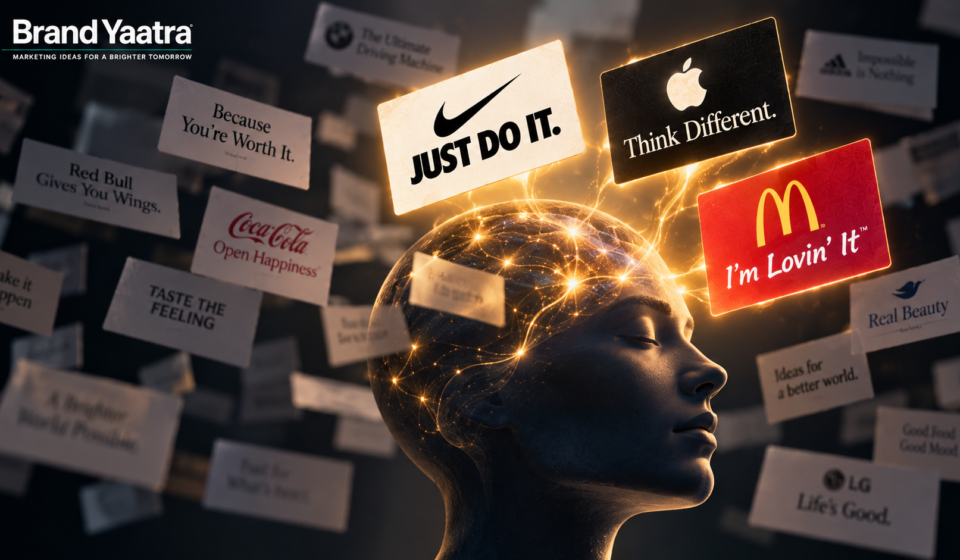

“Just Do It.”
“Think Different.”
“I’m Lovin’ It.”
You probably don’t need to see the logo to know which brands these belong to.
That’s the strange power of a good slogan.
A few words can sit in your memory for years.
But think about the number of advertising lines you saw yesterday.
Most of them are already gone.
So what makes the difference?
Is it brevity?
Rhythm?
Emotion?
The brand name?
Or simply saying the same thing often enough?
Researchers have been studying this problem for years. And recent research reveals something marketers might not expect:
The slogan people like most isn’t necessarily the slogan they remember best.
That small distinction changes how we should think about memorable marketing.
Memorable and Likeable Are Not the Same Thing
One of the most interesting findings comes from research published in the Journal of Consumer Research.
The researchers analysed more than 800 real brand slogans and combined that analysis with laboratory experiments, an eye-tracking experiment and a field study.
They found a tension between two outcomes:
- Processing fluency: how easy something is to process
- Memory: how likely people are to remember it
Slogans that were easier to process tended to be liked more.
But some characteristics that made slogans less fluent could make them more memorable.
In other words:
Easy to like does not automatically mean easy to remember.
And that is important because marketers often treat “people liked the slogan” as proof that the slogan worked.
It isn’t necessarily.
Why “Make It Short” Is Not the Whole Answer
We’ve all heard the advice:
Keep your tagline short.
It sounds sensible.
And sometimes it is.
Short slogans are easy to read, easy to say and easy to fit into advertising.
But the research found something more complicated.
Shorter slogans tended to be more liked.
Longer slogans, however, were more likely to be remembered in the researchers’ analysis.
That doesn’t mean brands should suddenly create 25-word slogans.
It means length has to serve a purpose.
If your objective is immediate fluency, shorter may help.
If your objective is creating a distinctive memory trace, the answer may be more complicated.
So the next time someone says:
“A good slogan has to be short.”
The better response might be:
“Short for what?”
The Brand Name Creates Another Trade-Off
Here’s another counterintuitive finding.
The research found that slogans containing the brand name tended to be remembered better.
But slogans that omitted the brand name tended to be liked more.
Think about what that means.
Compare:
A slogan that sounds elegant on its own.
versus
A slogan that makes it harder to forget which company said it.
These are not always the same thing.
For a campaign designed mainly to create positive feelings, the first may be useful.
For advertising where brand recall matters, explicitly connecting the line to the brand can matter more.
That distinction becomes especially important when you consider how much advertising is consumed without an immediate purchase.
A person might not buy anything today.
But if they remember the brand later, the advertising may still have done useful work.
Think About Nike’s “Just Do It”
Consider one of the world’s most recognisable brand lines:
Just Do It.
It is short.
It is easy to say.
It is emotionally loaded.
And it has become strongly associated with Nike.
But its power doesn’t come from the three words alone.
Decades of consistent use helped turn the line into a recognisable brand asset.
We’ve explored that story in our breakdown of how Nike turned “Just Do It” into a global brand asset.
The important lesson here is that a slogan doesn’t become memorable simply because the words are clever.
Memory is built through repeated association.
The words need somewhere to live in the consumer’s mind.
Familiar Words Are Not Always the Most Memorable
Another interesting part of the research concerns the words themselves.
Words that were more familiar and easier to process tended to make slogans more likeable.
But less familiar and more concrete words could contribute to memorability.
This creates another tension.
Imagine two slogans.
The first uses very familiar, generic language.
It is immediately understandable.
The second contains a more unusual or concrete expression.
It may require slightly more mental processing.
The first might feel smoother.
The second might leave a stronger trace.
This doesn’t mean marketers should deliberately make slogans confusing.
It means distinctiveness has a role in memory.
Your Brain Doesn’t Remember Every Advertising Message Equally
Think about your own memory.
You probably can’t recall most advertisements you’ve seen this week.
Yet certain phrases suddenly appear in your head years later.
Why?
Because advertising memory isn’t simply a storage system that records everything equally.
Some messages receive stronger associations.
Some are connected to emotions.
Some are unusual.
Some are repeated.
Some become associated with distinctive sounds, visuals or situations.
And some become linked to a brand so consistently that the words themselves trigger the brand.
That last part is particularly valuable.
A slogan isn’t truly doing its job if people remember the line but can’t remember who said it.
Recognition Is Different From Brand Recall
This distinction is easy to miss.
Imagine someone sees:
“Think Different.”
They recognise it immediately as an Apple line.
That’s a strong brand association.
But imagine someone remembers a phrase but attributes it to the wrong company.
The words survived.
The brand connection didn’t.
For marketers, that creates a useful question:
Are we trying to make people remember the words, or remember the brand through the words?
Those aren’t always identical objectives.
Why Weird Can Sometimes Work
Marketers often want slogans to sound natural.
That’s understandable.
But there is a danger in making every brand message perfectly smooth.
If a slogan sounds exactly like every other slogan in the category, it may be easy to process but difficult to distinguish.
Consider the difference between:
“Quality you can trust.”
and a line with a more unusual structure, idea or expression that people haven’t encountered repeatedly.
The first may be perfectly understandable.
But understanding something is not the same as remembering it.
The research suggests that some reduction in processing fluency can sometimes improve memory.
That’s why a little friction isn’t always the enemy.
The right amount of friction can make a message worth noticing.
But Don’t Confuse “Memorable” With “Good”
This is where marketers can misuse research.
If unusual language can increase memorability, should every brand create a strange slogan?
No.
If longer slogans can sometimes be remembered better, should every brand write longer slogans?
No.
If putting the brand name in the slogan helps memory, should every slogan repeat the brand name?
Not necessarily.
The point isn’t to find one magic formula.
The point is that different characteristics solve different problems.
A slogan can be:
- Likeable
- Memorable
- Distinctive
- Brand-linked
- Easy to understand
- Emotionally powerful
And those qualities don’t always move together.
Good brand strategy starts by deciding what the line needs to accomplish.
New Research Is Taking Slogan Memorability Even Further
In August 2026, researchers Ada Aka and John McCoy published a new study in the Journal of Marketing Research focused specifically on predicting slogan memorability.
The researchers combined findings from previous literature with natural-language processing, human ratings and text-embedding methods.
They evaluated predictive models against recognition and cued brand-recall judgments for existing slogans.
The study is particularly interesting because it moves beyond asking:
“What characteristics seem related to memorable slogans?”
and toward:
“Can we predict which slogans are likely to be remembered?”
The authors also demonstrate their models by predicting memorability for candidate slogans for new brands.
That’s a sign of where marketing research is heading.
Language can increasingly be analysed at scale rather than only through intuition and creative judgement.
But that doesn’t mean the creative process is disappearing.
It means marketers may eventually have better tools for evaluating the ideas they create.
So What Actually Makes a Slogan Memorable?
There isn’t one universal formula.
But the research gives marketers several useful principles.
1. Don’t optimise only for brevity
Short can be useful, but shorter isn’t automatically more memorable.
2. Separate liking from memory
A slogan people enjoy may not be the one they remember later.
3. Think about the brand connection
If brand recall matters, the relationship between the slogan and the brand cannot be an afterthought.
4. Don’t make everything perfectly generic
Familiar language can be easy to process, but distinctive language can help create stronger memory.
5. Give the slogan a clear job
Is it communicating a benefit? Building emotion? Creating recognition? Differentiating the brand? Supporting a campaign?
The answer should influence the words.
6. Repetition still matters
A memorable line becomes much more powerful when consistently connected with the same brand over time.
The Real Problem With Most Slogan Advice
Search for advice on writing a memorable slogan and you’ll find plenty of rules.
Keep it short.
Make it emotional.
Make it simple.
Make it catchy.
Use rhyme.
Make it unique.
All of these sound useful.
But they hide the most important question:
Memorable for what purpose?
A slogan is not operating in a vacuum.
It belongs to a brand.
It appears in advertising.
It competes with thousands of other messages.
It needs to be associated with something meaningful.
And eventually, it needs to help the brand become easier to remember and recognise.
That is why the strongest slogans aren’t merely clever sentences.
They become part of the brand’s memory structure.
What Marketers Should Take Away
The next time someone proposes a slogan and says:
“People really like it.”
Ask another question.
“Will they remember it?”
And then ask an even better one:
“Will they remember which brand it belongs to?”
Because advertising has two very different jobs.
Sometimes you want people to feel something.
Sometimes you want them to remember something.
And sometimes you need both.
The research suggests that these goals can pull language in different directions.
That’s why writing a memorable slogan isn’t simply about finding the cleverest five words.
It’s about understanding how those words behave inside a person’s mind.
The best slogan isn’t necessarily the one people like most.
It’s the one that does the job the brand actually needs it to do.
Frequently Asked Questions
What makes a brand slogan memorable?
Research suggests that memorability can be influenced by factors including linguistic properties, concreteness, familiarity, length, brand-name inclusion and processing fluency. There is no single formula that guarantees memorability.
Are shorter slogans more memorable?
Not necessarily. Research on more than 800 brand slogans found that shorter slogans tended to be more liked, while longer slogans were more likely to be remembered. This is a relationship observed in the research, not a rule that every long slogan will outperform a short one.
Should a slogan include the brand name?
Including the brand name can strengthen the connection between the slogan and the brand and was associated with better memory in the research discussed here. However, slogans without the brand name tended to be liked more, so the appropriate choice depends on the communication objective.
Why are some slogans remembered for years?
Memorability can result from a combination of language, distinctiveness, repetition, emotional association and consistent connection with a brand. A slogan becomes especially powerful when the words repeatedly appear alongside the same distinctive brand.
Is memorability more important than likability?
Neither is universally more important. A campaign may prioritise positive attitudes, while another may prioritise brand recall or recognition. The research suggests that characteristics that improve one outcome do not always improve the other.
Can AI predict whether a slogan will be memorable?
Emerging research suggests that predictive modelling can help estimate slogan memorability. A 2026 Journal of Marketing Research study used natural-language processing, human ratings and text embeddings to model slogan recognition and brand recall. These tools can support evaluation, but they do not eliminate the need for strategic and creative judgement.
Sources & Further Reading
This article is based primarily on peer-reviewed research rather than generic slogan-writing advice.
- Predicting the Memorability of Brand Slogans — Ada Aka & John McCoy, Journal of Marketing Research, 2026.
- Intel Inside: The Linguistic Properties of Effective Slogans — Brady T. Hodges, Zachary Estes & Caleb Warren, Journal of Consumer Research, 2024.
Research is used here to explain patterns in slogan liking and memorability. Individual brand slogans should not be treated as proof that a particular linguistic characteristic caused a brand’s success.