
Imagine you walk into a coffee shop.
You expect five or six choices.
Instead, the menu has:
- 18 coffees
- 12 milk options
- 9 syrups
- 6 sizes
- 8 toppings
- 4 temperature options
At first, it feels impressive.
“They have everything.”
Then you start reading.
What is the difference between these two?
Which one is actually better?
Do I want oat milk or almond milk?
Should I add vanilla?
Is the premium option worth it?
And suddenly, the thing that was supposed to give you freedom creates work.
This is the basic idea behind choice overload.
But there is an important correction to the popular version of the story.
More choice is not automatically bad.
Research suggests that the effect depends on things such as how complicated the options are, how difficult the decision is, how uncertain people are about what they want and whether they are trying to minimize effort. A major meta-analysis of choice-overload research found that these factors can substantially change how assortment size affects decision-making.
So the real marketing question isn’t:
“How many choices should we give customers?”
It is:
“How much decision-making work are we asking customers to do?”
What Is Choice Overload?
Choice overload happens when the number, complexity or similarity of available options makes a decision harder rather than easier.
A customer may experience:
- confusion
- decision difficulty
- comparison fatigue
- regret
- choice deferral
- lower confidence
- or simply a desire to leave the decision for later
That last one matters enormously for marketers.
Because a customer who cannot decide today may not come back tomorrow.
Choice overload is therefore not simply a psychological curiosity.
It can become a conversion problem.
The Classic Choice Overload Story
One of the most famous discussions around choice overload comes from research on assortments and consumer decision-making.
The basic idea is easy to understand.
Imagine two shelves.
Shelf A
Six varieties of jam.
Shelf B
Twenty-four varieties of jam.
Which shelf sounds better?
Probably the second one.
More variety should mean a greater chance of finding something you like.
And that is an important benefit of large assortments.
But more options can also create another problem:
more options mean more comparisons.
You now have to evaluate more possibilities before deciding.
The interesting question is not whether people like having options.
They do.
The interesting question is when the additional options stop helping and start increasing the mental effort required to choose.
More Choice Is Not the Same as Better Choice
Think about buying a pair of running shoes.
You might see:
- 5 models
- 25 models
- 250 models
More products technically increase the chance that the perfect shoe exists somewhere in the catalogue.
But finding it becomes harder.
Now add:
- different cushioning systems
- heel drops
- materials
- running surfaces
- stability levels
- colours
- prices
The customer is no longer simply choosing a shoe.
They are performing a research project.
And that is where marketers need to think differently.
Your job is not necessarily to reduce the number of products.
Your job may be to reduce the amount of thinking required to choose between them.
Why Choice Becomes Harder
There are several reasons.
1. Too Many Options Increase Comparison Work
When you have three options, comparing them is relatively easy.
With thirty options, the customer has to make many more comparisons.
And if the products are similar, the problem becomes even worse.
Imagine:
| Product | Price | Battery | Camera | Storage |
|---|---|---|---|---|
| A | ₹39,999 | Good | Very good | 128 GB |
| B | ₹42,999 | Very good | Good | 256 GB |
| C | ₹44,999 | Excellent | Very good | 128 GB |
Now imagine doing that comparison across 40 phones.
The customer isn’t just evaluating products anymore.
They are evaluating their own evaluation.
2. Similar Options Can Be Harder Than Very Different Options
Suppose you’re choosing between:
Option A: ₹500
Option B: ₹5,000
The decision is obvious for many people because the two products occupy very different price and value positions.
But consider:
₹1,899
₹1,999
₹2,099
Now the customer may start searching for tiny differences.
Choice becomes difficult not simply because there are many products, but because the products are difficult to distinguish.
3. Uncertainty Makes Choice Harder
Imagine you’re buying something you know extremely well.
You may be comfortable comparing ten options.
Now imagine buying something you know almost nothing about.
Even three options might feel overwhelming.
Research on choice overload identifies preference uncertainty as one of the factors that can increase the likelihood of overload.
This has a major implication for marketers:
The same product assortment can feel completely different to an expert and a beginner.
The Beginner’s Problem
Imagine an experienced photographer shopping for a camera.
They understand:
- sensor size
- lens compatibility
- dynamic range
- autofocus systems
- low-light performance
They may actually enjoy having dozens of options.
Now give the same catalogue to someone buying their first camera.
Suddenly every specification creates another question.
“What does this mean?”
“Do I need it?”
“Is this one better?”
“What if I choose the wrong one?”
For inexperienced customers, education can be more valuable than additional choice.
This Is Where Good Marketing Gets Interesting
A weak marketer thinks:
“We have 50 products. Let’s show customers all 50.”
A stronger approach asks:
“How can we help the customer find the right product faster?”
That can mean:
- filters
- recommendation tools
- comparison tables
- best-for labels
- guided quizzes
- default recommendations
- product bundles
- clear categories
- expert recommendations
- use-case-based navigation
In other words:
More products can coexist with less decision friction.
The Real Enemy Is Often Decision Friction
Think about a customer journey.
Discover product
↓
Understand product
↓
Compare alternatives
↓
Choose
↓
Buy
Every additional uncertainty adds friction.
And sometimes marketers accidentally create friction while trying to be helpful.
They add:
- more features
- more specifications
- more variants
- more badges
- more comparison points
- more promotional messages
Individually, each piece looks useful.
Together, they can become exhausting.
Choice Overload vs Information Overload
These ideas are related, but they aren’t identical.
Choice overload concerns the difficulty created by available alternatives.
Information overload concerns the difficulty created by the amount or complexity of information a person must process.
Online shopping can produce both at the same time.
Imagine a smartphone marketplace with 300 phones.
That’s choice overload.
Now imagine every phone has 40 specifications, 20 reviews and dozens of comparison points.
That’s information overload.
Put them together and the customer can become confused before they ever reach the checkout.
Research in online shopping has found that information overload can negatively affect consumers’ subjective decision experience, while filtering mechanisms can help reduce some of that burden.
Choice Overload Is Already an E-Commerce Problem
This becomes particularly relevant online because digital stores can carry enormous assortments.
A physical store has limited shelf space.
An online marketplace doesn’t have the same constraint.
That creates a fascinating tension.
The internet can give customers more choice than ever before.
But it can also make choosing harder than ever before.
Recent research involving Indian e-commerce users found that both choice overload and information overload were associated with consumer confusion, while consumer confusion was associated with online shopping cart abandonment.
The study does not mean that “more products cause cart abandonment” in every situation. The relationship is more complicated than that. But it provides a useful current example of how choice and information can become part of the decision-friction problem.
Why Customers Sometimes Leave Without Buying
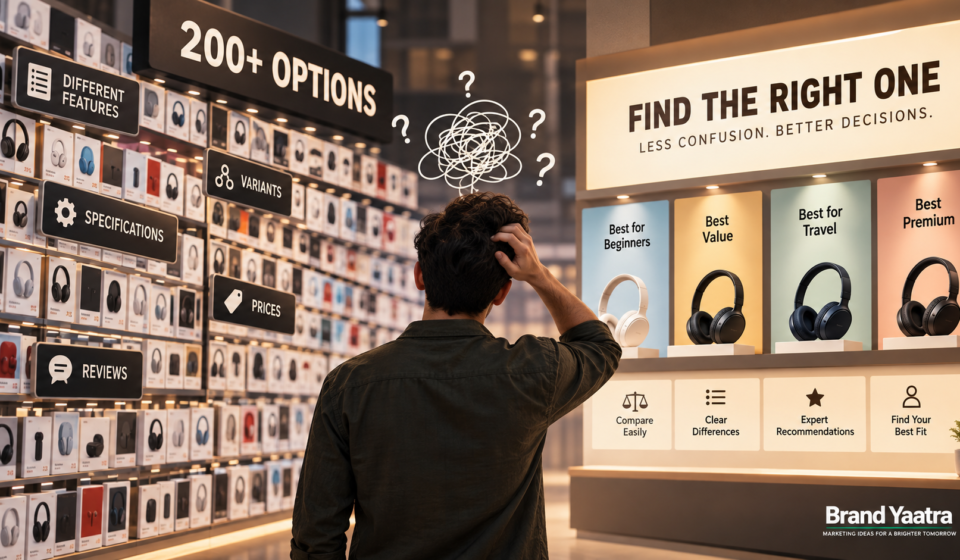
Imagine you’re shopping for headphones.
You find 200 options.
At first, you’re excited.
Then you narrow them down to:
15.
Then:
7.
Then:
3.
And now you’re stuck.
Because the three are almost identical.
You open another tab.
Read reviews.
Watch a YouTube video.
Search Reddit.
Check another store.
Come back.
And eventually:
“I’ll decide later.”
That’s the moment marketers should worry about.
The customer didn’t reject the product.
They rejected the effort required to choose it.
The Psychology of “Just Tell Me Which One to Buy”
This is why recommendation systems can be so powerful.
Instead of asking:
“Which of these 80 products do you want?”
a brand can ask:
“What are you trying to do?”
Then:
Running → Beginner → Under ₹10,000
And suddenly the catalogue becomes manageable.
The brand hasn’t necessarily reduced its inventory.
It has reduced the customer’s search space.
That’s an important distinction.
Amazon, Netflix and the Era of Personalized Choice
Modern digital platforms have an interesting answer to choice overload:
personalization.
Instead of showing everyone the same massive catalogue, platforms can prioritize what they think is most relevant to each person.
Netflix doesn’t expect every viewer to manually browse everything available.
E-commerce platforms don’t expect every shopper to examine every product.
Streaming services, marketplaces and recommendation engines all attempt to turn:
“Everything available”
into:
“Here are the things most relevant to you.”
That is one of the most important ways technology can reduce decision friction without reducing actual choice.
But Personalization Has Its Own Problem
More personalization isn’t automatically better either.
If a recommendation engine becomes too confident, it can hide useful alternatives.
If it becomes too complex, it can create another layer of decision-making.
And if customers don’t understand why something was recommended, trust can suffer.
The goal isn’t:
maximum personalization.
The goal is:
useful guidance.
The Power of “Best For”
One of the simplest ways to reduce choice friction is to organize products around customer situations.
Instead of:
- Model A
- Model B
- Model C
- Model D
try:
- Best for beginners
- Best for professionals
- Best for travel
- Best value
- Best premium option
You’re changing the customer’s question.
From:
“Which product is objectively best?”
to:
“Which product is best for me?”
That’s a much easier decision.
Why Defaults Matter
Defaults can also reduce decision effort.
Imagine signing up for a software plan.
You see:
- Basic
- Professional
- Business
- Enterprise
Now imagine the Professional plan is marked:
Most Popular
The label doesn’t force the decision.
But it gives the customer a starting point.
Instead of asking:
“Which of four plans should I investigate?”
they can ask:
“Is the popular plan right for me?”
That is a much smaller mental task.
Comparison Tables Can Be More Powerful Than More Copy
When products are difficult to compare, a clear comparison table can reduce mental effort.
| Feature | Basic | Pro | Premium |
|---|---|---|---|
| Storage | 50 GB | 250 GB | 1 TB |
| Users | 1 | 5 | 20 |
| Support | Priority | Dedicated | |
| Best for | Individuals | Small teams | Growing companies |
The customer doesn’t have to open three different pages and remember the differences.
The comparison has been done for them.
This is not about manipulating the customer.
It’s about reducing unnecessary cognitive work.
Choice Architecture: The Marketer’s Real Job
This leads to a broader concept:
Choice architecture
Choice architecture is the way options are presented and organized so that people can make decisions within a particular environment.
For marketers, that means thinking about:
- what options are shown
- how they are grouped
- what is highlighted
- what information appears first
- what comparisons are easy
- what recommendations are provided
- what defaults exist
- how many decisions are required before checkout
The product catalogue is only one part of the experience.
The architecture around the catalogue matters too.
Don’t Just Remove Options
This is where marketers can overcorrect.
They learn about choice overload and conclude:
“Let’s give customers fewer products.”
Not necessarily.
A large assortment can be valuable.
Customers may appreciate having more possibilities, especially when they know what they want.
The research literature is clear that the relationship between assortment size and choice outcomes is conditional rather than a simple “more is worse” rule.
The better question is:
Can customers navigate the choice easily?
When More Choice Can Actually Be Better
More options can be useful when:
- customers have clear preferences
- the options are meaningfully different
- the category is familiar
- customers enjoy exploring
- the decision is low-risk
- comparison tools are strong
- the additional options increase the chance of finding a good fit
Think about buying clothes.
If you know exactly what style you want, a large catalogue can be fantastic.
You don’t want five shirts.
You want 500 possibilities so you can find the one that feels right.
The problem isn’t variety.
The problem is unstructured variety.
The Difference Between Variety and Friction
Here’s a useful way to think about it:
Variety creates opportunity.
Complexity creates work.
Great marketing tries to preserve the first while reducing the second.
That might mean:
500 products
→ 5 categories
→ 3 recommended options
→ 1 clear explanation
→ easy comparison
→ purchase
The customer still has access to the full catalogue.
But they don’t have to mentally process all of it at once.
What This Means for E-Commerce Marketers
If you run an online store, don’t only ask:
“How many products should we sell?”
Ask:
- Can customers find the right product quickly?
- Can they understand the differences?
- Can they compare options easily?
- Do beginners know where to start?
- Do experts have enough flexibility?
- Can customers filter based on meaningful needs?
- Are our recommendations actually useful?
- Are we presenting too many decisions at once?
- Can customers confidently explain why they chose the product?
That last question is underrated.
A customer who understands why they chose your product may feel more confident after buying it too.
Choice Overload and Pricing
Pricing can make the problem even more complicated.
Imagine:
- ₹499
- ₹699
- ₹799
- ₹899
- ₹999
- ₹1,099
- ₹1,299
Now add discounts to each one.
And subscription options.
And bundles.
And limited-time offers.
The customer is no longer choosing between products.
They’re choosing between pricing architectures.
Pricing psychology works partly because customers evaluate numbers relative to context and alternatives. Our earlier article on why ₹999 can feel cheaper than ₹1,000 explores how those reference points can influence perception.
The lesson here is broader:
Every additional pricing option can become another decision.
Choice Overload and the Customer Journey
This connects directly to the broader marketing funnel.
A customer already has to move through:
Awareness → Interest → Consideration → Intent → Conversion → Retention
At every stage, unnecessary complexity can create friction.
That’s why understanding the digital marketing funnel is useful here.
Marketing isn’t only about creating demand.
It’s also about making the path from interest to action easier to navigate.
What Choice Overload Teaches Us About Good Marketing
There is a deeper lesson here.
Customers don’t necessarily want:
more information.
They want:
more useful information.
They don’t necessarily want:
more products.
They want:
a better chance of finding the right product.
They don’t necessarily want:
more features.
They want:
confidence that the features they need are included.
That’s a very different way of thinking about marketing.
A Practical Choice-Overload Checklist
Before launching a product page, pricing page, marketplace or campaign, ask:
1. How many decisions does the customer need to make?
Count them.
Size.
Colour.
Plan.
Add-ons.
Delivery.
Payment.
Every decision adds potential friction.
2. Which decisions actually matter?
Some choices are important.
Others can be simplified.
3. Are the options meaningfully different?
If five options are almost identical, explain the difference or consolidate them.
4. Can customers filter by their goal?
“Best for beginners” is often more useful than “Model 372B.”
5. Can customers compare without opening ten pages?
Make the comparison easy.
6. Do beginners know where to start?
Give them a starting point.
7. Can experienced customers go deeper?
Don’t oversimplify the experience for everyone.
8. Are recommendations transparent?
Explain why something is recommended when possible.
9. Are you testing decision friction?
Look at:
- search refinement
- filter usage
- comparison behaviour
- time to purchase
- conversion rate
- checkout abandonment
- customer support questions
10. Are you measuring the business outcome?
A shorter decision process isn’t automatically better if it reduces product fit or customer satisfaction.
The Most Important Lesson
Choice overload is often described as:
“People don’t like too many choices.”
That’s too simplistic.
People often like choice.
Choice gives people control.
Choice creates variety.
Choice increases the chance of finding something that fits.
The problem begins when the cost of evaluating those choices becomes greater than the value created by having them.
And that is where marketers have a real opportunity.
You don’t necessarily need to offer less.
You need to help customers choose better.
Brand Yaatra Takeaway
The next time you see a website proudly saying:
“We have 10,000 products.”
don’t immediately think:
“That’s impressive.”
Ask:
“How easy is it for the customer to find the right one?”
Because the competitive advantage may not belong to the brand with the biggest catalogue.
It may belong to the brand that makes the catalogue easiest to navigate.
That’s the subtle difference between giving people options and giving people confidence.
And in marketing, confidence is often what gets the decision over the line.
Frequently Asked Questions
What is choice overload?
Choice overload is the difficulty people can experience when the number or complexity of available alternatives makes a decision harder rather than easier. Its effects depend on factors such as decision difficulty, option complexity and how certain people are about their preferences.
Is more choice always bad for consumers?
No. Research does not support a simple rule that more options are always harmful. Large assortments can be valuable when consumers have clear preferences or when additional options increase the chance of finding a suitable product.
What causes choice overload?
Choice overload can become more likely when options are complex or similar, the decision is difficult, preferences are uncertain or the customer is trying to minimize decision effort.
What is the difference between choice overload and information overload?
Choice overload relates primarily to the number or complexity of alternatives. Information overload relates to the amount or complexity of information a person must process. Online shopping can create both simultaneously.
How can marketers reduce choice overload?
Marketers can reduce decision friction through useful categories, filters, comparison tools, recommendations, “best for” labels, guided selling, clear defaults and concise explanations of meaningful differences.
Should brands reduce the number of products they sell?
Not necessarily. The better question is whether customers can navigate the assortment effectively. A large catalogue can work well when products are well organized and customers have tools that help them narrow their choices.
How does choice overload affect e-commerce?
Choice and information overload can contribute to consumer confusion. Recent research involving Indian e-commerce users found associations between overload, consumer confusion and online shopping cart abandonment, although the relationship is not simply that “more products cause abandonment.”
Can personalization reduce choice overload?
Yes, personalization and recommendation systems can reduce the amount of information customers need to process by prioritizing relevant options. But personalization needs to remain useful and understandable rather than creating another layer of complexity.
What is choice architecture?
Choice architecture refers to how options are organized and presented within a decision environment. For marketers, this can include product categories, defaults, recommendations, comparisons, filters and the order in which information is presented.
What is the biggest marketing lesson from choice overload?
The goal isn’t necessarily to give customers fewer choices. It is to make useful choices easier to understand, compare and act on.


[…] This is closely related to the lesson behind choice overload. […]
[…] That connects with our earlier look at why more choices can make buying harder. […]
[…] This connects directly with our earlier article on why more choices can make buying harder. […]
For the lives I’m playing, I look for 58jllive it’s safe, secure and helpful. Its site is super easy to access!