
Have you ever opened an app and seen:
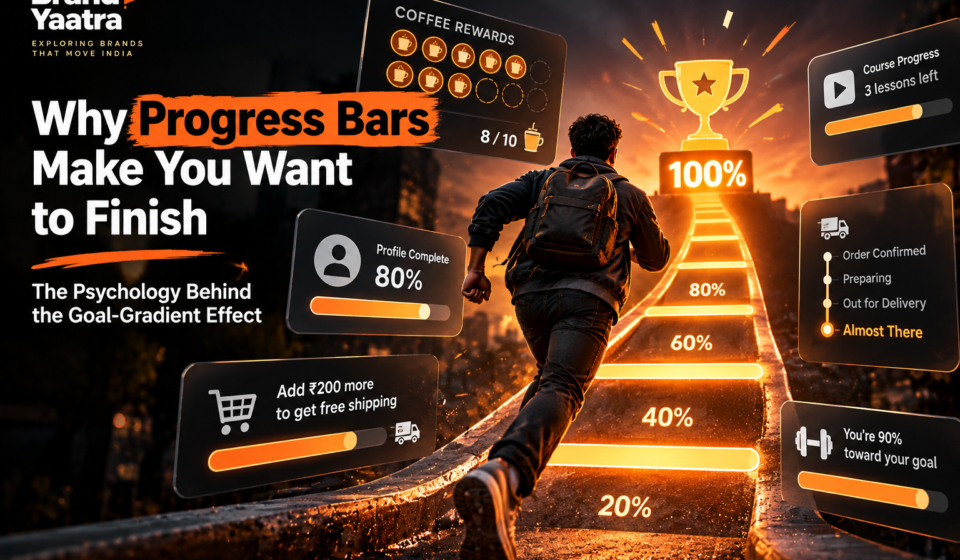
Profile 80% complete.
And suddenly felt the urge to finish the remaining 20%?
Or collected eight stamps on a coffee card and thought:
“I’m almost there. I might as well get the next two.”
Or watched a delivery progress bar move from:
Order confirmed → Preparing → Out for delivery → Almost there.
Somewhere along the way, an ordinary task starts feeling unfinished.
And the closer you get to the end, the more you want to complete it.
This is closely related to a behavioural principle known as the goal-gradient effect.
The basic idea is surprisingly simple:
As people perceive themselves getting closer to a goal, their effort toward that goal can increase.
For marketers, that creates a fascinating opportunity.
Because sometimes the difference between:
“I’ll do it later.”
and:
“I’m almost done. Let me finish.”
isn’t the reward.
It is the feeling of progress.
What Is the Goal-Gradient Effect?
The goal-gradient effect describes a pattern in which effort tends to increase as someone gets closer to a desired goal or reward.
Imagine two customers.
Customer A has collected 1 out of 10 stamps.
Customer B has collected 8 out of 10.
The reward is identical.
Both need more purchases.
But psychologically, the situations feel very different.
Customer A sees:
“Eight purchases still left.”
Customer B sees:
“Only two more.”
The remaining effort hasn’t changed.
The perceived distance has.
And that distinction matters.
The Coffee Card Experiment That Made This Interesting
One of the most widely discussed demonstrations of the goal-gradient effect comes from research by Ran Kivetz, Oleg Urminsky and Yuhuang Zheng.
The researchers studied behaviour in a real café loyalty program.
Customers became more likely to purchase coffee as they approached the number of purchases required to earn a reward.
They also tested something even more interesting.
Imagine two loyalty cards.
Card A
10 stamps required.
0 stamps already completed.
Card B
12 spaces on the card.
2 stamps are already filled in as a bonus.
In both cases, the customer still needs to make 10 additional purchases to complete the card.
The actual work remaining is therefore equivalent.
But customers who received the card with the apparent head start completed the program faster.
The research described this as illusionary goal progress: giving people a perception that they have already made progress toward the goal can change how motivated they feel to complete it. :contentReference[oaicite:2]{index=2}
That’s a remarkable finding.
The marketer didn’t reduce the amount of work required.
They changed the customer’s starting point.
Why “Almost There” Feels Different
Think about running a 10-kilometre race.
At kilometre 1:
“I have a long way to go.”
At kilometre 8.5:
“I’m almost there.”
The remaining distance is objectively smaller.
But psychologically, the difference can be even larger.
The finish line becomes more mentally available.
The reward becomes easier to imagine.
And each additional step feels more meaningful because it represents a larger fraction of the remaining journey.
This is why progress itself can become motivating.
Marketing Has Been Using This for Years
Once you understand the mechanism, you start seeing it everywhere.
Loyalty cards
Buy 10 coffees.
Get the 11th free.
The closer you get, the more salient the reward becomes.
Fitness apps
“You’re 85% toward your weekly goal.”
The number turns activity into progress.
Learning platforms
“One lesson left.”
The course is no longer a huge commitment.
It is one unfinished task.
Software onboarding
“Your workspace is 90% complete.”
Suddenly adding one more piece of information feels easier.
Free shipping
“You’re ₹180 away from free delivery.”
Now the customer isn’t simply deciding whether to buy another product.
They are deciding whether to complete a goal.
Games
Level 9 of 10.
Three more points.
One more challenge.
The reward is always psychologically nearby.
The interface keeps reminding you:
You’re close.
The Progress Bar Is More Than a Design Element
A progress bar looks innocent.
Just a rectangle filling from left to right.
But psychologically, it does something important.
It converts an abstract task into a visible journey.
Without a progress indicator:
“Complete your profile.”
With one:
“Your profile is 80% complete.”
The task hasn’t changed.
But the customer can now see:
where they started → where they are → how far they have left.
That makes the distance to completion easier to understand.
And once the finish line becomes visible, completing the task can become more attractive.
Progress Changes the Question
This is one of the most useful ways to think about the effect.
Without progress:
“Do I really want to do this?”
With visible progress:
“Do I really want to leave this unfinished?”
That’s a completely different psychological question.
The first asks whether the entire task is worth starting.
The second asks whether abandoning existing progress is worth it.
And that difference can matter enormously.
The Psychology of the “Almost Finished” Task
Imagine you’ve spent 45 minutes completing an online course.
The platform tells you:
92% complete.
Would you stop?
Maybe.
But psychologically, stopping now can feel strange.
You’ve already invested time.
You’re close to the end.
The remaining effort looks small relative to what you’ve already completed.
The final lesson suddenly feels disproportionately easy to justify.
That’s the power of perceived distance.
But There Is a Crucial Detail: The Goal Has to Matter
Progress isn’t magic.
A progress bar cannot manufacture motivation from nothing.
Imagine a website saying:
“Your account is 93% complete!”
But the missing 7% asks you to fill in information you don’t care about.
You may simply close the page.
The goal-gradient effect doesn’t mean:
“Show a progress bar and everyone will finish.”
It means perceived progress can influence effort under the right conditions.
The goal still needs to be meaningful.
The remaining task needs to be achievable.
And the reward needs to justify the effort.
Research on the goal-gradient effect is strongest when applied to specific goal and reward contexts rather than treated as a universal rule of human motivation. :contentReference[oaicite:3]{index=3}
Why Artificial Progress Can Work
The coffee-card experiment raises a fascinating question.
Why should two bonus stamps matter when they don’t reduce the number of additional purchases required?
Because people don’t always evaluate progress purely in terms of remaining physical effort.
We also interpret where we are relative to the goal.
Compare:
0 / 10 complete
with:
2 / 12 complete
Both require 10 more actions.
But the second person has a visible history of progress.
The journey has already started.
That can change motivation.
This Is Why Onboarding Designers Love Progress Indicators
Onboarding has a particularly nasty problem.
The user has not yet experienced enough value to justify a lot of effort.
So asking them to complete:
- Profile
- Preferences
- Team details
- Integrations
- Notifications
- Payment information
can feel exhausting.
But break the process into visible stages:
Step 1 of 5
then:
Step 2 of 5
and:
You’re 80% done.
The same workflow can feel much more manageable.
This is not necessarily because the work became easier.
The customer now has a clearer mental model of the journey.
Free Shipping Uses the Same Logic
Consider this message:
“Add ₹200 more to get free shipping.”
At first glance, this looks like a pricing tactic.
But psychologically, it can also function as a goal.
The customer is no longer simply deciding:
“Do I need another product?”
They are thinking:
“I’m ₹200 away.”
That wording changes the frame.
And it connects directly with the broader psychology of thresholds and reference points explored in Brand Yaatra’s article on why ₹999 can feel different from ₹1,000.
The number isn’t being evaluated in isolation.
It is being evaluated relative to a reference point.
The Same Principle Can Increase Retention
Imagine a customer has already completed:
7 out of 10 actions required for a loyalty reward.
Leaving now means abandoning visible progress.
Continuing means getting closer to the reward.
That can create a motivational pull.
And this is where the goal-gradient effect becomes particularly relevant to loyalty marketing.
The original research found that stronger acceleration toward the first reward was associated with faster re-engagement in the program. :contentReference[oaicite:4]{index=4}
More recent research has continued examining how goal proximity and residual rewards can affect persistence, including after service failures. A 2026 study found that closer goal proximity could increase resistance to switching in the studied loyalty contexts, although the effect weakened when the service failure was severe. :contentReference[oaicite:5]{index=5}
That last qualification matters.
Progress can strengthen motivation.
It cannot permanently compensate for a bad product.
Progress Cannot Rescue a Broken Experience
Imagine a food-delivery app telling you:
“You’re only one order away from your reward!”
But your previous three orders arrived late.
The food was cold.
Customer support ignored you.
At some point, the reward stops being persuasive.
This is an important marketing lesson.
Behavioural design can amplify value. It cannot permanently replace value.
If the underlying experience is poor, adding more gamification may simply make the problem more obvious.
The Dark Side of Progress Mechanics
There is another side to this.
A mechanism that helps people complete useful tasks can also encourage behaviour that isn’t particularly useful to them.
Consider:
- “Only ₹50 more to unlock the reward.”
- “You’re almost at Gold status.”
- “Just one more purchase.”
- “Complete today’s challenge.”
- “Don’t lose your streak.”
These messages can make stopping feel like losing progress.
That’s where marketers need to be careful.
The goal should not simply be:
“How do we keep the customer going?”
A better question is:
“Are we helping the customer reach something they genuinely want?”
That distinction separates useful behavioural design from dark patterns.
Progress Can Be Used for Good Marketing
Used responsibly, progress mechanics can reduce uncertainty and make difficult tasks feel manageable.
Consider:
Learning
“Three lessons left in this module.”
Financial goals
“You’re 70% toward your savings target.”
Fitness
“Two kilometres remaining.”
Onboarding
“Your account is almost ready.”
Professional development
“Complete one more section to earn your certificate.”
In each case, progress can help translate an abstract goal into something concrete.
What Marketers Should Actually Design
If you’re building a product, website or campaign, don’t start by asking:
“Where can we put a progress bar?”
Start with five better questions.
1. What is the customer’s goal?
If there is no meaningful goal, progress indicators are cosmetic.
2. Can the customer see their progress?
If the journey is invisible, effort can feel disconnected from achievement.
3. Is the remaining distance understandable?
“Almost done” works better when the customer knows what “done” actually means.
4. Does each action visibly move them forward?
If five actions produce no visible progress, motivation can weaken.
5. Is the destination worth reaching?
This is the most important question.
A progress bar cannot make an irrelevant destination valuable.
Progress Is Also a Form of Communication
Here’s a subtle point marketers often overlook.
A progress indicator isn’t only motivating.
It communicates information.
It tells the customer:
- Where am I?
- How much have I done?
- How much remains?
- What happens when I finish?
That can reduce uncertainty.
And reducing uncertainty is a major part of good customer experience.
This is closely related to the lesson behind choice overload.
Customers don’t necessarily need less information.
They need information that makes the decision easier.
Progress is useful because it converts complexity into a simple signal:
You’re here. The destination is there. You’re getting closer.
The Goal-Gradient Effect and the Marketing Funnel
Think about a traditional customer journey:
Awareness → Interest → Consideration → Conversion → Retention
Each stage represents a different kind of progress.
But customers don’t always know what progress looks like.
A good marketer can make the journey more visible.
For example:
Discover → Compare → Choose → Setup → First Result
Now the customer isn’t staring at one giant objective.
They’re moving through smaller milestones.
This is one reason structured customer journeys matter.
Brand Yaatra’s complete digital marketing funnel guide explores how customers move from awareness through consideration, conversion, retention and advocacy.
The goal-gradient effect adds another layer:
How does the customer perceive their movement through that journey?
Don’t Confuse Activity With Progress
This is especially important for marketers.
A customer can be extremely busy without actually getting closer to a meaningful outcome.
Imagine a software onboarding flow with:
- 12 settings
- 8 preferences
- 5 integrations
- 10 profile fields
The interface might show:
“65% complete.”
But what does that mean?
If the customer still hasn’t experienced the product’s core value, the percentage is almost meaningless.
Good progress indicators measure movement toward something the customer actually cares about.
Not just movement through forms.
How to Test Whether Progress Actually Helps
This is where psychology should meet experimentation.
Don’t assume a progress bar works because it looks good.
Test it.
For example:
Control
“Complete your profile.”
Variation
“Your profile is 80% complete. Add two details to finish.”
Then define:
- Completion rate
- Time to completion
- Drop-off rate
- Downstream conversion
- Customer satisfaction
And don’t stop at:
“The progress-bar version got more completions.”
Ask whether those completed profiles actually produced better business outcomes.
This is exactly why experimentation needs discipline. Brand Yaatra’s guide on why A/B tests fail explores how premature conclusions, weak samples, multiple comparisons and poor hypotheses can turn apparently scientific testing into misleading evidence.
The Most Interesting Part: Progress Changes the Value of the Next Action
This may be the deepest lesson.
Suppose you need 10 actions to reach a reward.
At the beginning, one action is:
10% of the journey.
Near the end, one action can feel like:
the final step.
Objectively, one action is still one action.
Psychologically, its meaning can change depending on where you are in the journey.
That means marketers aren’t only designing rewards.
They’re designing the perceived distance between actions and outcomes.
The Big Marketing Lesson
We often think motivation comes from the reward at the end.
But motivation can also come from seeing ourselves move toward the reward.
That’s why:
- progress bars work
- loyalty cards work
- milestones work
- streaks work
- completion meters work
- achievement levels work
- “almost there” messages work
When designed well, they make an abstract journey visible.
And visible progress can make the next step feel easier to justify.
Brand Yaatra Takeaway
The goal-gradient effect sounds like a small psychological detail.
It isn’t.
It explains something marketers see every day:
A customer who ignores your reward at the beginning may suddenly become much more active near the end.
A user who postpones completing their profile may suddenly finish when the interface says “90% complete.”
A shopper who wasn’t planning another purchase may reconsider when the message says:
“You’re ₹200 away from free shipping.”
The underlying principle is simple:
People don’t experience distance only objectively. They experience it psychologically.
And when the finish line becomes visible, the next step can feel much more valuable.
But there’s an important responsibility attached to that insight.
Don’t use progress to keep people trapped in a journey they don’t want.
Use it to make a worthwhile journey easier to complete.
Because the best behavioural marketing doesn’t make customers feel like they’re being pushed.
It makes them feel:
“I’m already this far. Let’s finish.”
Frequently Asked Questions
What is the goal-gradient effect?
The goal-gradient effect describes the tendency for effort toward a goal to increase as people perceive themselves getting closer to that goal or its reward.
How does the goal-gradient effect work in marketing?
Marketers can make progress visible through loyalty cards, progress bars, milestones, streaks, completion meters and reward thresholds. These mechanisms can make the distance to a desired outcome feel smaller and encourage continued effort.
What did the famous loyalty-card research find?
Kivetz, Urminsky and Zheng found that customers in a real café loyalty program purchased more frequently as they approached a reward. They also found that customers given loyalty cards with apparent bonus progress completed the program faster, even though the actual number of additional purchases required was equivalent. :contentReference[oaicite:6]{index=6}
Why do progress bars work?
A progress bar makes an otherwise abstract journey visible. It tells users where they are, how much they have completed and how much remains. When the goal is meaningful and achievable, that perception of progress can increase motivation.
Can artificial progress increase motivation?
Research has found that apparent head starts can influence behaviour in certain reward-program contexts. However, this does not mean artificial progress will universally motivate people. The relevance of the goal, the reward and the remaining effort still matter.
Can progress bars manipulate customers?
They can be used in manipulative ways, particularly when they create artificial urgency or pressure people to continue spending or engaging with something they don’t actually value. Responsible design should make genuine progress clearer rather than disguise the true cost of an action.
Does the goal-gradient effect work for every task?
No. The effect should not be treated as a universal law of motivation. Research is strongest in specific goal and reward contexts, and factors such as goal importance, task difficulty and the size of the reward can influence behaviour.
How can e-commerce brands use the goal-gradient effect?
They can make meaningful thresholds visible, such as progress toward free shipping, loyalty rewards or bundle benefits. The key is to make the remaining distance clear and ensure that the additional action creates genuine value for the customer.
How can SaaS companies use it?
SaaS products can show meaningful onboarding milestones, setup progress and achievement of useful outcomes. The strongest implementation connects progress to actual product value rather than simply counting completed forms.
What is the biggest lesson for marketers?
Don’t only design the reward. Design the journey toward the reward. Making meaningful progress visible can change how customers perceive the effort required to finish.
Sources & Further Reading
- Kivetz, Urminsky & Zheng, The Goal-Gradient Hypothesis Resurrected — Journal of Marketing Research. Read the research
- Columbia Business School — The Goal-Gradient Hypothesis Resurrected. Research summary
- Ha, When rewards buffer service failures: The role of residual value in loyalty programs, Journal of Hospitality and Tourism Management, 2026. Read the research