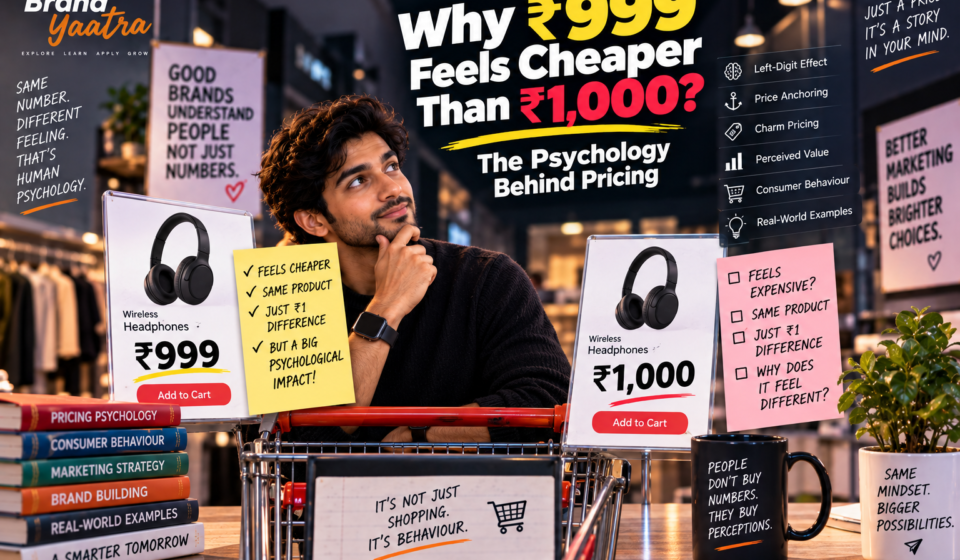

You know ₹999 and ₹1,000 are almost the same amount of money.
The difference is just ₹1.
Yet put these two prices next to each other:
₹999
₹1,000
And somehow, one feels like a deal.
The other feels like a psychological boundary has been crossed.
That’s not an accident.
For decades, marketers, retailers and researchers have studied what happens inside our minds when we see different prices.
And the fascinating part is this:
Consumers don’t always experience prices mathematically.
We experience them psychologically.
That’s why ₹999 can feel meaningfully cheaper than ₹1,000 even though the numerical difference is tiny.
But there’s an important twist.
The famous “end everything in 9” strategy isn’t a magical conversion hack.
Research shows that its effectiveness depends heavily on the context, the product, the comparison price, the brand and the shopper’s objective.
So let’s unpack what is really happening.
The ₹1,000 Psychological Wall
Imagine you’re shopping for headphones.
You see:
₹999
Then:
₹1,000
Technically:
₹1,000 − ₹999 = ₹1
That’s a difference of only 0.1%.
But your brain doesn’t necessarily process those prices as:
“These products are separated by 0.1%.”
Instead, the leftmost digit changes.
999 → 1,000
You have moved from the 900s into the 1,000s.
And that change can influence how large the price feels.
Researchers Manoj Thomas and Vicki Morwitz demonstrated this phenomenon in a series of experiments published in the Journal of Consumer Research.
They found that nine-ending prices such as $2.99 can be perceived as smaller than $3.00 particularly when the leftmost digit changes.
This is known as the:
Left-Digit Effect
And it is one of the most interesting ideas in pricing psychology.
Your Brain Doesn’t Treat Every Digit Equally
Think about how you read:
₹4,999
You don’t consciously calculate:
4,999 = 4,000 + 900 + 90 + 9.
You recognize the number extremely quickly.
But when comparing prices around a psychological boundary, the leftmost digit can carry disproportionate weight.
Consider:
₹2,999 vs ₹3,000
The numerical difference is only ₹1.
But visually and psychologically:
2 → 3
That’s a bigger-looking change.
Now compare:
₹2,998 vs ₹2,999
The numerical difference is again ₹1.
But the leftmost digit remains:
2 → 2
The psychological effect is generally much weaker.
That’s exactly why the classic ₹999 vs ₹1,000 comparison is so interesting.
The magic isn’t simply the number 9.
It’s the boundary created by the leftmost digit.
So Is ₹999 Actually “Cheaper” in Your Brain?
Not exactly.
And this is where marketing articles often oversimplify the science.
The research doesn’t say:
“Everyone always thinks ₹999 is dramatically cheaper than ₹1,000.”
The effect is conditional.
Thomas and Morwitz found that the left-digit effect was strongest when the nine-ending price crossed a left-digit boundary, and its strength also depended on the comparison context.
Other research has also found that price-ending effects can influence consumer choice, but that the impact varies according to price level and shopping goals.
So think of ₹999 not as a mind-control trick.
Think of it as a small psychological nudge.
And marketers love small nudges.
Because when you sell thousands or millions of products, tiny changes in behaviour can become meaningful.
Welcome to Charm Pricing
This broader strategy is often called:
Charm Pricing
Charm pricing generally refers to setting prices just below a round number.
Examples:
- ₹99 instead of ₹100
- ₹499 instead of ₹500
- ₹999 instead of ₹1,000
- ₹1,999 instead of ₹2,000
- ₹4,999 instead of ₹5,000
The theory is simple:
Make the price appear slightly smaller while keeping it close to the desired price point.
But here’s where things get interesting.
Charm pricing isn’t just about making something “look cheap.”
It’s about how consumers perceive the price relative to a reference point.
₹999 Is Also a Communication Signal
Imagine two shirts.
Shirt A
₹999
Shirt B
₹1,000
They’re practically identical in price.
But the prices communicate slightly different things.
₹999 can suggest:
“This is a deal.”
₹1,000 can suggest:
“This is a clean, established price.”
That distinction matters.
Because prices don’t only communicate how much something costs.
They can communicate:
- affordability
- quality
- discount
- prestige
- value
- positioning
- urgency
- brand personality
And that brings us to one of the biggest lessons in pricing:
A price is part of your brand communication.
Why Luxury Brands Often Don’t Play the ₹999 Game
Now imagine seeing:
Rolex — ₹4,99,999
It feels strange.
Very strange.
A luxury brand often wants the price to feel:
- confident
- premium
- deliberate
- substantial
- uncompromising
A round number can support that perception better than a bargain-style nine ending.
Research on nine-ending pricing also suggests that the effect is highly context-dependent and can even work against premium brands in some situations.
That’s why you shouldn’t blindly copy:
₹999 = more sales
The real question is:
What does this price communicate about my brand?
Cheap Is Not the Same as Good Value
This distinction is critical.
Suppose you launch a premium skincare brand.
Your serum costs ₹3,000.
You change it to:
₹2,999
Have you suddenly made it more attractive?
Maybe.
But you may also have changed the psychological signal.
Instead of:
“Premium skincare.”
It could start feeling slightly more like:
“Retail promotion.”
That’s not automatically bad.
But it has consequences.
Your pricing should match your positioning.
Discount-oriented brand
₹499
Accessible premium
₹1,499
Premium
₹2,000
Luxury
₹2,500
The exact numbers aren’t universal.
The relationship between price and positioning is what matters.
The Psychology Doesn’t Stop at ₹999
Now let’s introduce another powerful concept.
Price Anchoring
Suppose you walk into a store and see:
₹4,999
Today: ₹2,999
Suddenly ₹2,999 feels attractive.
Why?
Because your brain now has a reference point:
₹4,999
You aren’t evaluating ₹2,999 in isolation.
You’re evaluating it relative to the anchor.
Research on advertised reference prices has found that reference and sale prices can influence consumers’ expectations of what a product should cost and can subsequently affect purchase intention.
This is the psychology behind one of the oldest tricks in retail.
Show me the expensive number first.
Then show me the cheaper number.
And suddenly the cheaper number feels better.
₹2,999 Feels Different Depending on What Came Before
Look at these two situations.
Situation A
₹2,999
No context.
You think:
“Is that expensive?”
You need more information.
Situation B
₹5,999
₹2,999
Now your brain has something to compare against.
The question changes from:
“Is ₹2,999 expensive?”
to:
“Wow, I’m saving ₹3,000.”
Same selling price.
Completely different psychological frame.
That’s anchoring.
This Is Why “Was ₹X, Now ₹Y” Is So Powerful
E-commerce websites use this everywhere.
Fashion.
Electronics.
Furniture.
Travel.
Subscriptions.
Food delivery.
Courses.
Software.
You see:
MRP: ₹4,999
Offer: ₹2,999
And your brain immediately calculates:
₹2,000 saved.
But here’s the important marketing lesson:
The reference price has to be credible.
If a brand invents absurdly high “original” prices just to make the discount look enormous, consumers may eventually stop trusting the promotion.
Good pricing psychology works best when it supports genuine value.
Not when it tries to manufacture fake value.
Another Trick: The Three-Price Menu
Now imagine you’re buying a subscription.
Basic — ₹499
Pro — ₹999
Premium — ₹1,999
Which one do you choose?
You might choose Pro.
But here’s the interesting part.
Now imagine the company adds:
Basic — ₹499
Pro — ₹999
Premium Plus — ₹2,999
Suddenly ₹1,999 can feel more reasonable.
Why?
Because your reference point changed.
This is closely related to decoy pricing and the broader use of comparative price structures.
The company isn’t necessarily trying to sell the most expensive option.
Sometimes it is trying to make the middle option feel like the sensible choice.
The Middle Option Is a Psychological Sweet Spot
Think about popcorn at a cinema.
You might see:
Small — ₹200
Medium — ₹350
Large — ₹380
Suddenly:
Large for ₹380
looks much better than:
Medium for ₹350
The extra ₹30 feels tiny compared with the additional quantity.
This is another reason pricing is not simply:
Cost + profit = selling price.
Consumers evaluate prices relative to alternatives.
Your pricing architecture matters.
People Don’t Buy Prices.
They Compare Prices.
This might be the most important sentence in the entire article.
A price rarely exists in isolation.
₹999 compared with:
₹1,000
feels different.
₹999 compared with:
₹499
feels expensive.
₹999 compared with:
₹1,499
feels cheap.
Same ₹999.
Three completely different perceptions.
That’s why pricing strategy isn’t simply about choosing a number.
It’s about designing the context around the number.
Why ₹999 Can Work Better Than ₹1,000
Let’s put the psychology together.
₹999 can:
- cross below a major price threshold
- create a bargain association
- activate the left-digit effect
- feel psychologically below ₹1,000
- work well for price-sensitive categories
- fit promotional positioning
Research has found that just-below pricing can shift choice toward lower-priced alternatives in some contexts.
But notice the wording:
in some contexts.
That’s important.
Because ₹999 Doesn’t Always Win
This is where we need to kill one of the biggest myths in marketing.
“Always end your price in 9.”
No.
Don’t.
Research on nine-ending pricing shows considerable variation depending on the brand, category, store, customer base and price level. Overusing nine-ending prices can also reduce their effectiveness.
And newer research continues to challenge simplistic assumptions about price endings.
For example, a 2022 study found that under certain multi-digit conditions, prices ending in repeated 1s could generate stronger discount perceptions than prices ending in 9s.
So the lesson isn’t:
9 is magical.
The lesson is:
Humans are sensitive to how numbers are framed.
Sometimes ₹1,000 Is Better Than ₹999
This is especially important for premium brands.
Imagine two restaurants.
Restaurant A
Chef’s Tasting Menu — ₹2,999
Restaurant B
Chef’s Tasting Menu — ₹3,000
Which feels more premium?
There is no universal answer.
But ₹3,000 can communicate:
- confidence
- simplicity
- premium positioning
- intentional pricing
while ₹2,999 may communicate:
- deal
- affordability
- retail
- psychological discount
If your brand is trying to feel exclusive, that distinction matters.
Pricing Can Change How People Judge Quality
Here’s another fascinating dimension.
Consumers sometimes use price as a signal of quality.
This is especially relevant when they can’t easily evaluate quality before purchase.
Think about:
- wine
- skincare
- consulting
- jewellery
- hotels
- restaurants
- luxury fashion
- professional services
If you know nothing about two consulting firms and one charges ₹10,000 while another charges ₹1,000, you may wonder:
“Why is the first one so expensive?”
But you may also wonder:
“What does the expensive one know that the cheap one doesn’t?”
Price becomes a signal.
That doesn’t mean expensive products are better.
It means price itself can become information when consumers have limited information.
Recent research continues to examine how price endings interact with quality and image perceptions, with findings suggesting the relationship is more complicated than the old “9-ending = cheap quality” assumption.
The ₹999 Trap
There’s another problem.
If everything costs:
- ₹99
- ₹199
- ₹299
- ₹499
- ₹999
eventually the pattern becomes obvious.
And when consumers recognize the tactic, the psychological effect can weaken.
Research on nine-ending pricing has found that its effectiveness can erode when retailers use it too extensively.
That’s why good pricing isn’t about finding one trick.
It’s about using the right price architecture for the right situation.
Think About Apple’s Pricing Again
Remember our earlier Brand Yaatra case study on Apple?
Apple is a great contrast.
Apple doesn’t need to constantly communicate:
“₹99 OFF!”
Its brand equity allows it to emphasize:
- product experience
- ecosystem
- design
- performance
- status
- convenience
- financing
- trade-in value
rather than making the entire brand about being the cheapest option.
That’s a completely different pricing psychology.
And this is where pricing connects directly with branding.
Pricing Is Positioning
Think about these hypothetical products.
₹299 perfume
Feels accessible.
₹1,499 perfume
Feels more premium.
₹7,999 perfume
Feels luxurious.
₹49,999 perfume
Now you’re probably buying something other than fragrance.
You’re buying:
status + scarcity + story + identity + experience.
The product hasn’t necessarily changed proportionally.
The meaning has.
That’s why price is one of the strongest signals a brand can send.
Why Discounts Can Be Dangerous
Discounts feel great.
But there’s a catch.
If you constantly teach customers:
₹2,999 → ₹1,499
they may eventually stop believing ₹2,999 is the real price.
They learn:
“Wait for the sale.”
And now you’ve trained customers not to buy at full price.
This can create a dangerous cycle:
Discount
↓
Purchase spike
↓
Customer waits for next discount
↓
Full-price demand weakens
↓
Brand discounts again
↓
Customers wait again
That’s why smart brands think carefully about promotional pricing.
The Psychology of “Only ₹100 More”
Here’s another simple but powerful tactic.
Imagine:
Basic — ₹899
Pro — ₹999
The difference is:
₹100
So the Pro version feels like an easy upgrade.
Now change the framing:
Basic — ₹899
Pro — ₹999
Instead of saying:
“Pro costs ₹999.”
say:
“Upgrade for just ₹100.”
Same economics.
Different psychology.
The second framing makes the incremental cost the focus.
And consumers often evaluate upgrades relative to the base option.
This Is Why Add-Ons Work
You’ve probably seen:
₹799
Then:
Add dessert for ₹99
Or:
₹999
Then:
Upgrade to premium for ₹199
Once you’ve already committed to spending ₹999, an additional ₹99 can feel relatively small.
The additional cost is judged against the initial purchase.
Again:
context changes perception.
₹999 vs ₹1,000 Is Really a Story About Human Decision-Making
At first, this looks like a story about numbers.
It’s not.
It’s a story about how humans make decisions.
We use:
- shortcuts
- comparisons
- reference points
- mental categories
- context
- emotions
- expectations
instead of calculating every purchase from scratch.
Imagine if you had to mathematically analyze every price you saw.
A supermarket trip would take three hours.
Your brain doesn’t work like that.
It uses shortcuts.
And marketers design pricing environments around those shortcuts.
The Five Pricing Psychology Principles Every Marketer Should Know
Let’s turn everything into a practical framework.
1. Left-Digit Effect
₹999 can feel meaningfully different from ₹1,000 because the leftmost digit changes.
Best suited to contexts where crossing a psychological price threshold matters.
2. Price Anchoring
Show a credible reference price and the selling price can feel more attractive by comparison.
₹4,999 → ₹2,999
The ₹4,999 becomes the mental anchor.
3. Comparative Pricing
Don’t evaluate a price alone.
Consumers compare it with:
- competitors
- alternatives
- previous prices
- other product tiers
- perceived value
4. Price-Quality Signalling
A higher price can sometimes communicate higher quality, expertise or exclusivity—especially when quality is difficult to evaluate directly.
5. Context
The same price-ending strategy can work differently depending on:
- product category
- customer
- brand positioning
- price level
- shopping goal
- competitive environment
Research strongly supports this contextual view rather than a universal “9 always wins” rule.
A Practical Pricing Framework for Marketers
Before choosing a price, ask these seven questions.
1. What do I want the product to feel like?
Cheap?
Accessible?
Premium?
Luxury?
Professional?
2. What is the customer’s reference price?
What are they comparing you with?
3. Am I crossing a psychological threshold?
₹999 → ₹1,000
₹4,999 → ₹5,000
₹49,999 → ₹50,000
These thresholds may matter more than the ₹1 difference itself.
4. Should my price look promotional?
If yes, a just-below price may fit.
If no, a round price may communicate better.
5. What are competitors charging?
Your price doesn’t exist in a vacuum.
6. What does my price say about my brand?
This question is often ignored.
It shouldn’t be.
7. Have I actually tested it?
This is the most important one.
Don’t assume.
Test.
Run:
₹999 vs ₹1,000
or
₹1,499 vs ₹1,500
or
₹1,999 vs ₹2,000
Then measure:
- conversion rate
- average order value
- revenue
- profit
- refund rate
- customer quality
- repeat purchases
Because the cheapest-looking price isn’t necessarily the most profitable price.
Here’s the Experiment I’d Run
Suppose you’re selling a product.
Current price:
₹1,000
Test:
Version A
₹1,000
Version B
₹999
Keep everything else identical.
Same:
- product
- page
- copy
- images
- audience
- traffic source
- offer
Then compare.
But don’t stop at conversion rate.
Imagine:
₹1,000
Conversion: 5%
₹999
Conversion: 5.4%
At first glance:
₹999 wins.
But if the ₹999 version produces substantially lower contribution margin, it may not actually be the better business decision.
Marketing isn’t about winning the experiment.
It’s about winning the economics.
And Here’s an Even Better Experiment
Don’t only test:
₹999 vs ₹1,000
Test:
₹899 vs ₹999 vs ₹1,000 vs ₹1,099
Now you’re learning something much more valuable.
You’re discovering the shape of demand around the psychological threshold.
Maybe:
₹899 → huge conversion
₹999 → strong conversion
₹1,000 → small drop
₹1,099 → major drop
Or maybe nothing meaningful happens.
Your customers get the final vote.
The Biggest Mistake Marketers Make With Pricing Psychology
They copy what other brands do.
Amazon uses ₹999.
So they use ₹999.
A competitor gives 40% off.
So they give 40% off.
A SaaS company uses:
₹499 / ₹999 / ₹1,999
So they copy it.
But pricing isn’t a template.
It depends on:
your product + your audience + your positioning + your alternatives + your economics.
So… Does ₹999 Actually Work?
Sometimes.
But not because humans are stupid.
And not because the number 9 has magical powers.
It works because humans process numbers using shortcuts, comparisons and reference points.
The leftmost digit can influence perceived magnitude.
Reference prices can influence expectations.
Price endings can influence choice.
But the effects are context-dependent, and research does not support treating ₹999 as a universal conversion formula.
That’s the much more interesting answer.
Brand Yaatra Takeaway
The next time you see:
₹999
don’t just think:
“They’re trying to make it look cheaper.”
Look deeper.
Ask:
What psychological threshold are they trying to cross?
Then ask:
What price are they anchoring me against?
Then:
What does this number tell me about the brand?
And finally:
What alternatives am I comparing it with?
Because pricing isn’t simply:
How much should we charge?
It’s:
What should this number make the customer feel?
That’s the real game.
₹999 and ₹1,000 may be separated by just one rupee.
But in the mind of a customer, they can represent two very different stories.
And that’s why one of the smallest details on a price tag can become one of the biggest decisions in marketing.
Frequently Asked Questions
Why does ₹999 feel cheaper than ₹1,000?
One explanation is the left-digit effect. When ₹999 becomes ₹1,000, the leftmost digit changes from 9 to 1 in the thousands place. Research has found that such left-digit changes can influence perceived price magnitude, particularly when the prices are close.
What is charm pricing?
Charm pricing is a pricing technique in which products are priced just below a round number, such as ₹999 instead of ₹1,000 or ₹499 instead of ₹500.
Does pricing something at ₹999 always increase sales?
No. Research indicates that the effectiveness of nine-ending pricing varies by product, brand, category, customer and context. In some situations it can even be counterproductive.
What is the left-digit effect?
The left-digit effect describes how the leftmost digit of a price can disproportionately influence perceived price magnitude. For example, consumers may perceive $2.99 differently from $3.00 even though the numerical difference is only one cent.
What is price anchoring?
Price anchoring occurs when an initial or reference price influences how consumers evaluate another price. For example, ₹2,999 can appear more attractive when presented alongside a credible ₹4,999 reference price.
Should premium brands use ₹999 pricing?
Not automatically. A premium brand may benefit from round pricing if it wants to communicate simplicity, confidence or premium positioning. Nine-ending prices can have different effects depending on the category and brand.
Why do online stores use ₹499, ₹999 and ₹1,999 so often?
These prices can help products sit just below psychological thresholds such as ₹500, ₹1,000 and ₹2,000. They can also fit promotional or value-oriented positioning.
Is ₹999 really cheaper than ₹1,000?
Mathematically, almost not at all. Psychologically, the two prices can be perceived differently because of how consumers process numerical information and compare prices.
Final Thought
The most fascinating thing about pricing is that customers don’t buy numbers.
They buy perceptions of numbers.
₹999 isn’t powerful because it’s one rupee cheaper.
It’s powerful because ₹999 and ₹1,000 don’t necessarily mean the same thing in the customer’s mind.
And once you understand that, a price tag stops looking like a number.
It starts looking like what it really is:
a piece of marketing.
Sources
- Thomas & Morwitz, Penny Wise and Pound Foolish: The Left-Digit Effect in Price Cognition, Journal of Consumer Research.
- Manning & Sprott, Price Endings, Left-Digit Effects, and Choice, Journal of Consumer Research.
- The Impact and Determinants of Nine-Ending Pricing in Grocery Retailing, Journal of Retailing.
- Research on advertised reference prices and anchoring effects.
- Research on alternative price endings and discount perceptions.
- 2026 research examining price endings, quality and image perceptions.