Why “Limited Edition” Makes People Want Things More: The Psychology of Scarcity

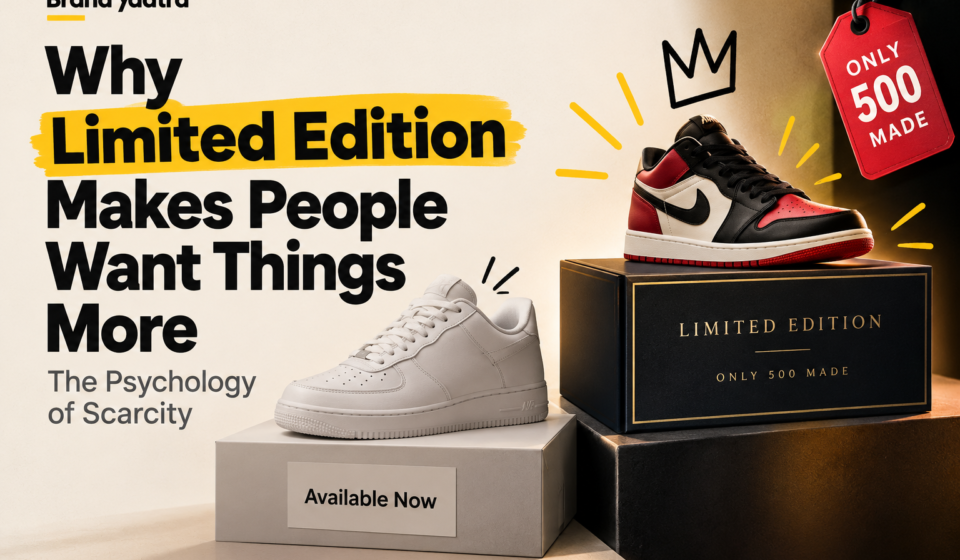
Imagine two identical products sitting next to each other.
One says Available now.
The other says Limited Edition. Only 500 made.
Suddenly, the second one feels different.
Maybe you weren’t planning to buy either.
But now you’re thinking:
“What if I miss it?”
That tiny phrase — limited edition — can change how people perceive a product.
From sneakers and watches to beauty products, festive packaging and brand collaborations, marketers regularly turn ordinary availability into something that feels temporary, rare or difficult to obtain.
But scarcity marketing isn’t as simple as “make something scarce and people will buy it.”
The interesting question is why scarcity works in some situations, why it fails in others, and what marketers can actually learn from it.
What Is Scarcity Marketing?
Scarcity marketing is the use of limited availability, restricted quantities, time limits or exclusive access to influence how consumers perceive a product or offer.
It can take several forms:
- Limited quantity: “Only 500 units produced.”
- Limited time: “Available this weekend only.”
- Demand-based scarcity: “Only 3 left.”
- Exclusive access: “Members only.”
- Limited distribution: “Available only at select stores.”
These signals can make a product feel more valuable, exclusive or urgent.
But they don’t all work in exactly the same way.
Why Does Scarcity Make Things Feel More Valuable?
When something is difficult to obtain, people can perceive it differently from something that is freely available.
A product that everyone can easily buy is ordinary.
A product that very few people can obtain can start to feel:
- special
- exclusive
- unique
- worth pursuing
Scarcity can therefore change more than availability.
It can change perception.
That’s one reason the same basic product can feel more desirable when it is presented as a limited edition.
“Limited Edition” Changes the Question
Consider two messages.
“Our best-selling sneaker.”
And:
“Limited edition sneaker. Only 2,000 pairs.”
Both can make the product attractive, but they trigger different ideas.
The first tells you:
Other people chose this.
The second tells you:
You may not get another chance.
One uses popularity as reassurance.
The other introduces rarity.
And rarity can make the decision feel more important.
The “What If I Miss It?” Effect
Without scarcity, the customer may ask:
“Do I want this?”
With scarcity, the question can become:
“Do I want this enough to risk losing it?”
Those are very different decisions.
The first is about desire.
The second introduces the possibility of regret.
That’s why:
“Buy this.”
can feel very different from:
“Buy this before it’s gone.”
The product hasn’t changed.
The perceived opportunity has.
Limited Quantity vs Limited Time
Marketers often treat these as interchangeable, but they communicate different things.
Limited quantity
“Only 1,000 units exist.”
The scarcity comes from supply.
The message is:
There simply aren’t many of these.
Limited time
“Available until Sunday.”
The scarcity comes from time.
The message is:
You have a short window to act.
Research has found that different scarcity cues can produce different effects depending on the product and buying situation.
So the better marketing question isn’t:
“Should we use scarcity?”
It is:
“What kind of scarcity actually makes sense for this product?”
Why Limited Editions Work So Well for Certain Products
Think about a limited-edition sneaker.
Or a watch.
Or a fashion collaboration.
These products can carry meanings beyond their functional use.
They can communicate:
- taste
- identity
- status
- individuality
- membership
That makes scarcity particularly interesting.
If owning something rare helps someone express something about themselves, scarcity can become part of the product’s perceived value.
The product isn’t simply:
“A sneaker.”
It becomes:
“A sneaker not everyone can own.”
Scarcity Can Turn Ownership Into Identity
Imagine that 10,000 people own the same product.
Now imagine only 500 people own a special version.
The second product can become a signal.
Not necessarily because it performs better, but because it communicates:
“I have something not everyone has.”
This is particularly relevant to categories where consumption has a strong identity or social component, such as fashion, luxury products, collectibles and collaborations.
Scarcity can therefore become part of the product’s story.
But Here’s Where Scarcity Marketing Gets Dangerous
If scarcity becomes too obvious, people may stop believing it.
Imagine a website that says:
“Only 2 left!”
Every day.
For six months.
Eventually, the message stops feeling like useful information.
It starts feeling like a sales tactic.
And once consumers become suspicious of the tactic, scarcity can lose some of its persuasive power.
That’s the paradox:
Scarcity works partly because people believe the thing is scarce.
If they stop believing it, the mechanism starts breaking down.
Fake Scarcity Is Not the Same as Scarcity
There is a major difference between:
“We produced 500 units.”
and:
“Only 2 left!”
when the company actually has thousands sitting in a warehouse.
The first is a genuine product decision.
The second is a claim about availability.
Good scarcity makes something genuinely limited.
Bad scarcity merely says it is.
That distinction matters because short-term conversion is not the only thing a brand is building.
It is also building trust.
And Sometimes Limited Editions Can Backfire
This is the part that gets lost in most explanations of scarcity marketing.
Scarcity isn’t universally positive.
Research has found situations in which limited-edition packaging produced lower purchase intentions than standard packaging.
Why?
Because consumers don’t automatically interpret scarcity as desirable.
Sometimes rarity can create excitement.
Sometimes it can create inconvenience, suspicion or simply fail to add meaningful value.
That is why context matters.
Scarcity Works Differently for “Want” Products and “Need” Products
Compare two purchases.
Purchase A
A limited-edition sneaker collaboration.
Purchase B
A replacement water filter.
Scarcity can add excitement to the first.
For the second, it may create anxiety.
The difference is simple:
In the first case, rarity can be part of the appeal.
In the second, availability is the appeal.
That’s why scarcity needs to fit the category.
Why Luxury Brands Use Scarcity Differently
Luxury brands have an interesting relationship with scarcity.
They don’t necessarily want every customer to feel:
“Hurry! Only three left!”
That can sound like mass-market promotional language.
Instead, scarcity may be communicated through:
- limited production
- special collections
- exclusive access
- private appointments
- waiting lists
- controlled distribution
The scarcity becomes part of the brand story.
That is very different from putting a countdown timer on a product page.
It also connects with why luxury brands rarely discount: premium positioning often depends on protecting the perception that the product isn’t simply another item competing for a quick sale.
Scarcity Can Also Create a Story
Sometimes the real power of a limited edition isn’t that fewer units exist.
It’s that the product now has a reason to exist.
Imagine:
Regular product:
“Our classic chocolate bar.”
Limited edition:
“Our festive collaboration with an Indian illustrator. Available for one season.”
The second product has context.
It has an occasion.
It has a story.
Scarcity becomes more than a sales tactic.
It becomes a storytelling device.
Why Collaborations and Limited Editions Go Together
Consider what happens when a brand collaborates with:
- an artist
- a designer
- a celebrity
- a sports team
- another brand
- a cultural event
The collaboration already gives the product novelty.
Scarcity adds another layer:
Novel + rare.
That combination can be more compelling than either element alone.
But the product has to earn the story.
Putting “LIMITED EDITION” on a normal product doesn’t automatically create cultural value.
Why Constant Limited Editions Can Destroy the Meaning of Limited
Here’s a simple thought experiment.
Brand A launches:
One limited edition every three years.
Brand B launches:
A “limited edition” every three weeks.
If everything is special, nothing is special.
Scarcity depends partly on contrast with normal availability.
If customers expect another “exclusive” drop next Tuesday, today’s scarcity loses some of its meaning.
That doesn’t mean brands should never run multiple limited releases.
It means the brand should understand what scarcity is supposed to accomplish.
The Difference Between Scarcity and Urgency
These concepts are related but not identical.
Scarcity: “Only 500 exist.”
Urgency: “You need to act now.”
Scarcity is about availability.
Urgency is about timing.
A marketer can have one without the other.
A collectible may be genuinely scarce but available indefinitely through resale.
A ticket sale may have plenty of inventory but close at a particular time.
The psychological experience is different.
Scarcity and Choice Overload Can Work Together
Imagine a website with 200 products.
Then imagine the same website saying:
“Our limited collection: 6 products.”
The second experience isn’t only about scarcity.
It also reduces the decision space.
The customer now has a smaller, more meaningful set of choices.
That connects with our earlier look at why more choices can make buying harder.
Sometimes making something feel special and making it easier to choose can happen at the same time.
Scarcity Can Change the Meaning of the Same Product
Imagine a plain black T-shirt.
Nothing particularly special.
Now imagine the same T-shirt with:
“Edition 037 / 500”
The physical object may be almost identical.
But the second version communicates something different.
It says:
“This belongs to a defined set.”
The customer isn’t just buying the shirt.
They’re buying membership in the 500.
But Scarcity Doesn’t Create Value From Nothing
This is perhaps the most important lesson.
If the underlying product is terrible, making only 100 of them doesn’t magically make it desirable.
Scarcity can amplify perceived value.
It doesn’t manufacture product-market fit.
It doesn’t fix poor quality.
It doesn’t repair a weak brand.
And it doesn’t guarantee sales.
The strongest scarcity strategies usually sit on top of something people already want:
- a strong product
- a compelling design
- a relevant collaboration
- a meaningful story
- a strong brand
- a desirable experience
A Simple Scarcity Framework
Before using scarcity, ask six questions:
1. Is it actually limited?
If not, you’re creating a trust problem.
2. Why is it limited?
A credible reason makes the scarcity easier to understand.
3. Does rarity add value to this category?
It works differently for a sneaker than for a replacement battery.
4. Is the product desirable without the scarcity message?
If not, scarcity may simply expose the weakness.
5. What are you trying to create?
Urgency? Exclusivity? Uniqueness? Collectibility? A reason to act now?
6. How often will you use scarcity?
Overuse can make “limited” feel ordinary.
The Brand Yaatra Takeaway
Marketers often treat scarcity as a shortcut:
Make less → create urgency → sell more.
Reality is more complicated.
Scarcity can change how people perceive a product, but its effect depends on the product, the type of scarcity, the consumer and the context.
So the better question isn’t:
“How can we make this scarce?”
Ask:
“If this were genuinely scarce, why would that make it more valuable to our customer?”
If you have a good answer, scarcity can become a powerful part of the strategy.
If you don’t, adding the words “LIMITED EDITION” probably won’t save the product.
Because the best scarcity marketing doesn’t simply make people fear missing a product.
It makes them understand why the product was worth wanting in the first place.