

Glue is not supposed to be interesting.
You buy it when something needs to stick.
You use it.
You put it away.
Done.
And yet, ask people to name an adhesive brand in India, and there is a very good chance one name comes to mind almost immediately:
Fevicol.
That is an unusual marketing achievement.
Because Fevicol didn’t simply build awareness for an adhesive. Over decades, it built a personality around a product that most brands would struggle to make emotionally interesting.
Its advertising became humorous. Its situations became exaggerated. Its characters became memorable. Its communication developed a recognizable style.
Eventually, the advertising itself became part of what people associated with the brand.
And that is what makes Fevicol such an interesting marketing case study.
The question isn’t simply:
“Why were Fevicol’s advertisements funny?”
The more useful question is:
“How did a glue brand turn a functional product benefit into a creative world people wanted to remember?”
The Product Was Functional. The Marketing Didn’t Have to Be.
Fevicol’s basic promise is straightforward:
Strong bonding.
There is nothing inherently entertaining about that.
A conventional adhesive advertisement could simply demonstrate strength.
Stick two objects together.
Pull them apart.
Show that they don’t separate.
Communicate the product benefit.
Move on.
Fevicol eventually found a much more memorable way to communicate the same idea.
Instead of repeatedly explaining strength, it created exaggerated situations in which the strength of the adhesive became the joke.
The product benefit remained functional.
The expression of that benefit became entertainment.
That distinction is incredibly important.
Fevicol’s First Big Marketing Challenge
When Pidilite launched Fevicol as a consumer brand, the company had to make an adhesive relevant beyond its original professional use.
Pidilite’s own brand history notes that the 30-gram collapsible tube introduced in 1970 helped establish Fevicol as a consumer brand, while the company also approached carpenters directly rather than relying only on conventional retail distribution.
That already tells us something important.
Marketing wasn’t treated as advertising alone.
The product, the channel and the people who influenced purchase all mattered.
Then came another important shift.
According to Pidilite, Fevicol’s early advertising focused on communicating the functional strength of the adhesive, but by the 1980s the communication evolved toward real-life situations and the humour that became associated with the brand.
That was the beginning of something much bigger.
The Smart Move: Don’t Explain Strength. Show It Through a Story.
Imagine two advertisements.
Advertisement A
“Fevicol is extremely strong.”
Then comes a demonstration.
Advertisement B
A ridiculous situation happens because something refuses to come apart.
The audience laughs.
Then they realize:
Oh. That’s the glue.
The second approach has a major advantage.
The audience doesn’t have to memorize a technical explanation.
They remember the situation.
And the situation carries the product benefit with it.
That is excellent advertising.
Fevicol Turned “Strong Bond” Into a Creative Territory
This is probably the most important strategic decision in the Fevicol story.
The brand didn’t need a completely new idea for every advertisement.
It had a central territory:
Things that simply refuse to come apart.
That territory could then be expressed in hundreds of different ways.
A bus.
A train.
A crowded situation.
A wedding.
A social situation.
A cultural moment.
A ridiculous physical demonstration.
The execution could change.
The underlying idea remained recognizable.
That is the difference between a campaign and a brand platform.
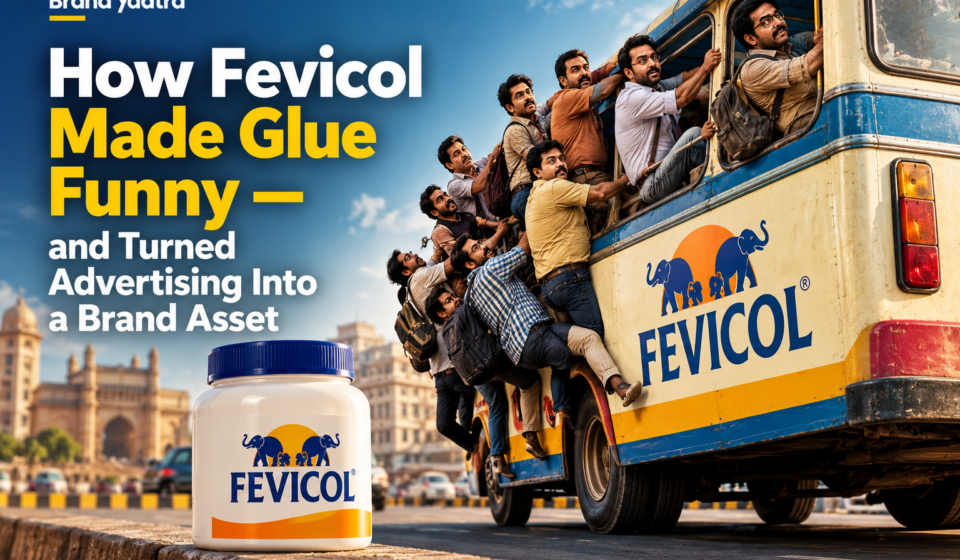
The Famous Fevicol Bus Ad Wasn’t Just a Funny Advertisement
One of Fevicol’s most famous pieces of advertising was its bus commercial.
The idea was simple and absurd: a bus becomes impossibly crowded because people are effectively stuck to it.
The exaggeration is what makes the product benefit memorable.
Pidilite records that the Fevicol bus commercial won a Silver Lion at the 2002 Cannes Lions International Festival of Creativity.
But the award isn’t the most interesting part of the story.
The more interesting part is why the idea worked.
The audience didn’t need to hear a technical explanation of adhesive strength.
They saw an exaggerated consequence of it.
And once the joke landed, the brand association landed with it.
Fevicol = impossible-to-break bond.
That is a much stronger memory structure than a list of product features.
Humour Wasn’t the Strategy. Consistency Was.
This is where marketers can easily learn the wrong lesson from Fevicol.
They see the advertisements and conclude:
“Fevicol succeeded because its ads were funny.”
Not quite.
Lots of brands make funny advertisements.
Very few build decades of recognizable communication around a consistent brand idea.
The real advantage came from repetition.
Different stories.
Different characters.
Different situations.
Different cultural references.
But repeatedly reinforcing the same basic association:
Fevicol makes things stick.
That consistency allows individual advertisements to strengthen one another instead of existing as isolated pieces of content.
This Is How Advertising Becomes a Brand Asset
Most advertisements disappear.
You see them.
You forget them.
A brand asset works differently.
It accumulates memory over time.
Think about a recognizable logo.
A colour.
A sound.
A character.
A tagline.
A distinctive style.
Or, in Fevicol’s case, a recognizable advertising world.
Eventually, consumers don’t need every advertisement to explain the brand from scratch.
The previous advertisements have already done some of the work.
That is a powerful compounding effect.
Fevicol Made the Product Benefit Entertaining
This is one of the strongest lessons from the brand.
Marketers often separate “brand communication” and “product communication” as if they are competing priorities.
Fevicol found a way to combine them.
The entertainment was built around the product truth.
The joke was not random.
The joke came from the strength of the adhesive.
That meant the entertainment wasn’t distracting from the product.
The entertainment was making the product easier to remember.
Why Absurdity Worked So Well
Normal product demonstrations have a problem.
They look like advertisements.
That means consumers can easily categorize them as something they are being asked to ignore.
Absurdity interrupts that pattern.
You see something unexpected.
You wonder what is happening.
You watch long enough to understand the joke.
Then the product explanation becomes part of the punchline.
Fevicol repeatedly used this mechanism:
Unexpected situation → curiosity → humour → product connection → memory.
That is a very efficient communication structure.
And Fevicol Didn’t Need to Behave Like a Luxury Brand
This is another important strategic point.
Different categories require different kinds of brand behaviour.
A luxury brand may want restraint, exclusivity and controlled communication.
Fevicol could afford to be loud, playful and exaggerated.
Its product category allowed humour to become part of the identity.
That doesn’t mean every brand should copy Fevicol’s style.
The lesson is to find the communication style that fits your own product truth and audience.
That is why copying another brand’s advertising tone is usually a weak strategy.
You can copy the surface.
You cannot copy the strategic fit underneath it.
Fevicol’s Advertising Became Familiar Enough to Become Expected
There is an interesting paradox here.
Good advertising needs to surprise people.
But strong brands also need consistency.
How can both be true?
By keeping the idea consistent while changing the execution.
That’s exactly where Fevicol’s strategy becomes useful.
You could expect:
“There will probably be something ridiculous.”
But you didn’t necessarily know what the ridiculous situation would be.
So the brand created a familiar frame with an unpredictable story inside it.
That is a very powerful creative structure.
The Brand Became Bigger Than the Product Category
At some point, Fevicol stopped being merely “a glue brand with funny advertisements.”
The brand itself became associated with strength, bonding and humour.
That matters because consumers don’t always remember product specifications.
They remember associations.
If someone thinks:
“This needs to stay stuck.”
and Fevicol is one of the first brands that comes to mind, years of communication have done their job.
And This Is Where Fevicol’s Strategy Connects to Brand Memory
Brand building isn’t only about making people aware that you exist.
It’s about building associations that can be retrieved when a relevant need appears.
Fevicol repeatedly linked its name to one memorable idea:
bonding that doesn’t break.
The humour made that association easier to remember.
The repetition strengthened it.
The distinctive creative style made it easier to recognize.
And the product experience gave the promise a functional foundation.
There Was Also a Business Strategy Behind the Advertising
It would be a mistake to study Fevicol as if advertising created the entire brand.
Advertising works inside a larger marketing system.
Pidilite’s history shows Fevicol’s development involved product decisions, packaging, relationships with carpenters, consumer distribution and brand-building activity alongside advertising.
The advertising became powerful because there was a real product and a real market underneath it.
That distinction matters.
A memorable advertisement can create awareness.
It cannot permanently compensate for a poor product.
The Carpenter Was More Important Than the Average Viewer
One of the less glamorous but more strategically important parts of Fevicol’s history is its relationship with carpenters.
Pidilite’s own account notes that the brand approached carpenters directly when it entered the consumer market.
That is smart category marketing.
In many product categories, the person who ultimately uses a product is not necessarily the only person influencing what gets purchased.
There can be:
- professionals
- retailers
- contractors
- installers
- designers
- family members
- other trusted influencers
Understanding that decision system can be just as important as making a memorable advertisement.
Then Fevicol Built a Long-Term Creative Memory
Over time, the brand accumulated more than individual campaigns.
It accumulated expectations.
Consumers began to understand what a Fevicol advertisement felt like.
That is a very valuable position for a brand.
Because now the brand has a creative shortcut.
You don’t need to explain the personality from scratch every time.
The audience already knows the world.
And the Strategy Is Still Evolving
This is important because Fevicol is not simply a historical advertising case.
Pidilite’s 2024–25 annual report described the Jugalbandi campaign as a return to Fevicol’s signature creative style and wit, using the musical journey of two brothers as the story.
That wording is revealing.
The company itself describes the campaign as a return to a recognizable creative style.
In other words, the brand isn’t abandoning the territory.
It is refreshing it.
And Pidilite’s 2025–26 reporting shows that the brand continued developing culturally rooted campaigns, including its Teeka ID initiative and further recognition for storytelling and creative work.
That is exactly how a long-running creative platform should work.
Same brand idea. New cultural expression.
That’s the Part Marketers Should Copy
Not the jokes.
Not the characters.
Not the visual style.
Not the exaggerated situations.
The strategic discipline.
Fevicol found a territory that belonged naturally to the product.
Then it stayed there long enough for the territory to become associated with the brand.
That is much harder than producing one viral campaign.
Fevicol vs the “New Campaign Every Month” Problem
A lot of modern marketing looks like this:
Campaign A.
Then Campaign B.
Then a festival campaign.
Then a celebrity collaboration.
Then a new visual identity.
Then a completely different tone.
Each campaign might be individually good.
But what is the consumer supposed to remember?
Fevicol’s long-term approach offers the opposite lesson.
Don’t make every campaign start the brand over again.
Let each campaign add another layer to the same memory.
What Fevicol Teaches Us About Distinctiveness
Strong brands often develop recognizable assets over time.
These can include:
- visual cues
- colours
- characters
- sounds
- phrases
- writing style
- advertising conventions
- recurring creative ideas
Fevicol’s advertising style became one of those recognizable cues.
That creates a useful connection with the broader Brand Yaatra idea of building a brand that can be recognized beyond simply displaying its name.
And this is something we can also see in very different categories. For example, Zomato’s brand-building journey shows how tone, cultural relevance and consistency can turn communication style itself into part of a brand’s identity.
But Fevicol’s Approach Isn’t Only About Advertising
This is perhaps the biggest mistake someone could make after reading this case study.
They could conclude:
“We need funnier advertisements.”
That’s not the lesson.
The lesson is:
Find a distinctive way to express a meaningful product truth, then repeat and evolve that idea consistently enough for it to become associated with your brand.
Sometimes that will involve humour.
Sometimes it won’t.
A B2B software company might use a different creative territory.
A luxury brand might use restraint.
A financial brand might use trust.
A sports brand might use ambition.
The principle remains the same.
What Marketers Can Learn From Fevicol
1. Turn a product benefit into an idea
“Strong adhesive” is a feature.
“Things that simply refuse to come apart” is a creative idea.
2. Don’t confuse novelty with distinctiveness
A completely new campaign every month can create activity without creating memory.
3. Let entertainment carry the product message
If people remember the joke but forget the brand, the creative has failed.
The best Fevicol work makes the joke inseparable from the product benefit.
4. Build a territory, not just a campaign
A campaign eventually ends.
A strong creative territory can last for decades.
5. Consistency creates compounding returns
Every new execution can strengthen the associations created by earlier ones.
6. Know who actually influences the purchase
Mass advertising is useful, but category influence can come from professionals, retailers and other decision-makers.
7. Refresh the expression, not the entire identity
The fact that Fevicol can create new stories without abandoning its core creative world is one of the strongest lessons from its longevity.
The Fevicol Marketing Framework
We can simplify the strategy into a simple chain:
PRODUCT TRUTH
Strong bonding
↓
CREATIVE TRANSLATION
Make the strength visible through exaggerated situations
↓
EMOTIONAL RESPONSE
Humour, surprise and curiosity
↓
MEMORY
Associate the experience with Fevicol
↓
CONSISTENCY
Repeat the territory across years
↓
DISTINCTIVENESS
The advertising style itself becomes recognizable
↓
BRAND EQUITY
The product becomes easier to recognize and remember when the category need appears.
The Bigger Lesson
Fevicol’s success is not really a story about funny advertisements.
It is a story about what happens when a brand discovers a creative territory that fits its product so naturally that the territory can survive for decades.
The product gives the brand its truth.
The creative idea gives that truth a personality.
Consistency gives the personality memory.
And memory eventually becomes an asset.
That is why Fevicol is such an interesting example.
It didn’t make glue exciting.
It made the idea of Fevicol memorable.
Brand Yaatra Takeaway
The easiest thing to copy from Fevicol is the humour.
It’s also the least important thing to copy.
The real lesson is much more strategic:
Find the strongest truth about your product. Turn that truth into a distinctive creative idea. Then stay with it long enough for consumers to associate the idea with your brand.
Fevicol could have spent decades telling people that its adhesive was strong.
Instead, it found a way to make people feel what “strong” meant.
That is the difference between communicating a benefit and building a brand around it.
And perhaps that is the most impressive thing Fevicol ever stuck to.
Its own idea.
Frequently Asked Questions
Why is Fevicol’s advertising considered successful?
Fevicol built a long-running creative platform around the idea of strong bonding. Instead of repeatedly explaining the functional benefit, its advertising often turned that benefit into humorous and exaggerated situations, making the brand easier to remember.
What is Fevicol’s marketing strategy?
Fevicol’s marketing combines product-led communication, relationships with key category influencers, broad consumer communication and a highly distinctive advertising style built around humour and the idea of strong bonding.
Why does Fevicol use humour in advertising?
Humour gives the brand a way to communicate a functional product benefit through memorable stories rather than technical demonstrations alone. The strongest executions connect the humour directly to the product’s bonding promise.
What can other brands learn from Fevicol?
Brands can learn the value of finding a distinctive creative territory, connecting that territory to a real product truth, maintaining consistency and refreshing the execution without abandoning the underlying brand idea.
Did Fevicol’s advertising win awards?
Yes. Pidilite records that the iconic Fevicol bus commercial won a Silver Lion at the 2002 Cannes Lions International Festival of Creativity. The brand has also received recognition for its continuing advertising work over the years.
Is Fevicol’s marketing only about advertising?
No. Advertising is one part of the broader strategy. Fevicol’s history also includes product development, consumer packaging, relationships with carpenters and contractors, distribution and category-building efforts.
Why is consistency important in Fevicol’s marketing?
Consistency allows individual campaigns to reinforce the same underlying brand association. Instead of every advertisement creating a completely new meaning, successive campaigns can build on the memory created by earlier ones.