
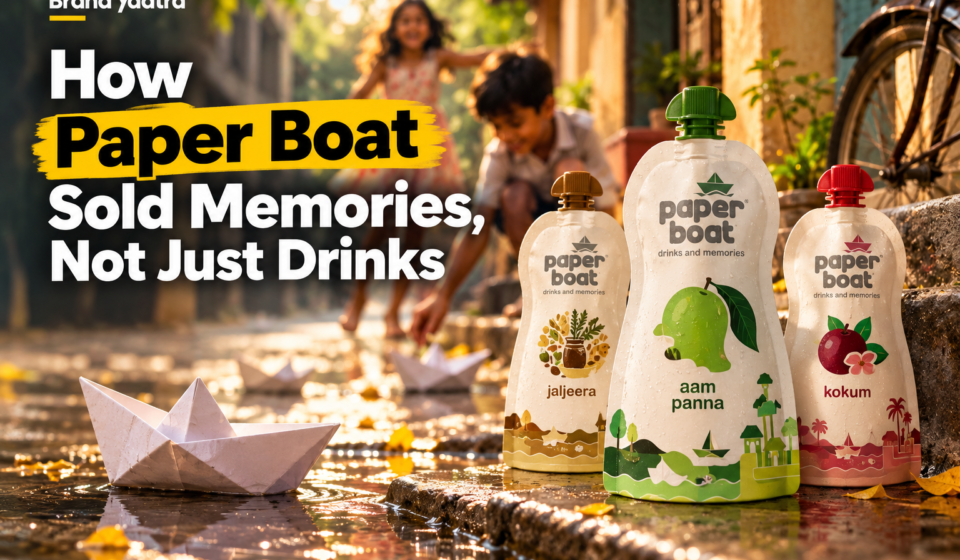

What do you remember when you think about summer vacations?
Maybe it is the taste of something your mother made.
Maybe it is a rainy afternoon.
Maybe it is making a paper boat and watching it disappear into a puddle.
Maybe it is something much smaller that you haven’t thought about in years.
Now imagine a beverage brand building an entire business around that feeling.
That is what makes Paper Boat such an interesting marketing case.
It did not enter India’s beverage market by trying to outspend the biggest soft-drink companies.
It did not need the loudest celebrity.
It did not try to win by making another version of the same cola, juice or energy drink.
Instead, Paper Boat looked somewhere else.
Backwards.
It looked at drinks many Indians remembered from childhood, brought them into modern packaged retail and wrapped the entire experience in nostalgia.
The result was more than a beverage proposition.
It was a brand built around memory.
And that gives marketers a much more interesting question to study:
How do you turn an ordinary product category into an emotional category that people can actually remember?
The Beverage Market Was Already Crowded
When Paper Boat entered the market, consumers already had plenty of choices.
Colas.
Fruit drinks.
Juices.
Energy drinks.
Sports drinks.
There was no obvious reason another beverage brand should matter.
And that is exactly where the opportunity appeared.
Hector Beverages did not have to ask:
“How can we make another beverage people prefer?”
It could ask:
“What beverage experience are people not getting from the existing market?”
The answer was surprisingly old-fashioned.
Traditional Indian drinks.
Drinks that existed in homes but were not widely available as modern packaged beverages.
That became the starting point for Paper Boat.
It Started With Aam Panna
According to Hector Beverages’ own account, the story began when the founders regularly shared homemade aam panna over lunch.
They wanted to find it commercially, but couldn’t find the kind of traditional drink they remembered.
That led to a bigger realization.
There were many Indian drinks that people knew from home, family and childhood but rarely encountered in modern packaged form.
The company saw an opportunity to bring those drinks into a contemporary consumer format while preserving their cultural character. :chatgpt-content-reference{index=”1″}
That sounds like a product opportunity.
But it eventually became a positioning opportunity.
Paper Boat Wasn’t Just Selling Traditional Drinks
This distinction is critical.
There are many ways to sell a traditional Indian beverage.
You can say:
“Made with traditional ingredients.”
You can say:
“Authentic Indian recipe.”
You can talk about taste.
You can talk about refreshment.
You can talk about ingredients.
Paper Boat went somewhere more emotional.
It connected the drink to the memories surrounding it.
That difference changed the competitive game.
Instead of asking consumers to compare one packaged beverage with another, the brand was asking them to remember something.
And memories are much harder for a competitor to copy.
The Real Product Became “Remembering”
Think about how most beverage advertising works.
A person takes a sip.
They smile.
Friends appear.
Music plays.
The product looks refreshing.
The brand name appears.
Paper Boat could have followed the same formula.
Instead, much of its communication was built around the emotional world surrounding childhood and familiar Indian experiences.
Its own brand story describes the mission as bringing traditional drinks and culinary memories forward for people who had grown up with them — and for people who had never experienced them. :chatgpt-content-reference{index=”2″}
That is a very different marketing proposition.
The drink is physical.
The value around it is emotional.
Why Nostalgia Was Such a Powerful Choice
Nostalgia is not simply “remembering old things.”
It is an emotional response to memories of the past.
And Paper Boat had an unusual advantage:
The product itself was already connected to memories.
Aam panna could remind someone of summer.
Jaljeera could remind someone of home.
A paper boat could remind someone of monsoon afternoons.
The brand didn’t have to manufacture every emotional association from scratch.
It could activate associations that consumers already possessed.
Academic research on Paper Boat specifically identifies nostalgia and emotional branding as central elements of the brand’s competitive strategy. :chatgpt-content-reference{index=”3″}
That is the important strategic distinction:
Paper Boat didn’t invent the emotion. It connected the product to an emotion that already existed.
Then Came the Name
“Paper Boat” is a surprisingly powerful brand name.
It isn’t descriptive of a beverage.
It doesn’t tell you what flavour the product contains.
It doesn’t sound technical.
Instead, it immediately creates an image.
A piece of paper.
Folded by hand.
Placed into water.
Watched as it floats away.
For many people, that simple object carries memories of childhood.
That was not accidental.
Accounts of the brand’s development describe the paper boat as a deliberate connection to childhood memories and the emotional world the founders wanted the brand to evoke. :chatgpt-content-reference{index=”4″}
And this is a lesson in naming.
A name does not always need to explain the product.
Sometimes its job is to open a door into a world.
The Packaging Had to Tell the Same Story
Imagine putting a traditional drink into a completely ordinary beverage bottle.
The product might still taste good.
But the packaging would be communicating:
“This is another packaged drink.”
Paper Boat took a different route.
Its distinctive stand-up pouch became part of the identity.
Elephant Design, which worked on the brand, describes the packaging as being inspired by the paper boats of childhood and designed to make the traditional beverages feel like an emotional experience rather than simply another packaged drink. :chatgpt-content-reference{index=”5″}
This is where the strategy gets particularly smart.
The consumer didn’t have to read an advertisement to encounter the brand idea.
The product itself was carrying the idea.
Name → packaging → product → communication.
All of them were pointing toward the same emotional territory.
That Is What Good Brand Strategy Looks Like
A weak brand strategy often looks like this:
Product says one thing.
Packaging says another.
Advertising says something completely different.
Paper Boat’s early positioning was much more coherent.
The drinks came from familiar Indian traditions.
The name evoked childhood.
The packaging reinforced the childhood connection.
The advertising expanded the emotional world.
The result was not just a collection of marketing assets.
It was a system.
Paper Boat Created a Category It Could Own
This may be the most important business lesson in the entire story.
Paper Boat wasn’t simply entering an existing battlefield and asking consumers to choose its version of a familiar product.
It helped make traditional Indian ethnic beverages into a modern packaged category.
That gave the brand a very different competitive position.
Instead of immediately asking:
“Are we better than Coca-Cola?”
or:
“Are we better than a fruit drink?”
the brand could establish a different question:
“Do you want the taste and feeling of those traditional drinks you remember?”
That is a much more interesting place for a challenger brand to compete.
Contemporary accounts of Paper Boat’s launch describe the same opportunity: the company entered in 2013 with traditional drinks such as jaljeera and aam panna at a time when the mainstream packaged beverage market was dominated by other categories. :chatgpt-content-reference{index=”6″}
The Brand Didn’t Need to Look Like a Typical Beverage Brand
This is another subtle advantage.
Most beverage packaging tries to communicate refreshment.
Bright colours.
Cold condensation.
Fruit imagery.
Large logos.
Paper Boat could communicate something quieter.
Warmth.
Illustration.
Childhood.
Stories.
Familiarity.
That helped it look different before the consumer even tasted the product.
And in a crowded shelf environment, that matters.
Then Advertising Turned Memory Into Story
One of Paper Boat’s early high-profile advertisements was deliberately long-form and emotional.
A 2015 Economic Times report described a 205-second Paper Boat film featuring a child making a paper boat, with references to childhood, Malgudi Days and Gulzar’s voice. The objective was explicitly described as evoking nostalgia. :chatgpt-content-reference{index=”7″}
Notice what the advertisement wasn’t doing.
It wasn’t desperately trying to convince you that the drink was refreshing.
It wasn’t throwing a celebrity at the camera.
It wasn’t shouting a discount.
It was creating a feeling.
And then connecting that feeling back to the brand.
That is emotional branding at its strongest.
The Product Appears Almost Secondary
That might sound like a dangerous strategy.
Why spend so much time talking about childhood when you’re trying to sell a drink?
Because the emotional story gives the product meaning.
Without the story, the product is:
A packaged traditional beverage.
With the story, it becomes:
A way of reconnecting with something familiar.
The physical product hasn’t changed.
The perceived meaning has.
But This Wasn’t Just “Nostalgia Marketing”
Calling Paper Boat a nostalgia brand is accurate.
Stopping there misses the strategy.
There were at least four connected decisions:
- Find overlooked products with cultural familiarity.
- Package them in a contemporary format.
- Build the brand around memory and emotion.
- Make every major touchpoint reinforce the same idea.
Nostalgia was the emotional engine.
It was not the entire business strategy.
That’s Why the Packaging Matters So Much
Imagine seeing the same Paper Boat advertisement without ever encountering the distinctive pouch.
The emotion might still work.
But when the same emotional idea appears in the physical product, the brand becomes easier to recognize.
This is the same principle behind strong distinctive brand assets.
For brands that can build recognizable assets, the objective isn’t to make every communication look identical.
It is to create enough consistent signals that the brand becomes recognizable.
Paper Boat’s pouch, name and visual world all helped create that recognition.
That makes this case particularly relevant alongside how distinctive brand assets help brands become recognizable.
Paper Boat Also Understood That “Indian” Isn’t One Thing
There is a trap in heritage marketing.
A brand can become so obsessed with looking traditionally Indian that it starts feeling artificial.
Paper Boat had an advantage because it wasn’t inventing an Indian aesthetic from scratch.
It was working with real drinks and real memories.
Aam panna.
Jaljeera.
Kokum.
Aamras.
Different regions and families have their own versions of these experiences.
That gave the brand a large cultural territory to explore without requiring every consumer to have exactly the same memory.
The Memory Didn’t Have to Be Identical
This is another reason nostalgia can be powerful.
You don’t need everyone to remember the same childhood.
You only need them to recognize the feeling.
One person might remember summer holidays at their grandparents’ house.
Another might remember school afternoons.
Another might remember monsoon rain.
Another might remember a drink their mother or grandmother prepared.
The details differ.
The emotional territory overlaps.
That gives the brand room to tell many different stories without abandoning its central idea.
This Is Where Paper Boat’s Strategy Gets Difficult to Copy
A competitor can copy a pouch.
A competitor can launch a mango drink.
A competitor can run a nostalgic advertisement.
A competitor can even use childhood imagery.
But copying all of the underlying history is much harder.
Paper Boat’s advantage came from connecting:
Product heritage + name + packaging + storytelling + cultural memory.
Copy one element and you don’t recreate the system.
That is the difference between copying execution and copying strategy.
But Nostalgia Has a Weakness
There is an obvious limitation to this strategy.
Memories belong to people.
And different generations remember different things.
A brand that relies too heavily on nostalgia can eventually become trapped in the past.
That is why Paper Boat cannot simply keep telling the same childhood stories forever.
It has to keep finding new ways to make its underlying idea relevant.
And the company has, in fact, expanded beyond the original drinks.
Hector Beverages’ own timeline shows Paper Boat moving into products such as chikki in 2016, Paper Boat Swing in 2018, trail mixes in 2021, zero-sugar sparkling water in 2022 and Nata de Coco beverages in 2024. :chatgpt-content-reference{index=”8″}
That expansion creates a strategic question:
Can a brand built around memories grow without becoming trapped by them?
That is much more interesting than simply saying nostalgia works.
The Brand Has to Evolve Without Losing Its Emotional Core
Look at the evolution carefully.
The original opportunity was traditional drinks.
The larger brand idea was memory.
Once the brand owns that emotional territory, it has more room to expand.
It can explore snacks.
New beverages.
Different formats.
Different moments.
As long as the expansion still feels like it belongs in the same emotional world.
That is a much more useful way to think about brand extensions.
Don’t ask only:
“Can we sell this product?”
Ask:
“Does this product make sense inside the world our brand has built?”
Paper Boat’s Biggest Advantage Wasn’t the Recipe
Traditional recipes can be reproduced.
Ingredients can be sourced.
Packaging can be imitated.
Advertising styles can be copied.
But a strong emotional association becomes harder to displace once enough people have connected it with a particular brand.
That is why Paper Boat is ultimately a brand-building case, not simply a beverage innovation case.
The Marketing Funnel Looked Different
Most beverage brands can think about communication like this:
Awareness → Trial → Repeat Purchase.
Paper Boat added another layer.
Memory → Emotion → Curiosity → Trial → Association.
The emotional association becomes important because the consumer isn’t only learning what the product is.
They are learning what the product means.
And Meaning Can Become a Competitive Advantage
Two drinks can have similar functional qualities.
They can even compete at similar price points.
But if one reminds you of home and the other doesn’t, the decision isn’t purely functional anymore.
That is the space Paper Boat entered.
It made the choice emotional.
And emotional differentiation can be especially valuable in categories where functional differences are difficult for consumers to evaluate quickly.
What Paper Boat Teaches About Building a Brand From Scratch
1. Don’t always enter the biggest existing category
Sometimes the better opportunity is an underserved need sitting between established categories.
2. Look for cultural behaviour, not just market size
The founders noticed something people already did at home that the packaged market wasn’t serving properly.
3. Find the emotion already attached to the product
Paper Boat didn’t manufacture nostalgia around random beverages. The drinks already had cultural and personal associations.
4. Make packaging part of the strategy
Your product should not contradict the story your advertising tells.
5. Give consumers something to remember
A product benefit is useful. A distinctive mental association is more powerful.
6. Don’t confuse nostalgia with decoration
Old photographs and retro fonts do not automatically create emotional connection. The memory has to feel relevant and authentic.
7. Build a world that can expand
A strong brand idea should give you room to create new products without making the brand unrecognizable.
The Paper Boat Marketing Framework
The strategy can be simplified into a chain:
UNMET NEED
Traditional Indian drinks were familiar but not widely available in modern packaged form.
↓
PRODUCT
Bring those drinks into a convenient contemporary format.
↓
EMOTIONAL INSIGHT
The drinks are connected to memories, childhood and home.
↓
BRAND IDEA
Paper Boat becomes a vehicle for memories.
↓
IDENTITY
Name, pouch, illustration and storytelling reinforce the same world.
↓
DIFFERENTIATION
The brand competes on emotional meaning rather than simply beverage functionality.
↓
BRAND EQUITY
The product becomes associated with a feeling that competitors cannot easily reproduce.
What Marketers Shouldn’t Copy
There is an easy mistake to make after studying Paper Boat.
A marketer sees the success and says:
“Let’s use nostalgia in our next campaign.”
That misses the point.
If you’re selling software, putting childhood photographs into your advertisement won’t suddenly create emotional depth.
If you’re selling a new financial product, using an old Hindi song doesn’t automatically create trust.
If you’re selling a new snack, adding retro packaging doesn’t give you cultural authenticity.
The lesson isn’t:
Use nostalgia.
The lesson is:
Find the emotional meaning that naturally belongs to what you’re selling.
For Paper Boat, that happened to be memory.
For another brand, it could be confidence.
Belonging.
Freedom.
Achievement.
Discovery.
Security.
The strategy starts with the product and the consumer, not with a trendy emotional trigger.
The Bigger Lesson
Paper Boat didn’t have the easiest product to market.
It entered a beverage market with powerful incumbents and familiar consumer habits.
So it changed the basis of competition.
Instead of asking people to compare another beverage with everything already on the shelf, it gave them something else to compare:
How does this make me feel?
That is a much harder question for competitors to answer.
And it shows why positioning can be more powerful than simply adding another feature.
Brand Yaatra Takeaway
The smartest thing Paper Boat did was not invent a new drink.
It found meaning in something people already knew.
Traditional beverages gave the brand a product foundation.
Childhood memories gave it an emotional foundation.
The paper boat gave it a memorable name.
The pouch gave it a distinctive physical identity.
Storytelling gave the brand a voice.
And consistency connected all of those pieces.
That’s the bigger lesson:
Sometimes the strongest way to make a new brand feel familiar is not to invent something completely new. It is to take something people already feel strongly about and give that feeling a new place to live.
Paper Boat didn’t just put traditional drinks into a pouch.
It put memories into a product.
And that is why people didn’t have to remember the advertisement to remember the brand.
They only had to remember something from their own lives.
Frequently Asked Questions
What is Paper Boat’s marketing strategy?
Paper Boat built its brand around traditional Indian beverages, nostalgia and emotional storytelling. Its strategy connected familiar drinks and childhood memories with distinctive packaging and a consistent brand identity.
Why is Paper Boat associated with nostalgia?
The brand deliberately connected traditional Indian drinks with childhood, family, home and memories of the past. Its name, packaging and advertising reinforced that emotional positioning.
How did Paper Boat differentiate itself?
Rather than competing only on conventional beverage attributes, Paper Boat focused on traditional Indian drinks and built an emotional identity around memory and nostalgia. This gave the brand a different position from mainstream beverage competitors.
Why is Paper Boat’s packaging important?
The distinctive pouch format became part of the brand’s identity and reinforced the childhood theme behind the name Paper Boat. Packaging therefore worked as more than a container; it helped communicate the brand positioning at the point of purchase.
What can other brands learn from Paper Boat?
The biggest lesson is to find an emotional or cultural meaning that naturally connects with the product, then express that meaning consistently across the product, packaging and communication.
Can nostalgia work for every brand?
No. Nostalgia works best when a genuine connection to the past already exists. Simply adding retro visuals or childhood references to a product does not create authentic emotional relevance.