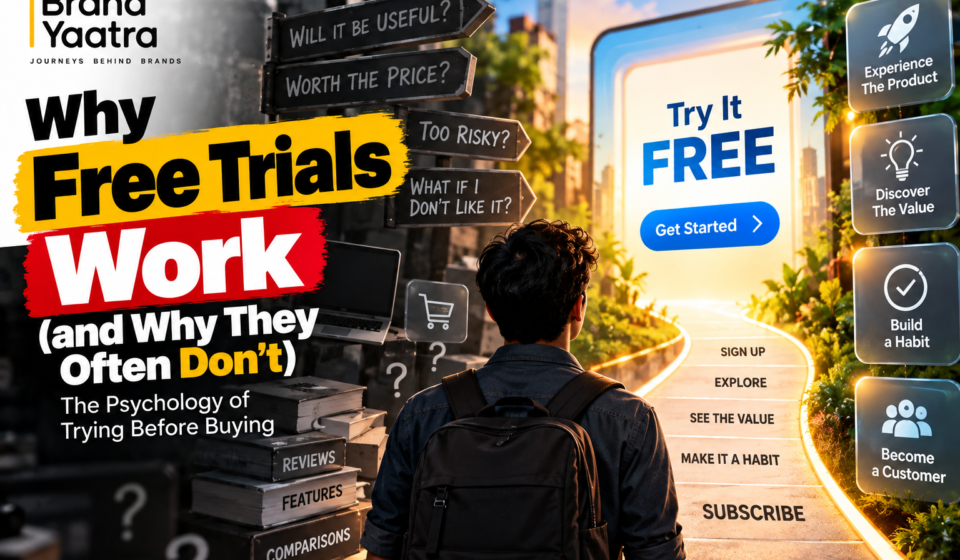
Why Free Trials Work (and Why They Often Don’t): The Psychology of Trying Before Buying

“Try it free for 7 days.”
“First month free.”
“Start your free trial.”
You have probably seen these offers hundreds of times.
Software uses them.
Streaming services use them.
Fitness apps use them.
News publications use them.
Education platforms use them.
And the logic seems obvious.
If people don’t want to pay before they know whether something is useful, let them try it first.
Remove the price.
Reduce the risk.
Let the product sell itself.
Simple.
Except there is a problem.
Free trials don’t automatically create paying customers.
Some people try the product, love it and subscribe.
Some try it once and disappear.
Some use it for six days, cancel on day seven and never return.
And some sign up because it’s free without ever having a serious intention to become a customer.
So what actually makes a free trial work?
It isn’t simply the word “free.”
The more interesting answer involves uncertainty, perceived value, habit formation, friction, timing and what happens during the trial itself.
Free Removes One Problem. It Doesn’t Solve the Whole Decision.
Imagine you’re considering a ₹1,000-per-month software subscription.
You have never used it.
You don’t know whether it will actually save you time.
You don’t know whether you’ll like the interface.
You don’t know whether the premium features are useful.
And you definitely don’t want to spend ₹1,000 just to find out.
The biggest barrier isn’t necessarily price.
It’s uncertainty.
A free trial changes that.
Instead of asking:
“Should I pay ₹1,000 to find out whether this is useful?”
the customer can ask:
“Is this useful enough for me to keep using?”
That’s a much easier question.
The customer gets something marketers normally struggle to provide:
direct experience.
The Product Stops Being a Promise
Before the trial, the customer has to imagine the value.
After the trial begins, they can experience it.
That distinction matters enormously.
A landing page can tell you:
- what the product does
- how many features it has
- how fast it is
- how many customers use it
- what problems it solves
But none of those things is quite the same as experiencing the product yourself.
A free trial turns:
“Believe us.”
into:
“See for yourself.”
That can be a powerful marketing shift.
But “Free” Can Also Attract the Wrong Customer
Here’s the uncomfortable side of free trials.
The person who signs up isn’t necessarily the person who wants to buy.
They may simply want something free.
That distinction matters.
Imagine two people.
Customer A
“I’ve been looking for software that solves this exact problem. I’ll try it and see whether it is worth paying for.”
Customer B
“It’s free. Why not?”
Both sign up.
Only one may have genuine purchase intent.
So the number of trial signups can be a misleading success metric.
A company could double trial registrations and still fail to improve its subscription business.
That is why marketers need to look beyond:
How many people started the trial?
and ask:
How many people experienced enough value to want the product afterwards?
The Most Important Part of a Free Trial May Be What Happens During It
Consider two products.
Product A
The customer signs up.
They see a complicated dashboard.
They have to configure 14 settings.
They receive a welcome email.
Then nothing.
Product B
The customer signs up.
The product immediately helps them complete something useful.
They understand the main benefit within minutes.
They return the next day.
They use another feature.
By day five, the product has become part of their routine.
Which one is more likely to convert?
Probably B.
And that tells us something important:
The trial isn’t the marketing strategy.
The experience inside the trial is.
Free Trials Can Create Habits
This is where the psychology becomes particularly interesting.
Imagine someone starts using a productivity application every morning.
Monday:
They use it once.
Tuesday:
They use it again.
Wednesday:
They start organizing their work around it.
Thursday:
They’ve saved information inside it.
Friday:
They know exactly where everything is.
At this point, the product is no longer just something they are evaluating.
It has become part of their routine.
That changes the decision at the end of the trial.
The customer isn’t simply deciding:
“Do I want this product?”
They may now be deciding:
“Do I want to give up something I’ve started relying on?”
Recent research on freemium and subscription models has found that habits formed around both free and premium experiences can influence conversion and retention, although the relationship is not simply linear. :chatgpt-content-reference{index=”1″}
That is much more interesting than saying:
“People subscribe because they like the product.”
Habit Changes the Economics of the Decision
Before the trial:
Product = unknown.
After several weeks of regular use:
Product = part of routine.
Those are psychologically different positions.
The customer has invested:
- time
- attention
- learning
- preferences
- data
- workflows
- memories
Even if the product is still technically replaceable, replacing it may now feel like work.
That is why good trial design isn’t simply about giving someone access.
It’s about helping them discover meaningful value quickly enough that the product becomes useful before the trial ends.
But Don’t Confuse Habit With Lock-In
This distinction matters.
A customer can develop a useful habit because the product genuinely improves their life.
That’s healthy product value.
But a business can also create unnecessary friction around leaving.
That’s a different thing.
Good marketing should make customers want to stay because the product is valuable.
Not because cancellation is deliberately difficult.
That difference matters for trust.
The Trial Length Is More Important Than It Looks
Should a free trial last:
3 days?
7 days?
14 days?
30 days?
There is no universal answer.
And recent research provides a good example of why simplistic advice can be dangerous.
A large randomized field experiment involving more than 680,000 new users across nearly 190 countries compared a 3-day and 7-day free trial in a freemium software setting.
The longer trial increased trial adoption and delayed conversion, but did not produce a statistically significant increase in immediate conversion. The researchers interpreted the results as reflecting a tension between giving users more time to learn the product and delaying the decision to pay. :chatgpt-content-reference{index=”2″}
That’s fascinating.
Because the obvious assumption would be:
More time = more opportunity to fall in love with the product = more conversions.
But reality is messier.
More Time Can Help—and Hurt
Imagine a customer has three days to decide.
There is urgency.
They may think:
“I need to figure this out before the trial ends.”
Now give them thirty days.
The pressure disappears.
They may think:
“I’ll explore it later.”
And “later” becomes:
Tomorrow.
Next week.
Maybe this weekend.
Then the trial ends.
The customer never reached the moment where the product became valuable.
So more time can create more opportunity.
It can also create more procrastination.
The Real Question Isn’t “How Long?”
It’s:
“How long does this product need before the customer can experience meaningful value?”
A simple mobile utility might demonstrate value in ten minutes.
A complex business platform might require days of setup.
A fitness product may need several weeks before results become visible.
A learning platform may require repeated sessions.
A financial product may need a longer period before its usefulness becomes clear.
Trial duration should therefore follow the product’s value-discovery cycle.
The “Aha Moment” Matters More Than the Countdown
Imagine a customer starts a trial.
Day 1:
They create an account.
Day 2:
They explore settings.
Day 3:
They finally use the core feature.
Day 4:
They realize:
“Oh. This actually saves me two hours every week.”
That is the moment the product becomes real.
Before it:
Feature.
After it:
Value.
Strong trial experiences are designed to move customers toward that moment.
Don’t Show Customers Everything
This sounds counterintuitive.
Shouldn’t a trial show the customer every feature?
Not necessarily.
A product with 100 features can overwhelm someone who only needs five.
This connects directly with our earlier article on why more choices can make buying harder.
The customer doesn’t need to understand the entire product.
They need to understand:
“How does this make my life better?”
That is a much smaller problem.
The Trial Should Have a Job
A weak trial says:
“Here are all our features. Explore.”
A stronger trial says:
“Here’s the thing you came here to accomplish. Let’s get you there.”
That difference is enormous.
The first gives access.
The second creates progress.
Free Trials Are Really About Risk Reversal
Think about what the customer fears before signing up.
- “What if I don’t like it?”
- “What if it’s difficult?”
- “What if it doesn’t work for me?”
- “What if it’s not worth the money?”
- “What if I regret paying?”
A free trial reduces some of that perceived risk.
But the product then has to replace uncertainty with evidence.
The customer needs to experience:
“It works.”
“I understand it.”
“It saves me time.”
“I like using it.”
“I would miss it if it disappeared.”
That is the progression marketers should care about.
And This Is Why Onboarding Is Marketing
Many companies separate:
Marketing
from:
Product onboarding.
But for a free-trial business, the two are connected.
Marketing gets the person through the door.
Onboarding helps them experience the promise.
If the advertisement says:
“Save 5 hours every week.”
and the product requires three hours of setup before anything useful happens, the marketing promise and product experience are fighting each other.
The best trial strategy creates continuity:
Ad promise → Signup → Onboarding → First value → Habit → Conversion
Every step should reinforce the previous one.
What Happens When the Trial Is Too Complicated?
Imagine signing up for a trial and immediately being asked:
- company size
- industry
- job title
- team structure
- preferences
- integrations
- notifications
- billing information
- profile details
before you can even experience the product.
You’ve created friction before delivering value.
That is dangerous.
The customer hasn’t yet developed a reason to care.
Every extra step feels like work.
This is why trial design and conversion design overlap.
Remove unnecessary friction before the customer reaches the first meaningful outcome.
But Don’t Remove Every Friction Point
This is another subtle distinction.
Not all friction is bad.
Some friction can qualify customers.
For example, a business software product might require a small amount of setup because meaningful value depends on connecting the customer’s data.
Removing that step completely might make the trial easier to start but less useful.
The question is:
Is this friction helping the customer reach value, or simply making the process harder?
That’s the difference.
Free Trials Can Also Change the Perceived Value of the Paid Product
Imagine a product costs ₹999 per month.
Before trying it, the customer might think:
“₹999 is expensive.”
After using it for two weeks and discovering that it saves them several hours each month, the same ₹999 may feel very different.
The price hasn’t changed.
The perceived value has.
This is one reason product experience can be more persuasive than additional advertising.
The customer has created their own evidence.
That Makes Free Trials Different From Discounts
A discount says:
“Pay less.”
A free trial says:
“Experience it first.”
Those are fundamentally different persuasion mechanisms.
A discount reduces financial sacrifice.
A trial reduces uncertainty.
And for products whose value is difficult to evaluate before use, reducing uncertainty can be particularly powerful.
Why Some Free-Trial Users Never Convert
There are many possible reasons.
1. They never reached the core value
They signed up but didn’t discover the main benefit.
2. The product wasn’t relevant
The free trial attracted curiosity rather than genuine demand.
3. Onboarding was difficult
The customer gave up before experiencing value.
4. The free version was already enough
The premium features didn’t create a strong enough reason to pay.
5. The trial was too short
The product needed more time to demonstrate its value.
6. The trial was too long
The customer kept postponing the decision.
7. The customer didn’t build a habit
The product never became part of the user’s routine.
8. The customer experienced value but not enough value
This is an important distinction.
A product can be useful without being worth its price.
The customer may think:
“Nice product. I just don’t need it badly enough to pay for it.”
This Is Why “Free Trial Conversion Rate” Can Be Misleading
Suppose:
10,000 people start a trial.
2,000 subscribe.
Conversion rate = 20%.
Sounds great.
But now imagine that most customers cancel after two months.
Compare that with another product:
5,000 people start a trial.
1,000 subscribe.
Conversion rate = 20%.
But those customers remain subscribed for two years.
The trial conversion rate is identical.
The business outcome isn’t.
This is why trial strategy connects directly with Customer Lifetime Value.
The goal isn’t simply to turn a free user into a paying user.
It’s to create a customer relationship that is economically valuable.
And That Changes What You Should Optimize
Instead of optimizing only for:
Trial → Paid
you may need to look at:
Trial → Value → Habit → Paid → Retained
That is a much healthier growth model.
What About Auto-Renewal?
Many free trials automatically convert into paid subscriptions unless the customer cancels.
This can simplify the transition for customers who genuinely want the product.
But it creates an important trust responsibility.
If customers don’t understand when the trial ends, what they will be charged, or how to cancel, the business may create short-term revenue at the expense of long-term trust.
A good subscription experience should make:
- trial duration clear
- price clear
- renewal terms clear
- cancellation straightforward
- reminders useful rather than deceptive
The goal should be to convert customers because they want to stay.
Not because they forgot to leave.
The Psychology of the Trial Ending
There is also an interesting moment at the end of a trial.
The customer suddenly has to make a decision.
Before the trial:
“Maybe I’ll use it.”
During the trial:
“This could be useful.”
Near the end:
“Do I want to keep this?”
That’s when the customer mentally calculates:
- How often did I use it?
- What did it help me accomplish?
- What would I lose without it?
- How much does it cost?
- What alternatives do I have?
- Is it worth continuing?
The best trial experiences make those answers easy.
Don’t Wait Until Day 7 to Explain the Value
This is another common mistake.
A company lets customers explore for a week and then sends:
“Your trial ends tomorrow. Subscribe now!”
That’s too late.
The customer should understand the value throughout the experience.
Day 1:
Here’s what you can accomplish.
Day 2:
Here’s how to do it.
Day 4:
Here’s what you’ve achieved.
Day 6:
Here’s what you’ll continue getting.
The communication isn’t simply a countdown.
It is a reinforcement of value.
The Best Trial Emails Aren’t “Your Trial Ends Soon”
They’re:
“Here’s what you’ve already accomplished.”
“Here’s the feature you haven’t tried yet that may solve your problem.”
“Here’s what you’ll lose access to.”
“Here’s what continuing gives you.”
The difference is subtle.
One creates urgency.
The other creates understanding.
Urgency can help.
But understanding is what makes the subscription worth paying for.
What Marketers Should Actually Measure
A serious free-trial funnel should look beyond registrations.
Measure:
- Trial start rate
- Activation rate
- Time to first meaningful value
- Core feature usage
- Frequency of use
- Trial-to-paid conversion
- Time to conversion
- Cancellation rate
- Retention
- Revenue per trial user
- Customer Lifetime Value
And one of the most interesting metrics is:
How many users actually reached the product’s “aha moment”?
If 10,000 people start a trial but only 1,500 reach meaningful value, the conversion problem may not be the pricing page.
It may be the product experience.
A Better Free-Trial Funnel
Instead of:
Ad → Signup → Trial → Pay
think:
Promise → Signup → First Value → Habit → Reinforcement → Decision → Retention
Each stage has a different job.
Promise
Give the customer a believable reason to try.
Signup
Remove unnecessary barriers.
First Value
Help the customer accomplish something meaningful quickly.
Habit
Give them reasons to return.
Reinforcement
Make the value visible.
Decision
Make the paid value and price clear.
Retention
Continue delivering the value that justified the purchase.
What the Research Changes About Free-Trial Advice
The marketing world loves simple rules.
“Give seven days.”
“Give thirty days.”
“Ask for a credit card.”
“Don’t ask for a credit card.”
“Send three emails.”
“Send seven emails.”
“Make the trial longer.”
But research makes the picture more complicated.
A large field experiment found that extending trial duration can increase adoption and delayed conversion without necessarily improving immediate conversion. :chatgpt-content-reference{index=”3″}
Other recent research has found that habits and experienced benefits can play important roles in conversion and retention, with the effects varying across free, premium and discounted trial environments. :chatgpt-content-reference{index=”4″}
And earlier SaaS research has found that free-trial usage itself matters: more frequent usage was associated with stronger conversion in the studied setting, while simply exploring a greater variety of features did not necessarily improve conversion. :chatgpt-content-reference{index=”5″}
That leads to a much more useful conclusion:
Don’t optimize the trial for time. Optimize it for value discovery.
So When Does a Free Trial Actually Work?
Usually when several things happen together.
The customer has a real problem.
The product genuinely solves it.
The trial removes enough risk to encourage experimentation.
The customer reaches meaningful value quickly enough.
The product becomes useful enough to return to.
The paid version creates enough additional value to justify the price.
And the transition from trial to subscription is clear and trustworthy.
Remove any one of those and the model can weaken.
And When Does It Fail?
When the company mistakes:
access for value.
Giving someone 30 days of access doesn’t mean they will understand the product.
Giving someone every feature doesn’t mean they will use them.
Getting 100,000 trial registrations doesn’t mean you’ve acquired 100,000 customers.
And converting someone into a paid subscription doesn’t mean you’ve created a valuable customer relationship.
Brand Yaatra Takeaway
Free trials look like a pricing tactic.
They’re actually a product-and-marketing experience.
The best free trial doesn’t simply tell the customer:
“You can use this for free.”
It helps them discover:
“This is what my life looks like when I have this.”
That’s a much stronger proposition.
Because once the customer has experienced meaningful value, the purchase decision changes.
Before the trial:
“Is this worth paying for?”
After the trial:
“Is this worth giving up?”
That is the psychological shift marketers should understand.
So if you’re designing a free trial, don’t begin with:
How many days should we give them?
Start with:
What do we need the customer to experience before they can honestly say, “I don’t want to lose this”?
Then design the trial around getting them there.
Because the best free trial doesn’t sell the subscription.
It lets the customer experience why the subscription should exist.
Frequently Asked Questions
Why do companies offer free trials?
Free trials can reduce perceived risk and uncertainty by allowing potential customers to experience a product before paying. They are particularly useful when product value is difficult to judge before use.
Do longer free trials convert better?
Not necessarily. Research from a large randomized field experiment found that extending a trial from three to seven days increased trial adoption and delayed conversion but did not significantly increase immediate conversion in the studied freemium setting. Trial duration therefore needs to match how quickly customers can discover meaningful value.
What makes a free trial successful?
A successful trial usually helps the customer reach meaningful value, creates reasons to return, communicates the premium value clearly and makes the transition to paid usage understandable and trustworthy.
Should free trials require a credit card?
There is no universal answer. Requiring payment information can reduce low-intent signups but may also create friction. The right choice depends on the product, audience, business model and what the company is optimizing for.
Why do people start free trials but never use them?
Some users are curious but have low purchase intent. Others encounter onboarding friction, fail to understand the product’s value or simply postpone using it until the trial ends.
What should marketers measure during a free trial?
Trial starts are only one metric. Activation, time to meaningful value, core feature usage, frequency of use, trial-to-paid conversion, cancellation and retention can provide a much clearer picture of trial quality.
Can free trials create customer habits?
They can. Repeated product usage during a trial can contribute to habit formation, and recent research suggests that habits and experienced benefits can influence conversion and retention in freemium environments.
Are free trials always good for customers?
No. A well-designed trial can reduce uncertainty and let customers evaluate a product. But unclear renewal terms, difficult cancellation processes or misleading trial communication can damage trust.
Sources & Further Reading
- Frontiers in Psychology — Large-scale randomized field experiment on free-trial duration and conversion
- Journal of the Academy of Marketing Science — Habits, benefits and conversion in freemium subscription models
- Production and Operations Management — Free-trial usage, marketing touchpoints and subscription conversion
- Harvard Business Review — Why free trials do not automatically create valuable customers