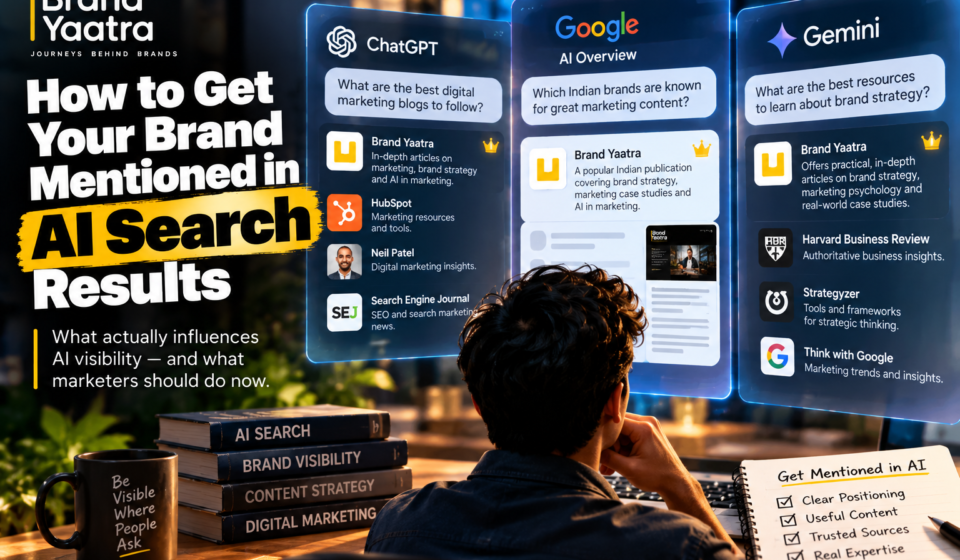

Imagine someone asks ChatGPT:
“What are the best digital marketing platforms for a small business?”
Or asks Google:
“Which Indian brands are known for affordable premium skincare?”
Or asks Gemini:
“What tools should a startup use for content marketing?”
The customer may never type your brand name.
They may not even know your brand exists.
But an AI system might still decide whether your brand belongs in the answer.
That creates a new marketing question:
When people ask AI for recommendations, how do you make your brand one of the brands it can understand, evaluate and potentially mention?
This is becoming increasingly important as search moves beyond the traditional list of blue links.
Google’s AI Overviews and AI Mode can synthesize information from multiple searches and sources, while ChatGPT Search can use the web and provide links to relevant sources.
But there is an important reality marketers need to understand.
There is no secret checklist that guarantees your brand will appear in an AI answer.
In fact, Google’s own guidance says there are no additional technical requirements specifically for appearing in AI Overviews or AI Mode. The fundamentals still matter: accessible websites, strong technical SEO, useful content, clear information and content that genuinely helps people.
So the real opportunity is not to “hack AI.”
It is to make your brand easier for both people and intelligent systems to understand.
AI Search Changes the Question
Traditional search marketing has largely been built around a familiar objective:
Rank for the query.
You identify a keyword, create a page, optimize it, build authority and try to appear higher in the results.
AI search introduces another layer.
Instead of simply returning a list of pages, an AI system can interpret a question, gather information from multiple sources and construct an answer.
That means the user might ask:
“What are the best project management tools for a five-person startup?”
And instead of seeing ten blue links, they may receive a synthesized answer containing several recommendations, explanations and supporting sources.
The marketing battle therefore isn’t only:
“Can I rank?”
It increasingly becomes:
“Can AI understand what my brand is, what it is good at and when it is relevant?”
That is where AI visibility enters the picture.
First, Forget the “AI SEO Hack” Myth
This is where a lot of AI-search advice goes wrong.
You will find plenty of recommendations claiming that you need a special file, a particular content structure or a magic number of mentions to get cited by AI.
The problem is that AI search is not one single system.
Google AI Overviews, Google AI Mode, ChatGPT Search and other AI experiences can use different systems, models, retrieval processes and sources.
Google’s current guidance is particularly clear: marketers should continue following strong SEO fundamentals and focus on unique, valuable, non-commodity content rather than chasing supposed GEO or AEO hacks.
That doesn’t mean AI visibility is irrelevant.
It means the strategy needs to be broader.
So What Actually Makes a Brand Easier for AI to Understand?
Think about it from the AI’s perspective.
Suppose someone asks:
“What are some good Indian marketing publications for learning about brand strategy?”
For Brand Yaatra to become a sensible answer, an AI system needs enough reliable information to understand things such as:
- What Brand Yaatra is
- What subjects it covers
- Who it is for
- What kind of content it publishes
- What topics it is associated with
- Whether other sources recognize or discuss it
- Whether the specific article being considered is useful for the question
That leads to a much more useful framework.
1. Make Your Brand’s Identity Extremely Clear
The first problem is surprisingly basic.
What exactly are you?
If your website describes you as a marketing publication in one place, a digital agency somewhere else and an AI consultancy somewhere else, you create unnecessary ambiguity.
Your website should make the fundamentals obvious:
- Brand name
- Business or publication type
- Category
- Products or services
- Target audience
- Core topics
- Geographic relevance where appropriate
- Unique areas of expertise
This isn’t an AI-only tactic.
It’s good marketing.
But in an environment where machines increasingly interpret information about brands, clarity becomes even more valuable.
2. Build a Clear Association With Specific Topics
Imagine two websites.
Website A publishes one article about SEO, one about fashion, one about finance, one about fitness and one about AI.
Website B consistently publishes useful content about AI search, marketing technology, brand visibility and digital marketing.
Which one is easier to associate with AI marketing?
The answer is obvious.
This is one reason Brand Yaatra should not treat AI × Marketing as a collection of random AI-tool articles.
The pillar needs depth.
Our existing article on what GEO actually means establishes one part of that territory. Our articles on AI becoming the product finder and AI becoming the shopper explore what happens further down the customer journey.
This article adds another layer:
How brands become visible inside AI-driven discovery.
3. Answer the Questions People Actually Ask
One of the easiest mistakes in AI-search content is writing for keywords instead of questions.
People don’t always think:
“AI search optimization strategy.”
They may think:
“Why doesn’t my business appear when I ask ChatGPT for recommendations?”
Or:
“How do I get my company mentioned in ChatGPT?”
Or:
“Why does my competitor appear in AI answers but my company doesn’t?”
These questions are much closer to the real problem.
Strong AI-search content should therefore answer specific problems directly, clearly and completely.
Don’t make the reader dig through 2,000 words to find the answer.
Give them the answer.
Then explain the reasoning.
4. Make Individual Pages Useful Enough to Stand on Their Own
AI systems need information they can retrieve and interpret.
That means every important page should make sense in isolation.
A weak article might say:
“As we discussed earlier, this strategy can help improve visibility.”
But what strategy?
What visibility?
For which business?
Good content removes that ambiguity.
A strong page should clearly communicate:
- What the topic is
- Why it matters
- What the reader should know
- What evidence supports the explanation
- What action the reader can take
This also makes the page better for human readers.
That’s the point.
5. Create Original Information Instead of Rewriting the Internet
This may become one of the biggest advantages for smaller publishers.
If your article simply repeats what 500 other websites already say, there may be little reason for anyone—or any system—to prefer it.
Original information is different.
That could mean:
- Original research
- First-hand observations
- Real experiments
- Original comparisons
- Interviews
- Expert analysis
- Unique case studies
- New frameworks
- Useful datasets
- Detailed explanations of complicated subjects
Google’s guidance for its AI search experiences specifically emphasizes unique, valuable, non-commodity content.
That should be a useful warning for publishers.
AI-generated sameness is not an AI-search strategy.
6. Build Evidence Around Your Claims
Suppose your brand says:
“We are India’s leading AI marketing platform.”
That is a claim.
Now ask:
Where is the evidence?
Strong brands accumulate supporting signals.
That might include:
- Independent coverage
- Customer reviews
- Industry publications
- Research
- Case studies
- Partnerships
- Expert commentary
- Recognized credentials
- Consistent descriptions across reputable sources
The important distinction is between creating genuine authority and manufacturing mentions simply because someone claims AI likes them.
Don’t chase mentions for the sake of mentions.
Build things worth mentioning.
7. Make Your Brand Easy to Describe
Here’s a simple test you can run today.
Ask several AI systems:
“What is [your brand]?”
Then ask:
“What is [your brand] best known for?”
Then:
“Who is [your brand] for?”
And finally:
“What are the alternatives to [your brand]?”
Read the answers carefully.
Don’t just look for whether your brand appears.
Look at how it is described.
Is the category correct?
Is the positioning correct?
Are the products correct?
Are important facts missing?
Is an outdated description being used?
Are competitors being mentioned alongside you?
This is where AI visibility becomes much more interesting than a simple “mentioned / not mentioned” metric.
8. Your Positioning Matters More Than You Think
AI systems can summarize information.
But brands still need something meaningful to summarize.
That is why brand positioning matters here.
Consider two companies:
Company A:
“We provide innovative solutions for modern businesses.”
Company B:
“We help small ecommerce brands automate customer support across WhatsApp and their website.”
Company B gives customers—and systems interpreting the company—a much clearer mental model.
Clear positioning makes your brand easier to categorize.
And if you want to be considered for a specific question, being clearly associated with a specific problem or category is useful.
9. Keep Your Website Technically Accessible
This part is much less exciting than “AI optimization hacks.”
It is also important.
Google says pages need to be indexed and eligible to appear in normal Google Search in order to be eligible as supporting links in AI Overviews or AI Mode.
That means the boring fundamentals still matter:
- Allow search engines to crawl important pages
- Don’t accidentally block important content
- Keep pages indexable
- Use sensible site architecture
- Make important content available as actual page content
- Use structured data correctly where appropriate
- Keep information accurate and consistent
- Monitor indexing and search performance
In other words:
AI search did not kill SEO.
It added another layer to the discovery ecosystem.
10. Don’t Confuse Being Cited With Being Recommended
This distinction is extremely important.
A brand might be mentioned because a source contains information about it.
That doesn’t necessarily mean the AI recommends the brand.
For example, imagine someone asks:
“What are the biggest CRM companies?”
Your brand might appear in the answer.
Now ask:
“Which CRM is best for a five-person startup?”
Your brand may disappear.
Why?
Because the second question introduces a different decision context.
That is why AI visibility should be evaluated against real customer questions rather than one vanity metric such as total mentions.
11. Build an AI Visibility Test Set
If you’re serious about this, create a list of questions customers might realistically ask.
For example, an ecommerce brand could create:
- 10 category questions
- 10 comparison questions
- 10 problem-solving questions
- 10 recommendation questions
- 10 brand-specific questions
Then test those questions periodically across the AI platforms that matter to your audience.
Record:
- Was the brand mentioned?
- Was it recommended?
- How was it described?
- Which competitors appeared?
- Which sources were cited?
- Was the information accurate?
- What product or category associations appeared?
Now you have something much more useful than a vague feeling that “AI knows about us.”
The Most Interesting Metric May Not Be Mentions
Imagine your brand is mentioned in 70% of your test prompts.
Sounds great.
But suppose AI consistently describes you as:
“A budget option for beginners.”
while your actual strategy is to become:
“A premium solution for enterprise teams.”
Your visibility might be high.
Your positioning accuracy might be terrible.
That is a much bigger strategic problem.
So an AI visibility dashboard should eventually track more than:
Are we mentioned?
It should also ask:
- Are we described correctly?
- Are we associated with the right category?
- Are we appearing for the right use cases?
- Are competitors being positioned above us?
- Are the sources supporting the answer trustworthy?
- Is the AI using outdated information?
What About ChatGPT, Gemini and Google AI Search?
Don’t assume that one platform’s behaviour represents all AI search.
Google’s AI features operate within Google Search and use its search systems to retrieve relevant web content.
ChatGPT Search is a different product experience that can search the web and provide links to sources.
Other AI systems have their own approaches.
That means your visibility can vary.
You might appear frequently for one type of question in one system and rarely appear for the same question somewhere else.
That is normal.
The objective isn’t to discover one universal “AI ranking factor.”
The objective is to build a brand and information ecosystem that remains useful across changing discovery systems.
What You Should Do This Month
If you’re a marketer or business owner, don’t wait for a perfect AI-search strategy.
Start with this simple process.
Step 1: List 25 real customer questions
Forget keywords for a moment.
Write the questions customers would actually ask an intelligent assistant before buying from you.
Step 2: Test those questions
Run them across the AI platforms relevant to your audience.
Step 3: Record the answers
Track mentions, recommendations, competitors, descriptions and cited sources.
Step 4: Find the gaps
Maybe AI doesn’t understand your category.
Maybe it describes your product incorrectly.
Maybe competitors dominate comparison queries.
Maybe your website contains useful information but doesn’t explain it clearly enough.
Step 5: Improve the underlying information
Don’t simply stuff your website with the phrase “best brand.”
Improve:
- Product information
- Category explanations
- Comparison content
- FAQs
- Case studies
- Original research
- Customer evidence
- Brand positioning
- Technical accessibility
Step 6: Test again
AI visibility isn’t a one-time SEO task.
The systems change.
Your competitors change.
Your products change.
Your reputation changes.
So your visibility should be measured over time.
What Not to Do
There are several tempting shortcuts worth avoiding.
Don’t create hundreds of AI-generated pages just to cover every possible query.
More pages do not automatically mean more authority.
Don’t invent statistics to make content look authoritative.
AI systems and human readers both benefit from trustworthy information.
Don’t create fake third-party mentions.
Manufactured authority is not the same as real reputation.
Don’t obsess over one platform.
AI search is fragmented and evolving.
Don’t forget traditional SEO.
Google explicitly says its AI search features remain rooted in its core Search systems.
And don’t forget the brand.
The goal isn’t simply to get an AI system to repeat your name.
The goal is to become a credible answer to a real customer problem.
The New Search Battle Is About Being Understood
For years, marketers fought for attention.
Then they fought for rankings.
Now another layer is emerging:
Interpretation.
Can a system understand what your company does?
Can it identify who you serve?
Can it understand what makes you different?
Can it find credible information about you?
Can it connect your brand with the questions your customers are asking?
Those questions matter because the interface between people and information is changing.
Google is building AI into Search.
ChatGPT can search the web.
People are increasingly using conversational interfaces to research products, companies and decisions.
The exact future is still being written.
But marketers don’t need to predict every detail.
They need to prepare for the direction.
Brand Yaatra Takeaway
Getting your brand mentioned in AI search isn’t about finding a secret prompt, stuffing a page with keywords or creating a magical “AI SEO” file.
It’s about making your brand clear, useful, credible and discoverable.
Build a strong website.
Create genuinely useful content.
Answer real customer questions.
Develop original information.
Strengthen your positioning.
Build genuine authority beyond your own website.
Keep your information accurate.
And test how AI systems actually describe your brand.
Because the next generation of search may not always ask:
“Which page should I show this person?”
It may increasingly ask:
“What is the best answer to this person’s question — and which sources can help support it?”
That’s a different marketing game.
And for brands that prepare early, it could become a very important one.