
We talk a lot about “AI search” as if there is one simple question:
How do I get my brand recommended?
But there is a problem with that question.
Recommended for what?
Recommended to whom?
At what price?
For which use case?
With what constraints?
That made us wonder:
If we keep the underlying buying problem the same but change the way we ask the question, do the brands and sources that surface also change?
So we tested it.
We created different versions of the same commercial questions and ran them through live web search. We weren’t trying to decide which product was objectively “best.” We wanted to see what changed when the question changed.
The result was a useful reminder for marketers:
The wording of the question can change the competitive landscape that a customer sees.
What We Actually Tested
We created multiple versions of the same underlying intent.
The idea was simple: keep the core problem similar, but change the framing.
For example, instead of asking only:
“What are the best email marketing tools for a small business?”
we also tested variations around:
- affordability
- comparison
- ecommerce requirements
- automation
- technical simplicity
We repeated the same approach across SEO tools and social-media scheduling software.
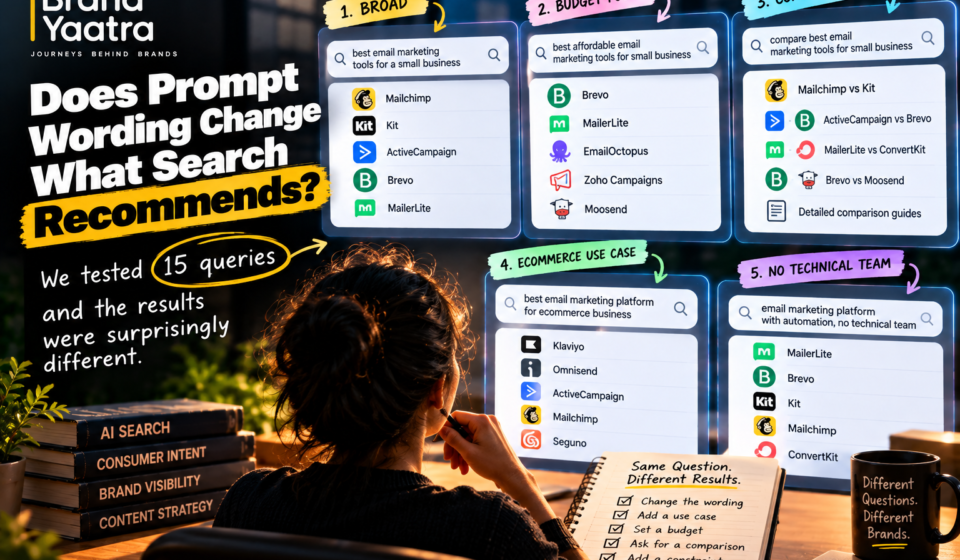
In total, we tested 15 variations of commercial questions.
We were looking at three things:
- Which brands appeared?
- Which types of pages surfaced?
- Did changing the context change the competitive set?
Test #1: “What Are the Best?”
Our baseline questions were deliberately broad.
For example:
“What are the best email marketing tools for a small business?”
This kind of query produced broad comparison content covering several platforms.
Names such as Mailchimp, Kit, ActiveCampaign, Brevo and MailerLite appeared across the results we examined.
That makes sense.
The question gives the search engine very little information about what “best” actually means.
Price?
Features?
Ease of use?
Automation?
Analytics?
Ecommerce?
There isn’t one obvious answer.
So broad queries tend to create broad recommendation environments.
The result is a crowded category where many brands can plausibly appear.
Test #2: Add a Budget Constraint
Next, we changed the question:
“What are the best affordable email marketing tools for a small business with a limited budget?”
Now the question had a decision criterion.
And the results became more price-oriented.
Lower-cost platforms and comparison pages that emphasized pricing became much more relevant to the query.
The important point isn’t whether one of those tools is “the winner.”
The important point is that the definition of value changed the competitive set.
A brand can be highly visible for:
“best email marketing platform”
and much less visible for:
“best affordable email marketing platform for a small business.”
Those look like nearly identical questions.
They aren’t.
Test #3: Turn the Question Into a Comparison
We then changed the framing again:
“Compare the best email marketing tools for a small business. Which one would you choose and why?”
This subtly changes the job.
The searcher is no longer simply asking for a list.
They are asking for a decision.
That made comparison-oriented pages much more relevant.
Instead of simply seeing generic “best tools” lists, we encountered content structured around head-to-head evaluations and comparisons between individual platforms.
This matters enormously for marketers.
If your content only answers:
“What is our product?”
you may be missing the much more commercially important question:
“How does our product compare when someone is choosing between alternatives?”
Test #4: Give the Searcher a Real Business Problem
Next came a much more realistic prompt:
“I run a small ecommerce business. Which email marketing platform should I use for abandoned carts, newsletters and customer segmentation?”
This was one of the most interesting changes.
The question stopped being about “email marketing software” in the abstract.
It became an ecommerce problem.
That made ecommerce-focused platforms and content much more relevant.
Platforms such as Klaviyo and Omnisend became much more prominent because the question itself introduced ecommerce-specific jobs to be done.
Again, the lesson isn’t that one platform automatically wins.
The lesson is that category visibility and use-case visibility are not the same thing.
Test #5: Remove the Technical Team
Our final variation changed another variable:
“Recommend an email marketing platform for a small business that wants automation but doesn’t have a technical team.”
Now the problem wasn’t simply:
“Which platform has automation?”
It was:
“Which platform gives me automation without creating a technical headache?”
That pushes usability and simplicity much higher in the decision.
The question had changed the definition of a good answer.
We Saw the Same Pattern Beyond Email
This wasn’t just an email-marketing phenomenon.
We repeated the exercise with SEO tools.
A broad search for:
“best SEO tools for a small business”
produced broad comparison pages covering familiar tools and categories.
But once the question introduced budget, ecommerce, technical SEO or a specific workflow, the content became more specialized.
Some results emphasized free tools. Others focused on major SEO platforms. Ecommerce-specific searches shifted the discussion toward product-page optimization, technical audits, structured data and other store-specific requirements.
We saw a similar pattern with social-media scheduling.
A generic question produced broad lists containing platforms such as Buffer, Later, Hootsuite, Metricool and SocialBee.
But once the search emphasized budget, number of accounts, visual planning or team workflows, the evaluation criteria changed.
The search wasn’t necessarily looking for a different category.
It was looking for a different definition of “best.”
So What Actually Changed?
After running the variations, four patterns kept appearing.
1. “Best” Is an Empty Word Without Context
When someone asks for the “best” tool, the search system has to infer what they mean by best.
Price?
Features?
Ease of use?
Automation?
Ecommerce?
Team collaboration?
Analytics?
There is no single answer.
So broad queries tend to create broad recommendation environments.
2. Constraints Narrow the Competitive Set
Add:
- a budget
- a business type
- a technical constraint
- a platform requirement
- a specific job to be done
and suddenly the question becomes easier to answer.
But it also becomes harder for brands that aren’t relevant to that particular context.
3. Use Cases Can Matter More Than Category Leadership
A company doesn’t always win because it is the biggest name in the category.
It can win because it fits the question better.
That is an important distinction for marketers.
Instead of asking only:
“How do we become one of the biggest brands in our category?”
also ask:
“Which specific customer situations should make our brand the obvious answer?”
4. The Searcher’s Situation Changes the Recommendation
This might be the biggest takeaway.
The customer isn’t really searching for “the best tool.”
They are searching for the best tool for their situation.
Those are very different problems.
And This Is Where AI Search Gets Interesting
Traditional search already shows why query framing matters.
But the implications become even more interesting as people increasingly ask conversational systems questions in natural language.
Instead of typing:
“email marketing tools small business”
a person can ask:
“I run a five-person ecommerce company. We need abandoned-cart emails, basic segmentation and automation, but nobody on the team is technical. What should we use?”
That is not just a longer keyword.
It contains a decision context.
And that is one reason AI search changes the marketing challenge.
The question becomes less about owning one keyword and more about being relevant across the situations in which customers ask questions.
We recently explored the broader challenge of getting your brand mentioned in AI search results.
The lesson from this experiment adds another layer:
Being visible for one question does not mean being visible for the customer’s entire decision journey.
What This Means for Brands
This changes how marketers should think about content.
Instead of creating one giant page titled:
“The Best X”
think about the different questions customers might ask.
For example:
- What is the best option?
- What is the cheapest good option?
- What is best for a small team?
- What is best for ecommerce?
- What is easiest for beginners?
- What is best if I need automation?
- What should I choose instead of Competitor X?
- Which option is best for my specific problem?
These aren’t simply eight keyword variations.
They are eight different decision contexts.
The Content Opportunity Is Bigger Than “Rank for Our Keyword”
This is where our experiment connects with Generative Engine Optimization (GEO).
If discovery becomes more conversational, brands need information that helps answer real questions.
That could mean:
- comparison pages
- use-case guides
- pricing explanations
- implementation guides
- case studies
- product documentation
- customer examples
- original research
- clear positioning
The goal isn’t to manufacture pages for every imaginable prompt.
That would simply create more content nobody needs.
The goal is to understand the real decisions customers are trying to make and make your brand genuinely useful within those decisions.
There Is a Bigger Branding Lesson Here
There is an interesting connection between search visibility and positioning.
If a brand wants to be recommended for a particular problem, it needs to be strongly associated with that problem.
That brings us back to something more fundamental than SEO:
What do you want your brand to be known for?
We explored that question in our guide to brand positioning.
The stronger the association between a brand and a meaningful customer problem, the easier it becomes to build content, products, proof and communication around that territory.
AI search doesn’t eliminate that principle.
It makes the principle more visible.
One Experiment. One Useful Warning.
We started this test expecting to learn something about prompts.
We did.
But the bigger lesson was about marketing.
Customers don’t have one question.
They have situations.
They have constraints.
They have budgets.
They have fears.
They have competing options.
And the way they describe those things changes the information that becomes useful.
Our 15-query test showed that even small changes in framing can shift the types of pages, sources and brands that surface.
That means marketers shouldn’t think only about:
“What keyword do we want to rank for?”
They should increasingly ask:
“What questions do we want to be the right answer to?”
That is a much harder question.
But it is also a much more strategic one.
Brand Yaatra Takeaway
Our experiment wasn’t proof that one brand will always beat another when a prompt changes.
Search results change, sources change and rankings change. AI systems can also behave differently from traditional search, so the findings shouldn’t be treated as a universal ranking formula.
What the test did show is simpler:
Changing the question changes the information environment.
For marketers, that means visibility shouldn’t be measured only against one generic query.
Build a list of the real questions customers ask.
Include the budgets, use cases, comparisons and problems that shape their decisions.
Then ask:
“Would our brand be a useful answer here?”
If the answer is yes, build the evidence to make that true.
If the answer is no, don’t try to game the search.
Maybe the real problem is your positioning.
And that is a much more valuable problem to solve.