
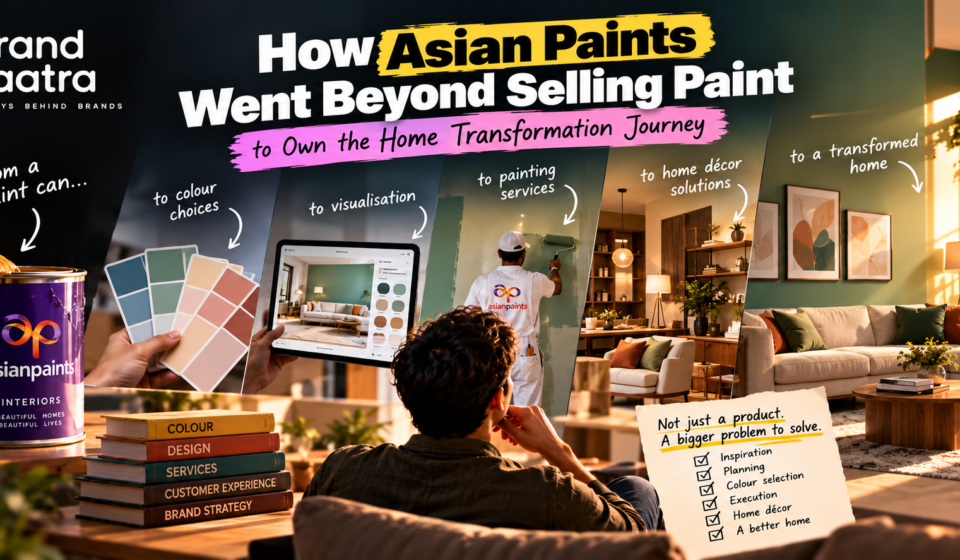
How Asian Paints Went Beyond Selling Paint to Own the Home Transformation Journey

Painting a home sounds simple.
Choose a colour. Buy some paint. Find someone to apply it.
But anyone who has actually painted a home knows that the paint is only one part of the problem.
Which shade will look right in natural light? Will the walls need repairs? How much paint is required? Is the contractor reliable? How long will the work take? What happens if the finish is uneven? And how do you know the final result will look anything like the inspiration you saved on your phone?
For the customer, buying paint is rarely just a product decision. It is part of a larger, expensive and often stressful home-improvement project.
That creates an interesting marketing opportunity.
Instead of competing only to sell the paint, what if a company could help customers navigate more of the entire project?
That question helps explain one of the most interesting developments in the Asian Paints story.
The company is known for decorative paints, colours and decades of advertising. But its business has expanded into painting services, home décor products, design experiences and digital tools that help people plan their spaces.
The important shift is not simply that Asian Paints sells more products today.
It is moving closer to the customer’s actual problem: transforming a home with less uncertainty.
1. The Real Competition Was Never Just Another Paint Brand
Imagine a customer who wants to repaint a two-bedroom apartment.
They might compare two paint brands, look at prices and select a finish. From a manufacturer’s perspective, that looks like a product-choice problem.
But the customer is thinking about something much bigger.
- Which colours will work with the furniture?
- Will the walls look good after the paint dries?
- Who will move the furniture and protect the floors?
- Will the painter arrive on time?
- How much will the complete job cost?
- Who will resolve a problem if the work is disappointing?
Notice how many of these questions have little to do with the chemical properties of paint.
They concern planning, selection, execution and trust.
This is where a product category can become a customer-experience opportunity.
A company that helps customers answer these questions can compete on more than price, shade availability or product specifications. It can compete on the overall experience of getting the job done.
That does not mean every customer wants a full-service solution. Some customers prefer to buy paint and manage the rest themselves. But for people who want guidance and convenience, the opportunity is much larger than a paint can.
2. Asian Paints Built Meaning Around Colour Before Expanding the Experience
Paint is a functional product. It covers a surface, protects it and changes its appearance.
But people rarely talk about their homes in those terms.
They talk about the room where their children grew up, the living room where everyone gathers, the first home they bought or the space they want to make their own.
Asian Paints has long used this emotional territory in its communication. Its well-known Har Ghar Kuch Kehta Hai campaign, for example, connects the home with personal memories and meaning rather than treating walls as empty surfaces.
In 2024, the company revisited the campaign after 22 years, inviting people to share their own stories about home. The brand’s official communication framed the revival as a tribute to the memories and emotions associated with a home.
The marketing significance is straightforward: the product may be paint, but the customer’s motivation often comes from what the finished space will mean to them.
That emotional association creates a foundation for a broader proposition.
If a brand already participates in the customer’s imagination of a better home, helping the customer plan and execute that home transformation becomes a natural extension of the relationship.
There is an important distinction here. An emotional campaign does not automatically prove that a customer will purchase more products or services. It can, however, help establish a more meaningful context for the brand than product specifications alone.
3. The Customer’s Biggest Problem Often Begins After Choosing the Colour
Picture two customers.
Customer A knows exactly what they want. They need a particular shade, have a trusted painter and are comfortable managing the project.
Customer B has saved photographs of beautiful living rooms but has no idea which colours will work in their own home. They are unsure about finishes, materials, budgets and contractors.
Both customers may need paint. But they do not need the same buying experience.
Customer A may value product availability and a straightforward purchase.
Customer B may value guidance, visualisation, recommendations and help coordinating the work.
A product-only strategy mainly addresses the first set of needs. A broader service strategy can address more of the second.
Asian Paints’ offering includes Beautiful Homes Painting Services, along with tools and experiences intended to help customers explore and plan their spaces. The company describes these as part of a wider move toward an integrated products-and-services platform.
This is strategically important because the company is not treating the moment of purchase as the only moment that matters.
It is addressing some of the uncertainty before the purchase and some of the practical difficulty after it.
4. Services Can Change What the Brand Is Competing On
When customers compare paint products, they can consider price, finish, durability, coverage, colour availability and brand reputation.
Those factors remain important. A service offering does not make the product itself irrelevant.
But services introduce additional dimensions into the decision.
- How easy is it to understand the options?
- Can someone help me choose the right solution?
- Can I get support with execution?
- How much coordination will I have to manage myself?
- Will I have a clearer idea of what to expect?
The competition therefore becomes broader than a simple comparison between two paint containers.
This can create an advantage when customers genuinely value the additional support. It can also create new responsibilities for the company: service quality, scheduling, contractor coordination and consistency become part of the experience.
That is the trade-off. Expanding the proposition can create more value, but it also means the brand must deliver across more customer touchpoints.
5. Beautiful Homes Makes the Strategy More Visible
Asian Paints’ Beautiful Homes proposition brings home décor into the picture.
The company’s offering extends beyond wall paint into areas that include furnishings, lighting, wall coverings, kitchens, wardrobes, bath fittings and other interior solutions.
Its retail strategy also includes Beautiful Homes stores designed to let customers explore products and materials in curated settings, with access to design guidance.
According to Asian Paints’ FY2025–26 Integrated Annual Report, the company had 74 Beautiful Homes stores across India. The report also described its broader home décor business as a one-stop home décor offering.
These details matter because customers do not experience their homes as separate product categories.
A homeowner might begin by thinking about a wall colour, then consider the curtains, lighting, furniture and overall style of the room.
Those decisions influence one another.
A coordinated environment can make it easier to explore how different elements work together. It can also help customers move from a vague idea to a more concrete plan.
The strategic opportunity is not simply to sell a customer a longer list of products.
It is to make more of the decisions involved in creating a home feel connected.
Of course, a broader catalogue only creates value when customers can navigate it. If the experience becomes confusing, additional choice can turn into additional work.
6. Digital Tools Can Help Turn Inspiration Into a Decision
Home improvement often begins with inspiration.
A customer sees a room on social media, saves a photograph or imagines a different colour scheme for their living room.
But inspiration is not the same as a decision.
The customer still needs to work out which products are suitable, whether the colours fit the room, what the project may require and how to proceed.
Digital tools can help bridge that gap.
Asian Paints’ official reporting describes digital experiences that support product and shade discovery, recommendations, calculators and navigation. The company has also described integrating its Asian Paints and Beautiful Homes platforms to create a broader décor destination.
These tools can make the journey more useful when they help customers answer practical questions instead of simply displaying more products.
For example, a shade-discovery tool can help narrow down possibilities. A calculator can help estimate requirements. A design consultation can help a customer think through the relationship between colours, finishes and furnishings.
Each tool addresses a different source of uncertainty.
That is the important principle: technology is valuable here when it helps the customer make a more informed decision or take the next step with greater confidence.
7. The Business Model Is Expanding Alongside the Brand Promise
A broader customer proposition also changes the business opportunity.
A paint manufacturer primarily sells products through a distribution and retail system. A more integrated home-improvement offering can involve products, services, consultations, physical experiences and digital discovery.
Asian Paints’ FY2025–26 reporting reflects this broader structure. It lists decorative and home décor together as a major business segment and describes services as a growth accelerator, with an emphasis on moving toward an integrated products-and-services platform.
The report also records more than 175,000 customers using Beautiful Homes Painting Services during the year, alongside participation from 3,900 dealers.
These are company-reported figures. They indicate the scale of the service offering, but they do not, by themselves, prove that services caused higher customer loyalty, greater profitability or increased paint sales.
Those outcomes would require more detailed evidence.
Still, the strategic direction is clear: the company is investing in ways to participate in more parts of the home-improvement journey.
That can create opportunities for deeper customer relationships, provided the additional services are useful and reliably delivered.
8. The Marketing Lesson: Solve the Larger Job, Not Just the Immediate Purchase
One of the most useful concepts in marketing is to look beyond the product a customer buys and understand the job they are trying to accomplish.
Someone buying a drill may actually want a hole in a wall.
Someone buying a mattress may want better sleep.
Someone buying accounting software may want fewer errors and less administrative work.
And someone buying paint may want a home that looks and feels different.
This perspective changes the questions a company asks.
Instead of asking only, “How do we sell more paint?” a company can ask:
- What makes the customer’s project difficult?
- Which decisions cause the most uncertainty?
- Where does the customer need expert guidance?
- What happens before and after the product is purchased?
- Which parts of the experience can we make simpler?
These questions can reveal opportunities that are invisible when the business is viewed only through its main product category.
For more on the strategic decisions that shape how a brand is understood, read our guide to brand positioning.
9. What Other Brands Can Learn From Asian Paints
Lesson 1: Understand the whole customer journey
Customers do not experience your business as a product catalogue. They experience a series of decisions, expectations and interactions. Find the points where they struggle.
Lesson 2: Emotional branding needs practical delivery
A powerful campaign can make people care. The product and service experience must give them a reason to continue trusting the brand.
Lesson 3: Expand only where the customer problem justifies it
Adding products and services is not automatically a good strategy. The expansion should solve connected customer needs rather than create an unrelated collection of offerings.
Lesson 4: Treat service quality as part of the brand
When a company promises guidance and convenience, execution becomes part of its marketing. A poor service experience can undermine the perception created by advertising.
Lesson 5: Use technology to reduce uncertainty
Digital experiences should help customers understand, compare, visualise or decide. More features are not necessarily better if the customer still cannot work out what to do next.
Lesson 6: Measure the results rather than assuming the strategy worked
Businesses should test whether broader services improve outcomes such as customer satisfaction, repeat purchase, conversion, project completion and profitability. These measures help distinguish a promising strategic idea from a genuinely effective one.
10. The Limits of the Strategy
There is a temptation to interpret every business expansion as a marketing success. That would be too simplistic.
A broader home décor proposition introduces operational complexity. Customers may need different levels of assistance. Product availability, design guidance, service quality and project execution must work together.
Some customers will prefer to purchase paint independently. Others may not want to buy décor products from the same provider. A one-stop proposition will not be the best choice for every customer or every project.
There is also a difference between having a wide offering and delivering a genuinely integrated experience. A collection of products becomes more useful only when customers can navigate it easily and understand how the pieces fit together.
Asian Paints’ annual reports describe the company’s investments and strategic direction. They should not be treated as independent proof that every initiative has delivered its intended commercial result.
The real test is whether the expanded experience solves meaningful customer problems and creates sustainable business value.
The Brand Yaatra Takeaway
Asian Paints is an interesting case because its marketing opportunity extends beyond the product that made it famous.
Paint remains central to the business. But the customer often wants something larger: a home that looks right, reflects their preferences and comes together without unnecessary stress.
By expanding into painting services, home décor, design experiences and digital tools, Asian Paints is trying to participate in more of that journey.
The lesson is not that every brand should become a one-stop shop.
The lesson is to understand what customers are really trying to achieve—and then decide whether your business can credibly help them achieve more of it.
Don’t stop at asking what your customer buys. Ask what your customer is trying to get done.
Sometimes, the biggest growth opportunity is hiding just outside the product category you thought you were in.
Frequently Asked Questions
What is Asian Paints’ marketing strategy?
Asian Paints combines product branding, emotional communication, distribution, painting services, home décor offerings and digital customer experiences. Its strategy increasingly addresses the broader home-improvement journey alongside its core paint business.
What is the significance of the Har Ghar Kuch Kehta Hai campaign?
The campaign connects homes with personal memories and emotions. Rather than presenting paint only as a functional product, it associates the home with the experiences and stories that make a space meaningful.
What is Beautiful Homes by Asian Paints?
Beautiful Homes is part of Asian Paints’ broader home décor proposition. Its offerings include home décor products, retail experiences and services intended to help customers explore and plan interior spaces.
Why has Asian Paints expanded beyond paint?
Homeowners often need more than paint: they may need help choosing colours, planning interiors, selecting complementary products and arranging painting work. A broader offering gives Asian Paints the opportunity to address more of these connected needs.
What can small businesses learn from Asian Paints?
Small businesses can identify the larger problem behind a customer’s purchase, simplify difficult decisions and provide useful support before or after the sale. They should expand their offering only when it addresses a real customer need and can be delivered well.
Sources and Further Reading