
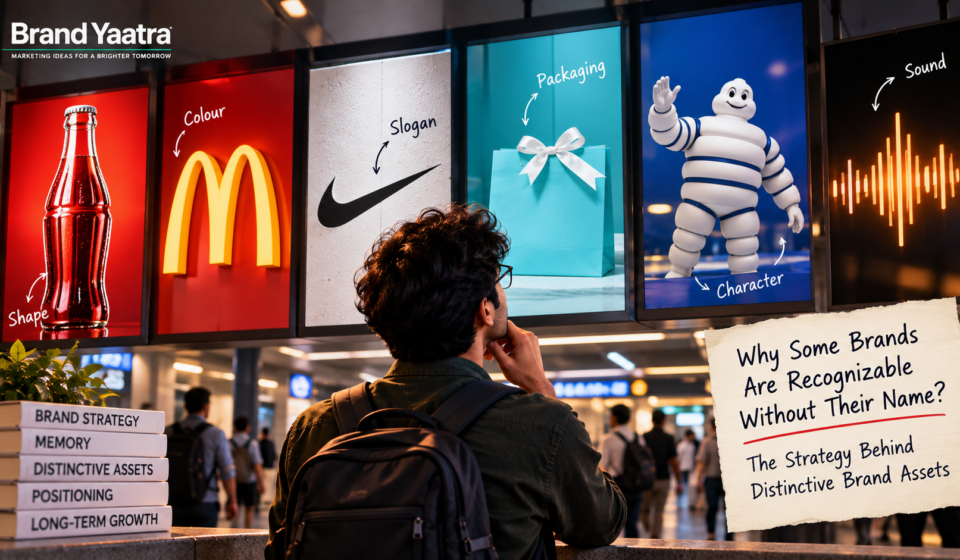
Why Some Brands Are Recognizable Without Their Name: The Strategy Behind Distinctive Brand Assets

Imagine seeing a red-and-white bottle shape.
You recognise the brand.
Imagine golden arches.
You know the brand.
Hear a particular three-note sound.
See a familiar shade of blue on a jewellery box.
Read three words:
Just Do It.
In each case, the brand name may not even need to appear.
That is not an accident.
Over time, brands can build certain visual, verbal or sensory cues so strongly that those cues begin to trigger the brand in people’s minds.
These are commonly called distinctive brand assets.
And they are one of the most interesting parts of brand strategy because they answer a deceptively simple question:
How can people recognise your brand before they actually see its name?
The answer isn’t simply “have a good logo.”
A logo can be distinctive.
So can a colour, character, slogan, sound, package shape, typography or visual style.
But the real value comes from something bigger:
Memory.
What Is a Distinctive Brand Asset?
A distinctive brand asset is a non-brand-name cue that consumers strongly associate with a particular brand.
It could be:
- A colour
- A logo
- A character
- A slogan
- A sound
- A package shape
- A typeface
- A visual style
- A particular design element
The important part is not simply that the company uses the element.
The important part is whether people connect that element with the brand.
The Ehrenberg-Bass Institute describes distinctive assets as non-brand-name triggers that remind category buyers of a brand. Its research and commercial work emphasise that these assets need to become both sufficiently recognisable and sufficiently associated with the brand to become strategically useful. :contentReference[oaicite:4]{index=4}
That distinction is critical.
Your brand might use purple everywhere.
That doesn’t automatically mean purple is your distinctive asset.
Your company might have a particular sound.
That doesn’t mean customers automatically connect that sound with you.
An asset becomes strategically valuable when the association exists in the customer’s memory.
The Difference Between a Brand Element and a Brand Asset
This is where many branding discussions become confusing.
A company can have hundreds of brand elements.
Only some become genuinely distinctive.
| Brand Element | Distinctive Brand Asset |
|---|---|
| Something the brand uses | Something consumers associate with the brand |
| Can be chosen internally | Must be established externally in memory |
| May look attractive | Helps trigger recognition |
| May be temporary | Can accumulate value through consistent use |
| Doesn’t necessarily identify the brand | Can help identify the brand without its name |
This is why a beautiful redesign doesn’t automatically make a stronger brand.
You can create something visually impressive and still lose recognition.
Because recognition isn’t created by the design team alone.
It is created in people’s memories.
Why Recognition Matters
Think about the number of brands competing for attention every day.
People scroll through feeds.
Compare products.
Walk through stores.
Browse marketplaces.
Watch videos.
Read reviews.
Use search engines.
Ask AI systems questions.
They are constantly exposed to commercial information.
A brand therefore has a problem before it even gets the opportunity to explain its product:
How do I get recognised?
Distinctive assets can help reduce that recognition problem by giving consumers familiar cues.
Kantar’s research on brand assets similarly focuses on how quickly and accurately consumers connect cues such as logos, colours, slogans and shapes with brands. :contentReference[oaicite:5]{index=5}
In other words:
The asset becomes a shortcut.
You don’t need to rebuild the entire brand explanation every time.
A familiar cue can begin the recognition process.
Think About Coca-Cola
Coca-Cola is a useful example because the brand has accumulated multiple recognisable cues over a very long period.
The red colour.
The contour bottle.
The Spencerian-style script.
The visual treatment.
Seasonal associations.
These elements don’t operate independently.
They reinforce one another.
Over time, consumers can encounter a combination of these cues and begin connecting them with Coca-Cola before the complete brand name is necessarily the first thing they process.
This is the strategic advantage of accumulated memory.
The brand doesn’t start from zero every time.
But Distinctiveness Is Not the Same as Being Different
This is one of the most important distinctions marketers should understand.
A brand can be visually unusual without being distinctive.
It can also be different without being memorable.
Imagine a new beverage brand launches with:
- A neon-green logo
- A strange typeface
- Unusual packaging
- A completely unexpected advertising style
It might look different.
But if customers cannot remember which brand those elements belong to, the difference hasn’t created much recognition.
Distinctiveness is about being identifiable as you.
Brand differentiation is a broader strategic question about why you are meaningfully different or preferable.
They can work together, but they are not the same thing.
Kantar’s research makes a similar distinction: distinctive assets can help recognition, but they are not sufficient on their own to create a strong differentiated brand position. :contentReference[oaicite:6]{index=6}
Distinctive Assets vs Brand Positioning
This is where distinctive assets connect directly with brand positioning.
Positioning answers questions such as:
- Who are we trying to matter to?
- What should we be known for?
- What problem do we solve?
- How are we different from alternatives?
Distinctive assets answer a different question:
What can help people recognise us?
For example:
Positioning: What should Nike mean?
Distinctive assets: What helps people recognise Nike?
The two should reinforce each other.
But they should not be confused.
Nike Shows How a Verbal Asset Can Become Powerful
Nike gives us a particularly useful example because its brand assets aren’t limited to visual identity.
The Swoosh is visual.
But “Just Do It” became a powerful verbal asset too.
As we explored in our breakdown of Nike’s “Just Do It” strategy, the phrase became much more than a campaign line.
Nike repeatedly connected it with athletes, ambition, action, perseverance and stories of overcoming challenges.
The words themselves weren’t magical.
The accumulated associations were.
That’s an important lesson for marketers.
You don’t build a brand asset simply by inventing a clever phrase.
You build it by repeatedly giving that phrase meaning.
How Does an Asset Become Distinctive?
There isn’t a single moment when a brand element suddenly becomes an asset.
It is built over time.
A useful way to think about the process is:
Element → Exposure → Association → Recognition → Memory
1. Element
The brand chooses a visual, verbal or sensory cue.
For example:
A colour.
A character.
A sound.
A slogan.
2. Exposure
The customer encounters it repeatedly.
Advertising.
Packaging.
Website.
Social media.
Retail.
Product experience.
3. Association
The customer begins connecting the cue with the brand.
4. Recognition
The cue becomes increasingly useful as a shortcut to identifying the brand.
5. Memory
The association becomes part of the mental structure surrounding the brand.
This is why consistency matters so much.
Consistency Is What Gives Assets Their Power
Imagine a brand changing its identity every year.
2026:
Bright orange.
2027:
Dark blue.
2028:
Minimal black and white.
2029:
Neon green.
Each individual identity might look excellent.
But the consumer keeps receiving a new recognition problem.
What does this brand look like?
What does it sound like?
What should I associate with it?
Brand memory needs repetition.
That doesn’t mean every advertisement should look identical.
It means there should be enough continuity for the consumer to connect today’s communication with yesterday’s.
Kantar’s work on distinctive assets similarly highlights clarity, consistency and communication as important principles in strengthening brand cues. :contentReference[oaicite:7]{index=7}
Consistency Does Not Mean Doing the Same Creative Forever
This is another common misunderstanding.
A brand can be consistent without becoming boring.
Look at Nike.
The athletes change.
The stories change.
The cultural context changes.
The production style changes.
The media changes.
But recognisable brand assets can remain.
The same principle can apply to Coca-Cola, McDonald’s and many other brands.
The creative expression evolves.
The memory cues remain connected.
Same brand. New story.
The Five Types of Distinctive Brand Assets
1. Visual Assets
These are the most obvious.
- Logo
- Colour
- Shape
- Typography
- Packaging
- Illustration style
They help people recognise a brand visually.
2. Verbal Assets
These include:
- Slogans
- Taglines
- Specific phrases
- Names
- Recurring verbal expressions
“Just Do It” is a strong example of a verbal brand asset.
3. Character Assets
Characters can become powerful recognition devices.
Think of mascots, animated figures or recurring personalities associated with a brand.
They can make a brand more human and easier to recognise.
4. Sonic Assets
Some brands use sound as a recognition mechanism.
A short musical signature.
A distinctive audio cue.
A particular voice.
These can become useful because they work even when the brand isn’t visible.
5. Structural or Product Assets
Sometimes the physical shape of a product or package can become recognisable.
A particular bottle.
A package silhouette.
A unique product form.
These assets can be especially powerful because they connect branding directly with physical experience.
Why Marketers Often Overestimate Their Own Brand Assets
There is a dangerous assumption in branding:
“Everyone knows this is ours.”
Maybe they do.
Maybe they don’t.
Internal teams see their brand assets constantly.
They see them in:
- Presentations
- Brand guidelines
- Meetings
- Campaign reviews
- Websites
- Packaging
- Internal documents
Customers don’t.
That means marketers can become overconfident about how distinctive an asset really is.
A design element may feel deeply connected to the brand internally while consumers barely notice it.
That is why measurement matters.
How Do You Measure a Distinctive Asset?
A useful measurement approach asks whether consumers actually connect the asset with the intended brand.
One simple way to think about the evaluation is:
| Question | What It Tells You |
|---|---|
| Do people recognise the asset? | Fame or recognition |
| Do they connect it with your brand? | Association |
| Do they connect it uniquely with you? | Distinctiveness |
| How quickly do they make the connection? | Intuitive recognition |
Kantar’s Brand Imprint work, for example, evaluates assets through dimensions including fame, distinctiveness and intuitiveness, using response-based research to understand how quickly consumers connect cues with brands. :contentReference[oaicite:8]{index=8}
The broader lesson is simple:
Don’t decide that an asset is distinctive just because your brand team likes it.
Test the association.
What Happens When a Brand Changes a Distinctive Asset?
This is where brand redesign becomes strategically interesting.
A company might look at an old logo and think:
“This feels outdated.”
So it changes everything.
New logo.
New colours.
New typography.
New packaging.
New advertising.
From a design perspective, the result may look better.
But the brand may have accidentally removed assets that consumers already recognised.
That creates a strategic trade-off:
Modernisation vs accumulated recognition.
The right question isn’t simply:
“Does the new identity look better?”
It is:
“What recognition are we gaining, and what recognition are we giving up?”
That is a much more useful branding question.
Why Consistency Beats Constant Reinvention
Imagine learning a new language.
If you encounter a word once, you may forget it.
Encounter it repeatedly in different contexts and it becomes easier to remember.
Brand assets can work in a similar way.
The customer sees the colour in an advertisement.
Then on the packaging.
Then on the website.
Then in a store.
Then on social media.
The same cue keeps appearing.
Eventually, the cue becomes familiar.
That is why distinctive assets are long-term strategic investments rather than decoration.
Distinctive Assets Should Make Your Brand Easier to Recognise
There is a useful test marketers can apply:
Could someone recognise this communication as ours before reading the brand name?
If the answer is consistently “no,” there may be a branding opportunity.
For example, imagine removing:
- The logo
- The company name
- The website URL
- The obvious product name
Would anything remain that could identify the brand?
Maybe it’s a colour.
Maybe a character.
Maybe a visual style.
Maybe a slogan.
Maybe a sound.
Maybe a distinctive product shape.
If nothing remains, the brand may be relying heavily on its name for recognition.
That isn’t automatically bad.
But it means there may be an opportunity to build stronger memory cues.
The Distinctive Asset Test Marketers Can Run
Here’s a simple exercise for your next brand workshop.
Step 1: Remove the Brand Name
Take five recent advertisements.
Remove the logo and brand name.
Step 2: Show Them to Customers
Ask:
“Which brand do you think this is?”
Step 3: Record the Associations
Look for:
- Correct recognition
- Incorrect recognition
- “I don’t know” responses
- Commonly mentioned colours
- Commonly mentioned visual elements
- Commonly mentioned phrases
Step 4: Repeat With Individual Assets
Test the colour alone.
The sound alone.
The character alone.
The package shape alone.
The slogan alone.
This can reveal something important:
Your most visible brand element may not be your strongest distinctive asset.
What Makes a Strong Distinctive Asset?
There isn’t one universal formula, but strong assets tend to have several useful characteristics.
They Are Recognisable
People can connect the cue with the brand.
They Are Consistently Used
The brand doesn’t constantly replace them.
They Are Relevant to the Brand
The cue contributes to the overall brand world rather than feeling completely random.
They Are Flexible
The asset can work across different campaigns, formats and channels.
They Are Supported by Meaning
The asset isn’t doing all the strategic work by itself.
It connects to a broader brand story, positioning and experience.
And Here’s the Important Catch: Recognition Alone Isn’t Enough
Imagine a brand that everyone recognises.
But nobody particularly wants it.
That’s not the complete branding equation.
A distinctive asset can help answer:
“Is that you?”
But brand strategy also needs to answer:
“Why should I care?”
And:
“Why should I choose you?”
This is why distinctive assets should sit inside a broader brand strategy, not replace it.
The asset creates recognition.
Positioning creates strategic meaning.
The product and experience provide proof.
Marketing creates repeated exposure.
Together, those pieces can strengthen the brand.
The Brand Asset Flywheel
A useful way to think about the system is:
Strategic Idea → Distinctive Cue → Consistent Execution → Repeated Exposure → Recognition → Memory → Stronger Brand Association
Then the cycle repeats.
The next campaign uses the same cue.
The next product uses it.
The next social post reinforces it.
The next advertisement adds another association.
Over time, the asset becomes more valuable because it carries accumulated memory.
What Small Brands Can Learn From This
Distinctive assets aren’t only for global companies.
A small business can start deliberately.
Choose a small number of recognisable cues.
Use them consistently.
Make sure they fit the brand.
Don’t redesign them every few months.
Don’t copy a competitor’s visual language.
And most importantly:
Give people enough exposure to learn the association.
A distinctive asset isn’t created by a brand guideline document.
It is created through repeated customer experience.
Five Mistakes Brands Make With Distinctive Assets
1. Changing Everything Too Often
Constant redesign can interrupt accumulated recognition.
2. Assuming “Unique” Means “Distinctive”
Something can be unusual without being connected to your brand in memory.
3. Using Too Many Cues
If everything is supposed to be distinctive, nothing necessarily becomes strongly associated.
4. Copying Category Conventions
If every competitor uses the same colours, photography and visual language, those elements won’t help much with recognition.
5. Measuring Internally Instead of Externally
Your employees know your brand.
Your customers are the ones who need to recognise it.
The Bigger Lesson for Brand Strategy
Brand building is often discussed as if it is mainly about creating something new.
A new logo.
A new campaign.
A new tagline.
A new visual identity.
But some of the most valuable branding work is actually about building memory over time.
That changes how marketers should think.
Instead of asking only:
“Does this campaign look good?”
Ask:
“Does this campaign strengthen something we want people to remember about us?”
Instead of:
“Should we change the colour?”
Ask:
“What recognition have we already built around this colour?”
Instead of:
“Should we create a completely new campaign idea?”
Ask:
“Can we create something new while strengthening the brand associations we already own?”
Those questions move branding from decoration toward strategy.
Final Takeaway
The strongest brands don’t always need to introduce themselves.
Sometimes a colour does it.
Sometimes a shape.
Sometimes a sound.
Sometimes a character.
Sometimes three words.
But none of these cues becomes valuable simply because a company chooses them.
The value comes from what happens afterward.
Repeated exposure.
Consistent use.
Strong associations.
Relevant experiences.
Years of memory.
That is what turns a brand element into a distinctive brand asset.
And that is the deeper branding lesson:
Don’t just create things people can see.
Create cues people can remember.
Because when the brand name disappears and the association remains, you know you’ve built something much more valuable than a logo.
Frequently Asked Questions About Distinctive Brand Assets
What is a distinctive brand asset?
A distinctive brand asset is a visual, verbal, sonic or physical cue that consumers associate strongly with a particular brand. Examples can include colours, logos, characters, slogans, sounds and packaging shapes.
What is the difference between a brand asset and a brand element?
A brand element is something a company uses as part of its identity. A distinctive brand asset has a stronger consumer association: people can connect the element with the brand, ideally without needing the brand name.
Are logos distinctive brand assets?
They can be. A logo becomes strategically distinctive when consumers reliably associate it with the intended brand. Simply having a logo does not guarantee that it functions as a strong distinctive asset.
Can a colour become a brand asset?
Yes. A colour can become a distinctive asset when consumers strongly associate that colour or colour combination with a particular brand. The strength of that association depends on factors such as uniqueness, consistency and consumer memory.
What is an example of a distinctive brand asset?
Examples include Nike’s Swoosh and “Just Do It”, McDonald’s Golden Arches and Coca-Cola’s distinctive visual and packaging cues. The important point is not merely that these elements exist, but that they have accumulated strong associations with their respective brands.
Are distinctive brand assets the same as brand positioning?
No. Positioning defines what a brand wants to mean relative to alternatives. Distinctive assets help people recognise the brand. They work together but serve different strategic purposes.
How do brands build distinctive assets?
Brands build distinctive assets through consistent use, repeated exposure and strong association between the cue and the brand. Measurement can also help determine whether consumers actually recognise and uniquely associate the asset with the brand.
Why shouldn’t brands change their identity too often?
Frequent changes can weaken accumulated recognition if consumers have already learned to associate existing cues with the brand. A redesign should therefore consider both the new identity and the recognition value of existing assets.



[…] connects with a broader principle we explored in our article on distinctive brand assets: recognition is an asset that can accumulate over […]
Really impressed with the loading speed here. Everything is smooth and the interface is super intuitive. Definitely my new favorite spot! megah138login