
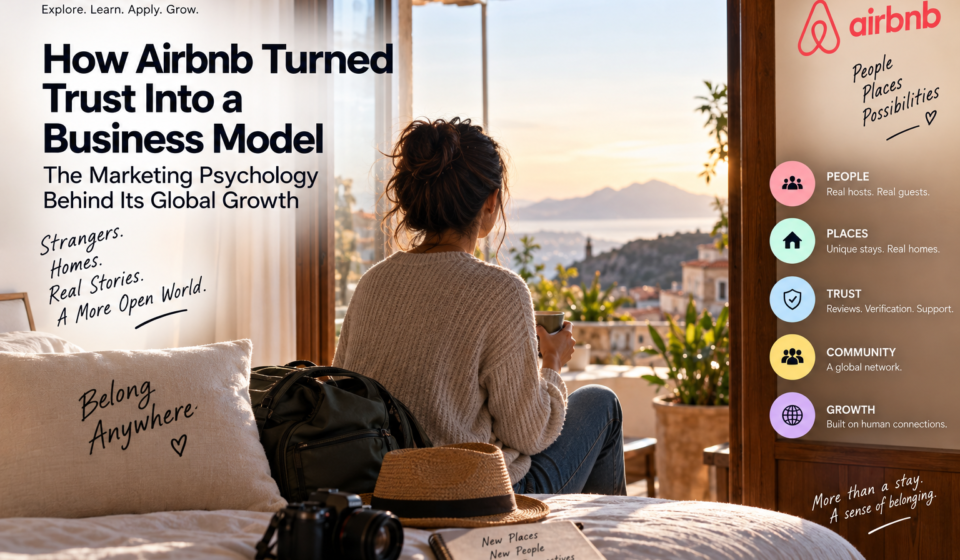
How Airbnb Turned Trust Into a Business Model: The Marketing Psychology Behind Its Growth

Would you stay in a stranger’s home?
Not a hotel.
Not a resort.
Not a friend’s house.
A stranger’s home.
And before you say yes, imagine that this person also has your money, your arrival time, your phone number, and access to the place you’re staying.
Back in the early days of Airbnb, this wasn’t just a marketing problem.
It was the business problem.
Because Airbnb wasn’t simply asking:
“Would you like a cheaper place to stay?”
It was asking something much harder:
“Would you trust a stranger enough to sleep in their home?”
That is why Airbnb is such an interesting marketing case study.
Its biggest innovation wasn’t simply putting homes on a website.
It was building a system that could make transactions between strangers feel trustworthy enough to happen at enormous scale.
Today, Airbnb says it has more than 5.5 million hosts, more than 9 million active listings, and more than 2.5 billion guest arrivals worldwide.
But none of that would have been possible if people hadn’t overcome the original psychological barrier:
“Why should I trust this person?”
And that is where the real Airbnb marketing strategy begins.
The real problem Airbnb was solving
At first glance, Airbnb solved a simple problem:
People need places to stay.
But hotels already solved that problem.
There were already millions of rooms.
There were booking websites.
There were travel agents.
There were hostels.
There were vacation rentals.
So Airbnb needed to solve something different.
Its opportunity was the unused capacity sitting inside people’s homes.
A spare bedroom.
An empty apartment.
A holiday home.
A unique property that wasn’t part of the traditional hotel system.
The problem?
Connecting strangers to those spaces created enormous uncertainty.
A traveler could wonder:
- Is the home actually real?
- Will it look like the photos?
- Is the host trustworthy?
- Is the neighborhood safe?
- Will someone actually be there?
- Will the host cancel?
- What happens if something goes wrong?
- What if the property is completely different from the listing?
And the host had their own questions:
- Who is this guest?
- Will they respect my property?
- Will they damage something?
- Will they cause problems?
- Can I trust them inside my home?
- What happens if they don’t show up?
- What if something goes wrong?
Airbnb therefore had a two-sided trust problem.
Guests needed to trust hosts.
Hosts needed to trust guests.
That is much harder than selling a normal product.
Airbnb’s original insight: Trust could be designed
This is one of the most important ideas in Airbnb’s history.
Airbnb’s co-founder and CEO Brian Chesky has repeatedly described trust as central to the company’s business.
The company’s own description of its early challenge is essentially this:
People believed strangers would never trust one another enough to share homes.
Airbnb’s response wasn’t simply:
“People are actually nice.”
That wouldn’t be enough.
Instead, Airbnb gradually built a system around the transaction.
Profiles.
Reviews.
Ratings.
Identity verification.
Photos.
Messaging.
Payment systems.
Host and guest histories.
Policies.
Support.
Safety measures.
Listing information.
These individual features may look ordinary today.
Together, they solve a massive psychological problem.
They make an anonymous stranger feel less anonymous.
The psychology of trusting a stranger
Imagine two situations.
Situation A
You see:
“Nice apartment. ₹7,000 per night.”
No photo of the owner.
No reviews.
No history.
No information about the property.
Would you book it?
Probably not.
Now imagine:
Sarah — Superhost
★★★★★ 4.91
327 reviews
Identity verified
Hosted for 6 years
Guests repeatedly mention:
“Exactly like the photos.”
“Great communication.”
“Spotlessly clean.”
“Easy check-in.”
Suddenly the decision feels different.
The apartment hasn’t physically changed.
But your perception of risk has changed.
This is one of the most important lessons from Airbnb:
Trust doesn’t always require eliminating uncertainty. Sometimes it requires making uncertainty easier to evaluate.
Airbnb turned social proof into infrastructure
Social proof is a classic psychological principle.
When people aren’t sure what to do, they look at what other people have done.
That’s why:
- Restaurant ratings matter.
- Product reviews matter.
- Testimonials matter.
- Follower counts matter.
- “Best seller” labels matter.
- Customer logos matter.
Airbnb built social proof directly into the transaction.
Instead of asking:
“Is this host trustworthy?”
the platform gives you signals that help answer the question.
You can see:
- Reviews
- Ratings
- Host information
- Previous guest experiences
- Listing details
- Photos
- Booking history and other profile signals
This changes the decision from:
Trust a stranger
to:
Evaluate evidence about a stranger.
That’s a much easier psychological decision.
Reviews aren’t just feedback. They’re a trust engine.
A review on Airbnb does something incredibly valuable.
It transfers information from one person’s experience to another person’s decision.
Guest A stays somewhere.
↓
Guest A leaves a review.
↓
Guest B reads the review.
↓
Guest B feels more confident booking.
↓
Guest B completes the transaction.
↓
Guest B eventually leaves another review.
And the cycle continues.
This creates a marketplace flywheel.
More bookings
↓
More experiences
↓
More reviews
↓
More information
↓
Less uncertainty
↓
More trust
↓
More bookings
This is why reviews are far more important than simply being a customer-service feature.
They are part of the marketplace’s growth infrastructure.
Airbnb didn’t just build trust between people. It built trust in the platform.
This distinction matters.
Imagine Airbnb only connected you with a host.
If something went wrong, you might think:
“I trusted the host and they disappointed me.”
But eventually you might also think:
“I shouldn’t have trusted Airbnb.”
That’s dangerous.
A marketplace therefore needs users to trust not only each other, but the platform facilitating the transaction.
Airbnb has built layers around this problem.
Identity verification.
Payments.
Messaging.
Reviews.
Support.
Listing standards.
Reservation screening.
Policies.
Safety systems.
These mechanisms communicate:
“You’re not completely on your own here.”
That’s a major psychological difference.
Identity verification makes strangers feel less anonymous
One of Airbnb’s most direct trust mechanisms is identity verification.
Airbnb currently requires identity verification for hosts and booking guests in its stays ecosystem.
The platform can verify information using trusted third-party sources or government identification, depending on circumstances and region.
Why does this matter psychologically?
Because anonymity increases uncertainty.
Compare:
“Someone named Rahul booked my apartment.”
with:
“This is a verified person with a history on the platform.”
The second feels more accountable.
The person becomes more than a username.
They become an identifiable participant in a system.
That changes behavior on both sides.
And that leads to a broader marketing principle:
Accountability can increase trust because people behave differently when their identity is attached to their actions.
Profiles turn transactions into relationships
Another clever part of Airbnb is the profile.
A profile provides context.
Instead of interacting with an anonymous customer, hosts can see information about guests such as their first name, Airbnb history, number of trips and reviews from previous hosts.
Likewise, guests can learn about hosts.
This creates something psychologically important:
context.
Context makes people easier to understand.
And understandable people often feel less risky than anonymous people.
That’s why platforms across the internet use profiles.
LinkedIn.
Uber.
Upwork.
eBay.
Amazon.
Airbnb.
The principle is similar:
Identity + history + reputation = reduced uncertainty.
Photography became part of Airbnb’s trust strategy
Now we get to one of Airbnb’s most underrated marketing decisions:
Photography.
Think about how much information a hotel website can provide.
Then think about a random apartment being offered by an individual.
The guest needs to know:
What does this place actually look like?
Is it clean?
Is the bedroom real?
Is there enough space?
What is the view?
What does the bathroom look like?
Is this worth the price?
Images answer questions that words can’t answer efficiently.
Airbnb therefore invested heavily in professional photography.
The company launched its professional photography program in 2010.
And Airbnb’s current data says listings using its Professional Photography service saw a 19% average net uplift in bookings over the following 365 days, based on its analysis of more than 14,700 global listings.
That doesn’t mean photography alone caused every booking increase.
But it demonstrates something important:
Presentation affects perceived trust and perceived value.
A blurry photo doesn’t just look unprofessional.
It creates uncertainty.
A clear, well-composed photograph can reduce it.
The listing became a product page
This is where Airbnb starts looking less like a travel company and more like a sophisticated e-commerce marketplace.
Think about a typical listing.
You have:
- Main image
- Gallery
- Property description
- Amenities
- Location
- Reviews
- Host profile
- Pricing
- Availability
- House rules
- Cancellation information
- Booking details
The listing isn’t just information.
It’s a conversion interface.
Its job is to move the customer through several psychological questions:
“Is this real?”
Photos and listing details.
“Is it good?”
Ratings and reviews.
“Can I trust the host?”
Profile and reputation.
“Is it right for me?”
Amenities, location and description.
“Is the price reasonable?”
Price comparison and alternatives.
“What happens if something goes wrong?”
Policies and platform support.
“Should I book now?”
Availability, timing and other decision signals.
This is conversion optimization applied to trust.
Airbnb reduced perceived risk instead of eliminating actual risk
This distinction is important.
No marketplace can remove all risk.
Things can still go wrong.
Hosts can disappoint guests.
Guests can behave badly.
Properties can have problems.
Cities can regulate short-term rentals.
Reviews can be imperfect.
People can make mistakes.
Airbnb therefore doesn’t need to create a world with zero uncertainty.
It needs to create a system where the perceived risk is low enough for the transaction to happen, while continuously managing actual risks.
That’s a much more realistic business strategy.
“Belong Anywhere” was more than a slogan
Airbnb’s brand positioning eventually moved beyond:
“Find a place to stay.”
Its famous positioning around “Belong Anywhere” gave the company a much more emotional territory.
A hotel sells accommodation.
Airbnb could sell:
A sense of belonging.
That distinction matters.
A hotel room says:
“Here is your room.”
Airbnb’s brand story says:
“Here is your opportunity to experience a place differently.”
The company began framing hosts as part of the experience.
Local neighborhoods became part of the experience.
Homes became part of the experience.
Travel became less transactional.
This gave Airbnb something traditional accommodation companies struggled to own:
a human story around the stay.
Airbnb turned hosts into part of the brand
This is one of the company’s smartest marketing moves.
Airbnb doesn’t have to create every experience itself.
Its hosts create much of the inventory and much of the emotional experience.
A host can become:
- A local guide
- A storyteller
- A recommendation engine
- A source of cultural context
- A memorable part of the trip
Airbnb therefore has something unusual.
Its customers can also become part of the product experience.
That creates enormous scalability.
The company doesn’t need to build a hotel in every neighborhood.
It can enable local people to provide the supply.
Airbnb’s marketing shifted from selling rooms to selling experiences
This became increasingly visible in Airbnb’s advertising.
Instead of focusing only on:
“Here is a beautiful apartment.”
Airbnb could show:
“Here is what your trip could feel like.”
A family cooking together.
A couple exploring a neighborhood.
Friends staying somewhere unusual.
A traveler experiencing local culture.
A host welcoming guests.
The home becomes a stage for the experience.
That’s powerful because consumers rarely buy the physical product alone.
They buy what the product enables.
People don’t buy a camera because they love cameras.
They buy what they can do with it.
People don’t buy running shoes because they love rubber and foam.
They buy what running enables.
And Airbnb isn’t really selling square footage.
It’s selling:
travel + place + experience + possibility.
Airbnb’s marketplace flywheel
Now put the pieces together.
Airbnb has two sides:
Hosts
They provide supply.
Guests
They create demand.
The challenge is that neither side is very valuable without the other.
One empty apartment isn’t a marketplace.
One traveler isn’t a marketplace.
The magic happens when they connect.
The flywheel looks something like this:
More hosts
↓
More listings
↓
More choice
↓
More useful destinations and price points
↓
More guests
↓
More bookings
↓
More host earnings
↓
More people willing to become hosts
↓
More listings
↓
More guests
And then trust mechanisms strengthen the loop:
More bookings → more reviews → more information → more trust → more bookings.
This is why marketplace businesses can become extremely powerful once network effects begin working.
Airbnb understood that trust compounds
Suppose Airbnb has 10 listings.
There aren’t many reviews.
Not much history.
Few hosts have reputations.
The platform feels risky.
Now imagine millions of transactions have happened.
There are:
- Reviews
- Host histories
- Guest histories
- Ratings
- Photos
- Profiles
- Search data
- Pricing information
- Listing standards
- Platform policies
The platform now has something it didn’t have at the beginning:
institutional memory.
Every completed transaction creates information that can help future transactions.
That is incredibly valuable.
Trust can therefore become a cumulative advantage.
The stranger becomes less strange
This is perhaps the simplest way to understand Airbnb’s entire marketing strategy.
At the beginning:
Stranger
↓
“Who is this?”
↓
Profile
↓
“Okay, I know a little about them.”
↓
Verification
↓
“Okay, they have verified information.”
↓
Reviews
↓
“Other people have interacted with them.”
↓
Photos
↓
“I can see what I’m buying.”
↓
Messaging
↓
“I can communicate with them.”
↓
Platform protection
↓
“If something goes wrong, Airbnb is involved.”
↓
Trust
↓
Booking
The person hasn’t magically become trustworthy.
The system has made the person more legible.
And that is the genius.
Airbnb’s trust strategy is really a risk-reduction strategy
Marketers often talk about building trust as if trust is purely emotional.
It isn’t.
Trust is also economic.
When perceived risk falls, people become more willing to transact.
Think about buying a ₹500 product from an unknown website.
You might hesitate.
Add:
- 10,000 reviews
- Secure payments
- Easy returns
- Verified seller
- Customer support
- Clear product images
Suddenly the purchase feels safer.
The product didn’t necessarily improve.
The transaction became easier to trust.
Airbnb built an entire business around this principle.
The psychology behind Airbnb’s growth
Several psychological principles are working simultaneously.
1. Social proof
Other people’s experiences influence our decisions.
Reviews reduce uncertainty.
2. Familiarity
Repeated exposure makes a platform feel safer.
The more people see Airbnb, the less unusual the concept feels.
3. Authority
Verification, policies and platform standards create signals that Airbnb is managing the transaction.
4. Loss aversion
People are highly sensitive to potential losses.
A bad hotel room is frustrating.
A bad experience in a stranger’s home can feel much riskier.
Airbnb therefore has strong incentives to reduce perceived downside.
5. Availability of information
More information doesn’t automatically create trust.
But useful information can reduce uncertainty.
Photos, reviews, profiles and property details help customers make decisions.
6. Reciprocity and human connection
The host-guest relationship can feel more personal than a conventional anonymous hotel transaction.
This supports Airbnb’s broader belonging narrative.
Airbnb didn’t just build a travel brand. It built a reputation system.
This is the bigger business lesson.
A marketplace needs a way to answer:
“Who should I trust?”
Amazon has seller ratings.
Uber has driver and rider ratings.
eBay has seller feedback.
Upwork has freelancer reviews.
Airbnb has host and guest reputation systems.
In each case, reputation becomes part of the infrastructure.
The marketplace isn’t just matching supply and demand.
It’s also helping participants evaluate one another.
That’s a much deeper role.
Airbnb’s marketing advantage: the product creates stories
There’s another reason Airbnb has strong marketing potential.
Every trip creates a story.
A unique home.
A beautiful view.
A strange apartment.
A local neighborhood.
A host.
A family trip.
A birthday.
A honeymoon.
A festival.
A memorable experience.
These stories can become marketing content.
And Airbnb has leaned into this through campaigns centered on hosts, travel experiences and real-world moments.
Its “Made Possible by Hosts” campaign, for example, used real photographs from real Airbnb trips to tell stories around what hosts make possible.
This is powerful because the brand doesn’t have to invent every story.
The customers are already creating them.
Airbnb’s India strategy shows another important lesson
A global brand cannot simply copy-paste one marketing message everywhere.
India has its own travel behaviors, cultural moments and event-driven demand.
Airbnb has increasingly highlighted India’s growth and local travel opportunities.
In its Q4 2025 results, Airbnb reported that nights booked by travelers originating in India were up about 50% year over year, while first-time bookers in India increased by more than 60%.
And Airbnb has increasingly connected its platform to major events and travel moments in India.
This is an important lesson for marketers:
Global positioning can remain consistent while local execution changes.
The brand can stay Airbnb.
But the reason someone uses Airbnb can be deeply local.
What happens when trust breaks?
This is where the Airbnb story becomes more interesting.
A weak case study would say:
“Airbnb built trust and became successful.”
Real businesses aren’t that simple.
The same system that enables trust can be damaged by:
- Fraud
- Misleading listings
- Safety incidents
- Discrimination
- Poor-quality properties
- Hidden fees
- Host cancellations
- Guest misconduct
- Regulatory problems
Airbnb has publicly acknowledged major trust and safety challenges over the years.
That led to increasingly sophisticated verification, safety and quality systems.
The lesson is important:
Trust is not a branding campaign.
It is an operational responsibility.
If your advertising says:
“Trust us.”
but the product experience says:
“Good luck.”
the brand eventually loses.
Trust is not what you say. It’s what happens after the transaction.
This is perhaps the most important takeaway for marketers.
You can put:
“Trusted by 10,000 customers”
on your homepage.
But if customers have terrible experiences, the claim becomes meaningless.
Real trust is created by repeated evidence.
Promise
↓
Experience
↓
Proof
↓
Repetition
↓
Reputation
That’s how trust compounds.
What smaller brands can learn from Airbnb
You don’t need to build a global marketplace to use Airbnb’s principles.
1. Identify the biggest perceived risk
Ask your customer:
“What makes you hesitate before buying?”
It might be:
- “Will this work?”
- “Is this company legitimate?”
- “Will I get what I paid for?”
- “Can I trust the quality?”
- “Will I get support?”
- “What happens if something goes wrong?”
That’s where your marketing should focus.
2. Don’t just make claims. Provide evidence.
Instead of:
“We are experts.”
Show:
- Case studies
- Reviews
- Results
- Certifications
- Examples
- Demonstrations
- Before-and-after work
- Real people
Evidence beats adjectives.
3. Make your customer less uncertain
Give them:
- Clear pricing
- Real photos
- FAQs
- Policies
- Examples
- Testimonials
- Process explanations
- Guarantees where appropriate
Every unanswered question creates friction.
4. Turn reviews into an asset
Don’t treat reviews as something customers occasionally leave.
Build a system around collecting and displaying useful customer feedback.
The goal isn’t simply:
“Get 5-star reviews.”
It’s:
“Help the next customer understand what it is like to buy from us.”
5. Make the people behind the business visible
People trust people more easily than anonymous organizations.
Show:
- Founders
- Team members
- Experts
- Customers
- Behind-the-scenes work
- Real processes
Human visibility can reduce psychological distance.
6. Use professional presentation
Airbnb’s photography lesson applies everywhere.
Good presentation doesn’t magically make a bad product good.
But poor presentation can make a good product look risky.
Your:
- Website
- Product images
- Case studies
- Social profiles
- Proposal
- Packaging
- Content
all contribute to perceived credibility.
The Brand Yaatra Trust Framework
Here’s a framework marketers can actually use.
TRUST =
T — Transparency
Show people what they’re actually buying.
R — Reputation
Give customers evidence that others have had good experiences.
U — Understandability
Make your offer and process easy to understand.
S — Signals
Use credentials, verification, examples, people and proof strategically.
T — Track record
Show that you have done this successfully before.
The more uncertainty your customer has, the more important these become.
Airbnb’s marketing playbook
Let’s reduce the case study to a practical table.
| Airbnb Principle | What Airbnb Did | Marketing Lesson |
|---|---|---|
| Solve a real friction | Connected travelers with hosts | Find an unmet problem |
| Reduce uncertainty | Reviews, profiles and verification | Make risk easier to evaluate |
| Use social proof | Ratings and reviews | Let customers sell credibility |
| Show the product | Detailed listing photography | Visual proof matters |
| Build reputation | Host and guest histories | Give people a reason to trust |
| Create emotional meaning | “Belong Anywhere” | Move beyond functional benefits |
| Build a marketplace | Hosts + guests | Create reinforcing network effects |
| Use customer stories | Host and guest campaigns | Let real experiences become content |
| Protect trust | Safety and quality systems | Brand promise must reach operations |
| Localize execution | Country and event strategies | Global brand, local relevance |
| Expand the experience | Services and Experiences | Grow from the core customer need |
| Use technology carefully | AI-powered search and support | Technology should reduce friction |
The biggest lesson from Airbnb
Airbnb didn’t win because people suddenly became comfortable with strangers.
It won because the company kept reducing the psychological distance between strangers.
A stranger became a profile.
A profile became a verified identity.
An identity gained reviews.
Reviews created reputation.
Reputation reduced uncertainty.
Lower uncertainty increased bookings.
More bookings created more reviews.
More reviews created more trust.
And trust became the fuel for the marketplace.
That is the real Airbnb growth story.
Final takeaway
The most important thing Airbnb sells isn’t a bedroom.
It isn’t a villa.
It isn’t an apartment.
It isn’t even travel.
At a deeper level, Airbnb sells something much more valuable:
confidence in a transaction that would otherwise feel risky.
And that is why Airbnb is such a powerful marketing case study.
Because almost every business has a trust problem.
A customer might wonder:
“Will this actually work?”
“Will they deliver?”
“Is this company legitimate?”
“Will I regret buying this?”
The companies that answer those questions most convincingly don’t just have better marketing.
They have designed their entire customer experience to make trust easier.
Airbnb’s greatest marketing lesson is therefore simple:
Don’t just tell customers why they should trust you. Build a system that gives them reasons to.
That is how trust stops being a slogan—
and becomes a business model.
Frequently Asked Questions
What is Airbnb’s marketing strategy?
Airbnb’s marketing strategy combines trust-building, marketplace network effects, social proof, community, brand storytelling, organic discovery, host-generated supply and product-led growth. Its brand positioning has also emphasized belonging and unique travel experiences.
How did Airbnb build trust?
Airbnb built trust through mechanisms including reviews, ratings, profiles, identity verification, listing information, photography, messaging, platform policies, safety measures and reputation systems.
Why are reviews important to Airbnb?
Reviews reduce uncertainty by giving future guests information about previous experiences. They also create a reputation system that helps guests evaluate hosts and hosts evaluate guests.
How does Airbnb use social proof?
Airbnb uses ratings, reviews, host information and other reputation signals to help customers evaluate listings and hosts. Seeing evidence from previous guests can make an unfamiliar listing feel less risky.
Why is photography important to Airbnb?
Photography helps customers understand what a property actually looks like before booking. Airbnb has invested in professional photography, and its current analysis reports higher booking performance for listings using its Professional Photography service.
What does “Belong Anywhere” mean for Airbnb?
“Belong Anywhere” reflects Airbnb’s effort to position travel around connection, local experiences and belonging rather than only accommodation. It gives the brand a more emotional territory than simply competing on rooms or price.
What can small businesses learn from Airbnb?
Small businesses can reduce perceived risk by using customer reviews, case studies, transparent pricing, clear processes, professional presentation, visible expertise and strong customer support. The goal is to give customers evidence rather than simply asking them to trust the brand.
Is Airbnb a marketplace?
Yes. Airbnb connects hosts who provide accommodations and other offerings with guests who demand them. Its marketplace also relies on reputation and trust mechanisms to help participants transact with one another.
What is Airbnb’s biggest marketing lesson?
Airbnb demonstrates that trust can be designed into a customer experience. Instead of relying only on brand messaging, businesses can build systems that reduce uncertainty and provide customers with evidence.



[…] Airbnb, for example, had to solve a fundamental trust problem: would people be willing to stay in someone else’s home? […]