
There was a time when a digital marketer needed a separate tool for almost everything.
One tool for keyword research.
Another for email.
Another for social scheduling.
Another for design.
Another for analytics.
Another for landing pages.
Another for competitor research.
Then AI arrived.
And suddenly, almost every marketing tool became an AI tool.
That created a new problem.
There are now too many tools.
Every week brings another AI writer.
Another image generator.
Another SEO assistant.
Another social-media copilot.
Another “all-in-one” marketing platform.
The question for marketers is no longer:
“What AI tools exist?”
It is:
“Which tools are actually worth putting into my marketing workflow?”
This guide is built around that question.
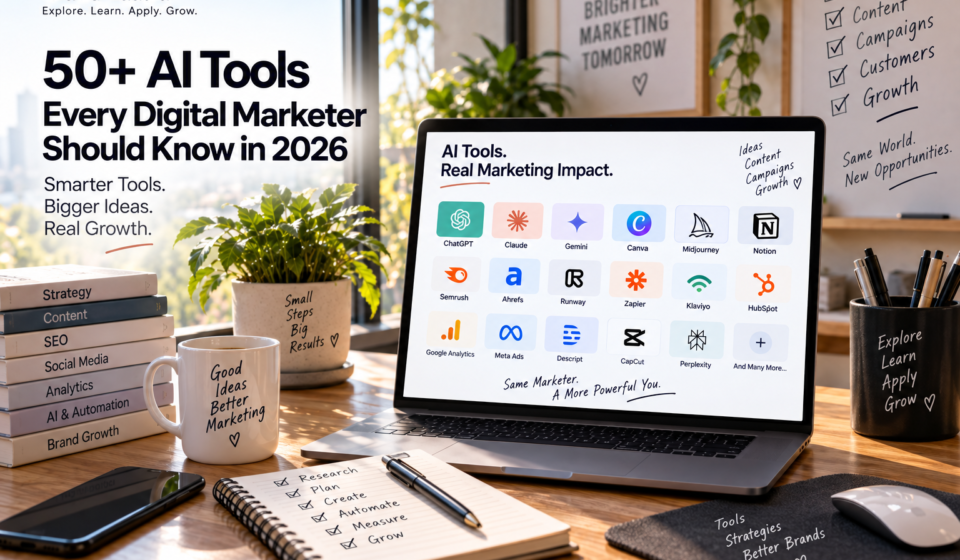
Instead of giving you 50 tools and telling you that every one is “amazing,” we’ll organize them by the job they actually help you do.
You’ll find tools for:
- AI research
- Writing and content
- SEO
- GEO and AI-search visibility
- Design
- Image generation
- Video
- Audio and voice
- Social media
- Email marketing
- Analytics
- Customer research
- Automation
- CRM
- E-commerce
- Presentations
- Productivity
And we’ll also answer a more important question:
Do you actually need the tool?
Because adding 20 AI tools to your stack isn’t an AI strategy.
It is tool sprawl.
The AI Marketing Stack in 2026
Before looking at individual tools, think about marketing as a system.
A typical AI-assisted workflow can look like this:
Research
↓
Strategy
↓
Create
↓
Optimize
↓
Publish
↓
Distribute
↓
Measure
↓
Learn
↓
Improve
The best AI stack supports this loop.
The worst one creates another 17 browser tabs.
How We Selected These AI Marketing Tools
This isn’t a ranking from #1 to #50.
There is no universal “best AI marketing tool.”
The right tool depends on:
- Your marketing objective
- Team size
- Budget
- Existing software
- Technical ability
- Content volume
- Data requirements
- Workflow complexity
So each tool below is categorized by its strongest use case.
Also, AI features change extremely quickly.
A tool that is best today may not be best six months from now.
That’s why this should be treated as a living list, not a permanent ranking.
1. AI Research & Strategy Tools
These are the tools to use before you start producing content.
Because AI should not only help you create faster.
It should help you think better.
1. ChatGPT
Best for:
Research, brainstorming, strategy, writing, analysis, ideation, data work and marketing workflows.
ChatGPT has evolved far beyond simple question-and-answer chat.
Its current capabilities include web search, deep research, file analysis, image generation, projects and longer multi-step workflows.
Best marketing uses:
- Content research
- Campaign brainstorming
- Competitor analysis
- Customer research synthesis
- Content briefs
- Marketing strategy
- Data analysis
- Copy variations
- Content repurposing
- Research reports
Why marketers should know it
It can sit across multiple stages of the marketing workflow rather than performing only one specialized task.
Watch out for:
Don’t use it as a substitute for original research or fact-checking.
2. Claude
Best for:
Long-form writing, document analysis, reasoning and working with large amounts of context.
Claude is particularly useful when you need to work through lengthy documents or develop structured written material.
Best marketing uses:
- Brand guidelines
- Long-form content
- Research synthesis
- Strategy documents
- Content editing
- Customer-feedback analysis
- Messaging frameworks
Watch out for:
Like every generative AI system, Claude can produce confident mistakes.
3. Gemini
Best for:
Google ecosystem workflows, research, multimodal work and AI-assisted productivity.
Gemini is particularly interesting for marketers already working heavily inside Google’s ecosystem.
Best marketing uses:
- Research
- Brainstorming
- Content
- Document analysis
- Google Workspace workflows
- Image understanding
- Marketing analysis
Watch out for:
Don’t assume a Google-connected tool automatically gives you better marketing strategy.
The workflow still matters more than the model.
4. Perplexity
Best for:
AI-powered research and source discovery.
Perplexity combines conversational answers with web search and citations.
Its current Research capabilities can conduct multiple searches, analyze many sources and produce a structured report.
Best marketing uses:
- Market research
- Competitor research
- Trend research
- Industry research
- Source discovery
- Topic research
- Initial fact-finding
Watch out for:
Always open important sources yourself.
A citation is not automatically proof that the underlying claim is correct.
5. NotebookLM
Best for:
Researching a defined collection of sources.
NotebookLM is particularly useful when you want AI to work primarily from documents and sources you provide.
Best marketing uses:
- Research reports
- Competitor documents
- Brand guidelines
- Customer interviews
- Research papers
- Meeting notes
- Industry reports
Watch out for:
It is most useful when your source library is good.
Garbage sources still produce garbage research.
6. Google Trends
Best for:
Understanding search interest and trend direction.
Google Trends isn’t an AI writing tool.
That’s exactly why it belongs in an AI-era marketing stack.
Use it for:
- Topic validation
- Trend research
- Seasonal demand
- Regional interest
- Comparing topics
- Content planning
Why it matters
AI can generate 100 article ideas.
Google Trends can help you decide which ideas people are actually searching for.
7. SparkToro
Best for:
Audience research.
SparkToro helps marketers understand what audiences search for, read, watch, follow and discuss.
Use it for:
- Audience research
- Competitor audience research
- Podcast research
- Publication research
- Influencer discovery
- Content strategy
Best insight:
Don’t only research keywords.
Research where your audience already pays attention.
8. Similarweb
Best for:
Market and competitor intelligence.
Use it to understand traffic patterns, audience behavior and competitive digital ecosystems.
Use it for:
- Competitor research
- Market research
- Traffic benchmarking
- Channel analysis
- Audience analysis
Watch out for:
Third-party traffic estimates are estimates.
Treat them as directional data, not absolute truth.
9. Exploding Topics
Best for:
Finding emerging trends.
Useful when you want to identify subjects before they become completely saturated.
Use it for:
- Content strategy
- Product research
- Emerging topics
- Market opportunities
- Trend discovery
SEO & GEO AI Tools
AI hasn’t eliminated SEO.
It has expanded the visibility problem.
You now have to think about:
Traditional search visibility
and increasingly:
AI-search visibility.
10. Semrush
Best for:
All-round SEO and competitive research.
Semrush covers areas such as:
- Keyword research
- Competitor research
- Site auditing
- Backlinks
- Content
- Rank tracking
- Advertising research
- AI-related visibility workflows
Best for:
Marketing teams that want one broad SEO platform.
Watch out for:
Don’t let a giant keyword database replace actual search-intent analysis.
11. Ahrefs
Best for:
SEO research and backlink analysis.
Ahrefs is particularly well known for its link index and SEO research capabilities.
Use it for:
- Keyword research
- Backlink research
- Competitor analysis
- Content research
- Site audits
- Rank tracking
Best for:
Marketers who care deeply about organic search and authority.
12. Surfer
Best for:
Content optimization.
Surfer focuses heavily on helping marketers optimize content around search intent and competing pages.
Use it for:
- Content briefs
- SEO optimization
- Content scoring
- Topic coverage
- On-page optimization
Watch out for:
Don’t write for a score.
Write for the person searching.
13. Clearscope
Best for:
SEO content optimization.
Clearscope helps content teams identify relevant terms and topics that can improve topical coverage.
Best for:
Editorial teams publishing large volumes of search-focused content.
14. Frase
Best for:
AI-assisted content research and optimization.
Frase combines research, content briefs and AI writing/optimization workflows.
Use it for:
- Topic research
- Content briefs
- SEO writing
- Optimization
- Competitor analysis
15. Screaming Frog SEO Spider
Best for:
Technical SEO crawling.
It isn’t primarily an AI tool.
But it belongs in an AI-era marketing toolkit because automation and AI don’t replace technical SEO.
Use it for:
- Broken links
- Redirects
- Metadata
- Canonicals
- Duplicate content
- Crawl analysis
- Technical audits
16. Google Search Console
Best for:
Understanding how Google actually sees your website.
Again, this isn’t an AI tool.
But it should be in every serious SEO stack.
Use it for:
- Search queries
- Impressions
- Clicks
- CTR
- Indexing
- URL inspection
- Sitemap monitoring
- Search performance
Brand Yaatra note
This is already part of our own setup.
Keep it.
Don’t replace first-party search data with an AI tool.
17. Profound
Best for:
AI-search visibility and GEO measurement.
Profound focuses on understanding how brands appear across AI search and answer engines.
Use it for:
- AI visibility
- Brand mentions
- AI-search monitoring
- Competitive visibility
- GEO measurement
Why it matters
Traditional rank tracking doesn’t fully answer:
“What does AI say about my brand?”
18. Otterly.AI
Best for:
Tracking brand visibility across AI search environments.
Useful for marketers trying to understand whether their content or brand appears in AI-generated answers.
Use it for:
- AI search tracking
- Brand mentions
- Competitor visibility
- GEO monitoring
19. Google Keyword Planner
Best for:
Search demand and Google Ads keyword research.
It remains useful even in the AI era.
Use it for:
- Keyword discovery
- Search-volume direction
- Paid search planning
- Keyword ideas
20. AnswerThePublic
Best for:
Understanding the questions people ask around a topic.
Use it for:
- Content ideas
- FAQ research
- Search-intent mapping
- Topic expansion
AI Writing & Content Tools
AI writing is easy.
Good writing is still hard.
The goal should therefore be:
AI for speed + human judgment for quality.
21. Jasper
Best for:
Marketing-focused AI content workflows.
Jasper is built specifically around marketing use cases rather than generic chat.
Use it for:
- Campaign content
- Brand voice
- Marketing copy
- Content workflows
- Team collaboration
Best for:
Marketing teams that want a dedicated AI content environment.
22. Copy.ai
Best for:
Marketing and go-to-market workflows.
Use it for:
- Sales copy
- Marketing content
- GTM workflows
- Outreach
- Content generation
- Workflow automation
23. Writer
Best for:
Enterprise content governance and brand-controlled AI.
Use it for:
- Brand voice
- Enterprise content
- AI governance
- Marketing workflows
- Internal knowledge
24. Grammarly
Best for:
Writing quality and editing.
Its AI features extend beyond grammar correction into rewriting, ideation and tone support.
Use it for:
- Editing
- Clarity
- Tone
- Emails
- Professional writing
- Content refinement
Best insight:
Use AI to improve your writing.
Don’t let AI erase your voice.
25. Notion AI
Best for:
AI inside a workspace.
Use it for:
- Meeting notes
- Content planning
- Project documentation
- Research
- Knowledge management
- Internal marketing workflows
26. Canva Magic Studio / Canva AI
Best for:
Marketing content creation.
Canva has expanded its AI capabilities across design, image and video creation.
Use it for:
- Social posts
- Presentations
- Ads
- Documents
- Visual content
- AI-generated images
- AI-generated video
- Brand assets
Best for:
Marketers who need speed without becoming professional designers.
AI Image & Design Tools
Visual marketing is increasingly AI-assisted.
But again:
Generating an image is easy.
Creating the right visual for the right audience is the difficult part.
27. Adobe Firefly
Best for:
Professional creative workflows.
Adobe’s current Firefly ecosystem spans image, video, audio and design, and increasingly connects multiple AI models inside Adobe’s creative environment.
Use it for:
- Image generation
- Image editing
- Video generation
- Sound
- Creative production
- Adobe workflows
Best for:
Teams already working in Adobe’s ecosystem.
28. Midjourney
Best for:
High-quality AI image generation and visual exploration.
Use it for:
- Concept development
- Campaign visuals
- Editorial imagery
- Moodboards
- Creative exploration
Watch out for:
AI-generated visuals still need human art direction.
29. Ideogram
Best for:
Images where typography and text inside the image matter.
Use it for:
- Posters
- Advertising concepts
- Typography-heavy graphics
- Social creatives
- Visual concepts
30. Leonardo AI
Best for:
Creative image generation and asset production.
Use it for:
- Concept art
- Marketing visuals
- Product concepts
- Brand imagery
- Creative experimentation
31. Adobe Express
Best for:
Fast social and marketing design.
Use it for:
- Social posts
- Flyers
- Short-form video
- Marketing assets
- Brand templates
AI Video Tools
Video is becoming easier to produce.
That doesn’t mean every brand needs more video.
It means the cost of experimenting with video is falling.
32. Runway
Best for:
AI video generation and creative video workflows.
Use it for:
- Generative video
- Video effects
- Creative concepts
- Visual storytelling
- Experimental campaigns
33. HeyGen
Best for:
AI avatars, presenters and multilingual video.
Use it for:
- Explainer videos
- Training
- Product demos
- Localization
- Presenter-led content
34. Synthesia
Best for:
Business and training video production.
Use it for:
- Training
- Internal communications
- Product education
- Corporate explainers
- Localization
35. Descript
Best for:
Editing video and audio through text-based workflows.
Use it for:
- Podcasts
- Interviews
- Video editing
- Transcription
- Short-form content
- Content repurposing
36. CapCut
Best for:
Fast social-video production.
Use it for:
- Reels
- TikTok
- Shorts
- Captions
- Short-form editing
- Social templates
37. Canva Video
Best for:
Marketers who want video creation integrated with their broader design workflow.
Canva’s AI video tools can generate clips from prompts and combine visuals with synchronized audio.
AI Audio & Voice Tools
Audio is becoming another major AI-generated medium.
38. ElevenLabs
Best for:
AI voice generation.
Use it for:
- Voiceovers
- Narration
- Localization
- Audio content
- Conversational experiences
39. Adobe Podcast
Best for:
Improving recorded speech and podcast audio.
Use it for:
- Voice cleanup
- Podcast production
- Interview audio
- Speech enhancement
40. Descript
Descript belongs here too because it combines transcription, editing and AI-assisted audio/video workflows.
AI Social Media Tools
Social media has a particular AI problem.
It’s very easy to automate.
And very easy to become boring.
Use AI to accelerate production.
Don’t automate personality.
41. Buffer
Best for:
Simple social scheduling and AI-assisted content workflows.
Use it for:
- Scheduling
- Content planning
- Publishing
- Analytics
- AI-assisted captions
Best for:
Solo marketers and small teams.
42. Hootsuite
Best for:
Larger social-media operations.
Use it for:
- Scheduling
- Analytics
- Social listening
- Engagement
- Team workflows
- AI-assisted social management
43. Later
Best for:
Visual-first social media management.
Use it for:
- TikTok
- Visual planning
- Scheduling
- Analytics
- Content calendars
- Creator workflows
44. Sprout Social
Best for:
Enterprise social management and analytics.
Use it for:
- Social publishing
- Analytics
- Listening
- Customer care
- Reporting
- Team workflows
45. Metricool
Best for:
Social scheduling and cross-platform analytics.
Use it for:
- Scheduling
- Social analytics
- Reporting
- Competitor monitoring
- Content planning
AI Email Marketing Tools
Email is one of the areas where AI can be genuinely useful because email marketing involves repeated workflows.
But personalization only works if the underlying customer data is good.
46. HubSpot
Best for:
CRM-connected marketing.
HubSpot combines CRM, marketing automation, email, customer data and AI-assisted workflows.
Use it for:
- Lead nurturing
- CRM
- Marketing automation
- Forms
- Landing pages
- Customer journeys
47. Klaviyo
Best for:
E-commerce and B2C lifecycle marketing.
Klaviyo’s AI capabilities are built into email creation, personalization, recommendations and optimization.
Use it for:
- SMS
- Segmentation
- Product recommendations
- Customer journeys
- E-commerce retention
48. Mailchimp
Best for:
Accessible email marketing.
Use it for:
- Newsletters
- Email campaigns
- Automation
- Audience management
- Landing pages
Best for:
Small businesses and growing email programs.
49. Brevo
Best for:
Email, SMS and broader customer communication.
Use it for:
- SMS
- Automation
- CRM
- Campaigns
AI Analytics & Customer Behavior Tools
AI can generate reports.
But analytics tools tell you what actually happened.
That distinction matters.
50. Google Analytics 4
Best for:
Website and app measurement.
Use it for:
- Traffic
- Acquisition
- Engagement
- Events
- Key events
- User journeys
- Funnel analysis
Brand Yaatra note
We already have GA4 connected.
This is one tool you absolutely do not need to replace just because another AI analytics product looks more impressive.
51. Microsoft Clarity
Best for:
Understanding how people actually use your website.
Clarity provides:
- Session recordings
- Heatmaps
- Scroll behavior
- Click behavior
- AI-assisted insights
And the core product is free.
Use it for:
- UX problems
- Conversion friction
- Landing-page analysis
- User behavior
- Content engagement
52. Hotjar
Best for:
Behavior analytics and qualitative website research.
Use it for:
- Heatmaps
- Session recordings
- Surveys
- Feedback
- User behavior
53. Mixpanel
Best for:
Product and event analytics.
Use it for:
- Product funnels
- Retention
- User journeys
- Feature adoption
- Behavioral analysis
54. Looker Studio
Best for:
Turning marketing data into dashboards.
Use it for:
- SEO dashboards
- GA4 reports
- Google Ads reporting
- Search Console reporting
- Client dashboards
- Marketing performance
AI Automation Tools
This is where AI becomes especially powerful.
Instead of:
AI creates content
you can build:
Trigger → AI → decision → action → measurement
55. Zapier
Best for:
Connecting marketing tools without heavy coding.
Use it for:
- Lead routing
- Email workflows
- CRM automation
- AI workflows
- Content operations
- Notifications
Zapier has increasingly added AI-assisted automation and agentic workflows.
56. Make
Best for:
More complex visual automation workflows.
Use it for:
- Multi-step automations
- Data transformation
- CRM workflows
- Content pipelines
- AI workflows
- API-connected processes
57. n8n
Best for:
Flexible, technical workflow automation.
Use it for:
- AI agents
- APIs
- Data workflows
- Internal automation
- Custom marketing systems
Best for:
Teams comfortable with more technical workflows.
AI CRM & Customer Journey Tools
58. HubSpot CRM
HubSpot deserves another mention because CRM data can connect marketing activity to customer journeys.
Use it for:
- Lead management
- Lifecycle stages
- Sales handoff
- Marketing automation
- Customer data
- Reporting
The important idea isn’t the software itself.
It’s the connection between:
Marketing → Lead → Sales → Customer → Retention
AI E-commerce Marketing Tools
59. Shopify Magic / Shopify AI
Best for:
AI-assisted commerce workflows.
Use it for:
- Product descriptions
- Store content
- Marketing
- Customer support
- Merchandising
- E-commerce workflows
60. Gorgias
Best for:
E-commerce customer support automation.
Use it for:
- Customer service
- AI-assisted support
- Shopify workflows
- Order questions
- Returns
- Support automation
61. AdCreative.ai
Best for:
Generating and testing advertising creative concepts.
Use it for:
- Ad variations
- Creative concepts
- Social ads
- Performance marketing workflows
Watch out for:
AI can generate more creative variations than your strategy can possibly evaluate.
More ads don’t automatically mean better ads.
62. Meta Ads Manager
Not an AI-first tool, but essential for paid social.
Meta has integrated AI into its advertising systems for:
- Creative generation
- Campaign optimization
- Audience systems
- Advantage+ campaigns
Best for:
Paid social advertising.
63. Google Ads
Again, not an AI-first tool.
But Google increasingly embeds AI into:
- Campaign creation
- Asset generation
- Targeting
- Optimization
- Performance Max
- Search experiences
Best for:
Paid search and Google’s broader advertising ecosystem.
The 10 Tools I’d Learn First
If you’re overwhelmed by this list, don’t install 60 tools.
Start with ten.
1. ChatGPT
For thinking, research and execution.
2. Perplexity
For fast source-driven research.
3. Google Trends
For demand and trend validation.
4. Google Search Console
For actual organic-search performance.
5. Semrush or Ahrefs
For serious SEO research.
6. Canva
For everyday visual marketing.
7. CapCut or Descript
For video/content repurposing.
8. Buffer or Later
For social publishing.
9. GA4
For measurement.
10. Zapier or Make
For automation.
That’s already enough to build a very capable modern marketing workflow.
The AI Marketing Stack by Job
| Marketing Job | Tools to Consider |
|---|---|
| Research | ChatGPT, Perplexity, Gemini, NotebookLM |
| Audience research | SparkToro, Similarweb |
| Trends | Google Trends, Exploding Topics |
| SEO | Semrush, Ahrefs |
| Content optimization | Surfer, Clearscope, Frase |
| GEO | Profound, Otterly.AI |
| Technical SEO | Google Search Console, Screaming Frog |
| Writing | ChatGPT, Claude, Jasper, Copy.ai |
| Editing | Grammarly |
| Knowledge management | Notion AI, NotebookLM |
| Design | Canva, Adobe Express |
| Image generation | Firefly, Midjourney, Ideogram, Leonardo |
| Video | Runway, HeyGen, Synthesia, Descript, CapCut |
| Audio | ElevenLabs, Adobe Podcast |
| Social | Buffer, Hootsuite, Later, Sprout Social, Metricool |
| HubSpot, Klaviyo, Mailchimp, Brevo | |
| Analytics | GA4, Clarity, Hotjar, Mixpanel |
| Dashboards | Looker Studio |
| Automation | Zapier, Make, n8n |
| E-commerce | Shopify AI, Klaviyo, Gorgias |
| Paid advertising | Google Ads, Meta Ads Manager, AdCreative.ai |
Don’t Build a 60-Tool Marketing Stack
This is probably the most important section of the entire article.
AI has created a new form of marketing waste:
Tool accumulation.
A marketer sees:
“AI SEO tool.”
Adds it.
“AI social tool.”
Adds it.
“AI research tool.”
Adds it.
“AI writing tool.”
Adds it.
“AI analytics tool.”
Adds it.
Six months later:
47 subscriptions.
And somehow they’re still writing the campaign manually.
The solution is not more tools.
The solution is a better workflow.
Build a Marketing Stack, Not a Tool Collection
A good stack answers five questions.
1. What are we trying to achieve?
Traffic?
Leads?
Sales?
Retention?
Brand awareness?
Authority?
2. Where is the bottleneck?
Research?
Writing?
Design?
Distribution?
Analytics?
3. Can an existing tool already solve it?
Before buying something new, check your current stack.
Your existing software may already have the feature.
4. Does AI actually improve the outcome?
This is critical.
If AI saves 20 minutes but makes the content worse, you didn’t improve the workflow.
You made it faster to produce worse marketing.
5. Can we measure the benefit?
Ask:
What changed after we introduced this tool?
Time?
Cost?
Output?
Conversion?
Revenue?
Quality?
If you can’t answer that, reconsider the subscription.
The AI Marketing Workflow I’d Recommend
For a modern marketer, the workflow could look like this:
Step 1 — Research
Use:
Perplexity + ChatGPT + Google Trends
Find:
- What people care about
- What competitors publish
- What is changing
- What questions exist
↓
Step 2 — Strategy
Use:
ChatGPT / Claude / Gemini
Turn research into:
- Positioning
- Audience insights
- Content angles
- Campaign ideas
↓
Step 3 — Create
Use:
ChatGPT / Claude + Canva + Firefly + video tools
Create:
- Copy
- Images
- Video
- Presentations
- Social content
↓
Step 4 — Optimize
Use:
Semrush / Ahrefs / Surfer / Clearscope
Check:
- Search intent
- Topic coverage
- Technical SEO
- Competitive gaps
↓
Step 5 — Publish
Use:
CMS + social tools + email platform
↓
Step 6 — Measure
Use:
GA4 + Search Console + Clarity
↓
Step 7 — Automate
Use:
Zapier / Make / n8n
Automate repetitive work.
↓
Step 8 — Learn
Feed the results back into strategy.
That is where the real AI advantage begins.
What AI Should NOT Replace
AI is powerful.
But there are things marketers should be extremely careful about outsourcing completely.
Customer understanding
AI can summarize customer feedback.
It shouldn’t replace talking to customers.
Brand strategy
AI can generate positioning options.
It shouldn’t decide what your brand stands for without human judgment.
Original research
AI can help analyze research.
It shouldn’t be presented as original research when it isn’t.
Creative judgment
AI can generate 100 ideas.
Someone still needs to know which one is actually good.
Fact-checking
AI can accelerate research.
Humans still need to verify important claims.
Marketing accountability
If an AI-generated campaign fails, the AI isn’t going to explain the loss to your CEO.
You are.
The Biggest AI Marketing Mistake
The biggest mistake isn’t:
“Not using enough AI.”
It is:
Using AI without a marketing strategy.
Imagine two marketers.
Marketer A
Uses 20 AI tools.
Publishes 100 pieces of content.
Automates everything.
Has no clear audience.
No positioning.
No measurement.
No differentiation.
Marketer B
Uses five tools.
Understands the customer.
Has a strong positioning.
Creates useful content.
Measures outcomes.
Improves continuously.
I’d bet on Marketer B.
Every time.
AI Tools vs AI Strategy
Tools are the easy part.
Strategy is the difficult part.
AI can make:
- Bad ideas faster.
- Generic content cheaper.
- Weak campaigns more scalable.
- Unnecessary work more automated.
But it can also make:
- Good research faster.
- Great ideas easier to explore.
- Data easier to analyze.
- Creative production cheaper.
- Personalization more scalable.
- Complex workflows easier to automate.
The difference is not the AI.
It’s how you use it.
The Future of the AI Marketing Stack
The marketing stack is moving from:
Tools
to:
Workflows
and eventually:
Agents
Instead of asking:
“Which AI tool writes social captions?”
the future question becomes:
“Can my marketing system understand what happened, decide what should happen next, create the assets, publish them and report the result?”
That’s a much bigger shift.
The future marketing stack may look less like:
50 applications
and more like:
A small number of intelligent systems connected to each other.
Final Takeaway
You don’t need 50 AI tools.
You need the right 5–10 tools for the problems you’re actually trying to solve.
The best AI marketing stack isn’t the one with the most subscriptions.
It’s the one that creates the shortest path between:
Insight → Idea → Execution → Distribution → Measurement → Learning
AI is making execution cheaper.
It is making research faster.
It is making creative production more accessible.
It is making automation more powerful.
But none of that removes the fundamental job of marketing:
Understand people.
Create value.
Communicate clearly.
Build trust.
Earn attention.
Measure what matters.
AI can help you do all of those things.
It cannot decide what your brand should mean.
That’s still your job.
Frequently Asked Questions
What are the best AI tools for digital marketing in 2026?
There is no single best tool. ChatGPT, Claude, Gemini and Perplexity are strong general-purpose options; Semrush and Ahrefs are major SEO platforms; Canva and Adobe Firefly are useful for creative work; Runway and Descript are strong for video; Buffer, Hootsuite and Later support social workflows; GA4 and Search Console remain important measurement tools; and Zapier, Make and n8n support automation.
What AI tool is best for marketing research?
ChatGPT, Perplexity, Gemini and NotebookLM are useful for different research workflows. Perplexity is particularly useful for web research with citations, while NotebookLM is useful when you want to work from a defined collection of documents.
What is the best AI tool for SEO?
There isn’t one universal winner. Semrush and Ahrefs are broad SEO platforms, while Surfer, Clearscope and Frase focus more heavily on content optimization. Google Search Console remains essential because it provides first-party data about how Google sees your website.
What are the best AI tools for GEO?
GEO tools are still an emerging category. Platforms such as Profound and Otterly.AI focus specifically on AI-search visibility and monitoring. Traditional SEO tools are still important because AI systems also rely heavily on the broader web ecosystem.
What is the best AI tool for content writing?
ChatGPT, Claude, Jasper, Copy.ai and Writer can all support content workflows. The best choice depends on whether you need general reasoning, long-form writing, marketing workflows, brand governance or enterprise collaboration.
What is the best AI tool for social media?
Buffer, Later, Hootsuite, Sprout Social and Metricool are all useful, but they target different users. Buffer is particularly accessible for smaller teams, Later is strong for visual-first workflows, while Hootsuite and Sprout Social offer broader enterprise-oriented capabilities.
What is the best AI tool for creating images?
Adobe Firefly, Midjourney, Ideogram, Leonardo and Canva all serve different creative needs. The best choice depends on whether you prioritize professional creative workflows, visual quality, typography, asset generation or ease of use.
What is the best AI video generator?
Runway, Canva, HeyGen and other platforms serve different use cases. Runway is oriented toward creative generative video, while HeyGen and Synthesia are particularly useful for avatar and presenter-led business content.
Should marketers use multiple AI tools?
Yes, but selectively. Different tools are better at different jobs. The goal should be to build a small, connected workflow rather than collect dozens of subscriptions.
Are AI marketing tools replacing marketers?
No. They are changing what marketers spend time doing. AI can automate parts of research, production, analysis and execution, but strategy, judgment, positioning, customer understanding and accountability remain human responsibilities.
How many AI tools does a marketer actually need?
Most marketers can accomplish a great deal with a small core stack. A general AI assistant, research/search tool, SEO platform, design tool, analytics platform, social/email platform and automation tool can cover a large portion of the modern marketing workflow.
Are free AI marketing tools good enough?
Sometimes. Free versions are often sufficient for experimentation and small workflows. As usage grows, limitations around volume, automation, collaboration, data, integrations and advanced features may make paid plans worthwhile.
How often should an AI marketing tool list be updated?
Frequently. AI capabilities, pricing, models and integrations change rapidly. A serious 2026 tool guide should be treated as a living resource and reviewed periodically rather than left unchanged for years.