
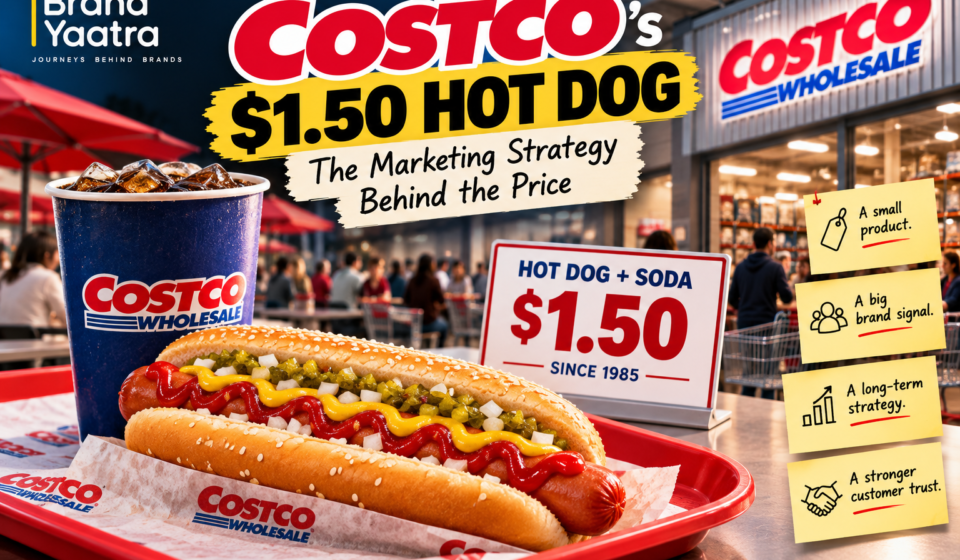

In a world where companies regularly raise prices, shrink packages and introduce premium tiers, one of America’s most recognizable food deals has refused to move.
At Costco’s US food courts, the hot dog and soda combo has remained priced at $1.50 since 1985.
That is an extraordinary run for a price. But the more interesting story is not the hot dog itself.
It is what customers have come to associate with it.
For many shoppers, the combo represents something bigger than an inexpensive lunch. It is a familiar signal that Costco is still trying to deliver value, even when costs elsewhere are changing.
Costco’s leadership has described the hot dog and its famous $4.99 rotisserie chicken as foundational value signals. The company has also invested in production efficiencies to help keep costs down rather than simply abandoning the price.
That makes this more than a pricing story. It is a case study in how a small product can reinforce the promise of an entire business.
The Product Is Small. The Brand Signal Is Not.
Most retailers use prices to communicate what an individual product is worth.
A lower price can suggest affordability. A premium price can suggest exclusivity, superior quality or status. Discounts can create urgency or encourage customers to try something new.
Costco’s hot dog does something different.
Its price has become a familiar reference point for the company’s broader value proposition.
Think about what happens when a shopper sees an unusually inexpensive deal inside a warehouse club. The shopper may not immediately calculate the retailer’s margins, supply-chain costs or purchasing power. But the deal can reinforce a simple impression:
This company knows how to keep prices low.
That impression can influence how customers interpret the rest of the shopping experience. It does not prove that every Costco product is the cheapest available, and it should not be treated as a guarantee of the lowest price on every item.
It does, however, give the retailer a concrete and memorable way to demonstrate its value-oriented positioning.
Why the $1.50 Price Became So Memorable
1. Consistency makes the signal easier to recognize
A price that changes frequently is difficult to turn into a lasting reference point.
A price that stays the same for decades is different. Customers can remember it, compare it with other prices and use it as shorthand for the company’s behaviour.
Consistency does not automatically create loyalty. But repeated exposure to the same recognisable offer can make the offer easier to recall.
Over time, the hot dog becomes more than an item on a menu. It becomes part of the Costco story that customers tell one another.
2. The deal is easy to explain
Some marketing propositions require a long explanation.
Costco’s hot dog deal does not.
The headline is straightforward: a hot dog and a drink for $1.50 at US food courts.
There is little complexity for the customer to decode. The price is specific, the product is familiar and the comparison with other everyday food prices is immediate.
This simplicity makes the deal naturally discussable. People can mention it in conversations, share stories about it or use it as an example of Costco’s approach to value.
3. The company has maintained the promise, not just the slogan
Any retailer can advertise low prices.
The harder task is to sustain a price when operating costs rise.
Costco has worked on the operational side of the equation, including producing its hot dogs at scale. Former CFO Richard Galanti explained in an interview that the company built a dedicated hot dog plant to reduce costs and help preserve the low price.
This is a crucial distinction. The price is not simply a clever communication device. It is connected to decisions about sourcing, production and operating efficiency.
That makes the promise more credible than a discount that appears for a weekend and disappears on Monday.
Costco Did Not Build This Story With Advertising Alone
It is tempting to interpret every successful brand story as the result of a brilliant campaign.
But the hot dog illustrates a different route to brand building: create a real business practice that is so consistent and easy to understand that it becomes part of the brand’s identity.
Costco’s membership model is central to this context. Customers pay to access the warehouse club, while the company uses a curated assortment, purchasing scale and operating discipline to deliver value across the shopping experience.
The hot dog sits inside that larger system.
It helps make the value proposition tangible. Customers do not need to read a corporate statement about price discipline to understand the deal. They can experience it directly.
This is the difference between saying that a brand stands for something and giving customers a reason to believe it.
The Psychology: A Familiar Price Becomes a Reference Point
Customers rarely evaluate every purchase from scratch. They use reference points to decide whether a price feels reasonable.
Once a person knows that Costco’s hot dog combo costs $1.50, that number becomes an easy reference point. It can shape expectations about the deal and strengthen the association between Costco and affordability.
This is related to the broader psychology of price perception. A number is not interpreted only as an amount of money; it is judged in context.
Our article on why ₹999 can feel cheaper than ₹1,000 explores another example of how the presentation of a price can affect perception.
Costco’s case is different. Rather than relying on a small numerical adjustment, it has maintained one recognisable price over a long period.
The lesson is not that every brand should freeze its prices. It is that a stable and credible reference point can become a meaningful part of how customers understand a company.
The Hidden Strategy: Protect the Signal Without Ignoring the Economics
Holding a price constant sounds simple until costs change.
Ingredients, labour, equipment, logistics and other operating expenses do not remain fixed forever. If a company promises an unusually low price, it must find a way to make the economics work.
Costco’s approach has included operational efficiencies and large-scale production. That is important because a price promise without a sustainable operating model can become a financial problem rather than a marketing advantage.
The goal is not to preserve a number at any cost. The goal is to understand why that number matters to customers and build a system capable of supporting it.
For another business, the right answer may be different. It might be a reliable entry-level product, transparent fees, a clear returns policy or a service that consistently saves customers time.
The principle is the same: identify the promise that matters, then make sure the business can repeatedly deliver it.
Why Competitors Cannot Simply Copy the Price
A competitor can sell a hot dog cheaply. It can run a promotion. It can even offer a similar deal.
But copying the price does not automatically copy the meaning customers have attached to it.
Costco’s offer is supported by years of familiarity, a recognisable food-court experience, a membership relationship and a wider reputation for value.
A rival may attract attention with a lower price. That does not guarantee that customers will transfer their trust or change where they shop.
This is a broader lesson about competitive strategy. Visible tactics are often easier to imitate than the operating system and accumulated customer expectations behind them.
When studying a successful brand, it is worth asking two questions:
- What can a competitor copy immediately?
- What has the company built over time that makes the tactic meaningful?
The second question is usually where the deeper strategic lesson sits.
What Smaller Businesses Can Learn From Costco
Most businesses cannot support a decades-long price commitment on a popular product. They do not have Costco’s purchasing scale, membership model or supply-chain capabilities.
That does not make the lesson irrelevant. It means the lesson needs to be adapted.
1. Choose one promise customers can actually experience
Do not try to stand for everything at once.
A local café might promise that its coffee is ready quickly during the morning rush. A software company might promise transparent pricing without surprise charges. An online retailer might promise a simple returns process.
The promise should matter to the customer and be specific enough to test.
2. Prove the promise through operations
If a brand promises speed, its fulfilment process must support speed. If it promises transparency, its terms and fees must be clear. If it promises dependable support, customers need a realistic way to get help.
Marketing can explain the promise. Operations make it believable.
3. Make the proof easy to remember
Customers are unlikely to remember every detail of a brand’s strategy.
They are more likely to remember a distinctive and repeatable experience: a clear price, a useful guarantee, a remarkably easy process or a service detail that consistently saves them effort.
Find the proof point that best expresses what your brand wants to mean.
4. Measure the economics before making a public commitment
A compelling promise can become dangerous if the business cannot sustain it.
Before guaranteeing a price, turnaround time or service level, model the costs under realistic conditions. Consider what happens when demand increases, suppliers change prices or exceptional cases arise.
A promise that collapses under pressure can damage trust more than a modest promise delivered consistently.
5. Do not confuse attention with loyalty
A famous deal may generate conversation. That does not mean every person who talks about it becomes a customer or that the deal alone explains the company’s success.
For Costco, the hot dog exists within a much broader retail and membership system. Other businesses should be equally careful to distinguish a memorable marketing asset from the full set of reasons customers choose them.
When This Strategy Can Go Wrong
A low-price signature product is not a universal growth strategy.
If customers visit only for the deal and do not value the rest of the business, the offer may generate activity without enough commercial return. If costs cannot be controlled, the price can become unsustainable. And if a brand promotes affordability while delivering poor quality or service, the promise may backfire.
There is also a risk in copying the visible tactic without understanding its role. A small retailer that cuts prices simply because Costco does may sacrifice margin without gaining Costco’s membership economics, purchasing power or customer expectations.
The right lesson is not “keep everything cheap.” It is “understand which proof point makes your value proposition believable, and build the business around it.”
Frequently Asked Questions
Why has Costco kept its hot dog combo at $1.50?
The price has become a recognisable part of Costco’s value proposition. Company leadership has described the combo as a signal of its commitment to low prices, while operational efficiencies have helped the company sustain the offer.
Is Costco’s hot dog a loss leader?
It is often described that way in media coverage, but the economics should not be reduced to that label alone. Costco has invested in producing hot dogs at scale to control costs. The more important strategic point is that the price supports the company’s broader value message.
What is the marketing lesson from Costco’s hot dog?
A small, consistent and tangible customer benefit can reinforce a larger brand promise. The benefit works best when it is supported by real operating decisions rather than advertising alone.
Should every business use a signature low-price product?
No. A signature offer must fit the company’s customers, positioning and economics. Some businesses will build stronger trust through reliability, service, quality, transparency or convenience rather than the lowest price.
The Bigger Lesson: Make Your Brand Promise Tangible
Costco’s hot dog is a reminder that brand building does not always begin with a campaign, a celebrity endorsement or a clever slogan.
Sometimes it begins with a decision the business keeps making.
Keep the offer recognisable. Find ways to support the economics. Make the value easy for customers to experience. Repeat the behaviour until it becomes part of what people expect from the company.
The $1.50 combo is not the whole Costco strategy. It does not explain every purchase, every renewal or every competitive advantage.
But it gives customers a simple, memorable example of the value the company wants to represent.
That is the real marketing lesson: do not just tell customers what your brand stands for. Give them something concrete that makes the promise believable.
Sources and Further Reading