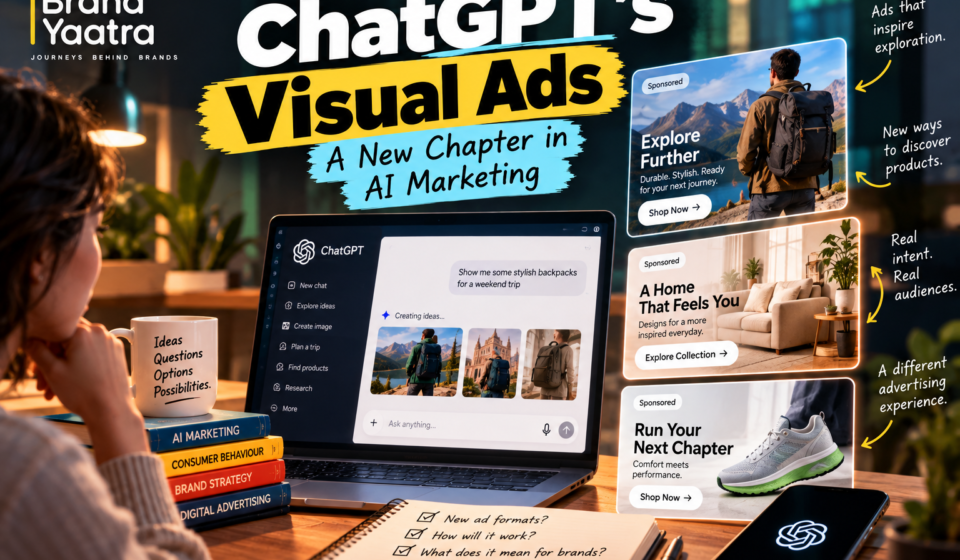

Imagine someone asking an AI assistant to help plan a weekend trip. They describe the destination, budget, preferred style of travel and the kind of experience they want.
In that conversation, a hotel, travel company or luggage brand might have an opportunity to reach them—not through a conventional search results page, but through an advertising experience built around visual product discovery.
That possibility is becoming more concrete.
On October 5, 2026, OpenAI announced a new visual advertising format for ChatGPT. The initial plan is to test ads during image generation in the United States later in October, with a selected group of advertisers. The ads are intended to help people discover products and imagine how they could fit into their lives.
This is an announcement about a new advertising format, not proof that it has already transformed consumer behaviour. But it raises a strategically important question for marketers:
What changes when advertising enters an experience where people are exploring ideas, asking questions and making decisions through AI?
What Has OpenAI Actually Announced?
OpenAI’s October 5 announcement introduces a visual ad format for ChatGPT, alongside expanded measurement tools, measurement partnerships and work on brand suitability.
The initial visual format is planned for testing during image generation. OpenAI says these ads will be clearly labelled and kept separate from the image being created. It also states that advertising does not influence the answers ChatGPT provides.
Those distinctions matter. The announced format should not be confused with an unrestricted ability for brands to insert products into every AI-generated image or pay to determine the substance of an answer.
OpenAI also described expanded measurement capabilities and partnerships intended to help advertisers understand campaign impact using familiar measurement systems. It highlighted work on attribution, incrementality and brand suitability.
These are early developments. The announcement does not establish how well the new format will perform across industries, how consumers will respond over time or whether visual advertising in AI will outperform established channels.
Why Visual Advertising in AI Is Interesting
Traditional digital advertising often competes for attention while people browse feeds, watch videos or scan search results.
AI conversations can begin differently. A person may arrive with a problem, a goal or an unfinished idea.
Consider three situations:
- Someone is exploring ways to redesign a small living room.
- A traveller is imagining a more comfortable long-distance journey.
- A shopper is trying to understand which kind of product fits their needs.
In each case, images can help people understand possibilities. A visual advertisement could show a product in use, communicate a style or help someone picture an experience.
The opportunity is not simply to put a product picture beside a chatbot. It is to make advertising useful at a moment when the person is exploring what they might want.
That is the strategic idea behind the format. Whether it works will depend on execution, relevance, trust and the actual experience users receive.
The Shift From Interrupting Attention to Supporting Discovery
Much of digital advertising has been built around capturing attention. A brand creates a headline, video or image designed to interrupt scrolling and earn a few seconds of consideration.
Discovery-led advertising has a different challenge. It needs to help a person understand a possibility, evaluate an option or move closer to a decision.
For example, a conventional luggage advertisement might say:
Travel smarter. Buy our new suitcase.
A discovery-oriented visual could instead help someone picture how a suitcase fits into a particular kind of journey, such as a short business trip or a family holiday.
The product still needs to earn consideration. A relevant image cannot compensate for an unsuitable product, an unconvincing offer or misleading claims.
But the creative task changes. Marketers need to think not only about what attracts attention, but also about what helps people make sense of a product.
Why Brand Visibility May Become More Complicated
AI-assisted discovery is already changing how marketers think about being found. When people use AI to research products, brands need clear information, credible evidence and a distinctive reason to be considered.
Our article on getting your brand mentioned in AI search results explores the organic visibility side of that challenge.
Visual advertising introduces a different question: how can a brand earn attention through a paid format inside an AI experience?
These are related, but they are not the same.
- Organic visibility concerns whether a brand or its information appears in relevant answers and discovery experiences without buying that placement.
- Paid visibility concerns whether a brand can reach relevant people through an advertising format.
- Brand preference concerns whether people have a reason to choose that brand once they understand their options.
A company could invest in advertising and still have weak product information. It could appear in an AI-generated recommendation and still fail to convert. It could attract a click and still be forgotten.
The strongest strategy treats visibility, product relevance and brand preference as connected challenges rather than interchangeable metrics.
Creative Strategy Will Need More Than Attractive Images
Visual advertising creates obvious creative opportunities, but attractive imagery is only the starting point.
A useful visual should communicate something meaningful about the product. It should help the audience understand the benefit, imagine the experience or recognise why the product might suit their needs.
For marketers developing creative for AI environments, four questions are worth asking.
1. What is the person trying to accomplish?
A product image is more useful when it connects to a real need. A brand selling ergonomic chairs should think about the working situations its customers face, not just the chair’s appearance.
2. What can the image communicate better than text?
Images can demonstrate appearance, scale, style, context and possible use. They should not be used to obscure important limitations or make claims that the product cannot support.
3. Does the creative make the brand distinctive?
If the visual could be used unchanged by five competing brands, it may be attractive without being memorable. Distinctive design, recognisable product details and consistent brand cues can help the creative build longer-term recognition.
4. Is the advertisement clearly distinguishable from the AI’s response?
People need to understand when they are seeing paid promotion. Clear labelling and separation between advertising and the assistant’s response are important to preserving trust.
Measurement Could Be More Important Than the New Format Itself
A new advertising placement can attract attention from marketers simply because it is new. That is not enough to justify a budget.
OpenAI’s announcement also discusses expanded measurement tools and partnerships. This is significant because advertisers need ways to understand whether exposure contributes to business outcomes.
Marketers should distinguish among several questions:
- Reach: Did the advertisement reach the intended audience?
- Engagement: Did people interact with the creative?
- Conversion: Did people complete a desired action after exposure?
- Incrementality: Did the advertising generate outcomes that would not otherwise have happened?
- Brand impact: Did it improve awareness, consideration or preference among relevant audiences?
These measures answer different questions. A campaign can generate clicks without generating incremental sales. A campaign can influence brand consideration without producing an immediate purchase.
Where possible, advertisers should use appropriate experiments and independent measurement methods rather than relying entirely on platform-reported attribution.
Early results reported by advertising partners can be useful signals, but they are not universal benchmarks. Results from selected advertisers should not be assumed to predict the performance of every business or industry.
What About Brand Safety and User Trust?
Advertising in an AI conversation creates a different context from placing an advertisement beside a web page or video.
Conversations can cover sensitive personal circumstances, complex decisions and topics where commercial influence may be inappropriate. The placement of an advertisement therefore matters alongside the advertisement itself.
OpenAI says it is developing brand suitability approaches and working with independent measurement partners to evaluate its safeguards. It has also stated that advertising does not influence ChatGPT’s answers and that ads remain separate from the image being created in the announced visual format.
These are stated design principles and planned safeguards, not a guarantee that every possible placement or measurement challenge has been solved.
Advertisers should ask practical questions before committing significant budgets:
- Where can the advertisement appear?
- How is it labelled to users?
- What controls exist for unsuitable contexts?
- What reporting and measurement are available?
- How can the advertiser assess the quality of the audience and the resulting outcomes?
In a new channel, transparency and measurement discipline are part of the buying decision—not details to consider after a campaign has launched.
What Should Indian Marketers Do Now?
The initial visual ad test announced by OpenAI is planned for the United States. Indian marketers should not assume that the same format is already available to them or that its eventual rollout, eligibility and pricing will be identical across markets.
There are still useful preparations brands can make without buying into an unproven channel.
Improve product information
Make product descriptions specific, accurate and easy to understand. Ensure that claims, specifications, variants, prices and availability are consistent wherever customers encounter the brand.
Build a stronger library of useful creative
Develop visual assets that show products in meaningful contexts. Prioritise clear demonstrations and distinctive brand cues over generic imagery that could belong to any competitor.
Separate paid discovery from organic visibility
Do not treat an advertising placement as proof that a brand is organically recommended by AI. Track the two activities separately so that the team can understand what each contributes.
Set measurement requirements before testing
Define what success would mean before launching a campaign. Depending on the objective, that might include qualified visits, incremental conversions, new customers or a measurable change in brand consideration.
Start with a focused experiment when access becomes available
Rather than moving a large budget immediately, test the format against a clear objective and a sensible comparison. Evaluate the results in context, including the quality of the audience, the cost of outcomes and any effect on existing campaigns.
What This Announcement Does Not Prove
It is easy to turn a new advertising feature into a sweeping prediction about the future of marketing. The evidence does not justify that yet.
The announcement does not prove that visual AI ads will outperform search advertising, that consumers will prefer them, or that brands will soon be able to purchase their way into AI-generated answers.
It also does not mean conventional advertising is becoming irrelevant. Search, social media, video, retail media and other channels continue to serve different audience needs and campaign objectives.
The meaningful development is narrower—and more useful: a major AI platform is expanding its advertising formats while investing in measurement and brand suitability. That creates a new area for marketers to evaluate as it develops.
Frequently Asked Questions
What are ChatGPT visual ads?
They are a visual advertising format announced by OpenAI on October 5, 2026. The initial test is planned during image generation in ChatGPT, with ads clearly labelled and separate from the image being created.
Will ChatGPT ads influence its answers?
OpenAI states that advertising does not influence the answers ChatGPT provides. Marketers should distinguish this stated principle from the separate question of how individual advertising placements perform.
Can Indian businesses advertise through the new visual format?
The announcement described an initial test in the United States later in October 2026. Businesses should check current advertiser eligibility and availability rather than assuming the visual format is already available in India.
Should brands change their marketing strategy because of this announcement?
They should monitor the format and prepare strong product information, creative assets and measurement plans. Major budget shifts should wait for relevant availability and credible performance evidence.
The Brand Yaatra Takeaway
The interesting part of ChatGPT’s new visual advertising format is not simply that another platform may sell ad space.
It is that advertising is beginning to develop inside experiences built around exploration, questions and decisions—not just feeds, pages and search results.
That creates a new creative opportunity, but it also raises familiar marketing challenges: relevance, differentiation, trust and measurement.
For now, the right response is neither to dismiss the format nor to declare it the future of advertising.
Watch how it develops. Understand the safeguards and measurement options. Test it when it becomes relevant and available. And judge it by the value it creates—not by the excitement surrounding its launch.
New advertising formats create opportunities. Good marketing still has to give people a reason to care.
Sources and Further Reading