
A chocolate malt drink and the NBA might not seem like an obvious marketing combination at first.
One belongs to the everyday world of breakfast, family routines and grocery shelves. The other is a global sports property built around elite athletes, competition, entertainment and passionate fans.
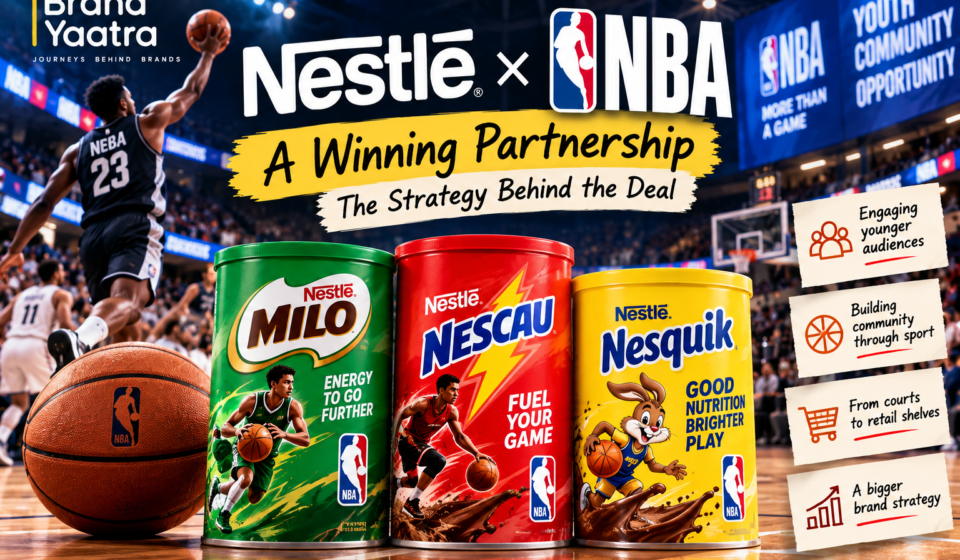
But on 7 October 2026, Nestlé and the National Basketball Association announced a multiyear international marketing partnership that brings these worlds together. Nestlé brands Milo, Nescau and Nesquik will become official NBA partners across 21 markets on four continents, with the agreement scheduled to begin on 1 January 2027.
Nestlé described it as its largest international brand collaboration to date. The announced programme includes youth basketball development initiatives, fan experiences, retail promotions and packaging featuring NBA branding.
The interesting marketing question is not simply why a food company wants to associate itself with a famous sports league.
It is this: How can a brand become more relevant to a new generation by participating in something its audience already cares about?
The Strategy Is Bigger Than Putting a Logo on a Basketball Court
Sports sponsorship is often reduced to visibility. A brand pays to appear on signs, jerseys, broadcasts or promotional material, and hopes that repeated exposure will improve awareness.
Visibility matters, but a partnership can offer much more when it is built around activities that audiences can actually experience.
According to the official announcement, the Nestlé–NBA collaboration will extend beyond branding to selected youth basketball programmes and platforms, including Jr. NBA/Jr. WNBA, NBA Basketball School, Coaches Academies, Her Time To Play and NBA 3X. It will also include selected NBA events, fan engagement platforms, retail programmes and on-pack promotions.
That creates several possible points of contact between the brands and consumers:
- A young person participates in a basketball development activity.
- A family encounters a promotion while shopping.
- A fan sees NBA branding on a familiar product.
- A consumer has an opportunity to engage with the sport through an event or promotion.
These activities are not equivalent, and the announcement does not yet demonstrate their results. But together they illustrate a more complete sponsorship strategy than simply buying a logo placement.
Why These Three Nestlé Brands?
The partnership covers Milo, Nescau and Nesquik. They share a broad connection to cocoa and malt drinks, but their roles and local recognition differ across markets.
That matters because a global partnership does not need to use one identical brand everywhere. The announced agreement spans markets including Australia, Brazil, Canada, France, Germany, Indonesia, Malaysia, Mexico, Nigeria, Singapore, Thailand, the United Kingdom, the United States and Vietnam, among others.
In different markets, different Nestlé brands can be the most familiar entry point for consumers. The company can use one major sports platform while activating the brands that make sense locally.
This is an example of a useful distinction in international marketing:
Consistency at the platform level does not require identical execution in every market.
A global partnership can supply a common idea, shared assets and a recognisable association. Local teams still need to decide how to make that association relevant to their consumers and retail environments.
Why Basketball Can Help a Consumer Brand Build Relevance
Consumers do not encounter brands only when they are comparing product features. They also encounter them through entertainment, communities, hobbies and shared experiences.
Basketball offers a cultural setting in which brands can participate in moments that already matter to fans and families.
For a consumer brand, that can create three opportunities.
1. Reach people through an existing interest
Sports audiences have a reason to pay attention before a sponsor enters the picture. Their interest in the game, athletes, teams or community creates a context for brand communication.
That does not guarantee that fans will care about the sponsor. The brand still needs a credible connection to the experience.
2. Connect product use with a broader occasion
A packaged drink is an everyday product. Basketball can provide a setting for conversations about activity, family participation and shared routines.
The challenge is to make that connection believable. A partnership becomes less convincing when the brand simply borrows sports imagery without offering anything meaningful to fans.
3. Create experiences that can be repeated
A single advertisement has a limited window of attention. A partnership can create multiple interactions across events, retail, promotions and community programmes.
Repeated experiences give the brand more opportunities to become familiar, provided the activations remain relevant and useful.
The Youth Engagement Angle—and Why It Needs Care
Nestlé and the NBA have positioned the partnership around engaging fans and inspiring youth participation in basketball. Selected youth programmes and development platforms form part of the announced plan.
That gives the partnership a purpose beyond product visibility: helping create opportunities for young people and families to participate in sport.
However, marketers should be careful not to treat participation messaging as automatic evidence of health benefits or improved brand perception. The announcement describes intended activities and objectives; it does not yet establish measurable outcomes.
There is also an important responsibility when food and beverage brands communicate around young audiences. Marketing should not imply that a product alone makes someone athletic, healthier or more successful. Claims about nutrition and performance need to be accurate, appropriate to the product and supported by evidence.
The strongest execution will be one where the partnership creates genuine sporting opportunities and communicates the products responsibly.
The Retail Connection Is Just as Important as the Sponsorship
Sports sponsorship can generate awareness, but the path from awareness to purchase is not automatic.
Nestlé’s announcement includes retail programmes, NBA-branded packaging and opportunities for consumers to win tickets, merchandise and other prizes.
These elements connect the partnership to the place where many purchasing decisions occur: the store.
Consider the journey:
- A consumer sees NBA content or takes part in a basketball-related activity.
- The partnership makes the Nestlé brand more recognisable in that context.
- The consumer later encounters the product in a retail setting.
- Packaging or a promotion provides a further reminder of the association.
This journey is a strategic model, not a result that has already been measured for the new partnership. Whether it changes buying behaviour will depend on execution, product preference, availability, price and many other factors.
The lesson is that a sponsorship becomes commercially more coherent when the brand plans for the transition from audience engagement to an appropriate purchase opportunity.
One Global Platform, Different Local Meanings
A partnership spanning 21 markets cannot assume that every audience follows basketball in the same way or gives every participating brand equal attention.
The local context matters.
In one market, basketball development programmes may be the strongest way to build a connection. In another, fan experiences or retail promotions may be more relevant. The participating Nestlé brand may also differ by market.
This is where international marketing becomes more than translating the same advertisement into different languages.
Global consistency can make a campaign recognisable. Local relevance helps it make sense.
For marketers, the useful question is not simply, “Can we run the same campaign everywhere?” It is, “Which parts of the idea should remain consistent, and which parts must change to reflect local behaviour?”
What Should Nestlé Measure?
The partnership has been announced, but its performance should be evaluated through evidence gathered after activation begins.
Useful measures could include:
- Brand awareness: Does recognition change among the audiences the partnership is intended to reach?
- Brand consideration: Does the association influence whether consumers consider the participating brands?
- Participation: How many people engage with the selected basketball activities, and how meaningful is that participation?
- Retail performance: Do relevant products or promotions show measurable changes compared with an appropriate baseline?
- Incremental impact: Can the company distinguish the partnership’s contribution from seasonality, distribution, pricing and other marketing activity?
- Local effectiveness: Which activations work best in which markets, and why?
Reach and impressions can show the scale of exposure, but they do not by themselves prove that the partnership changed attitudes or sales.
A rigorous evaluation would compare outcomes with suitable baselines or control groups where feasible. It would also separate the performance of individual activations rather than assuming that every part of a large partnership contributes equally.
What Other Brands Can Learn From the Deal
Lesson 1: Choose a platform that fits the audience
A famous property is not automatically the right partner. The audience, geography, brand positioning and intended outcome should all make sense together.
Lesson 2: Build activities around the association
A logo placement creates visibility. Experiences, retail programmes and community activities give the audience additional ways to encounter the partnership.
Lesson 3: Plan the path to purchase
Awareness and sales are different outcomes. If commercial impact matters, the strategy needs an appropriate bridge between audience engagement and product availability.
Lesson 4: Let local teams make the idea relevant
Global consistency is useful, but the strongest execution accounts for differences in consumer behaviour, local brand familiarity and retail conditions.
Lesson 5: Do not confuse the announcement with the result
A large partnership is a strategic commitment, not proof of success. The meaningful evaluation begins when the programme runs and credible performance data becomes available.
Frequently Asked Questions
What is the Nestlé–NBA partnership?
Announced on 7 October 2026, it is a multiyear international marketing partnership making Milo, Nescau and Nesquik official NBA partners across 21 markets on four continents. It is scheduled to begin on 1 January 2027.
What will the partnership include?
The announced plans include selected youth basketball programmes, fan engagement activities, NBA events, retail programmes, on-pack promotions and opportunities to win NBA-related prizes.
Why is this partnership important for marketing?
It shows how a consumer brand can use a global sports platform to connect audience engagement, local activations and retail opportunities within one partnership strategy.
Has the partnership already increased sales or brand awareness?
No results from the newly announced partnership have been established in the announcement. It is scheduled to begin in 2027, so claims about its commercial impact should wait for credible post-launch evidence.
The Bigger Lesson: A Partnership Must Give People More Than a Logo
The Nestlé–NBA deal is interesting because it is designed to connect a global sports property with everyday consumer brands through more than one channel.
The NBA brings a sports platform and fan engagement opportunities. Nestlé brings brands with local market presence. The announced programme connects those assets through youth participation, events, retail promotions and packaging.
Whether that strategy succeeds will depend on what happens after the announcement: how relevant the activations feel, how responsibly the brands communicate, and whether the partnership creates measurable value for audiences and the business.
For other marketers, the lesson is straightforward.
Do not ask only how many people will see your logo. Ask what people will be able to experience, remember or do because your brand is part of the partnership.
Sources and Further Reading