
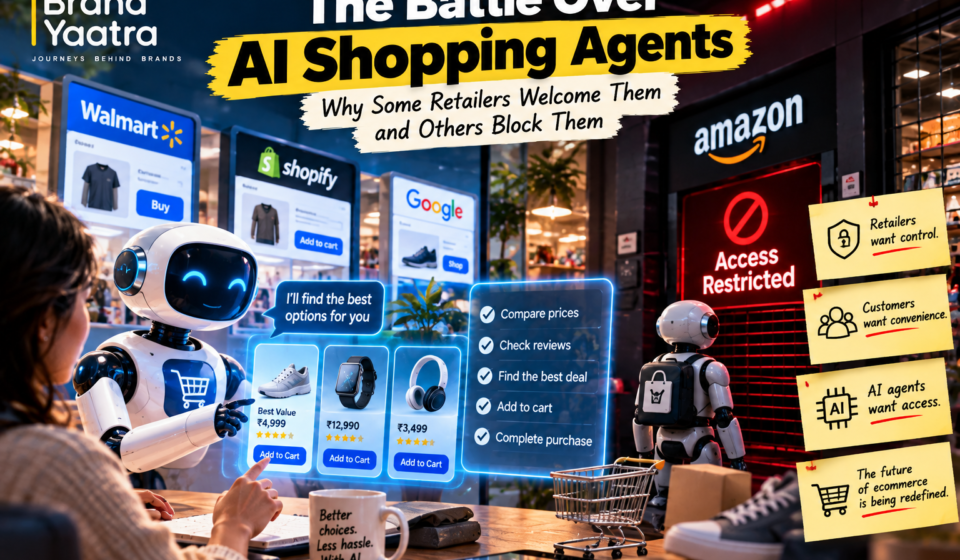

Imagine asking an AI assistant to find the best running shoes for your budget, compare the options, choose a size and complete the purchase.
For the customer, that sounds convenient. Instead of opening multiple websites, comparing dozens of products and navigating several checkout pages, an agent could do much of the work.
For a retailer, however, the same experience raises a difficult question.
If an AI agent chooses the product, controls the comparison and completes the purchase, what happens to the retailer’s relationship with the customer?
That question is becoming a real point of tension in ecommerce. Some retailers are experimenting with AI shopping integrations. Others are restricting or blocking third-party agents from accessing their websites or completing transactions.
Recent reporting has highlighted the contrast between Amazon’s restrictions on outside shopping agents and approaches from retailers and commerce platforms exploring ways to accommodate AI-assisted shopping.
This is not simply a technology dispute. It is a battle over discovery, data, customer relationships and the future role of the online store.
Why Would a Retailer Block an AI Shopping Agent?
At first glance, blocking a tool that could help customers buy products seems counterproductive. More convenient shopping should, in theory, make purchasing easier.
But a retailer’s website is more than a checkout page. It is also a place where the company presents products, communicates its positioning, recommends complementary items, collects customer signals and builds a relationship with shoppers.
An independent AI agent can potentially change who controls those interactions.
1. The retailer loses control over product discovery
Traditional ecommerce gives retailers considerable influence over how customers encounter products. They can organise categories, highlight collections, recommend items and explain the differences between alternatives.
An independent shopping agent introduces another decision-maker between the customer and the retailer.
The agent might shortlist only a few products from a much larger catalogue. It might compare price, specifications and reviews without displaying the retailer’s carefully designed merchandising experience.
That can be useful for shoppers, but it changes the retailer’s role. Instead of shaping the entire discovery journey, the retailer may become one of several suppliers evaluated by an external system.
2. The retailer may lose valuable customer signals
When a person browses a website directly, the retailer can learn from interactions such as searches, category visits, product comparisons and abandoned baskets, subject to applicable privacy rules and consent.
When an AI agent conducts much of that journey elsewhere, the retailer may receive less information about the customer’s original intent or decision process.
This matters because retailers use customer insights to improve product recommendations, understand demand and plan marketing activity.
The exact data a retailer receives will depend on the integration and transaction design. An agent-mediated purchase does not necessarily eliminate customer data, but it can change who sees what and who controls the interaction.
3. Existing business models may be disrupted
Retailers invest in advertising, merchandising, loyalty programmes and website experiences partly because those interactions can generate commercial value.
An AI agent that compares products across retailers may prioritise different criteria from the retailer’s own website. It might favour price, delivery speed, product specifications or a customer’s stated preferences rather than the retailer’s preferred cross-sell or promotional placement.
That creates a potential conflict between the retailer’s commercial objectives and the agent’s responsibility to help the shopper.
Retailers may therefore ask whether an external agent follows their access policies, protects customer information, respects transaction rules and provides enough transparency to support reliable purchases.
Why Some Retailers Are Opening the Door Instead
Blocking third-party agents is only one possible strategy. Other companies see AI shopping as an opportunity to reach customers through a new discovery channel.
Recent reporting has described different approaches across ecommerce, including integrations involving Walmart, Shopify and Google’s AI shopping experiences, while other retailers have chosen more restrictive policies.
These approaches are not identical. Some involve product discovery, while others can support more of the purchasing journey. But they illustrate a strategic choice: should a retailer try to keep the customer inside its own experience, or make its products accessible wherever customers choose to shop?
1. Access can create another route to customers
If shoppers begin product research through an AI assistant, a retailer that makes its products accessible to that experience may have an opportunity to be considered.
Restricting access could reduce that opportunity if the assistant cannot retrieve accurate information or complete the desired transaction.
That does not mean every retailer should allow every agent. It means access decisions can affect visibility in a changing discovery environment.
2. Better product data can improve discovery
AI agents need usable information to compare products. Product titles, specifications, sizes, availability, pricing, delivery details and return policies all influence whether an option can be evaluated accurately.
Retailers with clear and consistent product data may be better positioned to participate in agent-led shopping, provided the relevant platforms can access that information.
This makes product information a strategic marketing asset rather than a purely operational detail.
3. Retailers can shape the integration
Opening the door does not have to mean surrendering every part of the customer journey.
A retailer may choose to expose product information while retaining control over checkout, fulfilment, customer service or loyalty benefits. Another may use a platform integration that allows an AI assistant to initiate a purchase while the retailer’s own system manages the basket or transaction.
The right arrangement depends on the retailer’s economics, technology, customer expectations and the protections built into the integration.
The Bigger Conflict: Who Owns the Customer Relationship?
For years, ecommerce competition has focused on attracting people to a website or app and converting their visits into purchases.
AI agents could separate parts of that journey.
A customer might discover a product in one assistant, compare it through another service and complete the transaction through a retailer’s checkout. The retailer still fulfils the order, but it may not control every interaction that led to it.
This creates three competing interests.
- The customer wants useful recommendations, accurate information, convenience and control over the purchase.
- The AI agent needs access to relevant product information and a way to help the customer complete tasks reliably.
- The retailer wants sales, reliable transactions, customer relationships, useful data and control over its commercial experience.
These interests can overlap, but they do not always align.
A shopper may prefer an independent assistant that compares products across many retailers. A retailer may prefer an experience that keeps the customer within its own ecosystem. An AI platform may want to become the default starting point for product discovery.
The competition is therefore not only about who sells the product. It is also about who becomes the trusted intermediary between a customer’s need and the eventual purchase.
What This Means for Brand Visibility
For marketers, this shift creates a new challenge: being discoverable when a person is not necessarily browsing the brand’s website or even starting with a conventional search engine.
A retailer may have a strong website and still be poorly represented in an agent’s product comparisons if its information is incomplete, inaccessible or difficult to interpret.
That does not mean a brand can guarantee inclusion by adding a few keywords. AI shopping systems depend on their own access rules, product data sources, ranking or recommendation logic and transaction capabilities.
Brands should focus on the foundations they can control:
- Maintain accurate product titles, descriptions and specifications.
- Keep pricing, stock status and delivery information consistent.
- Explain product differences clearly rather than relying on vague superlatives.
- Make return policies, warranties and compatibility details easy to understand.
- Monitor how products appear in relevant AI-assisted discovery experiences where testing is possible.
Our article on AI becoming the product finder explores the broader implications of product discovery moving into AI-assisted experiences.
The key distinction is that product discoverability and permission to transact are separate issues. A retailer may allow an agent to read product information but restrict automated checkout. Another may permit a deeper integration. Marketers need to understand the specific rules of each platform rather than treating AI shopping as one uniform channel.
Four Risks Brands Should Not Ignore
1. Incorrect product information
If an agent receives outdated prices, incomplete specifications or incorrect availability, it can mislead the shopper even when the retailer’s own website is accurate.
Brands and retailers should establish clear product-data ownership and processes for keeping information current across channels.
2. Unclear responsibility when something goes wrong
If an automated purchase fails, customers need to know who is responsible for the transaction, refund, delivery or return.
Integrations should make those responsibilities clear rather than forcing customers to navigate between multiple companies.
3. Fraud, privacy and security concerns
Shopping agents may interact with websites, accounts and payment systems. Retailers need to consider authentication, permission boundaries, data handling and the possibility of automated abuse.
These concerns do not automatically justify blocking all agents, but they do make access controls and reliable technical standards important.
4. Becoming dependent on one discovery platform
A brand that receives too much of its visibility from a single AI platform could become vulnerable to changes in access, ranking, fees or product eligibility.
The sensible response is to treat AI-assisted shopping as a developing channel, not a reason to abandon direct customer relationships, existing search strategies or other routes to market.
What Should Ecommerce Marketers Do Now?
Marketers do not need to predict exactly which AI shopping model will win. They need to prepare their businesses to operate across different models.
Audit product data first
Check whether the product information available to external systems is complete, current and consistent. Prioritise the details customers need to compare products accurately.
Map access rules by platform
Determine which agents can access your catalogue, which can refer traffic and which can initiate or complete purchases. Do not assume that website access automatically includes permission to transact.
Protect the direct customer experience
Keep your own website, service experience, product information and customer support useful. AI discovery may introduce new routes to purchase, but a reliable post-purchase experience remains essential.
Test the quality of AI-driven traffic
Where analytics and privacy rules permit, assess the quality of visitors and transactions originating from AI-assisted discovery. Look beyond referral volume to conversion quality, returns, customer satisfaction and repeat purchases.
Decide what control your business needs
Some brands may benefit from broad distribution through external agents. Others may need stricter controls over pricing, fulfilment, customer data or brand presentation.
The choice should be based on the business model and customer experience, not simply on whether a technology is attracting attention.
Frequently Asked Questions
Why are some retailers blocking AI shopping agents?
Retailers may have concerns about security, data access, transaction reliability, customer relationships and the loss of control over product discovery. Their policies differ, and not every retailer blocks every type of AI tool.
Are all AI shopping agents blocked by retailers?
No. Retailers are taking different approaches. Some restrict third-party agents, while others are testing integrations or allowing selected AI-assisted shopping journeys.
How can brands prepare for AI shopping?
Maintain accurate product data, clarify access and transaction policies, test how products appear in relevant AI experiences and measure the quality of traffic and purchases where possible.
Will AI agents replace ecommerce websites?
That outcome is not established. AI agents may take over parts of product discovery or purchasing, but retailers still provide products, fulfilment, service and transaction infrastructure. The balance will depend on customer adoption and how the technology develops.
The Bigger Lesson: The Storefront May No Longer Be the Starting Point
The argument over AI shopping agents reveals a deeper change in ecommerce.
Retailers have spent years building websites, apps, loyalty programmes and advertising systems designed to attract customers directly. AI agents introduce the possibility that more customers will begin their shopping journeys somewhere else.
Some retailers will try to protect their existing experience. Others will experiment with new routes to discovery and purchase. Many will likely take different approaches depending on the product category, platform and customer need.
For marketers, the challenge is not simply to make a brand visible to AI. It is to understand how product discovery, customer trust and commercial control interact when an intermediary starts making more of the decisions.
The next ecommerce battle may not be fought only over who owns the storefront. It may be fought over who gets to choose which storefront the customer visits.
Sources and Further Reading