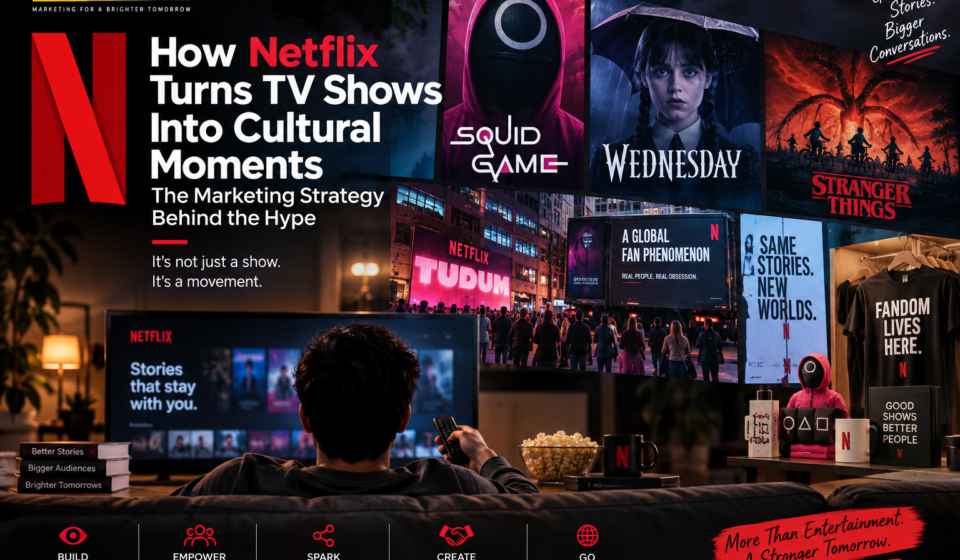
How Netflix Turns TV Shows Into Cultural Moments: The Marketing Strategy Behind the Hype

A new TV show can launch with millions of dollars behind it and still disappear within a week.
Then there is Netflix.
A show launches, people start talking about it, memes appear, social feeds fill up with clips, brands start joining the conversation, fans recreate scenes, and suddenly the show feels bigger than the screen it started on.
That is the interesting part.
Netflix isn’t simply marketing a TV show.
It is often marketing the world around the show.
That difference helps explain why titles such as Squid Game, Wednesday, Stranger Things and other Netflix properties can become cultural conversations rather than just entertainment products.
So what is Netflix actually doing?
Let’s break down the marketing strategy behind the hype.
Netflix Is Not Just Selling Content
The traditional entertainment model often looks relatively simple:
Create → Advertise → Release → Hope people watch.
Netflix has increasingly built a much broader ecosystem around its biggest titles.
The show itself becomes the centre of a much larger marketing system involving:
- Trailers and teasers
- Social media conversations
- Memes and short-form content
- Creators and celebrities
- Fan communities
- Live events
- Experiential marketing
- Brand partnerships
- Merchandise and products
- Games and interactive experiences
- Behind-the-scenes content
- News and editorial storytelling
The result is a powerful shift:
The show stops being only something people watch and becomes something people participate in.
1. Netflix Creates Anticipation Before the Show Arrives
One of the biggest mistakes marketers make is treating launch day as the beginning of marketing.
For Netflix, launch day can be the payoff of weeks or months of anticipation.
A teaser might reveal almost nothing.
A poster might introduce a character.
A short clip might create a question.
A release date announcement might become an event of its own.
Each piece gives people another reason to think about the title before they actually watch it.
This is important because attention is rarely created through one advertisement.
It is accumulated.
Small signals → curiosity → conversation → anticipation → launch.
By the time the show arrives, the audience may already feel familiar with its characters, world and story.
2. Netflix Understands That Fandom Is a Marketing Channel
This is probably one of the most important ideas behind Netflix’s modern marketing.
Fans aren’t just consumers.
They can become distributors of attention.
Think about what happens when someone becomes obsessed with a show.
- They share clips.
- They create memes.
- They discuss theories.
- They quote characters.
- They recommend the show.
- They make reaction videos.
- They recreate scenes.
- They argue about what happened.
Netflix doesn’t have to create every piece of this conversation itself.
Its job is often to give the audience something worth talking about.
This creates a very different marketing equation:
Brand content creates attention → fans create more content → more people discover the show → more people join the fandom.
The audience effectively becomes part of the distribution system.
3. Squid Game Shows What Happens When a Story Becomes an Experience
Squid Game is one of the clearest examples.
Netflix did not stop at promoting episodes.
The world of the show became something audiences could interact with.
For the final season in 2025, Netflix reported fan activations across more than 25 countries, with experiences inspired by the show’s games and visual identity.
The campaign extended into physical events, games, social content, partnerships and other experiences.
That matters because experiences create something advertising cannot easily reproduce:
participation.
Watching a commercial about a fictional game is one thing.
Actually participating in an experience inspired by that world is another.
The consumer is no longer simply seeing the marketing.
They are inside it.
4. Netflix Turns Distinctive Elements Into Brand Assets
Strong entertainment franchises often have recognisable visual and verbal assets.
Squid Game has its colours, symbols, masks and characters.
Stranger Things has its typography, characters, 1980s aesthetic and supernatural world.
Wednesday has a distinctive character, visual style and cultural identity.
These elements make the properties recognisable even when the Netflix logo isn’t present.
This is closely related to the concept of brand strategy.
The strongest brands don’t depend entirely on their names.
They build recognizable assets that trigger memory.
Netflix applies the same principle to entertainment franchises.
The more distinctive the world of a show becomes, the easier it becomes to create:
- Posters
- Social posts
- Merchandise
- Experiences
- Partnerships
- Memes
- Events
- Fan content
The fictional world becomes a marketing asset.
5. Netflix Gives Fans Reasons to Keep Talking
One piece of content can create attention.
A sequence of content can create momentum.
This is where Netflix’s editorial ecosystem becomes interesting.
Its Tudum platform provides news, interviews, behind-the-scenes stories, explainers, first looks and other content around Netflix titles.
Instead of letting the conversation end when someone finishes an episode, Netflix can give fans something else to consume.
They watch the episode.
Then they read about the episode.
Then they watch an interview.
Then they see a behind-the-scenes clip.
Then they discover another title.
Then they share something with a friend.
The entertainment experience becomes a loop.
Watch → Discuss → Discover → Share → Watch something else.
That is much more powerful than thinking of marketing as a single advertisement.
6. Netflix Uses Social Media to Amplify Conversations
Netflix has become particularly good at adapting its marketing to the culture of social platforms.
Instead of communicating like a traditional entertainment company all the time, its social content can feel native to the platform.
That means:
- Using humour
- Reacting to cultural moments
- Using short-form video
- Creating character-led content
- Releasing unexpected clips
- Encouraging fan reactions
- Working with talent
The objective isn’t always to explain the plot.
Sometimes the objective is simply to make people feel something.
Laugh.
Curiosity.
Shock.
Recognition.
FOMO.
Or the desire to send the post to someone else.
That is an important lesson for digital marketers:
Content designed for attention doesn’t always need to sell immediately.
Sometimes its job is to create the next conversation.
7. Netflix Makes Marketing Part of the Entertainment
This may be the biggest difference between Netflix and traditional advertising.
Instead of interrupting entertainment with marketing, Netflix can make the marketing itself entertaining.
A character appears in an unexpected setting.
A celebrity participates in a campaign.
A brand partnership extends the fictional universe.
A physical activation recreates part of the show.
A trailer becomes an event.
A release-date announcement becomes social content.
The boundary between content and promotion becomes much smaller.
And when marketing becomes entertaining, people have a reason to engage with it even when they aren’t actively planning to watch the show.
8. Netflix Turns Partnerships Into Cultural Distribution
Netflix also works with other brands to extend the reach of its biggest properties.
Partnerships can introduce a show to audiences who may not encounter Netflix’s own marketing channels.
For example, Netflix has used partnerships around major titles with brands across food, technology, retail, travel and consumer products.
This creates a simple but powerful effect:
One story gets multiple distribution networks.
Netflix brings the entertainment property.
The partner brings its audience.
Both brands get something to talk about.
And the fan gets another way to interact with the story.
This is why a good brand partnership isn’t simply about putting two logos next to each other.
It should create a reason for both audiences to care.
9. Netflix Thinks Globally, But Lets Stories Travel Locally
Another fascinating part of Netflix’s growth is its global approach.
A story doesn’t necessarily have to originate in Hollywood to become globally relevant.
Squid Game is a powerful example.
A Korean series became a worldwide cultural phenomenon.
Netflix has also invested heavily in stories from different countries and languages, creating a library that can travel across markets.
But global distribution does not mean every market receives exactly the same marketing.
Local creators, celebrities, cultural references, events and partnerships can make a global title feel relevant in a specific market.
This creates an important marketing principle:
Global scale works better when the story still feels locally relevant.
10. Netflix Doesn’t Just Market a Show. It Builds a World Around It.
Put all of this together and the strategy becomes clearer.
A traditional campaign might look like:
Advertisement → Awareness → View.
Netflix’s strongest entertainment campaigns can look more like:
Story → Characters → Curiosity → Conversation → Fandom → Experiences → Social sharing → Partnerships → More discovery.
The difference is enormous.
The first model treats marketing as communication.
The second treats marketing as an ecosystem.
The Netflix Marketing Flywheel
Here’s a simplified way to understand the system:
Great Story
↓
Distinctive Characters & World
↓
Curiosity & Anticipation
↓
Audience Watches
↓
Fans Talk & Create
↓
Social Conversation Grows
↓
Experiences & Partnerships Expand the World
↓
More People Discover the Story
↓
More Fandom
And then the loop starts again.
What Marketers Can Learn From Netflix
1. Don’t think only about the campaign
Think about the ecosystem around the campaign.
What happens before launch?
What happens after someone sees the content?
What gives them a reason to return?
2. Give people something worth talking about
Social media distribution becomes easier when the underlying idea is genuinely interesting.
Don’t begin with:
“What should we post?”
Begin with:
“What would make someone want to tell another person?”
3. Build distinctive assets
A memorable colour, character, phrase, visual style or recurring device can make content easier to recognise.
Consistency turns individual pieces of content into a larger identity.
4. Turn audiences into participants
Interactive experiences, challenges, communities, events and creator participation can make customers feel like participants rather than spectators.
5. Don’t separate brand and performance too aggressively
Some marketing creates immediate action.
Some creates memory.
Some creates conversation.
Some creates preference.
A strong marketing strategy understands how these jobs connect instead of expecting every piece of content to produce an immediate conversion.
Netflix’s Biggest Lesson: Attention Is More Valuable When It Compounds
The most interesting thing about Netflix’s marketing isn’t any single campaign.
It is the way multiple marketing activities reinforce each other.
A trailer creates curiosity.
Curiosity creates viewing.
Viewing creates conversation.
Conversation creates social content.
Social content creates discovery.
Discovery brings new viewers.
Fans then create even more conversation.
That is a marketing flywheel.
And it connects directly to the broader digital marketing funnel: awareness doesn’t have to be the end goal. It can be the beginning of a much longer customer journey.
Netflix has essentially learned how to turn entertainment into a distribution system for itself.
The show gets people watching.
The fandom gets people talking.
The ecosystem keeps the conversation alive.
And that is why the most successful Netflix titles can feel less like TV shows and more like cultural events.
Frequently Asked Questions
What is Netflix’s marketing strategy?
Netflix’s marketing strategy combines content promotion with social media, fandom, experiences, partnerships, distinctive brand assets and ongoing editorial content. The objective is not only to promote individual titles but also to create sustained audience attention around them.
How does Netflix use social media for marketing?
Netflix uses social platforms to distribute trailers, clips, memes, character content, announcements and culturally relevant content. It also uses social media to amplify conversations already happening among fans.
Why is Netflix marketing so effective?
A major reason is that Netflix often treats fans as participants in the marketing ecosystem. A successful show can generate conversations, memes, fan content, experiences and partnerships that extend the reach of the original content.
What can marketers learn from Netflix?
Marketers can learn to build anticipation, create distinctive assets, design content worth sharing, encourage participation and connect individual campaigns into a larger marketing ecosystem.
Is Netflix’s marketing strategy only about social media?
No. Social media is one part of a much larger system that includes content, product experience, events, partnerships, editorial content, advertising, fandom and physical experiences.
Final Thought
Netflix’s real marketing advantage isn’t simply that it knows how to advertise a show.
It knows how to give people a reason to care about the world around the show.
And once people care, they start doing some of the marketing themselves.
That is the difference between promoting content and building culture around it.