
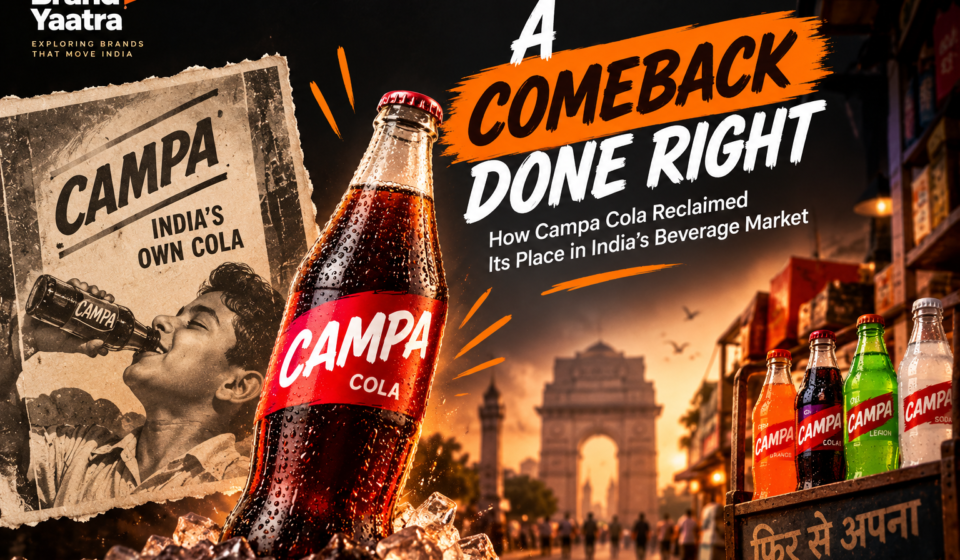
How Campa Is Bringing a Heritage Brand Back to Life: The Marketing Strategy Behind Its Revival

There are some brands people remember.
And then there are brands people remember remembering.
Campa belongs in the second category.
For many Indians, the name carries memories of an older India — a familiar bottle, a familiar taste and a brand that was once a serious name in Indian soft drinks.
Then it disappeared from everyday life.
Years later, Campa returned under Reliance.
But bringing back an old name is not the same thing as bringing back an old brand.
You can put a familiar logo on a bottle.
You can remind people of the past.
You can even create nostalgia.
But eventually, someone still has to pick up the bottle and buy it.
That is what makes Campa’s revival such an interesting marketing case study.
The challenge wasn’t simply:
“How do we make people remember Campa?”
The much harder question was:
“How do we turn an old memory into a modern reason to choose the brand?”
And the answer involves much more than nostalgia.
The Campa Story: From Heritage Brand to Modern FMCG Play
Campa became part of Reliance’s consumer-products portfolio as the company expanded aggressively into FMCG.
Reliance’s FY2022–23 reporting identified Campa among the brands acquired as the company built its consumer-products portfolio.
By 2023, Reliance was already describing the relaunch around the promise of “Great Indian Taste” and discussing plans to scale Campa across India and eventually into international markets.
That tells us something important.
The strategy was never simply to preserve Campa as a nostalgia product.
The ambition was to turn the heritage name into a scalable consumer brand again.
That requires a different approach.
You need the memory of the old brand.
But you also need a reason for today’s consumer to care.
Nostalgia Gets Attention. It Doesn’t Finish the Job.
Nostalgia is powerful because it can make an old brand feel emotionally familiar.
Someone who remembers Campa may not need to be introduced to the name.
There is already some mental history attached to it.
That gives a heritage brand something a new entrant doesn’t have:
pre-existing memory.
But memory creates an interesting problem.
The person remembering the original Campa is not necessarily the person who will drive the brand’s future growth.
There are younger consumers who may have no personal memory of the original brand.
For them, “Campa” is simply another beverage name.
That means the revival has to operate on two levels:
| Existing consumers | New consumers |
|---|---|
| “I remember this.” | “What is this?” |
| Nostalgia | Discovery |
| Familiarity | Relevance |
| Memory | New associations |
That is the real marketing challenge.
A heritage brand cannot live entirely in the past.
1. Campa Had Something New Brands Spend Years Building
Most new beverage brands begin with almost nothing in the consumer’s memory.
They have to build:
- awareness
- recognition
- associations
- trial
- repeat purchase
- brand meaning
Campa did not start from zero.
The name already existed in Indian consumer memory.
That does not guarantee success.
But it changes the starting point.
In brand strategy, accumulated memory can be valuable because consumers do not have to learn an entirely new name from scratch.
This connects with a broader principle we explored in our article on distinctive brand assets: recognition is an asset that can accumulate over time.
Campa had something similar at the brand-name level.
The challenge was turning that memory into contemporary relevance.
2. The Brand Wasn’t Relaunched as a Museum Piece
This is one of the most interesting parts of the strategy.
A heritage brand has two obvious choices.
It can lean heavily into the past:
“Remember how things used to be?”
Or it can almost completely ignore the past:
“Forget everything you knew. We’re a completely new brand.”
Neither approach is particularly easy.
The first risks making the brand relevant mainly to older consumers.
The second throws away some of the very memory that makes the heritage name valuable.
Campa’s revival is more interesting because it appears to use the past as an entry point while building a much larger present-day consumer business around it.
That includes new products, broader distribution, sports associations, regional variants and large-scale marketing.
The heritage gives the brand a story.
The modern business gives it a future.
3. Distribution Is Part of the Marketing Strategy
This is where many brand revival stories become too focused on advertising.
A brand can create enormous awareness and still fail if consumers cannot find it.
In FMCG, availability matters enormously.
If someone sees Campa today and decides:
“I’ll try it.”
the next question is:
“Where can I buy it?”
Reliance has invested heavily in distribution as part of its consumer-products expansion.
Its FY2025–26 reporting says RCPL had reached more than 3 million outlets through more than 5,000 distributors.
That figure refers to RCPL’s broader consumer-products distribution rather than Campa alone, so it should not be interpreted as three million Campa outlets.
But it shows the scale of the distribution infrastructure supporting the portfolio in which Campa operates.
And this is strategically important.
Marketing creates desire.
Distribution turns desire into availability.
Availability creates the opportunity for trial.
Trial creates the opportunity for repeat purchase.
So the actual chain looks more like:
Awareness → Availability → Trial → Experience → Repeat → Memory
Advertising is only one part of that system.
4. Reliance Added Scale to the Heritage
Campa’s revival also sits inside a much larger strategic move.
Reliance Consumer Products has been building a broad FMCG portfolio across beverages, staples, packaged foods and home and personal care.
Its FY2025–26 reporting says RCPL generated approximately ₹22,000 crore in gross revenue, while Campa itself generated more than ₹4,700 crore in gross sales during the year.
Again, these are company-reported figures.
The important marketing lesson isn’t simply the size of the number.
It is what scale makes possible.
Large distribution.
Manufacturing investment.
Retail relationships.
Digital commerce.
Advertising.
Sports partnerships.
Regional marketing.
New product development.
A heritage brand suddenly has access to infrastructure that its earlier incarnation did not have in the same way.
That changes the economics of a revival.
5. Campa Is Being Reintroduced Through Culture, Not Just Advertising
One of the clearest patterns in Reliance’s recent Campa activity is the use of cultural and sporting moments.
Its reporting highlights activations around cricket, including Campa Energy’s IPL activity and other beverage campaigns connected to major sporting occasions.
Reliance has also described regional campaigns for products such as Campa Power Up in Andhra Pradesh and Telangana and Purple Energy in Tamil Nadu.
This is important because a national brand does not necessarily need one identical communication strategy everywhere.
India is culturally diverse.
Language, entertainment, sports, food and local identity can all influence how brands become relevant.
A national brand can therefore combine:
- one broad brand identity
- regional products
- local language
- local cultural cues
- national events
- mass distribution
That gives the brand both scale and local relevance.
6. The Product Portfolio Is Doing More Than the Original Cola Could
Another interesting part of the revival is that Campa is no longer simply a story about one cola.
Reliance has expanded the Campa portfolio into different beverage occasions and products.
That includes products such as Campa Energy and other variants introduced over time.
This changes the strategic question.
Instead of asking:
“How do we make people buy Campa Cola?”
the broader question becomes:
“How can Campa become relevant across more drinking occasions?”
That matters because a brand with multiple relevant occasions has more opportunities to enter consumers’ routines.
And once a brand becomes part of behaviour, it is no longer relying only on advertising memory.
The product itself starts creating the association.
7. Price and Value Matter More Than Nostalgia
There is another part of the Campa story that is easy to miss.
Reliance has repeatedly described its broader consumer-products strategy around providing global-quality products at Indian prices.
That is particularly relevant in categories where consumers can switch between many alternatives.
A consumer may remember Campa.
They may enjoy the advertising.
They may be curious about the comeback.
But eventually they compare:
- taste
- price
- availability
- pack size
- occasion
- brand familiarity
- alternatives
Nostalgia can create the first purchase.
Value and product experience have to help create the next one.
That distinction is important for marketers.
Emotion can open the door. The product still has to keep people inside.
8. Campa Is Turning the Comeback Into a New Brand Story
A successful revival cannot remain a history lesson forever.
If every piece of communication says:
“Remember us?”
the brand eventually becomes trapped in its own past.
The more interesting strategy is:
“You may remember us. Now see what we’re becoming.”
That creates a bridge between generations.
Older consumers get recognition.
Younger consumers get discovery.
The brand gets permission to evolve.
This is one reason heritage brands can be strategically interesting.
The past supplies credibility or familiarity.
The present supplies relevance.
The future supplies growth.
What Campa’s Revival Tells Us About Heritage Brands
Campa is part of a broader marketing problem that many old brands eventually face.
How do you revive something people remember without simply recreating something that no longer fits the market?
The answer is rarely “bring back the old logo and advertise it heavily.”
A stronger approach is to rebuild the entire system around the heritage:
| Brand challenge | Strategic response |
|---|---|
| People remember the brand | Use that memory as an entry point |
| Younger consumers don’t know it | Build new associations |
| Consumers need access | Build distribution |
| One product limits occasions | Expand the portfolio |
| National brands can feel distant | Use regional and cultural relevance |
| Nostalgia creates curiosity | Let the product create repeat purchase |
The Campa Marketing Flywheel
Put the pieces together and the strategy starts to look less like a nostalgia campaign and more like a growth system.
Heritage
↓
Recognition
↓
Modern Product Portfolio
↓
Distribution
↓
Availability
↓
Trial
↓
Product Experience
↓
Repeat Purchase
↓
New Brand Memory
↓
Stronger Brand
And then the cycle starts again.
This is why Campa’s revival is more interesting than simply saying:
“Nostalgia works.”
Nostalgia is only one input.
The rest of the marketing system has to make the brand commercially relevant.
What Marketers Can Learn From Campa
1. Don’t confuse recognition with relevance
People remembering your brand is useful.
It doesn’t automatically mean they want to buy it today.
2. Heritage is an asset, not a complete strategy
The past can give you a story.
It cannot replace product quality, distribution, pricing or relevance.
3. Distribution is marketing
If consumers cannot find the product, awareness has nowhere to go.
4. Build for people who don’t remember you
A heritage brand needs to attract the next generation, not only reconnect with the previous one.
5. Give nostalgia somewhere to go
The strongest revival isn’t simply:
“Remember this?”
It is:
“Remember this? Here’s why it belongs in your life today.”
6. Let the product prove the marketing
A campaign can create curiosity.
The product experience determines whether curiosity becomes behaviour.
Campa vs. the Bigger Brand Revival Question
Campa’s story also connects with a larger principle of brand strategy.
A brand isn’t simply a name, logo or advertising campaign.
It is the collection of associations people build through repeated experiences.
That means a revival has to rebuild more than awareness.
It has to rebuild meaning.
And that meaning has to be supported by what the customer actually experiences.
This is also why consistency matters. As we explored in our analysis of distinctive brand assets, recognition becomes more valuable when consumers repeatedly connect brand cues with the same brand.
A heritage brand therefore has an unusual advantage:
It may already have some memory.
But it also has an unusual responsibility:
it has to decide what that memory should mean now.
The Bigger Lesson
Campa’s comeback is easy to describe as a nostalgia story.
But that explanation is too small.
The more interesting story is about turning old memory into new behaviour.
Reliance inherited a brand name with historical recognition.
Then it brought that name into a much larger FMCG system involving distribution, product expansion, sports and cultural marketing, regional relevance and large-scale execution.
The result, according to Reliance’s FY2025–26 reporting, is a Campa business generating more than ₹4,700 crore in gross sales.
Whether that trajectory continues will depend on the things that matter after the relaunch excitement fades:
- product experience
- availability
- pricing
- repeat purchase
- brand relevance
- competitive pressure
- long-term consumer memory
And that is the real lesson.
Bringing back a brand is easy compared with making people choose it again.
Campa had history.
The challenge was turning that history into a reason for the present.
That is what makes its revival worth watching.
Frequently Asked Questions
What is Campa’s marketing strategy?
Campa’s current strategy combines heritage and recognition with modern product expansion, broad distribution, value positioning, sports and cultural marketing, and regional activation. Reliance is building Campa as part of a much larger consumer-products business rather than treating it purely as a nostalgia brand.
Why was Campa brought back?
Reliance acquired Campa as part of its expansion into consumer products and began scaling the brand again. The company has described Campa as part of its broader beverage strategy and has expanded the portfolio beyond the original cola proposition.
How does nostalgia help a brand like Campa?
Nostalgia can provide existing consumers with familiarity and recognition. However, nostalgia alone does not guarantee repeat purchase. A revived heritage brand still needs relevant products, competitive value, availability and a reason for newer consumers to care.
What can other heritage brands learn from Campa?
Heritage can be used as a starting advantage, but the brand needs to evolve. The strongest revival strategy connects historical memory with present-day product relevance, distribution, cultural relevance and consistent brand building.
Is Campa’s ₹4,700 crore figure revenue?
Reliance’s FY2025–26 reporting describes Campa’s figure as more than ₹4,700 crore in gross sales. It should not be confused with net revenue or profit, and it is a company-reported figure.
Sources & Further Reading
This article uses company disclosures and contemporary marketing-industry reporting for factual verification. Strategic interpretations are Brand Yaatra’s analysis of those documented actions.
- Reliance Industries — Integrated Annual Report 2025–26
- Reliance Industries — FY2025–26 Consumer Products / Investor disclosures
- Reliance Industries — 2023 Annual Report and shareholder communications on Campa
- Exchange4media — reporting on Campa’s brand revival and marketing activity
Brand Yaatra Takeaway: A heritage brand gives you a head start in memory. It does not give you a shortcut to relevance.