
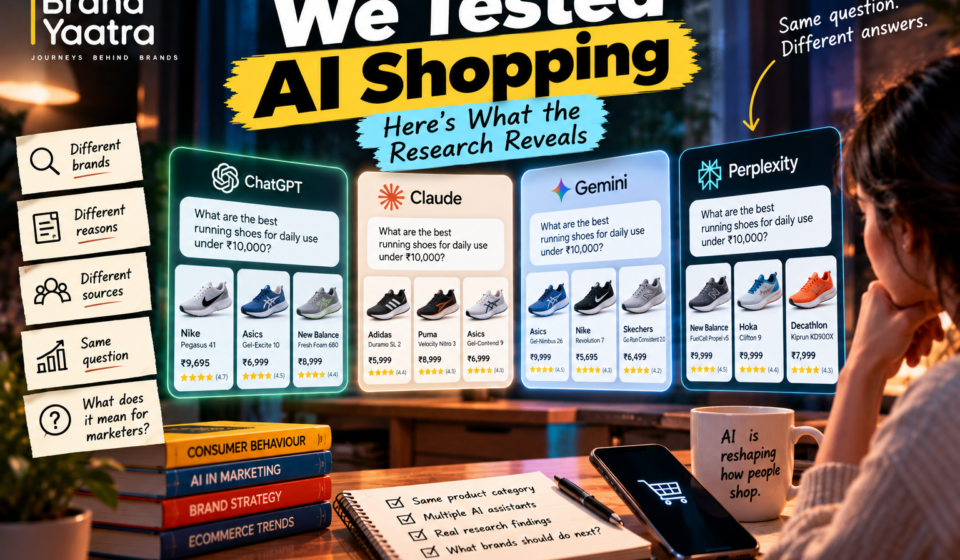

Imagine two shoppers asking an AI assistant to recommend a fitness watch. They have the same budget, the same needs and access to the same products.
Now imagine the assistant sees a different review, encounters a different recommendation first, or receives a slightly different piece of information about the shopper.
Could those small changes influence which product it chooses?
Research from the University of Pennsylvania’s Wharton Generative AI Labs suggests the answer can be yes. In a study involving roughly 26,000 tests, researchers found that AI shopping agents’ choices could shift when they encountered additional information, competing sources, different source orders or injected user preferences.
That finding matters to marketers because product discovery is changing. Consumers are increasingly using AI to compare options, understand trade-offs and shortlist brands before visiting a retailer.
The challenge is no longer just getting a product onto a search results page. It is understanding how a product becomes a recommendation in the first place.
What did the research actually test?
The Wharton research report, Agentic Shopping Is Complicated and Contingent, examined how AI shopping agents make product choices under different information conditions.
The researchers used a simulated shopping task in which an agent selected a fitness watch from a grid of eight products. They then changed the information available to the agent, including screenshots of reviews and recommendations from sources such as Reddit, Wirecutter and The Strategist.
The study tested six frontier models across several conditions, with repeated runs to measure how choices changed. It did not simply ask an AI once which product it liked. It examined what happened when the information surrounding the decision changed.
That distinction is important. A single recommendation tells us what an AI selected in one situation. Repeated tests can reveal whether that selection remains stable when the decision environment changes.
Finding 1: One source can change the recommendation
When the models saw only a product grid, individual models tended to settle on particular products. But introducing a review or recommendation from an external source could shift the choice.
In one reported condition, a screenshot featuring Wirecutter’s recommendation moved Google’s Gemini 3.5 Flash model towards the Fitbit Inspire 3 in essentially every run, a shift of approximately 99 percentage points from its baseline choice.
The result was not identical across every model. Some responded differently to the same source, which is precisely why the researchers’ repeated testing matters.
The marketing implication: a brand’s own product page is only one part of the information environment. Independent reviews, editorial recommendations and other credible references may influence what an AI system considers when comparing products.
This does not prove that a specific publication will make every AI recommend a particular brand. It shows that external information can matter under the conditions tested.
Finding 2: More information does not automatically produce a fairer comparison
It might seem reasonable to expect an AI assistant to balance several sources and select the product supported by the strongest overall evidence.
The Wharton experiments suggest that this is not always how the process works. When researchers introduced multiple sources pointing towards different products, the agents did not consistently average the recommendations. Which source had the strongest influence varied by model and source combination.
In other words, adding more information did not necessarily make the final choice more predictable.
For marketers, this challenges a tempting assumption: that publishing more content automatically increases the likelihood of being recommended.
Content quality, relevance and credibility still matter. But a growing pile of pages is not a guarantee of influence. Brands need to understand which information is useful to customers, which sources are credible in their category, and whether their product claims are clear and consistent.
Finding 3: The order of information can matter
The researchers also changed the order in which sources appeared. The underlying sources remained the same, but their sequence changed.
Some models continued to select the same product. Others changed their choices depending on the order of the sources they encountered.
This is a crucial limitation for anyone treating an AI recommendation as a permanent ranking of the best products.
A result observed in one run may not represent a universal preference. It may reflect a particular model, a particular information path and a particular set of conditions.
For brands monitoring AI visibility, this means one screenshot is not a reliable performance benchmark. A meaningful evaluation needs repeated queries, consistent measurement rules and records of what changed between runs.
Finding 4: Personal context can redirect product choice
Another experiment introduced a short statement of user preference into the decision context. The researchers tested whether that information would influence which fitness watch the agent selected.
For several models, the injected preference changed the choice. The effects differed across models, and the study reported that some agents could be redirected even in a condition where one product was objectively superior on price, rating and review count.
This does not mean personalisation is inherently bad. A shopper who enjoys hiking may genuinely benefit from a watch designed for outdoor activity.
The more important question is whether the assistant is using relevant, trustworthy information to serve the shopper’s needs—or whether irrelevant or misleading context is pushing it towards a poor choice.
For marketers, the lesson is not to manipulate a customer’s profile. It is to make product attributes, use cases, compatibility and limitations easy to understand, so a recommendation can be matched to a real need.
A second signal: AI shopping recommendations are becoming a retail battleground
The Wharton findings examine how recommendations can change within a controlled shopping simulation. Separate reporting suggests that retailer recommendations are also becoming commercially significant.
In an October 2026 analysis reported by MarketWatch, UBS analyst Michael Lasser tested 12 shopping-related prompts across ChatGPT, Claude, Gemini and Muse in New Jersey, New York and Minnesota.
The analysis found that Walmart was frequently recommended across shopping needs, while Costco was prominent for value and bulk purchases. Other retailers appeared in contexts where their propositions fit the task, such as Aldi for low grocery prices and Dick’s Sporting Goods for athletic equipment.
Read the reported UBS analysis via MarketWatch.
This is a different kind of evidence from the Wharton experiments. The UBS analysis looked at retailer recommendations across a limited set of shopping prompts and locations; the Wharton study examined the stability of product choices under controlled changes to the information environment.
Neither should be interpreted as a universal ranking of every retailer or brand. But together, they highlight two issues marketers should watch: which businesses appear in AI-assisted shopping journeys, and how stable those recommendations are when the context changes.
What does this mean for Indian marketers?
The shift is relevant beyond the US. NIQ’s Agentic Commerce India 2026 report, based on research conducted in August across India’s top eight metros, reports that 92% of surveyed consumers had used AI for shopping and 96% were open to using AI-powered shopping tools.
Those figures describe the study’s reported sample and scope; they should not be treated as proof that 92% of all Indian consumers shop with AI. They nevertheless signal that AI-assisted discovery deserves attention from Indian brands.
Consider a shopper looking for a laptop for college, a sunscreen for humid weather or a mixer-grinder for a small kitchen. The shopper may not begin with a brand name. They may describe a problem and ask the assistant to compare options.
That creates an opportunity for brands that explain their products clearly and provide useful, verifiable information. It also creates a risk for businesses whose product pages are incomplete, inconsistent or vague about who the product is for.
What brands should do next
1. Make product information specific
Replace vague claims such as “premium quality” or “best performance” with concrete specifications, compatibility details, use cases, materials, dimensions and limitations wherever relevant.
For example, a laptop page should make its processor, memory, storage, display size, weight and intended use easy to find. A skincare page should clearly explain its ingredients, formulation and appropriate use without making unsupported health claims.
2. Keep information consistent across the web
Check whether the product name, specifications, pricing information and availability are consistent across your website, product feeds, retailer listings and other important sources.
Consistency cannot guarantee that an AI will recommend a product, but it reduces avoidable ambiguity for customers and systems trying to understand the offer.
3. Earn credible third-party coverage
Invest in genuine customer reviews, expert evaluations, independent comparisons and useful category information. Do not manufacture reviews, pay for undisclosed endorsements or create misleading pages just to influence an AI answer.
The objective is to make your product easier to evaluate, not to manufacture an appearance of popularity.
4. Test AI visibility repeatedly
Build a small set of realistic shopping prompts that reflect the questions your customers ask. Record which brands appear, the order of recommendations, the reasons given, the sources cited and whether the product information is accurate.
Repeat the prompts across different sessions and dates. If possible, compare several AI assistants and keep the product category, location, budget and other constraints consistent.
Do not confuse a brand being mentioned with a brand being recommended, or a recommendation with a completed purchase. These are different stages of the shopping journey and should be measured separately.
5. Measure what you can actually influence
Track recommendation presence, source citations, factual accuracy, product-feed completeness, referral traffic and conversions where data is available. Treat each as a separate measure rather than collapsing them into a single AI visibility score.
For a broader foundation, see our guides on getting your brand mentioned in AI search results and AI becoming the product finder.
What this research does not prove
It is worth being precise about the limits of these findings.
- The Wharton study used controlled simulations and selected products, sources and models. Its results should not automatically be generalised to every live shopping assistant or product category.
- The UBS analysis covered 12 shopping prompts across three US states. It is a useful signal, not a comprehensive audit of all retailers or shopping situations.
- The NIQ findings cover the study’s defined metro-market sample. They are not a census of every Indian consumer.
- A recommendation can change without proving that a brand has gained or lost sales. Purchase behaviour needs to be measured separately.
These distinctions do not make the research less useful. They show why marketers should test claims carefully instead of turning early signals into universal rules.
The bigger lesson: AI visibility is not just a ranking problem
Traditional search encouraged marketers to think about positions on a results page. AI-assisted shopping introduces another layer: an assistant interprets a shopper’s needs, gathers information, compares alternatives and presents a shortlist.
The Wharton research shows that the information surrounding that process can change the final choice. The UBS analysis illustrates that AI assistants can surface some retailers more often than others under particular shopping conditions. NIQ’s India research suggests that AI-assisted shopping is already worth studying in the Indian market.
None of this means brands can reliably engineer every recommendation. It means they need to make their products understandable, their claims verifiable and their visibility measurable.
The question for marketers is no longer simply, “Can people find our product?” It is also, “When an AI compares products for a customer, does it have clear and credible reasons to include ours?”
That is a question worth testing—not assuming.