
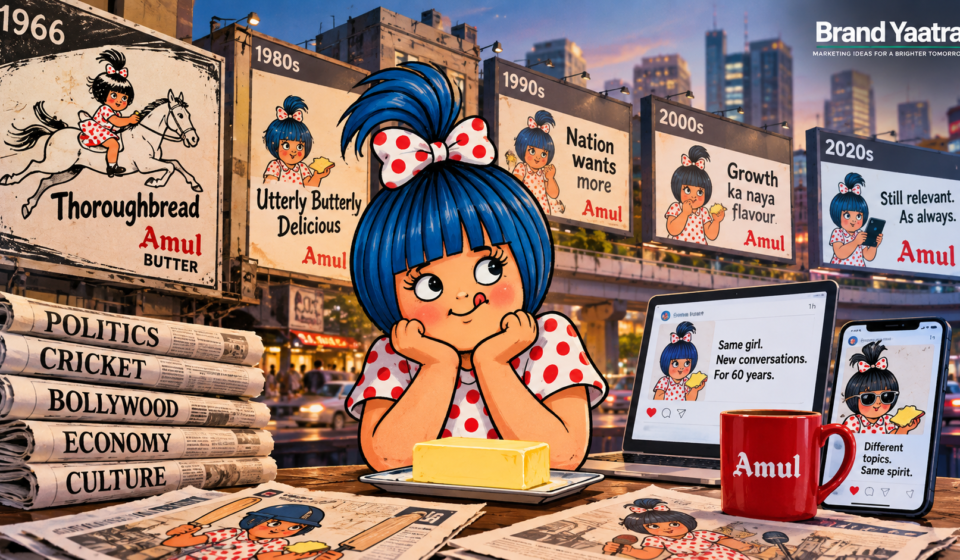

Think about an Amul advertisement.
You probably don’t need to see the logo for very long.
A little girl in a red-and-white polka-dot dress.
A clever one-liner.
A topical reference.
And that familiar tone that somehow manages to be playful, cheeky and instantly recognizable.
You know the brand.
That’s the interesting part.
Amul didn’t simply create an advertising campaign that lasted for decades.
It created a creative system that could keep changing while the brand itself remained recognizable.
The Amul Girl first appeared in 1966. Six decades later, Amul is still maintaining an archive of its topical advertising, including work from 2026.
So how did a butter campaign survive television, cable, the internet, social media, smartphones and the attention economy?
The answer isn’t simply humour.
It’s consistency.
It’s cultural relevance.
It’s distinctive brand assets.
And, perhaps most importantly, it’s the discipline to keep changing the subject without constantly changing the brand.
The Amul Girl Started With a Simple Problem
In 1966, Amul’s advertising team needed a mascot for Amul butter.
The campaign was developed by Sylvester daCunha, illustrator Eustace Fernandes and others involved in the account.
The brief called for a memorable character that could work particularly well in outdoor advertising.
That requirement mattered.
At the time, outdoor advertising relied heavily on hand-painted hoardings. The character therefore needed to be simple enough to reproduce and distinctive enough to be recognized quickly.
The result was the little girl who would become the Amul Girl.
She wore a red polka-dot dress, had blue hair and a deliberately simple visual style.
She wasn’t designed to look like a sophisticated celebrity endorsement.
She was designed to be recognizable.
And that turned out to be extremely important.
The First Big Shift: Amul Stopped Talking Only About Butter
There is only so much you can say about butter.
It’s creamy.
It tastes good.
It goes on bread.
It belongs in the kitchen.
If your advertising keeps repeating those same product messages, eventually you run out of interesting things to say.
Amul found another way.
Instead of making every advertisement about the product, it made the world around the product part of the advertising.
Politics.
Sport.
Films.
Festivals.
Popular culture.
News.
Everyday Indian life.
The brand could react to whatever people were already talking about.
That changed the role of the advertisement.
It was no longer simply:
“Here is our butter. Please buy it.”
It became:
“You saw what happened today. We saw it too.”
That is a very different relationship between a brand and its audience.
The First Topical Ad Was the Beginning of the Formula
One of the earliest topical Amul Girl advertisements appeared in March 1966 around horse racing.
The Amul Girl was shown riding a horse alongside the pun “Thoroughbread.”
The product was still present.
The slogan was still there.
But the advertisement was using something outside the product itself to create relevance.
And that became the basic creative formula:
Current event + Amul Girl + wordplay + product association.
Simple.
Repeatable.
And incredibly flexible.
Why This Was Such a Smart Marketing System
Most advertising campaigns have a problem.
They eventually become old.
The audience sees the same commercial.
The campaign gets replaced.
A new campaign arrives.
A new slogan appears.
A new visual identity follows.
Amul did something different.
It separated the brand framework from the creative subject.
The subject could change constantly.
The brand did not have to.
That distinction is one of the most important lessons in the entire Amul story.
The Topics Changed. The Brand Stayed the Same.
Imagine the Amul Girl commenting on:
- a cricket match
- a Bollywood release
- a political event
- a festival
- a major news story
- a cultural trend
- a business event
Those subjects are completely different.
But the audience still sees:
- the same character
- the same visual world
- the same wordplay-driven style
- the same playful personality
- the same product association
- the same recognizable brand
That is consistency without creative stagnation.
And that’s much harder to achieve than it sounds.
This Is What a Strong Brand Asset Actually Does
A brand asset is valuable when it helps people recognize and remember the brand.
That asset can be:
- a logo
- a colour
- a sound
- a character
- a phrase
- a shape
- a visual style
- or even a recognizable way of communicating
Amul has several of these working together.
The Amul Girl is one.
The red-and-white polka-dot visual world is another.
“Utterly Butterly” became another recognizable verbal element.
But the deeper asset is the combination.
When the audience sees the character, the visual style and the familiar wordplay together, they don’t have to work very hard to identify the brand.
That’s accumulated brand memory.
Our guide to brand strategy explores this broader idea: strong brands aren’t built from isolated visual decisions. Meaning develops from repeated associations across products, communication and customer experience.
Amul Didn’t Try to Own Every Topic
This is another subtle part of the strategy.
Amul could comment on something without pretending that Amul had expertise in everything.
The brand’s role was often that of a witty observer.
That is different from saying:
“Amul has an opinion on everything.”
The creative device was closer to:
“Something happened. Let’s find an Amul-shaped way to comment on it.”
That distinction allowed the brand to remain culturally relevant without completely abandoning its core personality.
The Amul Girl Became a Cultural Commentator
Over the decades, the Amul Girl appeared alongside references to some of the biggest moments in Indian popular culture and public life.
That included sport, politics, cinema and social events.
Some advertisements were harmless jokes.
Some were sharper.
Some generated controversy.
And that matters because a brand that comments on culture will inevitably enter cultural conversations.
In fact, one of the campaign’s defining characteristics has been its willingness to occasionally be cheeky enough to provoke a reaction.
That created something advertising usually struggles to buy:
attention that came from the subject itself.
Why Topical Advertising Works So Well
There is a psychological advantage to topical advertising.
When people already know what you’re referring to, they don’t have to spend much mental effort understanding the context.
The audience already has the first half of the story.
The advertisement supplies the second half.
That creates a small moment of recognition:
“Oh, I know what they’re talking about.”
Then comes the second reaction:
“That’s clever.”
And suddenly the advertisement has become more than an advertisement.
It has become a piece of commentary.
Amul Turned Advertising Into Something People Could Look Forward To
This is where the strategy becomes particularly interesting.
A normal advertisement interrupts content.
Amul’s topical advertising often became content itself.
People could discuss it.
Share it.
Remember it.
Look for the next one.
That changes the relationship between brand and audience.
The question stops being:
“How do we get people to notice this advertisement?”
And becomes:
“How do we make the advertisement worth noticing?”
That is a much more powerful question for any content marketer.
The Secret Was Not Just Humour
It is tempting to summarize Amul’s strategy as:
“Make funny ads.”
That’s probably the worst lesson you could take from this case study.
Thousands of brands can make jokes.
Thousands of brands can react to trends.
Thousands of brands can create topical posts.
Very few have spent decades building a recognizable character, voice and visual system around those behaviours.
The humour works because it comes from a recognizable brand.
Without the brand system, the joke is just a joke.
Consistency Became Amul’s Competitive Advantage
In marketing, consistency is often misunderstood.
People hear “be consistent” and imagine posting the same type of content every week.
That’s not what Amul demonstrates.
Amul’s consistency is strategic.
The subject changes.
The execution changes.
The cultural reference changes.
But the underlying brand character remains familiar.
That’s exactly what strong positioning should do.
You can explore that distinction in our guide to what brand positioning actually means.
Think of the Amul Strategy as a Formula
At a simplified level, the system looks like this:
Culture → Current Moment → Amul Perspective → Wordplay → Distinctive Character → Brand Memory
The genius is that the first part keeps changing.
The last part doesn’t have to.
That gives the brand an almost unlimited number of creative opportunities without forcing it to reinvent itself every time.
Why Amul Could Keep Going for Decades
There is a practical reason this system is so powerful.
It generates ideas continuously.
Think about the number of things happening around India every day.
- Cricket matches
- Film releases
- Awards
- Festivals
- Political moments
- Weather events
- Internet trends
- Consumer behaviour
- Food trends
- National celebrations
- Global events
Amul doesn’t need to invent a new world for every campaign.
It simply asks:
“What is happening right now, and how would the Amul Girl react to it?”
That’s a remarkably efficient creative engine.
And Then the Internet Arrived
At first, topical advertising lived heavily in outdoor media and print.
Then the media environment changed.
Television became more important.
Then websites.
Then social networks.
Then smartphones.
Then short-form video.
But the underlying idea didn’t need to change.
That is the strength of a durable brand platform.
The distribution channel can change without destroying the creative identity.
Amul’s topical advertising eventually became natural content for social platforms because it already had one characteristic social media rewards:
timeliness.
Amul Was Doing “Real-Time Marketing” Before the Phrase Became Popular
Modern marketers talk constantly about real-time marketing.
React quickly.
Join the conversation.
Use trending topics.
Create timely content.
Amul was doing a version of this decades before brands had social-media dashboards telling them what was trending.
The difference was that the medium was different.
The principle was the same.
Find a cultural moment.
Interpret it quickly.
Connect it to the brand.
Publish it while people still care.
That makes the Amul story especially relevant to today’s content marketers.
Speed Matters — But Relevance Matters More
There is an important warning here.
Real-time marketing isn’t simply about being fast.
A brand can be incredibly fast and still produce irrelevant content.
The real formula is closer to:
Speed + Cultural Understanding + Brand Fit + Creative Quality
If one of those disappears, topical content can quickly become noise.
Amul’s Creative System Also Created Distinctiveness
Imagine removing the Amul logo from one of its advertisements.
Could you still identify the brand?
That is the test of a strong distinctive asset.
The Amul Girl gives the audience a shortcut.
The illustration style gives another.
The wordplay gives another.
The product association gives another.
The combination makes the advertisement recognizable even before the audience consciously processes the brand name.
That’s similar to what we explored in our case study on how Nike turned “Just Do It” into a global brand asset.
Nike and Amul use very different creative systems.
But the strategic lesson is similar:
Repeated association can turn a simple creative element into something much bigger than the element itself.
Amul Also Shows Why Brand Memory Takes Time
There is a temptation in modern marketing to constantly optimize for novelty.
New campaign.
New colour.
New tagline.
New visual style.
New social format.
New personality.
New positioning.
But every time a brand changes its recognizable assets, it risks throwing away accumulated memory.
Amul demonstrates the opposite approach.
Keep the recognizable framework.
Keep feeding it new cultural material.
Let the audience build associations over time.
That is much slower than chasing a trend.
But it can create something much more valuable.
Familiarity.
What Amul Teaches Us About Brand Strategy
A strong brand strategy isn’t about repeating the same advertisement forever.
It’s about knowing which things should remain stable and which things should evolve.
For Amul:
| Stable | Flexible |
|---|---|
| Amul Girl | Topic |
| Visual identity | Headline |
| Playful personality | Cultural reference |
| Product association | Creative execution |
| Topical advertising format | Media channel |
This balance is extremely useful for modern brands.
You don’t have to choose between consistency and creativity.
You can build both.
What Small Brands Can Learn From Amul
You might look at Amul and think:
“This works because Amul is huge.”
But several parts of the strategy work at a much smaller scale.
1. Build a recognizable voice
Don’t sound like every competitor in your category.
If someone reads your post without seeing your logo, could they recognize you?
2. Create repeatable creative assets
You don’t need an Amul Girl.
You need something people can repeatedly associate with you.
It could be:
- a visual device
- a recurring character
- a phrase
- a particular illustration style
- a recognizable tone
- a recurring content format
3. Comment on culture only when it fits
Don’t jump onto every trend.
Ask:
“Does this make sense coming from our brand?”
If the answer is no, skip it.
4. Build systems instead of one-off ideas
One great campaign is useful.
A creative system that can produce hundreds of relevant campaigns is much more valuable.
5. Let the subject change while the brand stays recognizable
This may be the biggest lesson.
Your audience doesn’t need the same content every week.
They need to know who is talking.
What Amul’s Story Doesn’t Mean
It would be easy to turn this into an exaggerated lesson:
“Topical advertising is the secret to Amul’s success.”
That’s too simplistic.
Amul is a large, long-established cooperative dairy business with a broad product portfolio, distribution network and extensive consumer presence.
Advertising is one part of that larger business system.
The campaign’s longevity and cultural visibility are well documented, but that does not mean we can isolate the advertising campaign and claim that it alone caused Amul’s broader business performance.
That distinction matters.
A good marketing case study should explain what the evidence supports—not turn correlation into a convenient success story.
The Bigger Lesson: Don’t Confuse Novelty With Creativity
Modern marketing is obsessed with being new.
New format.
New trend.
New meme.
New platform.
New technology.
But Amul’s story suggests something more interesting.
You can create novelty inside a consistent brand system.
That’s a much more sustainable form of creativity.
The audience gets something new.
But they don’t have to relearn who created it.
Amul’s Marketing Flywheel
The entire system can be simplified into one loop:
Culture → Topic → Creative Interpretation → Attention → Recognition → Brand Memory → Expectation → More Attention
The audience already knows the character.
So every new advertisement starts with accumulated memory.
That means Amul isn’t starting from zero every time it publishes something.
It is building on everything that came before.
That Is the Real Power of a Long-Running Brand Asset
The Amul Girl isn’t valuable simply because she is old.
Age alone doesn’t create brand equity.
She is valuable because decades of communication have attached meanings to her.
When people see her, they don’t just see a cartoon character.
They can recognize a particular type of humour.
A particular visual style.
A particular relationship with Indian culture.
A particular brand.
That’s accumulated meaning.
Brand Yaatra Takeaway
Amul’s greatest marketing lesson isn’t:
“Be funny.”
It isn’t:
“Post about current events.”
And it isn’t even:
“Keep your mascot for 60 years.”
The deeper lesson is this:
Build a recognizable brand system, then keep giving that system new reasons to exist.
Amul kept changing the conversation without constantly changing the character.
It found a way to remain culturally relevant without becoming unrecognizable.
And that is why the Amul Girl is more than a mascot.
She is a piece of accumulated brand memory.
Six decades after she first appeared, the most impressive part isn’t that the character survived.
It’s that the character still gives the brand a way to participate in what people are talking about today.
That’s the difference between an advertisement people saw once and a brand asset people remember.
Frequently Asked Questions About Amul’s Marketing Strategy
When was the Amul Girl created?
The Amul Girl was created in 1966 as part of Amul’s advertising for butter. The campaign was developed by advertising professionals including Sylvester daCunha and illustrator Eustace Fernandes.
What was the first Amul Girl advertisement?
One of the earliest topical Amul Girl advertisements appeared in March 1966 around horse racing. The Amul Girl was shown riding a horse alongside the pun “Thoroughbread.”
Why is the Amul Girl campaign so memorable?
The campaign combines a distinctive character, recognizable visual style, topical humour, wordplay and long-term consistency. The subjects of the advertisements change, but the underlying brand identity remains familiar.
What is Amul’s marketing strategy?
Amul’s advertising strategy has historically combined strong brand recognition with topical communication, humour, cultural relevance and consistent creative assets. Its broader marketing activity sits within a much larger business involving products, distribution, partnerships and consumer communication.
What can marketers learn from Amul?
The biggest lesson is to distinguish between what should stay consistent and what should change. A brand can keep its personality, distinctive assets and strategic meaning while constantly finding new cultural contexts in which to communicate.
Is topical advertising always a good strategy?
No. Topical advertising works best when the subject is relevant to the brand, the creative execution is strong and the brand has something distinctive to contribute. Chasing every trend can make a brand look opportunistic or irrelevant.
Is the Amul Girl still being used today?
Yes. Amul continues to maintain an archive of its topical advertising, including entries from 2026. The continued use of the character demonstrates the longevity of the creative platform.
Did Amul’s advertising alone make the brand successful?
No single marketing campaign can reasonably be credited with causing the success of a large business on its own. Amul’s advertising is one important part of a much larger business system that includes products, distribution, pricing, operations and the cooperative structure behind the brand.