
You’ve probably done it.
You open an app just to check something.
Twenty minutes later, you’ve bought a pair of shoes you didn’t plan to buy.
Or a gadget.
Or a skincare product.
Or something that was sitting in your cart five minutes ago and suddenly felt urgent.
And then comes the question:
“Why did I buy this?”
Sometimes the answer is simple: you wanted it.
But sometimes something more interesting happened.
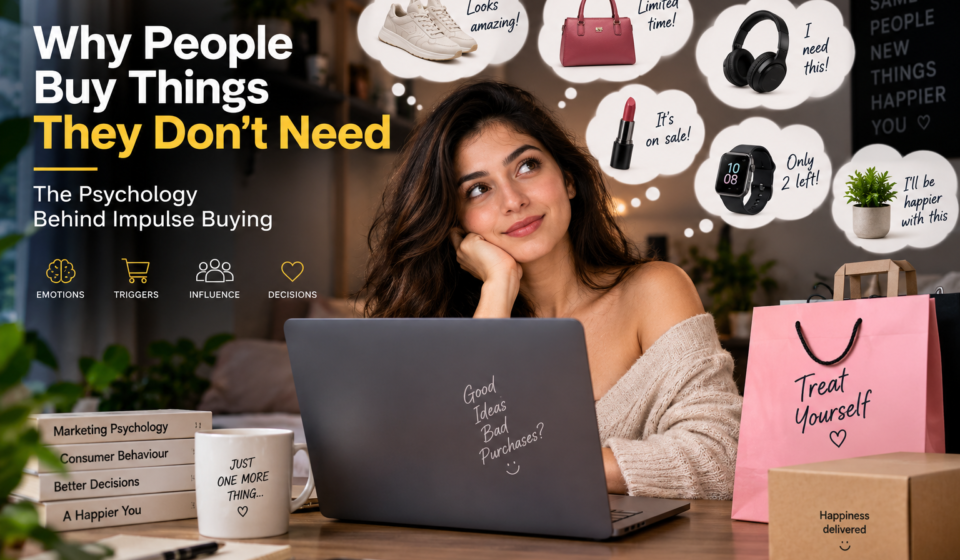
A limited-time offer appeared.
There were only “2 left.”
Someone else had just bought it.
The discount looked too good to ignore.
The checkout process was almost effortless.
Or you were bored, excited, stressed, curious or simply browsing.
That is where impulse buying comes in.
Impulse buying is generally understood as a purchase that happens without a prior shopping intention, often involving a sudden urge to buy. Research on online impulse buying has examined how personal factors, product characteristics and environmental cues can combine to influence this behaviour. :contentReference[oaicite:1]{index=1}
For marketers, this creates a fascinating question:
What makes someone move from “I don’t need this” to “Fine, I’ll buy it”?
The answer has less to do with one magical psychological trick and more to do with a chain of small triggers.
Let’s break that chain down.
What Is Impulse Buying?
Impulse buying is a purchase made without a prior intention to buy the product.
Imagine you walk into a supermarket intending to buy milk.
You leave with milk, chocolate, chips and a candle.
The milk was planned.
The candle wasn’t.
That is the basic idea.
Online shopping makes the process even easier because the customer doesn’t necessarily need to physically enter a store.
A product can appear:
- in a social media feed,
- inside a recommendation engine,
- in an email,
- through a push notification,
- during a livestream,
- inside a search result,
- or while browsing something completely unrelated.
The customer didn’t necessarily wake up thinking:
“Today I am going to buy this.”
The purchase intention can be created during the shopping experience itself.
That distinction is important.
Planned Buying vs. Impulse Buying
| Planned Purchase | Impulse Purchase |
|---|---|
| The need exists before shopping | The desire can emerge during shopping |
| Research often happens before purchase | Decision can happen quickly |
| Alternatives may be compared | Less comparison may occur |
| Decision is usually more deliberate | Emotion or situational cues can play a larger role |
| Purchase intention exists beforehand | Purchase intention may emerge suddenly |
Of course, real consumer behaviour isn’t this clean.
A customer can spend weeks considering a product and still make an impulsive decision about a particular version, accessory or upgrade.
Human behaviour sits on a spectrum.
The Impulse Buying Journey
One of the easiest ways to understand impulse buying is to imagine the psychological sequence.
Stimulus → Attention → Emotion/Arousal → Urge → Justification → Purchase
For example:
Stimulus: “Only 2 left.”
↓
Attention: “Wait, this might sell out.”
↓
Emotion: “I don’t want to miss it.”
↓
Urge: “Maybe I should get it now.”
↓
Justification: “It’s 30% off anyway.”
↓
Purchase: “Done.”
Research on online impulse buying frequently uses the Stimulus–Organism–Response (S–O–R) framework to understand this type of behaviour: external stimuli influence internal psychological states, which can then influence behavioural responses. :contentReference[oaicite:2]{index=2}
That’s useful because it shows something important:
The “buy” button is often the final step, not the beginning of the psychological process.
1. Scarcity Makes Things Feel More Valuable
You’ve seen these messages everywhere:
- Only 3 left
- Limited edition
- Sale ends tonight
- Last few remaining
- Almost sold out
Why do they work?
Because scarcity can change how we perceive an opportunity.
If something appears difficult to obtain, losing the opportunity can feel more painful.
And suddenly the question changes.
Instead of:
“Do I need this?”
the brain starts asking:
“What if I can’t get this later?”
That is a very different decision.
A field experiment published in Information & Management found that both limited-quantity and limited-time scarcity increased perceived arousal, which in turn contributed to impulse purchasing in the study’s online shopping environment. :contentReference[oaicite:3]{index=3}
Scarcity changes the frame
Without scarcity:
“Do I want this?”
With scarcity:
“Can I afford to lose this opportunity?”
That subtle shift can be powerful.
2. Urgency Shrinks the Time Available for Deliberation
Consider two messages:
Option A:
“₹500 off.”
Option B:
“₹500 off — ends in 12 minutes.”
The financial offer may be identical.
The psychological environment isn’t.
The countdown creates time pressure.
And time pressure can make people feel that delaying the decision has a cost.
Research examining online promotions has found that time-limited promotions can affect emotional responses and impulse purchasing. :contentReference[oaicite:4]{index=4}
This is why countdown timers are common in:
- flash sales,
- ticketing,
- travel,
- e-commerce,
- livestream shopping,
- and promotional campaigns.
But there is an important ethical distinction.
A real deadline is information.
A fake deadline is manipulation.
If a timer resets every time the page reloads, the brand isn’t simply creating urgency. It is manufacturing urgency.
3. FOMO Turns a Product Into an Opportunity You Might Lose
FOMO — the fear of missing out — isn’t limited to social media.
It can appear in shopping behaviour too.
Imagine two situations.
Situation 1:
“This product is available.”
Situation 2:
“Thousands of people are buying this, and the offer ends tonight.”
The second message introduces social and temporal pressure.
Now the product isn’t simply an object.
It becomes an opportunity.
And opportunities can disappear.
This is one reason limited editions, drops and time-bound releases can generate excitement well beyond the functional value of the product itself.
Recent research into live-stream shopping has also examined how scarcity, social influence and emotional reactions interact with impulse buying behaviour. :contentReference[oaicite:5]{index=5}
4. Social Proof Makes the Decision Feel Safer
Suppose you’re looking at a product you’ve never heard of.
You have two choices:
Product A: 3 reviews.
Product B: 18,000 reviews and a high average rating.
Even before reading every review, Product B can feel safer.
Why?
Other people’s behaviour provides information.
We often use the actions of others as a shortcut when we’re uncertain.
That is why marketers use signals such as:
- customer reviews,
- ratings,
- number of purchases,
- “bestseller” labels,
- testimonials,
- creator recommendations,
- customer photos,
- and social media engagement.
Social proof doesn’t necessarily create impulse buying on its own.
But it can reduce uncertainty.
And when uncertainty falls, the distance between “Maybe” and “Buy” can become smaller.
5. Discounts Give Us a Reason to Justify the Purchase
This is where price psychology becomes interesting.
Imagine seeing a jacket priced at:
₹4,000 → ₹2,499
You may not have needed the jacket.
But now you have a story to explain the purchase:
“I saved ₹1,501.”
The discount can become a justification.
This connects directly to the psychology behind why ₹999 can feel different from ₹1,000.
The important thing is that consumers don’t evaluate price in isolation.
They interpret it relative to reference points, previous prices, competing prices and perceived value.
So the psychological question isn’t always:
“Is this product worth ₹2,499?”
It can become:
“Am I getting something worth ₹4,000 for ₹2,499?”
That’s a completely different mental calculation.
6. “Free” Can Be Even More Powerful
There is something psychologically unusual about the word:
FREE.
Compare:
₹99 delivery
versus
FREE delivery above ₹499
The second option can make you search for another product just to cross the threshold.
Suddenly you’re spending more money because something is free.
This is one reason “free” is such a powerful marketing concept.
We’ve explored this in why brands give away free products: free can reduce the perceived risk of trying something and can make an offer psychologically easier to accept.
But free can also change behaviour at the checkout.
You might not have intended to spend ₹700.
But you might spend ₹700 to avoid paying ₹60 for delivery.
Congratulations.
You just spent ₹700 to save ₹60.
7. Convenience Removes Friction
Imagine wanting to buy something but having to:
- create an account,
- enter your address,
- verify your email,
- enter card information,
- confirm your phone number,
- and go through five more screens.
Now imagine everything is already saved.
One tap.
Done.
The product didn’t become more desirable.
The process became easier.
This is why friction matters so much in digital commerce.
Every extra step gives the customer another opportunity to reconsider.
Every unnecessary obstacle can interrupt momentum.
Reducing friction doesn’t force someone to buy.
It simply makes it easier for an existing intention or impulse to become an actual transaction.
8. Emotion Can Beat Deliberation
Imagine seeing a product after a stressful day.
You weren’t planning to shop.
But suddenly the product feels like a little reward.
That is different from rational product evaluation.
The purchase can become associated with:
- reward,
- excitement,
- comfort,
- self-expression,
- novelty,
- status,
- or escape.
This is why impulse buying isn’t simply about discounts.
Sometimes the product is functioning as an emotional object.
The customer isn’t only buying the product.
They’re buying how they expect the purchase to make them feel.
9. Novelty Makes the Brain Pay Attention
Humans are naturally attracted to things that feel new, unexpected or different.
That creates an obvious opportunity for marketers.
New colour.
New flavour.
New collection.
New drop.
New collaboration.
New version.
New limited edition.
The product doesn’t necessarily need to solve a completely new problem.
Sometimes the feeling of novelty is enough to make an existing product feel interesting again.
This is particularly powerful in categories where customers already own plenty of functional alternatives.
Fashion is an obvious example.
So are collectibles, cosmetics, gadgets and food.
10. Personalization Makes the Product Feel More Relevant
Imagine seeing:
“Recommended for you.”
versus:
“Because you viewed this last week.”
The second feels more personal.
Personalization can reduce the amount of searching a customer needs to do.
Instead of scanning thousands of products, the customer receives a smaller selection that appears relevant.
This can create a powerful combination:
relevance + convenience + timing.
And when those three meet, an impulse can become much easier to act on.
This is one reason recommendation engines have become such an important part of digital commerce.
11. Browsing Can Create the Need You Didn’t Have
This is one of the strangest parts of modern shopping.
Sometimes you don’t discover a product because you needed it.
You discover the need because you discovered the product.
Before seeing a product:
“I don’t need this.”
After seeing it:
“Actually… this would be useful.”
Now the brain starts building a case.
“I could use it for work.”
“It would save time.”
“I’ve wanted something like this for a while.”
“It’s on sale.”
“I’ll probably use it.”
This is where marketing meets self-justification.
The customer doesn’t necessarily feel manipulated.
They feel like they have discovered a solution.
12. The Checkout Is Designed to Maintain Momentum
Think about the moment immediately before purchase.
You have already:
- looked at the product,
- imagined owning it,
- checked the price,
- possibly read reviews,
- added it to the cart.
At this point, the psychological commitment is already higher than it was five minutes earlier.
That’s why checkout design matters.
Brands often try to reduce distractions and unnecessary friction at this stage.
But there is another important effect:
The longer you interact with a potential purchase, the more mentally real it can become.
Adding something to your cart can feel different from simply seeing it in a feed.
You’ve moved from:
“Interesting.”
to:
“This is mine… almost.”
That psychological shift matters.
13. The “Pain of Paying” Can Change the Experience
Spending money isn’t always psychologically neutral.
There can be a mental cost associated with handing over money.
Digital payments can make the transaction feel less tangible than physically handing over cash.
That’s one reason payment design matters.
The less effort and friction involved in paying, the less the payment process itself interrupts the purchase experience.
But this doesn’t mean digital payments automatically cause impulse buying.
Consumer behaviour depends on context, product, person and situation.
The broader lesson is simpler:
The experience of paying is part of the marketing experience.
14. Social Media Turns Shopping Into Entertainment
Traditional shopping begins with a need.
Social commerce can begin with entertainment.
You watch a video.
You see a creator using something.
You become curious.
You click.
You discover the product.
Then you buy.
The purchase journey has happened without a traditional shopping mission.
This is especially interesting in short-form video, influencer marketing and livestream commerce.
Research into livestream shopping has found relationships between social influence, emotional reactions, scarcity and impulse-buying behaviour, although the exact effects vary by context and study design. :contentReference[oaicite:6]{index=6}
In other words:
Entertainment can become a shopping environment.
The Impulse Buying Formula
We can now simplify the major triggers into one model:
Attention → Relevance → Emotion → Urgency → Justification → Low Friction → Purchase
Not every purchase contains every element.
But many successful impulse-purchase environments combine several.
| Trigger | What it does | Example |
|---|---|---|
| Novelty | Gets attention | “New launch” |
| Personalization | Creates relevance | “Recommended for you” |
| Social proof | Reduces uncertainty | “10,000+ reviews” |
| Scarcity | Creates perceived loss risk | “Only 2 left” |
| Urgency | Reduces time to deliberate | “Ends tonight” |
| Discount | Creates a purchase justification | “30% off” |
| Free | Reduces perceived cost or risk | “Free delivery” |
| Emotion | Creates desire | “Treat yourself” |
| Convenience | Reduces friction | One-click checkout |
Why “I Don’t Need It” Doesn’t Always Stop the Purchase
This is perhaps the most important insight.
Need and desire are not the same psychological variable.
You can genuinely not need something and still strongly want it.
Marketing doesn’t necessarily have to convince you that the product is necessary.
Sometimes it only needs to make the product:
- interesting,
- relevant,
- desirable,
- available now,
- and easy to purchase.
Then the customer can create the justification afterward.
That’s why phrases such as:
“I’ve been meaning to get one.”
“It was a really good deal.”
“I’ll definitely use it.”
can become part of the post-purchase story.
The purchase may have started emotionally and ended rationally.
Why Brands Want Impulse Purchases
From a business perspective, impulse purchases can increase:
- average order value,
- conversion opportunities,
- cross-selling,
- product discovery,
- repeat engagement,
- and revenue from otherwise unplanned purchases.
Think about the difference between:
“I came here to buy shampoo.”
and:
“I came here to buy shampoo and somehow left with shampoo, conditioner, a face wash and a candle.”
The second basket contains more than the original shopping mission.
That incremental behaviour is extremely valuable to retailers.
But Impulse Marketing Has an Ethical Problem
Understanding psychology creates power.
And power can be used well or badly.
There is nothing inherently wrong with encouraging spontaneous purchases.
A genuinely useful product, honestly communicated, can still be bought impulsively.
The problem begins when brands deliberately create false perceptions.
Examples include:
- fake countdown timers,
- fake scarcity,
- misleading discounts,
- fake reviews,
- hidden subscription terms,
- unnecessarily difficult cancellation processes,
- or deliberately confusing checkout experiences.
Good marketing should reduce uncertainty.
It should not manufacture uncertainty and then exploit it.
This distinction is especially important as digital interfaces become more personalized and persuasive.
How Marketers Can Use Impulse Psychology Responsibly
If you’re a marketer, the goal shouldn’t be:
“How can I trick someone into buying?”
A better question is:
“How can I make a genuinely valuable product easier to discover, understand and purchase?”
That can mean:
Use real scarcity
If stock is genuinely limited, communicate it clearly.
Use real deadlines
If an offer genuinely ends at midnight, a countdown can help customers understand the deadline.
Use genuine social proof
Show real reviews and real customer experiences.
Reduce unnecessary friction
Make checkout easier without hiding important information.
Make the value obvious
Don’t force customers to decode what the product actually does.
Use personalization to improve relevance
Recommendations should help customers discover useful products rather than simply maximize the number of products shown.
The best impulse marketing doesn’t manufacture desire from nothing. It helps an existing desire become actionable.
Impulse Buying in the Age of AI
AI is making this psychology even more interesting.
Recommendation systems can increasingly understand:
- what you’ve viewed,
- what you’ve bought,
- what you search for,
- what you tend to ignore,
- when you shop,
- and which products may be relevant to you.
That means marketing can potentially move from:
“Here is our product.”
to:
“Here is the product that is most relevant to you, at the moment you’re most likely to care.”
That is a significant shift.
The future of personalization may therefore be less about showing everyone the same advertisement and more about dynamically matching:
person + product + context + timing.
But the ethical question becomes even more important as targeting becomes more precise.
Impulse Buying vs. Smart Marketing
There is a temptation to think:
“If customers buy impulsively, the marketer has won.”
That’s too simplistic.
A purchase is not automatically a successful marketing outcome.
If the customer buys something they don’t value, feels regret and never returns, the short-term conversion may have created a long-term problem.
Good marketing should therefore think beyond:
Conversion
and consider:
Experience → Satisfaction → Retention → Trust → Advocacy
This is where impulse marketing connects back to the broader digital marketing funnel.
The purchase is one stage.
What happens afterward determines whether the transaction created real customer value.
7 Questions to Ask Before Designing an Impulse-Purchase Campaign
- What genuine customer desire are we responding to?
- Is our urgency real?
- Is our scarcity real?
- Are our reviews and social proof authentic?
- Does the customer clearly understand the offer?
- Are we reducing friction or deliberately hiding information?
- Will the customer still feel good about the purchase tomorrow?
That final question is particularly useful.
If your marketing only works while the customer is emotionally excited, you may have a conversion tactic — not a strong customer strategy.
Frequently Asked Questions About Impulse Buying
Why do people buy things they don’t need?
People may make unplanned purchases because of a combination of emotional states, product appeal, social influence, scarcity, urgency, discounts, convenience, novelty and situational cues. No single trigger explains every impulse purchase.
What is impulse buying in marketing?
Impulse buying in marketing refers to unplanned purchasing behaviour that can be influenced by product presentation, promotions, social proof, scarcity, urgency, emotional cues and the shopping environment.
Why does scarcity increase impulse buying?
Scarcity can increase perceived urgency and arousal by making an opportunity appear less available. Experimental research has found that limited-quantity and limited-time scarcity can increase perceived arousal and contribute to impulse purchases in online shopping contexts. :contentReference[oaicite:7]{index=7}
Does FOMO make people buy more?
FOMO can contribute to purchase motivation when people perceive that they may miss an opportunity, experience or product. Its effect depends on the individual, context and how the scarcity or social information is presented.
Do discounts cause impulse buying?
Discounts can encourage impulse purchases, particularly when they are combined with other cues such as urgency or scarcity. But a discount alone does not guarantee an impulse purchase.
Why does free delivery make people spend more?
Free delivery can change the perceived cost of an offer and may encourage customers to add additional items to reach a minimum order threshold. The exact effect depends on the customer, threshold and context.
Is impulse buying bad?
Not necessarily. An impulse purchase can be enjoyable or genuinely useful. The concern is when people feel manipulated, regret purchases, overspend or encounter misleading marketing practices.
How can brands encourage impulse purchases ethically?
Brands can use genuine scarcity, transparent promotions, authentic social proof, relevant recommendations, clear value communication and low-friction checkout while avoiding deceptive tactics.
Final Thought: The Purchase Often Starts Before the “Buy” Button
The most interesting part of impulse buying isn’t the final click.
It’s everything that happens before it.
A product catches your attention.
It feels relevant.
Someone else appears to like it.
The offer looks attractive.
There are only a few left.
The timer is running.
The checkout is effortless.
And suddenly the question changes from:
“Do I need this?”
to:
“Why shouldn’t I buy it?”
That is the psychology of impulse buying.
For marketers, understanding it is not about learning how to manipulate people.
It is about understanding the environment in which decisions happen.
Because consumers don’t make decisions in a vacuum.
They make them in stores, apps, feeds, search results, recommendation engines, checkout pages and increasingly AI-powered experiences.
Marketing doesn’t simply influence what people want.
It can influence what they notice, how they interpret it, how urgently they feel they need to act — and how easy it is to act on that feeling.
And that is why understanding consumer psychology is one of the most powerful tools a marketer can have.